Quantum Machine Learning: Revolutionizing Industries & Unleashing AI’s Future
Introduction
We stand at the precipice of a new technological era, one where the fundamental rules of computing are being rewritten. For decades, Moore’s Law has been the reliable engine of progress, but as we push the limits of classical computers, a new frontier is emerging: the strange and powerful world of quantum mechanics. When this world collides with the fastest-growing field in technology—artificial intelligence—we get Quantum Machine Learning (QML).
This isn’t just an incremental upgrade. QML represents a paradigm shift, a fusion of AI and quantum mechanics that promises to solve problems currently considered impossible. Imagine designing life-saving drugs in days instead of decades, creating uncrackable financial models, or optimizing global logistics with perfect efficiency. This is the future that quantum enhanced AI is building.
In this deep dive, we’ll journey into the heart of Quantum Machine Learning. We’ll demystify the core concepts, explore the groundbreaking QML applications transforming industries today, and look ahead to the future of QML. You’ll discover the immense impact of quantum machine learning and why it’s becoming a critical area for quantum computing for business and innovation.
The Quantum Leap: What Exactly is Quantum Machine Learning (QML)?
At its core, Quantum Machine Learning is an interdisciplinary field that seeks to use the principles of quantum computing to enhance and revolutionize machine learning algorithms. While classical machine learning models have achieved incredible feats, from powering recommendation engines to driving autonomous vehicles, they have their limits. They struggle with extraordinarily complex, high-dimensional problems and require vast amounts of computational power.
QML leverages the bizarre properties of the quantum world to overcome these hurdles. It processes information in a fundamentally different way, opening doors to computational capabilities that are exponentially greater than even the most powerful supercomputers today.
Beyond Bits: The Magic of Qubits, Superposition, and Entanglement
To grasp QML, you need to understand the building blocks of a quantum computer. Unlike classical computers that use bits (either a 0 or a 1), quantum computers use qubits.
- Superposition: A qubit can be a 0, a 1, or both at the same time. This property, called superposition, allows a quantum computer to explore a vast number of possibilities simultaneously. A system with just 300 qubits can represent more states than there are atoms in the observable universe.
- Entanglement: Described by Einstein as “spooky action at a distance,” entanglement is a phenomenon where two or more qubits become linked in a way that their fates are intertwined. Measuring the state of one instantly influences the state of the other, no matter how far apart they are. This interconnectedness allows for complex correlations to be processed in a way that’s impossible for classical systems.

The Synergy: How Quantum Mechanics Supercharges Machine Learning
This quantum toolkit gives QML its power. By processing information in high-dimensional quantum states, machine learning with quantum computers can identify intricate patterns, structures, and correlations in data that are invisible to classical algorithms. This ability to operate in an enormous computational space is the key to unlocking the much-sought-after quantum advantage in AI, where a quantum device can solve a meaningful problem significantly faster or more accurately than the best-known classical computer.
Related: Quantum AI Unleashed: The Future of Artificial Intelligence Is Weirder Than You Think
The Quantum Advantage: Why QML is a Game-Changer for AI
The term “quantum advantage” isn’t just a buzzword; it’s the finish line that researchers and corporations are racing toward. It signifies the point where a quantum computer can perform a task that is practically impossible for any classical supercomputer. QML is one of the most promising paths to achieving this.
Solving the Unsolvable: Tackling Complexity
Many of the world’s most critical challenges are fundamentally optimization problems. Finding the best drug molecule, the most efficient investment portfolio, or the optimal route for a delivery fleet involves sifting through a mind-boggling number of variables. Classical computers often have to take shortcuts or find “good enough” solutions. QML, particularly through quantum optimization algorithms, has the potential to find the true, optimal solution by exploring the entire problem space at once.
Speed and Efficiency with Quantum Algorithms
The true power lies in the development of new quantum algorithms for machine learning. These algorithms are designed from the ground up to run on quantum hardware. They can offer exponential speedups for specific tasks, such as factoring large numbers (Shor’s algorithm) or searching unsorted databases (Grover’s algorithm). In the context of ML, this could mean dramatically reducing training times for complex models from weeks to mere hours.
Unlocking New Possibilities in Data Analysis
Imagine a dataset with thousands of features. A classical ML model would struggle to find the subtle relationships between them all—a problem known as the “curse of dimensionality.” QML algorithms naturally operate in high-dimensional spaces (Hilbert spaces), making them uniquely suited to finding hidden patterns in complex data. This could revolutionize fields that rely on intricate data, like genomics, particle physics, and climate science.
Real-World QML: From Theory to Industrial Revolution
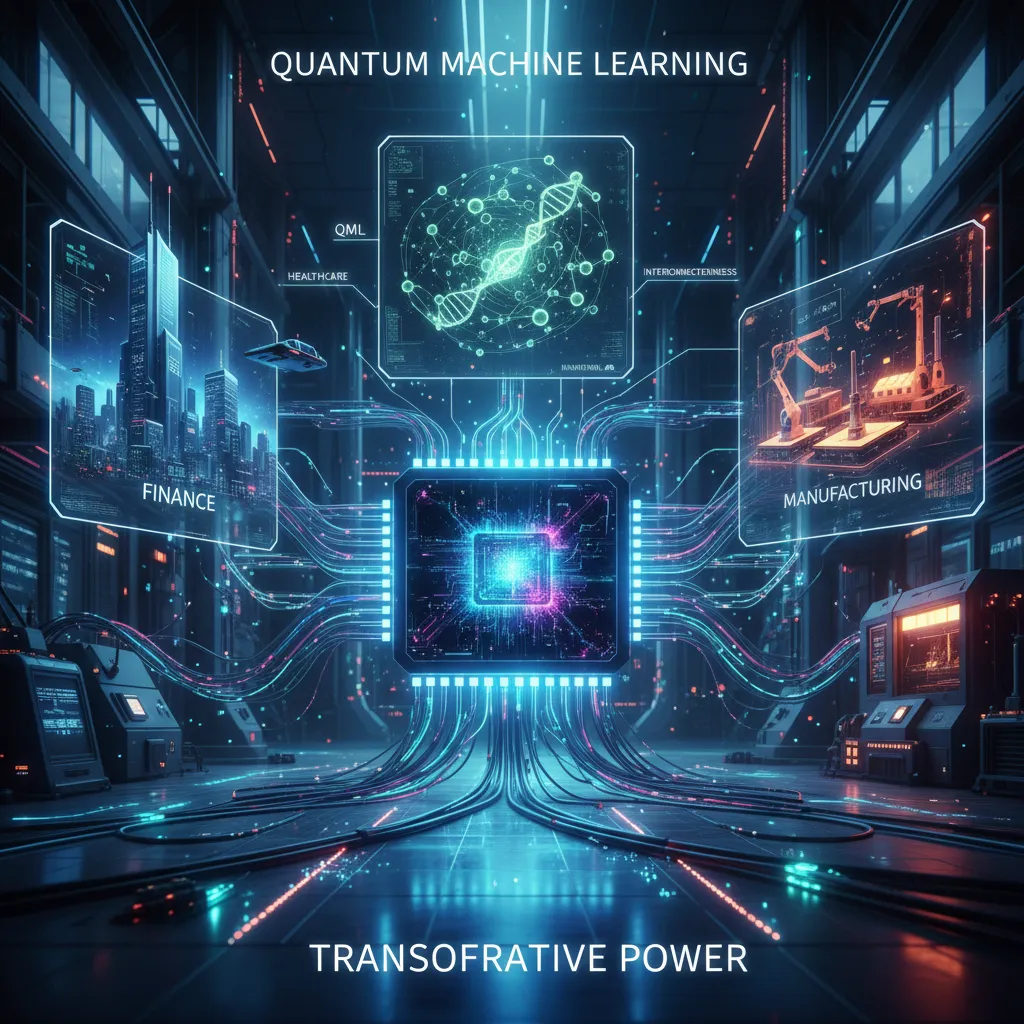
While we’re still in the early days, the impact of quantum machine learning is already being felt across various sectors. Companies are no longer just experimenting; they are actively developing real-world QML solutions to gain a competitive edge. Here are some of the most exciting QML use cases.

Financial Services: Quantum Optimization in Trading and Risk Analysis
The world of finance is built on complex models and high-stakes predictions. Financial services quantum machine learning is poised to be one of the first major areas of disruption.
- Portfolio Optimization: QML can analyze a vast array of assets and economic indicators to construct investment portfolios with the optimal balance of risk and return, far exceeding the capabilities of classical models.
- Risk Modeling: Simulating market crashes or complex derivative pricing is incredibly computationally expensive. QML can run more sophisticated Monte Carlo simulations to provide a much clearer picture of financial risk.
- Fraud Detection: By identifying subtle anomalies and patterns in massive transaction datasets, quantum-enhanced AI can create more robust and faster fraud detection systems.
Related: Ethereum ETF Impact: Strategies for Smart Crypto Investors
Healthcare & Drug Discovery: The Dawn of Personalized Medicine
The potential of healthcare quantum AI is nothing short of revolutionary. The process of discovering new medicines is notoriously long and expensive, largely due to the difficulty of simulating molecular interactions.
- Drug Discovery & Molecular Simulation: QML excels at quantum simulation for AI. It can accurately model how molecules will behave and interact, allowing scientists to design new drugs and therapies with unprecedented speed and precision. This is a game-changer for creating treatments for diseases like Alzheimer’s or cancer.
- Personalized Medicine: QML can analyze an individual’s complete genomic data alongside lifestyle and environmental factors to predict disease risk and tailor treatments specifically for them.
- Medical Imaging: Quantum algorithms could enhance the analysis of MRIs and CT scans, leading to earlier and more accurate diagnoses.
Materials Science & Manufacturing: Designing the Future from the Atom Up
Imagine being able to design a new material with the exact properties you need—a room-temperature superconductor, a hyper-efficient solar cell, or a stronger, lighter alloy for aircraft. Materials science QML makes this possible by simulating materials at the atomic level, a task that is impossible for classical computers. This will accelerate breakthroughs in battery technology, manufacturing, and sustainable materials.
Logistics & Supply Chain: Cracking the Ultimate Optimization Puzzle
For companies like FedEx, Amazon, and Walmart, logistics is a massive optimization puzzle. Finding the most efficient routes for thousands of vehicles to millions of destinations is a classic “Traveling Salesperson Problem” that becomes exponentially harder with each new stop. Logistics quantum computing can tackle these large-scale optimization challenges, leading to massive savings in fuel costs, reduced delivery times, and a smaller carbon footprint.

Energy Sector: A Greener Future Powered by Quantum AI
The energy sector quantum AI applications could be critical in the fight against climate change.
- Grid Optimization: QML can optimize the distribution of energy across a national power grid in real-time, preventing blackouts and integrating fluctuating renewable sources like wind and solar more efficiently.
- New Catalyst Discovery: Quantum simulations can help discover new catalysts for processes like carbon capture or the production of green hydrogen, accelerating the transition to a clean energy economy.
- Climate Modeling: Building more accurate and detailed climate models requires immense computational power. QML can help us better understand and predict the effects of climate change.
The Architects of Tomorrow: Key Quantum Algorithms for Machine Learning
While the underlying physics is complex, several key types of quantum algorithms for machine learning are emerging as the workhorses of the field:
- Quantum Support Vector Machines (QSVMs): These are used for classification tasks. They work by mapping data into a high-dimensional quantum state where it becomes easier to find a “hyperplane” that separates the data into different categories.
- Quantum Principal Component Analysis (QPCA): This is a quantum version of a popular dimensionality reduction technique, helping to find the most important features in a complex dataset.
- Quantum Neural Networks (QNNs): This is a broad and exciting area of research aiming to build neural networks that leverage quantum phenomena like superposition and entanglement, potentially leading to more powerful and efficient AI models.
- Variational Quantum Eigensolvers (VQE): This is a hybrid quantum-classical algorithm that is particularly promising for optimization problems in the current era of noisy, intermediate-scale quantum (NISQ) computers.
Related: The Multimodal AI Revolution: Beyond Text and Images
Navigating the Quantum Realm: Challenges and Hurdles on the Path Forward
Despite the immense promise, the road to widespread QML adoption is paved with significant quantum computing challenges. We are not yet in an age where quantum laptops are a reality.

The Hardware Hurdle: Qubit Stability and Error Correction
Quantum states are incredibly fragile. The slightest vibration or temperature fluctuation can cause a qubit to lose its quantum state, a process called “decoherence.” This introduces errors into calculations. Building stable, large-scale, and fault-tolerant quantum computers is the single biggest engineering challenge of our time.
The Data Dilemma: The Quantum Data Loading Problem
A major bottleneck is efficiently loading large classical datasets into a quantum computer. This process, known as state preparation, can be slow and can negate the potential speedup of the quantum algorithm itself.
The Talent Gap: A Need for Quantum-Ready Professionals
The field is so new that there is a severe shortage of people with the necessary skills—a unique blend of physics, computer science, and machine learning expertise. Universities and companies are racing to build a quantum-ready workforce.
Ethical Considerations and Explainable QML
Like classical AI, QML raises important ethical questions. As the models become more complex, their decision-making processes can become opaque “black boxes.” The development of explainable quantum machine learning is crucial for ensuring transparency, fairness, and accountability, especially in high-stakes applications like medicine and finance.
Related: Ethical AI in Generative Media: A Creator’s Guide to Navigating the Future
The Future Outlook: Investing in the Next Computing Paradigm
The challenges are formidable, but the momentum is undeniable. A tidal wave of investment in quantum AI is flowing from governments, venture capitalists, and tech giants like Google, IBM, and Microsoft. This has fueled a vibrant ecosystem of quantum machine learning startups, each tackling a different piece of the puzzle.
The quantum machine learning future outlook is bright. In the near term, we’ll see more hybrid approaches where classical computers handle most of the workload and offload specific, hard calculations to quantum co-processors. This is part of a broader trend of democratizing quantum machine learning, with cloud platforms like Amazon Braket and Microsoft Azure Quantum giving developers and researchers access to real quantum hardware today.
As the hardware matures, we will move closer to true quantum advantage, unlocking the full potential of these revolutionary technologies and marking one of the most significant quantum computing breakthroughs in history.
Conclusion
Quantum Machine Learning is more than just a theoretical curiosity; it’s the next frontier of artificial intelligence and a powerful engine for industrial innovation. By harnessing the fundamental principles of the universe, QML promises to solve humanity’s most complex and pressing problems—from curing diseases and mitigating climate change to revolutionizing finance and logistics.
The path forward is challenging, requiring breakthroughs in hardware, software, and talent. But the convergence of quantum computing and AI has sparked a global race to build the future. The quantum AI in industry is just beginning to take shape, and the companies and individuals who engage with it today will be the leaders of tomorrow. The journey into the quantum realm has begun, and it’s poised to redefine what’s possible.
Frequently Asked Questions (FAQs)
Q1. What is the main purpose of quantum machine learning?
The main purpose of Quantum Machine Learning (QML) is to leverage the principles of quantum mechanics, such as superposition and entanglement, to solve complex computational problems that are intractable for even the most powerful classical computers. It aims to achieve significant speedups and find more optimal solutions for tasks in optimization, simulation, and data analysis.
Q2. What is a simple example of quantum machine learning?
A simple example is in drug discovery. Simulating how a single drug molecule will interact with proteins in the human body is an incredibly complex problem for classical computers. A QML algorithm can model this interaction with high accuracy by using qubits to represent the quantum states of the molecule’s atoms, drastically speeding up the process of identifying promising new drug candidates.
Q3. Is quantum machine learning available now?
Yes, but in a limited capacity. We are currently in the Noisy Intermediate-Scale Quantum (NISQ) era. Researchers and businesses can access real quantum processors through cloud platforms from companies like IBM, Google, and Amazon. However, these systems are still small and prone to errors, making them suitable for research and solving specific, small-scale problems rather than for widespread commercial deployment.
Q4. What is the difference between AI and quantum AI?
Classical AI runs on classical computers using bits (0s and 1s) and encompasses machine learning, deep learning, and other techniques. Quantum AI (or Quantum Machine Learning) runs on quantum computers using qubits (which can be 0, 1, or both). This allows Quantum AI to process information in fundamentally different ways, enabling it to handle much higher levels of complexity and explore vast solution spaces simultaneously.
Q5. What are the main challenges facing QML?
The three primary challenges are:
- Hardware Stability: Qubits are extremely sensitive and lose their quantum properties easily (decoherence), leading to high error rates.
- Algorithm Development: Creating effective QML algorithms that provide a true quantum advantage over classical methods is still an active area of research.
- Data Loading: Efficiently loading large classical datasets into a quantum state without losing the quantum speedup is a significant bottleneck.
Q6. Which companies are leading the race in quantum computing?
Several major tech companies and startups are leading the way. Key players include Google, which demonstrated “quantum supremacy” with its Sycamore processor; IBM, which has a robust cloud platform (IBM Quantum) and a long-term development roadmap; and Microsoft, with its Azure Quantum ecosystem. Specialized startups like IonQ, Rigetti, and PsiQuantum are also making significant breakthroughs with different hardware approaches.