AI for Global Challenges: Solutions to Humanity’s Toughest Problems
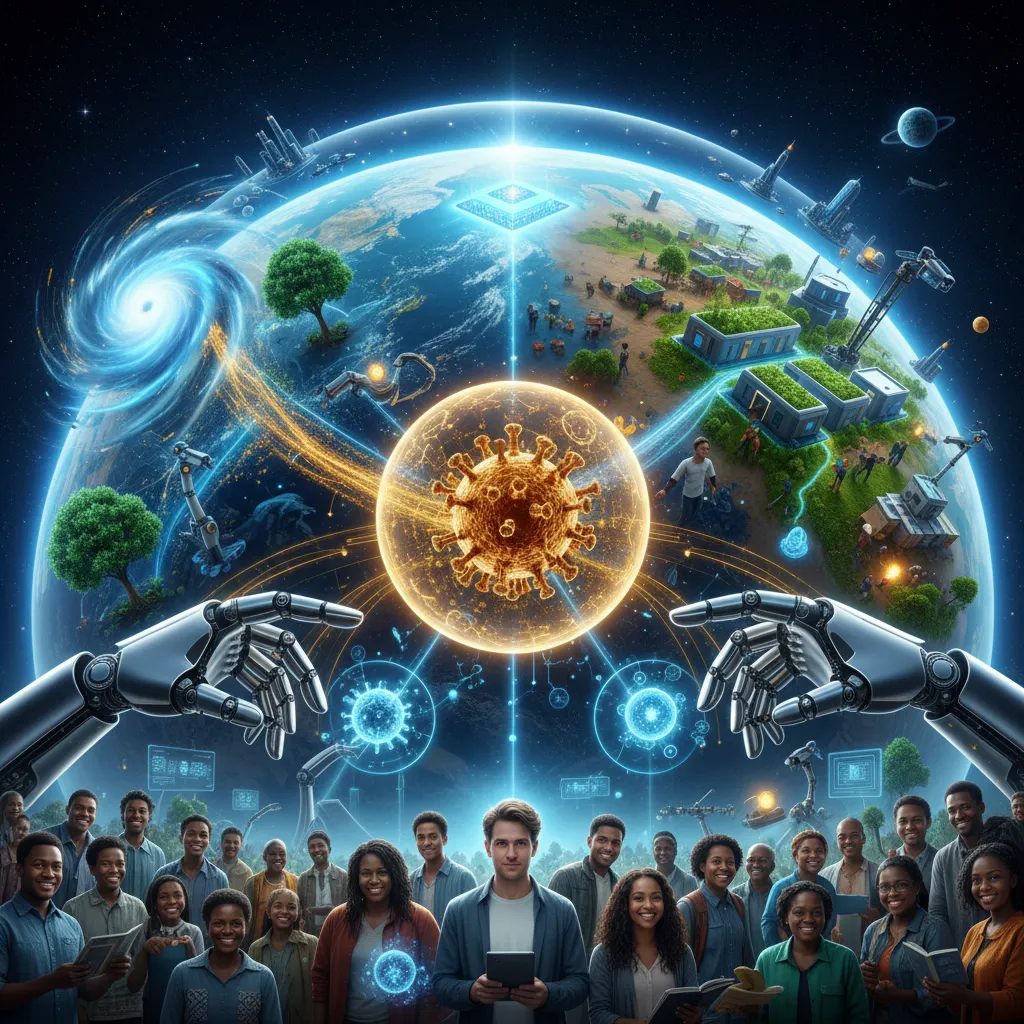
We stand at a pivotal moment in history. Humanity faces a complex web of interconnected challenges: a rapidly changing climate, unprecedented pandemics, persistent poverty, and systemic inequality. These aren’t simple problems with easy fixes. They are vast, multifaceted issues that demand a new level of thinking and a more powerful set of tools. Enter Artificial Intelligence.
Once the domain of science fiction, AI has evolved into a tangible, transformative AI technology with the potential to become one of our greatest allies. Far from being a distant, abstract concept, AI is already being deployed on the front lines, offering innovative solutions to some of the world’s most pressing problems. This isn’t about finding a single silver bullet; it’s about leveraging a powerful catalyst for change.
In this comprehensive guide, we’ll explore the incredible landscape of AI for humanity. We’ll move beyond the hype and dive into real-world applications where Artificial intelligence solutions are making a measurable impact. From predicting natural disasters to discovering life-saving drugs and creating sustainable food systems, you’ll learn how this technology is becoming an indispensable tool in our quest for a more equitable and sustainable future.
The Dawn of a New Era: AI as a Force for Social Good
At its core, the “AI for social good” movement is about harnessing the analytical and predictive power of algorithms to achieve positive humanitarian and environmental outcomes. It’s about aligning technological progress with the collective well-being of our planet and its people. This powerful synergy is increasingly focused on the United Nations’ AI sustainable development goals (SDGs), a blueprint for peace and prosperity.
But how does it work? It largely comes down to three key capabilities:
- Pattern Recognition: AI can analyze massive, complex datasets—from satellite imagery to genomic sequences—to identify patterns and correlations that are invisible to the human eye. This is crucial for everything from AI disease detection to understanding climate change.
- Predictive Modeling: By learning from historical data, AI can forecast future events with increasing accuracy. This is the foundation of AI disaster prediction, pandemic response modeling, and crop yield forecasting.
- Optimization: AI excels at solving complex logistical puzzles. This power of AI resource optimization is vital for managing power grids, water distribution networks, and humanitarian aid supply chains efficiently.
Let’s explore the specific domains where these capabilities are creating seismic shifts.
Combating Climate Change and Protecting Our Planet
The climate crisis is arguably the greatest challenge of our time. Its sheer scale requires solutions that can process planetary-level data and drive efficiency on an unprecedented scale. AI is stepping up to this monumental task.
Taming the Climate Crisis with Data
The first step in solving a problem is understanding it. AI climate change solutions are supercharging our ability to monitor and model the Earth’s climate systems. Sophisticated machine learning algorithms can sift through petabytes of data from satellites, ocean sensors, and weather stations to:
- Improve Climate Models: Create more accurate simulations of future climate scenarios, helping policymakers make informed decisions.
- Track Emissions: Use satellite imagery and sensor data to pinpoint sources of greenhouse gas emissions, from industrial plants to deforestation hotspots, enabling better enforcement of environmental regulations.
- Enhance Disaster Prediction: Analyze weather patterns to provide earlier and more accurate warnings for hurricanes, floods, and wildfires, giving communities crucial time to prepare and evacuate.

Revolutionizing Energy and Water Management
A sustainable future depends on a radical shift in how we manage our most precious resources. AI clean energy solutions are at the heart of this transition. AI algorithms are making renewable energy more reliable and efficient by managing smart grids. These systems can predict energy demand, forecast solar and wind output, and automatically balance the flow of electricity to prevent outages and reduce waste. Related: AI Smart Grids: A Sustainable Energy Future
Similarly, AI water management is becoming critical in a world facing increasing water stress. AI-powered systems can:
- Detect Leaks: Analyze flow data in municipal water systems to identify leaks in real-time, saving billions of gallons of water annually.
- Predict Shortages: Model rainfall patterns and consumption rates to forecast droughts and help authorities implement conservation measures proactively.
- Optimize Irrigation: In agriculture, AI ensures that water is used precisely when and where it’s needed, maximizing crop yields while minimizing waste.
Championing AI Environmental Protection
Beyond climate and resources, AI is a powerful tool for conservation. Computer vision algorithms are being used to monitor wildlife populations, track illegal logging and fishing activities, and identify plastic pollution in our oceans. This level of autonomous, large-scale monitoring provides conservationists and governments with the data they need to protect our planet’s biodiversity.
Revolutionizing Global Healthcare for All
The potential for AI in healthcare breakthroughs is immense, promising to make medical care more accessible, affordable, and personalized. From the lab to the clinic, AI is transforming how we fight disease and promote wellness.
The Future of Diagnosis: AI Disease Detection
One of the most impactful applications of AI is in medical imaging. Deep learning models, trained on millions of scans, can now detect signs of diseases like cancer, diabetic retinopathy, and Alzheimer’s with a level of accuracy that meets or even exceeds human experts. This doesn’t replace doctors; it empowers them. It acts as a tireless second pair of eyes, helping them spot subtle anomalies earlier and prioritize critical cases. Related: AI Revolutionizing Healthcare: Innovations and Future Trends
This transformative AI technology can dramatically reduce diagnostic times and improve outcomes, especially in regions with a shortage of specialists.

Accelerating Cures with AI Drug Discovery
Bringing a new drug to market can take over a decade and cost billions of dollars. AI drug discovery is set to radically change that equation. AI can:
- Analyze Biological Data: Rapidly analyze vast genomic and proteomic datasets to identify potential drug targets.
- Predict Molecular Properties: Simulate how different chemical compounds will interact with those targets, predicting their effectiveness and potential side effects before they are even synthesized in a lab.
- Repurpose Existing Drugs: Scan libraries of existing drugs to find ones that could be effective against new diseases, a crucial capability in a AI pandemic response scenario.
This acceleration was on full display during the COVID-19 pandemic, where AI played a role in everything from understanding the virus’s structure to helping develop vaccines in record time.
Making Healthcare Accessible
For billions of people, quality healthcare is out of reach. AI is helping to bridge this gap. AI for underserved communities is manifesting through:
- Telehealth Platforms: AI-powered chatbots can provide initial consultations, helping patients in remote areas determine if they need to see a doctor.
- Low-Cost Diagnostic Tools: AI algorithms that can run on smartphones are enabling community health workers to perform basic screenings for diseases without expensive equipment.
- AI Accessibility Tech: AI is powering next-generation prosthetic limbs, real-time captioning for the hearing-impaired, and text-to-speech tools that give a voice to those who cannot speak. Related: AI PCs: The Next Level of Personal Power
Nourishing the World: AI for Food and Water Security
By 2050, the world will need to feed nearly 10 billion people. Achieving AI food security without overwhelming the planet requires a smarter, more sustainable approach to agriculture.
The Rise of AI Smart Agriculture
Welcome to the world of precision farming. AI smart agriculture uses a combination of drones, satellite imagery, and on-ground sensors to give farmers a hyper-detailed view of their fields. AI platforms analyze this data to provide actionable insights, such as:
- Crop Health Monitoring: Identifying areas of a field affected by pests, disease, or nutrient deficiencies before the problem spreads.
- Yield Prediction: Forecasting harvest yields with high accuracy, helping farmers and the entire food supply chain plan more effectively.
- Automated Action: Controlling autonomous tractors and drones to precisely apply fertilizer, pesticides, or water, a prime example of AI resource optimization.
This data-driven approach not only increases crop yields but also significantly reduces the environmental impact of farming.

Building a More Equitable and Just Society
Technology is at its best when it uplifts everyone. AI is being increasingly applied to tackle deep-rooted social and economic challenges, from poverty to education gaps.
Tackling Poverty and Economic Disparity
AI poverty alleviation strategies focus on creating opportunities and improving the distribution of resources. AI models can analyze economic and social data to help governments and NGOs identify communities most in need and design more effective intervention programs. In the realm of AI in humanitarian aid, algorithms optimize supply chain logistics to ensure that food, water, and medical supplies reach disaster-stricken areas as quickly as possible. Furthermore, AI is fostering financial inclusion by helping to create more accurate credit scoring models for individuals without a formal banking history, opening up access to loans and capital.
Democratizing Knowledge with AI in Education
Every student learns differently. AI is making personalized education a reality, promising to improve AI in education access and quality globally. Adaptive learning platforms can tailor curriculum to a student’s individual pace and learning style, providing extra help in areas where they struggle and offering advanced challenges where they excel. This can help close achievement gaps and provide a high-quality educational experience to students anywhere in the world, regardless of their location or the resources of their local school.
Crafting Sustainable Cities for Tomorrow
More than half the world’s population lives in urban areas, a figure projected to rise to nearly 70% by 2050. AI urban planning solutions are essential for making our future cities livable, sustainable, and efficient. AI can optimize traffic flow to reduce congestion and pollution, help design more energy-efficient buildings, and improve the management of public services like waste collection. By simulating the impact of new AI infrastructure development projects, urban planners can make smarter, more sustainable choices for the cities of tomorrow. Related: AI-Powered Smart Homes: Your Guide to Sustainable Living
The Ethical Compass: Navigating the Challenges of Global AI
While the potential for good is enormous, the deployment of AI innovation world problems is not without risks. To truly serve humanity, we must address the Ethical AI global impact. Key challenges include:
- Algorithmic Bias: AI systems learn from data, and if that data reflects existing societal biases (related to race, gender, or socioeconomic status), the AI will perpetuate and even amplify them.
- Accountability: When an AI system makes a critical error—a misdiagnosis in healthcare or a flawed decision in the justice system—who is responsible? Establishing clear lines of accountability is crucial.
- Data Privacy: Many AI applications require vast amounts of personal data, raising significant privacy concerns. Robust regulations are needed to protect individuals.
- The Digital Divide: There is a risk that the benefits of AI will be concentrated in wealthy nations, potentially widening the gap between developed and developing countries.

Solving world problems with AI requires a human-centric approach. It demands collaboration between technologists, policymakers, social scientists, and the communities the technology is intended to serve. Transparency, fairness, and accountability must be built into these systems from the ground up.
Conclusion: A Future Forged by Human Ingenuity and Artificial Intelligence
The future of AI societal impact is not a predetermined story written in code. It is a narrative that we are actively writing together. Artificial Intelligence is one of the most powerful tools ever created, offering us a new lens to understand our world and a new set of solutions to fix its most intractable problems.
From the fight against climate change and the quest for global health to the pursuit of food security and social equity, AI is already proving its worth. It is a testament to human ingenuity—a technology we built to extend our own capabilities. The journey ahead requires not just brilliant algorithms, but also profound wisdom, ethical foresight, and a shared commitment to building a better world. The challenges are immense, but with powerful tools like AI in our hands, so is our capacity for creating positive, lasting change.
What are your thoughts on the role of AI in solving our biggest global challenges? Share your perspective in the comments below!
Frequently Asked Questions (FAQs)
H3: How is AI being used to solve global problems?
AI is used to solve global problems by analyzing vast datasets to identify patterns, make accurate predictions, and optimize complex systems. This includes modeling climate change, detecting diseases from medical scans, creating efficient smart grids for clean energy, improving agricultural yields, and streamlining the delivery of humanitarian aid.
H3: What are the top 3 global challenges AI can help solve?
The top three global challenges where AI is making a significant impact are:
- Climate Change: Through better climate modeling, disaster prediction, and management of clean energy grids.
- Healthcare: By accelerating drug discovery, enabling early disease detection, and personalizing treatments.
- Food Security: By powering smart agriculture to increase crop yields while optimizing the use of water and fertilizers.
H3: Can AI really help stop climate change?
While AI is not a single solution, it is a critical enabling technology. It can significantly help by making renewable energy more reliable, optimizing energy consumption in buildings and transport, creating more accurate climate models to guide policy, and monitoring deforestation and emissions in real-time. It empowers humans to make faster, more data-driven decisions in the fight against climate change.
H3: What is ‘AI for Social Good’?
‘AI for Social Good’ is a movement focused on applying artificial intelligence to address pressing social, humanitarian, and environmental challenges. It involves using AI for non-profit, humanitarian, and sustainable development purposes, such as improving public health, increasing access to education, aiding in disaster relief, and promoting environmental sustainability.
H3: What are the ethical risks of using AI to solve world problems?
The primary ethical risks include algorithmic bias, where AI systems perpetuate or amplify existing social inequalities; lack of transparency and accountability when AI makes mistakes; potential for job displacement; and concerns over data privacy and surveillance. Addressing these risks through robust governance and ethical guidelines is essential.
H3: How does AI contribute to the UN Sustainable Development Goals (SDGs)?
AI contributes to nearly all 17 SDGs. For example, it supports ‘Good Health and Well-being’ (SDG 3) through AI-driven diagnostics, ‘Climate Action’ (SDG 13) with better environmental monitoring, ‘Zero Hunger’ (SDG 2) via smart agriculture, and ‘Quality Education’ (SDG 4) through personalized learning platforms. It acts as a powerful tool to accelerate progress towards these goals.
H3: What are some real-world examples of AI in humanitarian aid?
Real-world examples include using satellite imagery and AI to map damage after an earthquake to direct rescue teams, optimizing supply chain routes to deliver food and medicine more efficiently to refugee camps, using natural language processing to analyze social media to get real-time information during a crisis, and deploying predictive analytics to forecast famine or disease outbreaks.