AI Financial Assistants: Revolutionizing Your Personal Wealth

Introduction
Managing personal finances in today’s complex world can feel like a full-time job. Between budgeting, saving, investing, and planning for the future, the sheer volume of data and decisions can be overwhelming. For decades, the only options were to go it alone with spreadsheets and willpower or hire an expensive human financial advisor. But a new era of money management is dawning, powered by artificial intelligence. Enter the AI financial assistant: a powerful, data-driven tool designed to democratize wealth management and put you in the driver’s seat of your financial future.
This isn’t just about another budgeting app. We’re talking about sophisticated AI money management systems that leverage machine learning to provide personalized insights, automate tedious tasks, and optimize your wealth-building strategy. From AI powered budgeting that learns your spending habits to automated wealth management platforms that rebalance your portfolio, these digital assistants are fundamentally changing our relationship with money.
In this comprehensive guide, we will explore the revolution in AI personal finance. You’ll learn exactly what these tools are, how they work, the incredible benefits they offer for personal wealth growth AI, and the critical security considerations you need to know. Get ready to discover how the future of finance AI is not some far-off concept—it’s here, and it’s ready to transform your financial life.
What Exactly Is an AI Financial Assistant?
At its core, an AI financial assistant is a software application or platform that uses artificial intelligence and machine learning algorithms to help individuals manage their finances. Unlike a simple calculator or spreadsheet, these assistants are dynamic, intelligent, and deeply personalized. They connect to your various financial accounts—checking, savings, credit cards, loans, and investments—to create a holistic, 360-degree view of your financial health.
The magic lies in the machine learning in finance models that power them. These algorithms don’t just track your past transactions; they analyze them to identify patterns, predict future cash flow, and provide actionable AI financial insights.
Think of it as the difference between a map and a GPS. A map shows you the terrain, but a GPS analyzes real-time traffic, suggests the fastest route, and reroutes you if you miss a turn. Similarly, traditional budgeting tools show you where your money went. An AI financial advisor uses that data to guide you toward your goals, alerting you to potential issues and highlighting opportunities you might have missed. These digital financial assistants are designed to be proactive, not just reactive.
The Core Pillars of AI-Powered Money Management
AI’s impact on personal finance isn’t a single feature; it’s a suite of interconnected capabilities that work together to streamline and enhance every aspect of your financial life. Let’s break down the key areas where these tools are making the biggest difference.
H3: Automated Budgeting and Expense Tracking
The foundation of financial wellness is understanding where your money goes. However, manual expense tracking is tedious and prone to error. This is where smart budgeting AI shines.
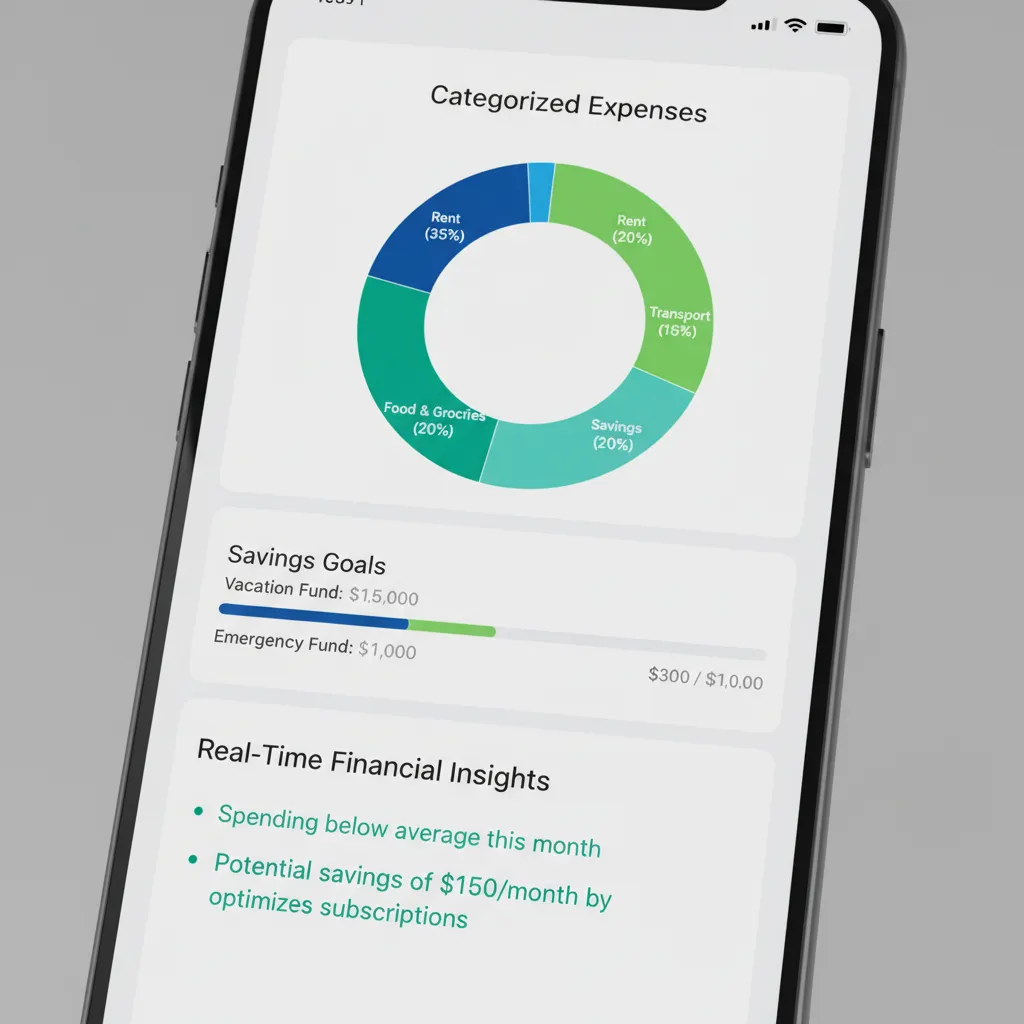
AI-powered systems automate this entire process. By securely linking to your bank and credit card accounts, an AI spending tracker can:
- Auto-Categorize Transactions: It intelligently sorts your spending into categories like “Groceries,” “Transportation,” or “Entertainment” with stunning accuracy, learning from your corrections over time.
- Identify Subscription Creep: AI can easily spot recurring charges, helping you find and cancel subscriptions you no longer use, directly enabling AI for saving money.
- Provide Spending Insights: These tools generate reports that visualize your spending habits, revealing trends you might not notice yourself. For example, it might show that you consistently overspend on dining out in the last week of the month.
- Create Dynamic Budgets: Instead of rigid, static budgets,
AI powered budgetingtools can create flexible spending plans based on your income cycles and historical spending data, sending you alerts when you’re nearing a category limit.
This level of personal finance automation frees you from the drudgery of data entry and provides a crystal-clear, real-time picture of your financial behavior.
H3: Intelligent Investing and Wealth Optimization
Investing has long been perceived as complex and inaccessible to the average person. AI investing tools and robo-advisors are changing that narrative completely.
The term Robo-advisors explained simply means an automated, algorithm-driven investment platform. When you sign up, you’ll answer a questionnaire about your financial goals, risk tolerance, and investment timeline. The AI then uses this information to construct and manage a diversified portfolio for you, typically using low-cost exchange-traded funds (ETFs).
But the intelligence goes deeper:
- Automated Rebalancing: The AI constantly monitors your portfolio. If market fluctuations cause your asset allocation to drift from your target (e.g., you want a 60/40 stock-to-bond ratio, but it’s become 65/35), it automatically buys and sells assets to bring it back in line.
- Tax-Loss Harvesting: More advanced platforms use AI to sell investments at a loss to offset capital gains taxes on your winning investments—a sophisticated strategy that was once the domain of high-net-worth individuals.
- AI Investment Strategies: AI can analyze vast amounts of market data, news sentiment, and economic indicators far faster than any human. This allows for data-driven investment decisions and helps in identifying emerging trends for AI wealth optimization.
These automated wealth management platforms make disciplined, long-term investing accessible and affordable for everyone. Related: Unlock Your Investing Potential with Fractional Shares: A Beginner’s Guide

H3: Proactive Debt Management and Savings Goals
Managing debt and saving for big goals like a down payment or a vacation requires discipline and planning. AI finance apps act as your personal accountability partner.
For AI debt management, the assistant can analyze all your outstanding loans (student loans, credit cards, mortgages) and suggest the most effective repayment strategy. It can run simulations for the “debt snowball” (paying off smallest debts first for psychological wins) versus the “debt avalanche” (paying off highest-interest debts first to save money) methods, showing you exactly how much you’d save and how quickly you’d be debt-free with each approach.
When it comes to savings, these tools help you:
- Identify Savings Opportunities: The AI can analyze your spending and say, “You spent $250 on coffee last month. If you cut that by 30%, you could save an extra $900 this year.”
- Automate Micr-Savings: Some apps use AI to round up your purchases to the nearest dollar and automatically transfer the spare change to a savings account.
- Track Goal Progress: By setting a goal within the app (e.g., “$5,000 for a trip to Japan”), the AI will help you create a savings plan and visualize your progress, keeping you motivated.
H3: Personalized Financial Planning and Advice
This is where AI truly begins to mirror the role of a traditional advisor. By understanding your complete financial picture, these platforms can offer personalized financial advice AI tailored to your unique situation.
This includes advanced areas like:
- AI Retirement Planning: Based on your age, income, current savings, and desired lifestyle in retirement, the AI can project your future wealth and tell you if you’re on track. If not, it can model the impact of increasing your savings rate or adjusting your investment strategy.
- AI Tax Planning: While not a replacement for a CPA, some AI tools can identify potential tax deductions, optimize contributions to tax-advantaged accounts like 401(k)s and IRAs, and provide basic AI tax planning insights.
- Financial Wellness Score: Many apps provide a holistic score for your overall AI for financial wellness, giving you a simple metric to track and improve upon, much like a credit score.
The Benefits: Why AI is a Game-Changer for Your Finances
Adopting Fintech AI solutions isn’t just about convenience; it offers tangible advantages that can significantly improve your financial outcomes.
- Democratization of Financial Advice: High-quality financial guidance is no longer reserved for the wealthy. AI makes sophisticated tools for budgeting, investing, and planning accessible to anyone with a smartphone.
- Hyper-Personalization: Unlike generic advice from a blog post, AI recommendations are based on your actual income, spending, and goals. The advice is tailored to your life, not a hypothetical average person.
- Unbiased, Data-Driven Decisions: Humans are prone to emotional decision-making, like panic-selling during a market downturn. AI operates purely on data and logic, helping you stick to your long-term strategy.
- Efficiency and Time Savings: AI automates the most time-consuming aspects of financial management, freeing up your time and mental energy to focus on what truly matters. Related: Unlock Peak Productivity: 10 AI Tools Revolutionizing Your Workday
- Proactive Insights: AI can spot problems and opportunities before you do, sending you alerts about upcoming bills, low account balances, or unusual spending activity, preventing costly mistakes.

Navigating the Risks: What to Watch Out For
While the benefits are compelling, it’s crucial to approach AI personal finance with a clear understanding of the potential risks. Handing over your sensitive financial data requires trust and due diligence.
H3: Security and Data Privacy
This is the number one concern for most users. A breach involving your financial data could be catastrophic. When choosing an AI finance app, you must prioritize secure AI finance. Look for platforms that offer:
- Bank-Level Encryption: Your data should be protected with 256-bit encryption, both in transit and at rest.
- Two-Factor Authentication (2FA): This adds a critical layer of security to prevent unauthorized access to your account.
- Read-Only Access: Most reputable apps use “read-only” access to your bank accounts, meaning they can view your transactions but cannot move money.
- A Clear Privacy Policy: Understand how the company uses and protects your data. They should not be selling your personal financial data to third parties.
H3: The “Black Box” Problem
Some complex AI models can be a “black box,” meaning it’s not always clear why they made a particular recommendation. While the advice is data-driven, the lack of transparency can be unsettling for some users. It’s important to use AI as a co-pilot, not to follow its advice blindly without understanding the underlying reasoning.
H3: Over-Reliance and Lack of Human Nuance
AI is a powerful tool, but it is not a perfect replacement for a human financial advisor, especially for complex, life-altering decisions. An AI can’t understand the emotional nuance of planning for a special needs child, navigating a messy divorce, or dealing with an inheritance. It excels at optimizing the numbers but lacks the empathy and life experience of a human professional. The ideal approach is often a hybrid one: using AI for day-to-day management and consulting a human advisor for major life events. Related: Will AI Take Your Job? The Ultimate 2024 Guide
The Future of Finance: What’s Next for AI Assistants?
The field of AI money management is evolving at a breakneck pace. The tools we have today are just the beginning. The future of finance AI points toward an even more integrated, predictive, and conversational experience.
We can expect to see:
- Predictive Life Event Analysis: AI will be able to analyze your finances and predict your readiness for major life events, like buying a house. It might advise you, “Based on your savings rate and local housing market trends, you’ll be ready for a 20% down payment in 18 months.”
- Hyper-Integrated Ecosystems: Your financial assistant will connect seamlessly with other parts of your digital life, from your calendar to your smart home, providing contextual advice.
- Fully Conversational AI: Interacting with your finances will be as simple as having a conversation. You’ll be able to ask complex questions like, “If I take that vacation to Italy next year, how will it impact my retirement goals?” and get an instant, detailed response.
- Greater Inclusivity: AI has the potential to provide financial services and guidance to underserved populations around the world, promoting greater financial literacy and inclusion. Related: The AI Search Revolution: Is This The End for Google?

Conclusion
AI financial assistants are no longer a futuristic fantasy; they are powerful, accessible tools that are fundamentally reshaping our approach to personal wealth. By automating budgeting, simplifying investing, and delivering personalized, data-driven insights, they empower us to take control of our finances with unprecedented clarity and confidence. They are moving us from a reactive state of financial stress to a proactive state of financial wellness.
While it’s essential to be mindful of security and to remember that AI is a tool, not a panacea, the advantages are too significant to ignore. The revolution in AI personal finance is here. By embracing these innovative technologies, you can spend less time managing spreadsheets and more time living your life, secure in the knowledge that your financial future is being optimized, one smart decision at a time.
Ready to take the first step? Start by researching a few of the top-rated AI finance apps, read user reviews, and see which one aligns best with your personal financial goals. Your journey toward automated wealth optimization starts now.
FAQs
H3: Q1. What is the best AI for personal finance?
There is no single “best” AI, as the ideal tool depends on your needs. For all-in-one budgeting, expense tracking, and net worth monitoring, apps like Monarch Money and Copilot are highly regarded. For automated investing, robo-advisors like Betterment and Wealthfront are industry leaders. The best approach is to identify your primary goal—be it budgeting, investing, or debt management—and choose a specialized app that excels in that area.
H3: Q2. Can AI replace a human financial advisor?
For many people, AI can handle the vast majority of day-to-day financial management, including budgeting, tracking investments, and basic goal planning. However, AI cannot replace the nuanced, empathetic advice of a human for complex life events like estate planning, navigating a major career change, or intricate tax situations. The best model is often a hybrid one, where AI handles the data and automation, and a human provides high-level strategy and emotional intelligence.
H3: Q3. How does AI help in financial planning?
AI revolutionizes financial planning by making it dynamic and data-driven. It continuously analyzes your income, spending, and investments to provide real-time projections for your goals, such as retirement or a home purchase. It can run thousands of simulations to determine the probability of success for your plan and suggest specific, actionable adjustments (like increasing your savings rate by 2%) to improve your odds.
H3: Q4. Are AI finance apps safe to use?
Reputable AI finance apps use bank-level security measures to protect your data. This includes 256-bit encryption, secure connections via trusted third-party aggregators like Plaid, and multi-factor authentication. Most apps also operate with “read-only” access, meaning they can analyze your financial data but do not have the ability to move money. Always research an app’s security protocols and user reviews before linking your accounts.
H3: Q5. What are robo-advisors?
Robo-advisors are digital platforms that provide automated, algorithm-driven investment management services. They use AI and modern portfolio theory to create and manage a diversified investment portfolio based on your specific goals and risk tolerance. They are a low-cost, accessible alternative to traditional human investment managers, making them ideal for new and experienced investors alike.
H3: Q6. How does AI track expenses automatically?
AI expense trackers work by securely connecting to your bank accounts and credit cards through an API. When a new transaction occurs, the AI analyzes the transaction data—such as the merchant name, amount, and location—and uses its machine learning model, trained on millions of transactions, to assign it to a logical category like “Groceries,” “Fuel,” or “Restaurants.” The system learns from your manual corrections to become more accurate over time.