Unleashing Creativity: The Top AI Art Generators of 2024
Introduction: The Dawn of a New Artistic Era
The digital canvas has always been a realm of boundless imagination, but never before has it been so radically transformed as it is today by the advent of artificial intelligence. In 2024, AI art generators are no longer a niche curiosity; they are powerful AI creative tools redefining what it means to be an artist, a designer, or simply someone with a creative spark. These sophisticated platforms, powered by generative AI art algorithms, are capable of transforming simple text prompts into stunning, complex visual masterpieces, pushing the boundaries of AI image generation.
From hobbyists exploring new forms of expression to professional artists and graphic designers seeking efficiency and novel inspiration, the impact of AI is undeniable. This article delves into the fascinating world of AI art software, highlighting the best AI art tools available this year. We’ll explore their unique features, discuss how they work, provide AI art tutorials for getting started, and even touch upon the ethical considerations and the burgeoning AI art market. Prepare to unlock new dimensions of your imagination as we journey through the top AI art generators of 2024, proving that the future of digital art is already here.
The Big Three: Pioneers in AI Art Generation
At the forefront of the AI art revolution stand a few key players that have captivated the world with their remarkable capabilities. These platforms represent the pinnacle of AI art technology, constantly evolving to offer more control, detail, and artistic flair.
Midjourney: The Artistic Powerhouse
Midjourney has solidified its reputation as one of the most aesthetically sophisticated AI art generators on the market. Known for its distinct, often cinematic and painterly style, Midjourney excels at producing highly artistic and imaginative visuals. It’s particularly favored by those looking to create illustrative, fantastical, and visually rich images that often require minimal post-processing.
Key Strengths and Features:
- Exceptional Aesthetics: Midjourney’s algorithms are trained to prioritize artistic quality, resulting in outputs that frequently possess a dreamlike or hyper-realistic beauty.
- Prompt Understanding: While demanding precision, Midjourney is adept at interpreting complex prompts, allowing users to guide the AI towards very specific visions.
- Iterative Refinement: Its system encourages iterative prompting, where users can continuously refine their ideas by adding or subtracting elements, styles, and parameters to their initial text-to-image AI prompt.
- Community and Collaboration: Operating primarily through Discord, Midjourney fosters a vibrant community where users share prompts, learn from each other, and explore new AI artistic styles.
Mastering Midjourney: Tips for Stunning Results
To get the most out of Midjourney, understanding prompt engineering art is crucial. Start with descriptive keywords, specify artistic styles (e.g., “oil painting,” “cyberpunk,” “Baroque”), lighting conditions (e.g., “cinematic lighting,” “golden hour”), and camera angles. Experimentation is key to discovering the nuances of this powerful AI creative tool. For more advanced insights, consider delving into dedicated AI art tutorials focused on Midjourney’s extensive parameters.
DALL-E 3: Precision, Integration, and Understanding
Developed by OpenAI, DALL-E 3 has made significant strides in AI image generation, particularly in its ability to understand and interpret nuanced textual prompts with remarkable accuracy. Integrated seamlessly within ChatGPT Plus and Enterprise, DALL-E 3 offers unparalleled ease of use and contextual understanding.
Key Strengths and DALL-E 3 Features:
- Superior Prompt Adherence: One of DALL-E 3’s standout DALL-E 3 features is its ability to follow complex and lengthy instructions precisely, generating images that closely match the prompt’s description, including text within images.
- ChatGPT Integration: Its integration with ChatGPT allows for conversational image generation. Users can refine their ideas through dialogue, and the AI will automatically re-interpret and generate new images based on the evolving conversation. This is a game-changer for AI enhanced creativity.
- Safety and Ethics: OpenAI has implemented robust safety measures to prevent the generation of harmful or inappropriate content, aligning with the principles of ethical AI art.
- Versatile Styles: While not always as inherently “artistic” as Midjourney by default, DALL-E 3 can be guided to produce a vast array of styles, from photorealistic to cartoonish, making it a versatile text to image AI tool for various AI in graphic design applications.
Leveraging DALL-E 3 for Design and Concept Art
For designers, marketers, and content creators, DALL-E 3 offers incredible efficiency. Need an illustration for a blog post? A unique visual for an advertisement? DALL-E 3 can rapidly prototype ideas, making it a valuable asset for quick iterations and conceptualization. It’s also an excellent starting point for those new to AI art for beginners due to its intuitive interface.
Stable Diffusion: Open-Source Versatility and Customization
Stable Diffusion, an open-source model, has democratized AI image generation, making advanced AI art technology accessible to a broader audience. Its open-source nature means it can be run locally on powerful consumer-grade hardware and has spawned a massive ecosystem of custom models, interfaces, and extensions.
Key Strengths and Stable Diffusion Tips:
- Unrivaled Customization: The biggest advantage of Stable Diffusion is its flexibility. Users can train their own models (LoRAs) on specific datasets, allowing for incredibly personalized results, from generating specific characters to replicating unique artistic styles.
- Local Control: Running Stable Diffusion locally provides privacy, speed (depending on hardware), and freedom from subscription fees, making it a strong contender for free AI art apps and midjourney alternatives.
- Vast Community and Resources: The community around Stable Diffusion is immense, constantly developing new stable diffusion tips, tutorials, checkpoints, and user interfaces (like Automatic1111’s Web UI) that enhance its capabilities.
- ControlNet: A revolutionary feature, ControlNet allows users to impose precise structural and pose control over generated images using reference images, significantly boosting its utility for professional AI art and AI digital painting.
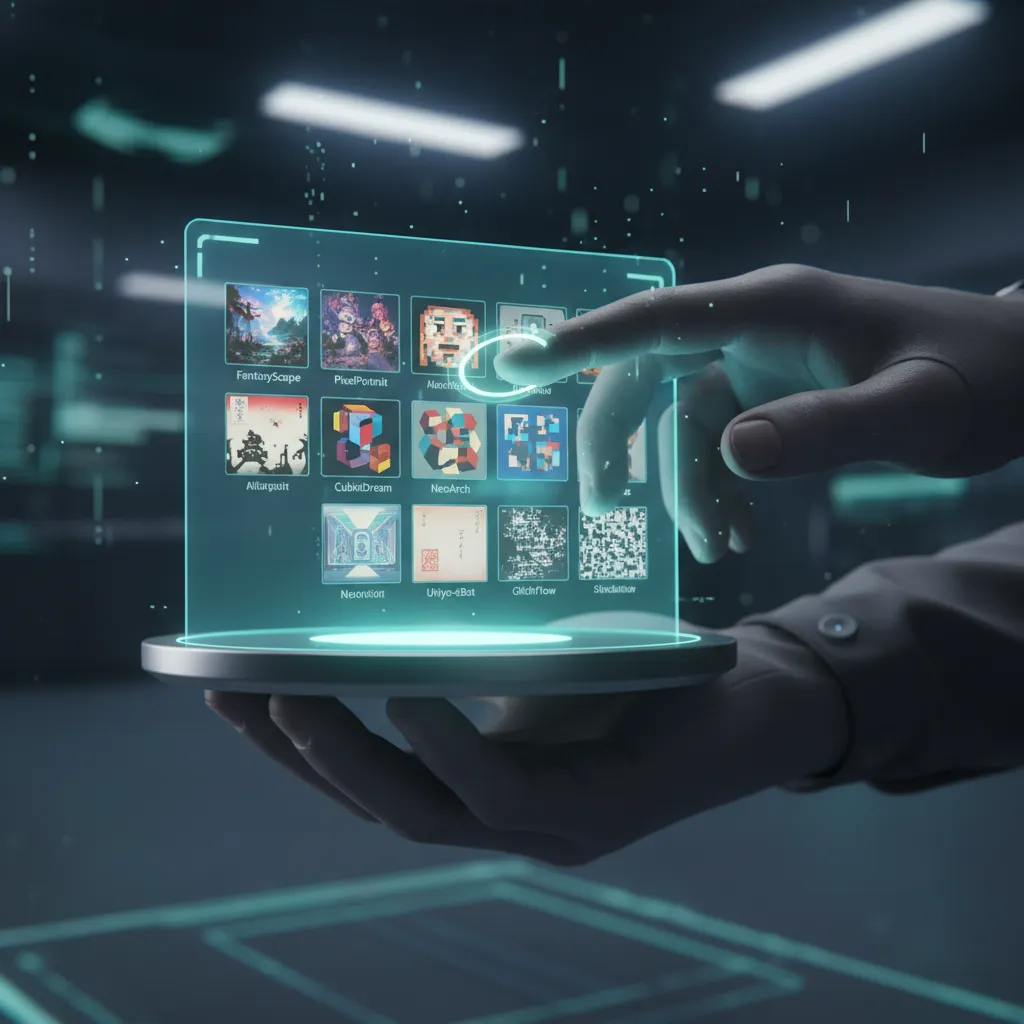 Hand interacting with holographic AI art styles, showcasing the diverse possibilities of AI in artistic creation.
Getting Started with Stable Diffusion
For AI art for beginners, starting with a cloud-based implementation or a user-friendly GUI like DiffusionBee is recommended. For those willing to delve deeper, installing Automatic1111’s Web UI opens up a world of advanced controls. Mastering prompt engineering art is essential, but combining it with ControlNet and custom models truly unlocks Stable Diffusion’s potential for innovative AI art.
Beyond the Giants: Other Top AI Art Tools of 2024
While Midjourney, DALL-E 3, and Stable Diffusion often dominate the conversation, the landscape of AI art generators is rich with other innovative platforms, each offering unique features and catering to different needs.
User-Friendly Platforms for Everyday Creativity
Many AI creative tools are designed with accessibility in mind, making AI art for beginners more approachable.
- Canva’s Magic Studio: Integrated directly into the popular design platform, Magic Studio offers AI image generation tools for creating visuals directly within your design projects. It’s perfect for quickly generating elements for social media, presentations, or marketing materials, making AI in graphic design more integrated than ever.
- Adobe Firefly: Adobe’s suite of generative AI features is seamlessly integrated into Creative Cloud applications like Photoshop and Illustrator. Firefly focuses on accelerating creative workflows with capabilities like text-to-image, generative fill, and text effects, providing powerful tools for professional AI art without leaving your familiar environment.
- NightCafe Creator: A popular online platform, NightCafe offers a user-friendly interface to experiment with various AI artistic styles and models, including Stable Diffusion, DALL-E 2 (older version), and VQGAN+CLIP. It’s an excellent midjourney alternative for those who prefer a web-based experience with a strong community aspect.
- Deep Dream Generator: This tool specializes in creating surreal, psychedelic imagery by enhancing patterns in images. It’s less about direct text to image AI and more about transforming existing photos into unique art, offering a different flavor of AI art inspiration.
Specialized AI Art Software
Some platforms cater to more specific artistic needs, pushing the boundaries of innovative AI art.
- Artbreeder: Known for its “breeding” mechanism, Artbreeder allows users to blend and evolve images, creating unique portraits, landscapes, and abstract art by manipulating “genes.” It’s a fascinating tool for artists interested in conceptual art and exploring variations.
- RunwayML: Beyond just image generation, RunwayML offers a comprehensive suite of AI tools for video editing, motion graphics, and image manipulation. Its text-to-image capabilities are robust, but its strength lies in its broader application for multimedia creators, appealing to those interested in the future of digital art beyond still images.
- Lexica Art: This platform serves as both an AI image generation tool and a vast searchable database of Stable Diffusion prompts and images. It’s an invaluable resource for prompt engineering art, allowing users to learn from others’ successful prompts and generate their own variations.
The growth in these AI creative tools indicates a vibrant and expanding AI art market, with options for every skill level and artistic ambition.
How AI Creates Art: The Technology Behind the Magic
Understanding the underlying AI art technology demystifies the process and empowers creators to use these tools more effectively. While the specifics can be complex, the core principles revolve around machine learning models trained on vast datasets of images and their descriptions.
Understanding Diffusion Models and GANs
The majority of modern AI art generators leverage one of two primary architectural approaches:
- Generative Adversarial Networks (GANs): Pioneered earlier, GANs consist of two neural networks—a generator and a discriminator—that compete against each other. The generator creates images, and the discriminator tries to determine if they are real or fake. This adversarial process refines the generator’s ability to create increasingly convincing images. While still used, diffusion models have largely overtaken GANs for high-quality text to image AI.
- Diffusion Models: These are the cutting-edge of generative AI art. Diffusion models work by learning to reverse a process of gradually adding noise to an image until it becomes pure static. During generation, they start with random noise and iteratively “denoise” it, guided by a text prompt, until a coherent image emerges. This process allows for incredible detail, stylistic control, and consistency, which are crucial for producing innovative AI art.
Prompt Engineering: Guiding the AI’s Vision
At the heart of AI image generation is prompt engineering art – the craft of writing effective text prompts to guide the AI. It’s not just about telling the AI what you want, but how you want it to be depicted.
Elements of an Effective Prompt:
- Subject: What is the main focus? (e.g., “a majestic dragon,” “a futuristic city”)
- Style: How should it look? (e.g., “oil painting,” “cyberpunk art,” “watercolor sketch,” “photo-realistic”) – this is where AI artistic styles come alive.
- Details: Add specifics about colors, lighting, composition, mood, and atmosphere. (e.g., “vibrant neon lights,” “soft morning glow,” “wide-angle shot,” “serene atmosphere”)
- Negative Prompts: Specify what you don’t want (e.g., ”[—no blurry, low quality, deformed]”). This is especially useful in tools like Stable Diffusion.
- Parameters: Many AI art software platforms offer parameters for aspect ratio, style weights, randomness, and more.
Mastering prompt engineering is like learning a new language – the language of the AI. Dedicated AI art tutorials can provide deeper insights into crafting prompts that yield consistent and spectacular results. It’s a key skill for anyone serious about professional AI art.
AI Art for Every Creator: From Beginners to Professionals
The accessibility of AI art generators means that virtually anyone can now engage with digital art creation, regardless of their traditional artistic background.
Getting Started: AI Art for Beginners
For newcomers, the world of AI image generation can seem daunting. However, many free AI art apps and user-friendly platforms are designed to ease the learning curve.
- Start Simple: Begin with straightforward prompts and gradually add complexity.
- Explore Web-Based Tools: Platforms like NightCafe, Canva’s Magic Studio, or even the free tiers of DALL-E (via various integrations) are excellent starting points as they require no software installation.
- Watch Tutorials: YouTube and platform-specific guides offer a wealth of AI art tutorials that can teach you the basics of prompt engineering art and interface navigation.
- Join Communities: Engaging with other AI art for beginners in online forums or Discord servers (like Midjourney’s) can provide invaluable tips, inspiration, and solutions to common challenges.
Professional Applications of AI Art
For experienced artists, graphic designers, and creative professionals, AI art generators serve as powerful accelerators and collaborators.
- Concept Generation: Quickly generate multiple visual concepts for projects, saving hours of manual sketching or rendering. This is especially useful in AI in graphic design for mood boards and initial design pitches.
- Style Exploration: Experiment with new AI artistic styles or blend existing ones to develop unique visual languages for brands or personal projects.
- Asset Creation: Generate textures, backgrounds, character variations, or specific elements for games, animations, and digital compositions.
- AI Digital Painting and Enhancement: Use AI to generate base images that can then be refined and painted over in traditional digital art software, blending AI art technology with human artistic skill.
- AI Art Portfolio Enhancement: Professionals can showcase their ability to leverage cutting-edge tools by including AI-assisted works in their AI art portfolio, demonstrating AI enhanced creativity.
- Marketing and Advertising: Create compelling and unique visuals for campaigns quickly, staying ahead of AI art trends.
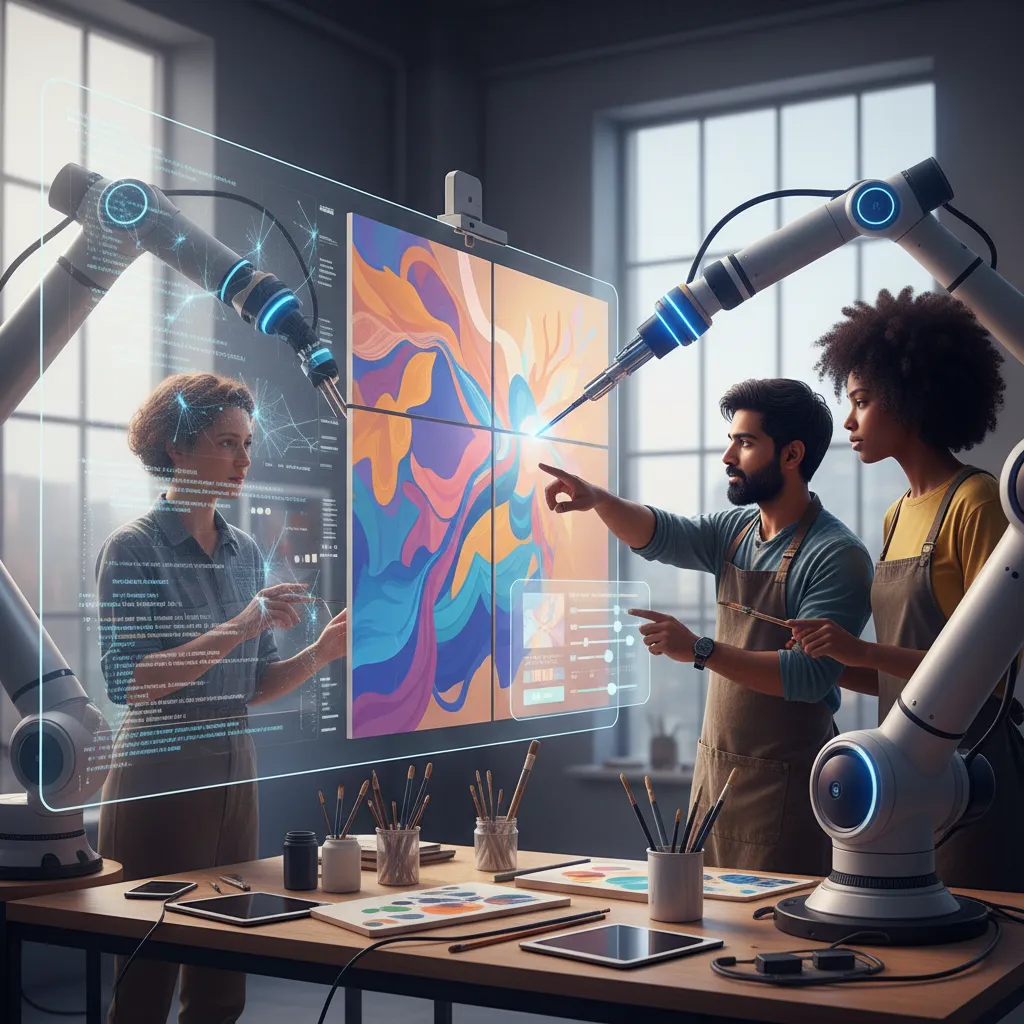 Artists collaborating with AI on digital art, symbolizing the synergy between human creativity and artificial intelligence.
The synergy between human creativity and AI for artists isn’t about replacement; it’s about augmentation. AI can handle the repetitive or initial ideation phases, freeing artists to focus on the nuanced storytelling, emotional depth, and unique human touch that define truly great art. This collaborative approach unlocks new levels of AI enhanced creativity and inspiration. Check out our related article on Top AI Productivity Tools for Peak Performance for more ways AI can boost your workflow.
Exploring Artistic Styles and Trends with AI
The ability of AI art generators to emulate and fuse countless AI artistic styles is one of their most captivating aspects. From the intricate details of Baroque to the stark lines of Minimalism, AI can interpret and reproduce almost any visual aesthetic.
Diverse Styles and Movements
- Photorealism: Create images indistinguishable from photographs, perfect for product visualization or architectural renderings.
- Impressionism & Expressionism: Generate works with the brushstrokes and emotional depth characteristic of these movements.
- Fantasy & Sci-Fi Art: AI excels at bringing imaginative worlds to life, from epic landscapes to futuristic cityscapes.
- Abstract & Surrealism: Produce highly conceptual and thought-provoking images that defy conventional forms.
- Pixel Art & Vector Art: Recreate specific digital aesthetics for game development or stylized illustrations.
These capabilities fuel the rapid evolution of AI art trends, with new styles and visual languages emerging constantly as creators push the boundaries of what generative AI art can achieve. For more on how AI is shaping content, see our post on Top AI Tools for Content Creation 2024.
AI Art Inspiration: Beyond the Obvious
AI art inspiration isn’t just about generating final pieces; it’s also about sparking new ideas. Sometimes, a “failed” or unexpected AI generation can lead to an entirely new concept or direction for a project. The process becomes a dialogue between human intent and algorithmic serendipity. Exploring image databases like Lexica Art or ArtStation can further fuel this inspiration, showcasing the vast spectrum of innovative AI art being created daily.
The Future Landscape: AI, Ethics, and the Art Market
As AI art technology rapidly advances, it brings forth important discussions about its societal implications, particularly concerning ethical AI art, intellectual property, and the evolving AI art market.
Ethical Considerations and Copyright
The question of AI and copyright art is one of the most pressing debates in the creative industry. Who owns the copyright to an AI-generated image? The user who wrote the prompt? The developer of the AI tool? Or the artists whose work was used to train the AI model?
- Training Data: Many AI models are trained on vast datasets of existing human-created art, leading to concerns about fair use and potential exploitation of artists’ work. This directly impacts the discussion around ethical AI art.
- Authenticity and Authorship: The rise of AI art challenges traditional notions of authorship and the unique value of human creativity.
- Deepfakes and Misinformation: The ability to generate highly realistic images also raises concerns about potential misuse, such as creating deepfakes or spreading misinformation.
These are complex issues that governments, legal bodies, and the creative community are actively grappling with. Solutions will likely involve a combination of new legal frameworks, transparent AI development practices, and industry-wide standards.
The Evolving AI Art Market
Despite the ethical debates, the AI art market is booming. Collectors are beginning to acquire AI-generated pieces, and platforms dedicated to selling AI art are emerging.
- New Opportunities: AI art creates new avenues for artists to monetize their skills, whether by selling their AI-generated works, offering prompt engineering art services, or using AI to accelerate their commercial projects.
- Accessibility and Democratization: The lower barrier to entry for creating art could lead to a more diverse and inclusive art scene, giving a voice to those who might not have had access to traditional artistic training or tools.
- The “Human Touch” Premium: In a world flooded with AI-generated content, the unique, emotionally resonant work of human artists may become even more valued. The future of digital art will likely be a hybrid one, where human and AI capabilities complement each other.
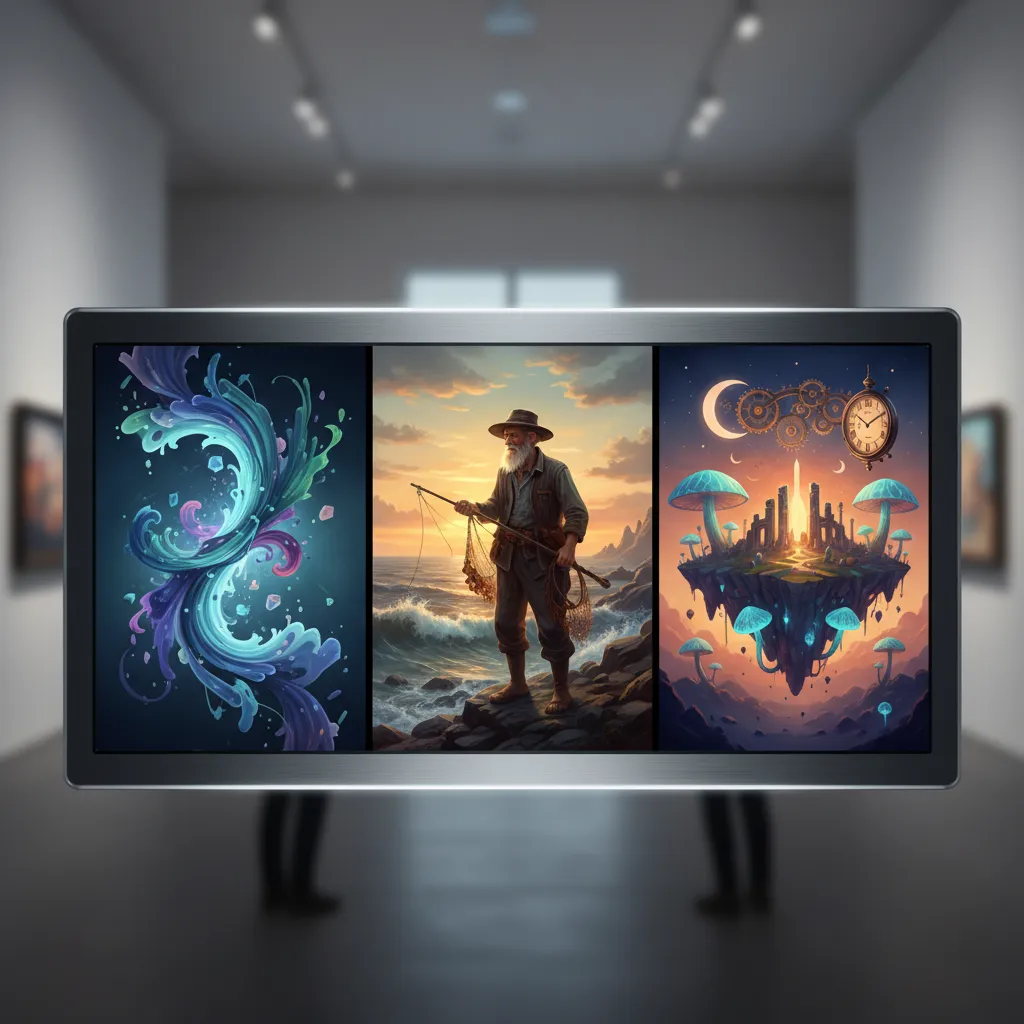 Digital display showing diverse AI art outputs, reflecting the vast range of styles and themes AI can generate.
The conversation around AI art is not just about technology; it’s about the very essence of creativity, ownership, and value in a rapidly changing world. As AI art trends continue to shape our visual culture, these discussions will only become more vital. For another perspective on AI’s transformative power, read our article on The AI Revolution in Healthcare: Transforming Patient Care & Medical Innovation.
Conclusion: The Creative Frontier of AI
The year 2024 marks a pivotal moment in the evolution of digital creativity, largely driven by the extraordinary capabilities of AI art generators. From the artistic finesse of Midjourney to the precise prompt understanding of DALL-E 3 and the unparalleled customization of Stable Diffusion, these best AI art tools are not merely novelties; they are fundamental shifts in how we conceive, produce, and interact with visual art.
We’ve explored how generative AI art empowers both AI art for beginners and seasoned professionals, fostering AI enhanced creativity and opening doors to new forms of AI digital painting and innovative AI art. The intricate process of prompt engineering art has become a new skill for the modern artist, allowing unprecedented control over AI image generation. While crucial discussions surrounding ethical AI art and AI and copyright art continue to shape the AI art market and the future of digital art, the potential for collaboration between human and machine remains immense.
As we look ahead, the blend of human imagination and AI art technology promises a horizon filled with untold artistic possibilities. Whether you’re a curious hobbyist, a burgeoning artist looking to build an AI art portfolio, or a designer seeking to streamline your workflow with AI in graphic design, now is the time to dive in. Embrace these AI creative tools, experiment with new AI artistic styles, and become a part of this thrilling new chapter in the story of art.
Unleash your inner artist with AI. What masterpiece will you create next?
FAQs
Q1. What are AI art generators?
AI art generators are software programs or online platforms that use artificial intelligence algorithms, primarily deep learning models like diffusion models or GANs, to create images, illustrations, and other visual art from textual descriptions (prompts) or existing images. They are a revolutionary form of generative AI art.
Q2. How do AI art generators work?
These tools work by taking a text prompt from a user and interpreting it based on vast datasets of images and their corresponding descriptions they were trained on. Diffusion models, common in 2024, start with random noise and iteratively refine it into a coherent image, guided by the prompt, a process often referred to as text to image AI.
Q3. Is AI art free to create?
Many AI art generators offer free tiers or trials, making it possible to create free AI art apps. Platforms like Stable Diffusion can also be run locally without cost. However, premium features, higher resolution outputs, or extensive usage often require subscriptions or credits, such as with Midjourney or DALL-E 3.
Q4. What is prompt engineering in AI art?
Prompt engineering art is the skill of crafting precise and descriptive text prompts to guide an AI art generator in creating specific and desired images. It involves understanding how the AI interprets language, specifying details like style, subject, lighting, and composition to achieve optimal results.
Q5. What are the best AI art tools for beginners?
For AI art for beginners, user-friendly platforms like NightCafe Creator, Canva’s Magic Studio, and the integrated DALL-E 3 (via ChatGPT) are excellent choices due to their intuitive interfaces and guided experiences. They offer simpler entry points than more complex tools like local Stable Diffusion installations.
Q6. Can AI art generators create specific artistic styles?
Yes, AI art generators are highly capable of emulating and blending a vast array of AI artistic styles, from photorealistic to impressionistic, cyberpunk, watercolor, and many more. Users can often specify desired styles directly within their prompts, making it a powerful tool for AI art inspiration.
Q7. What are the ethical concerns surrounding AI art?
Key ethical concerns include AI and copyright art (who owns AI-generated content?), the use of copyrighted human-created art in AI training datasets without consent or compensation, and the potential for AI art to devalue human artistic labor. Discussions around ethical AI art also touch on the generation of misinformation and harmful content.
Q8. How is AI transforming graphic design?
AI in graphic design is revolutionizing workflows by rapidly generating concepts, creating design assets, automating repetitive tasks, and enabling quick iterations. Tools like Adobe Firefly and Canva’s Magic Studio are integrating AI image generation directly into design software, enhancing efficiency and fostering AI enhanced creativity for designers.
 Cityscape with AI-generated architectural elements, illustrating the transformative potential of AI in shaping our future environments and designs.