The Rise of AI Gadgets: The End of Smartphones?

Introduction: The Dawn of the Post-Smartphone Era
For over a decade, the smartphone has been the unquestioned center of our digital universe. It’s the Swiss Army knife of modern life—a communication hub, a camera, a navigational tool, and an entertainment center, all housed in a sleek glass rectangle. But lately, there’s a growing sense of fatigue. We are spending hours staring at screens, navigating dense app ecosystems, and constantly managing notifications.
This fatigue has spurred innovators to ask: What if the next great computing leap isn’t about a better screen, but about no screen at all?
Welcome to the post-smartphone era, a theoretical landscape where tasks are handled by subtle, context-aware AI gadgets rather than traditional multi-purpose handheld devices. This is where wearable AI technology shines, pioneered by controversial and compelling devices like the Humane AI Pin and the Rabbit R1.
These new tech gadgets represent a radical shift from “apps and icons” to “intent and action.” They aim to remove the friction of interacting with technology, offering a glimpse into the future of mobile computing. The question isn’t just whether these devices are good, but whether they are heralds of the future of smartphones. This article will deep-dive into the technology, philosophy, and practical reality of this emerging class of AI hardware 2024, comparing the leading contenders and assessing their true potential to disrupt the dominance of the smartphone.
What Defines the New Wave of AI Gadgets?
The core difference between a smartphone with an AI assistant (like Siri or Google Assistant) and the new AI-powered devices is a fundamental shift in philosophy. Smartphones are general-purpose platforms where AI is an application layer. AI gadgets, however, are generative AI hardware first and foremost—devices designed from the ground up to leverage large language and action models to serve a single, seamless purpose: to anticipate and execute user intent.
This movement isn’t just about integrating AI; it’s about creating smartphone alternatives that focus on minimizing digital distraction while maximizing utility.
The Philosophy of Screenless and Context-Aware Design
The most defining feature of this new generation of AI personal assistants is their form factor. They embrace ambient computing, where computing power fades into the background, responding naturally to voice, context, and environment, rather than demanding visual attention.
- Screenless Devices: The push to eliminate the screen is a direct response to notification overload. By relying on voice-controlled AI, haptics, and sometimes subtle projections (as seen with the Humane Pin), these devices force the user to look up and engage with the real world.
- Intent-Based Interaction: Instead of opening an app, typing a query, and navigating menus, you simply state your intent: “Book me a taxi to the airport and find a good podcast for the ride.” The underlying AI, often a Large Action Model (LAM), handles all the necessary steps across various online services.
The design is often minimalist and highly portable, intended to be worn or easily carried, maximizing instant accessibility. This is the essence of wearable technology trends moving past mere fitness tracking.
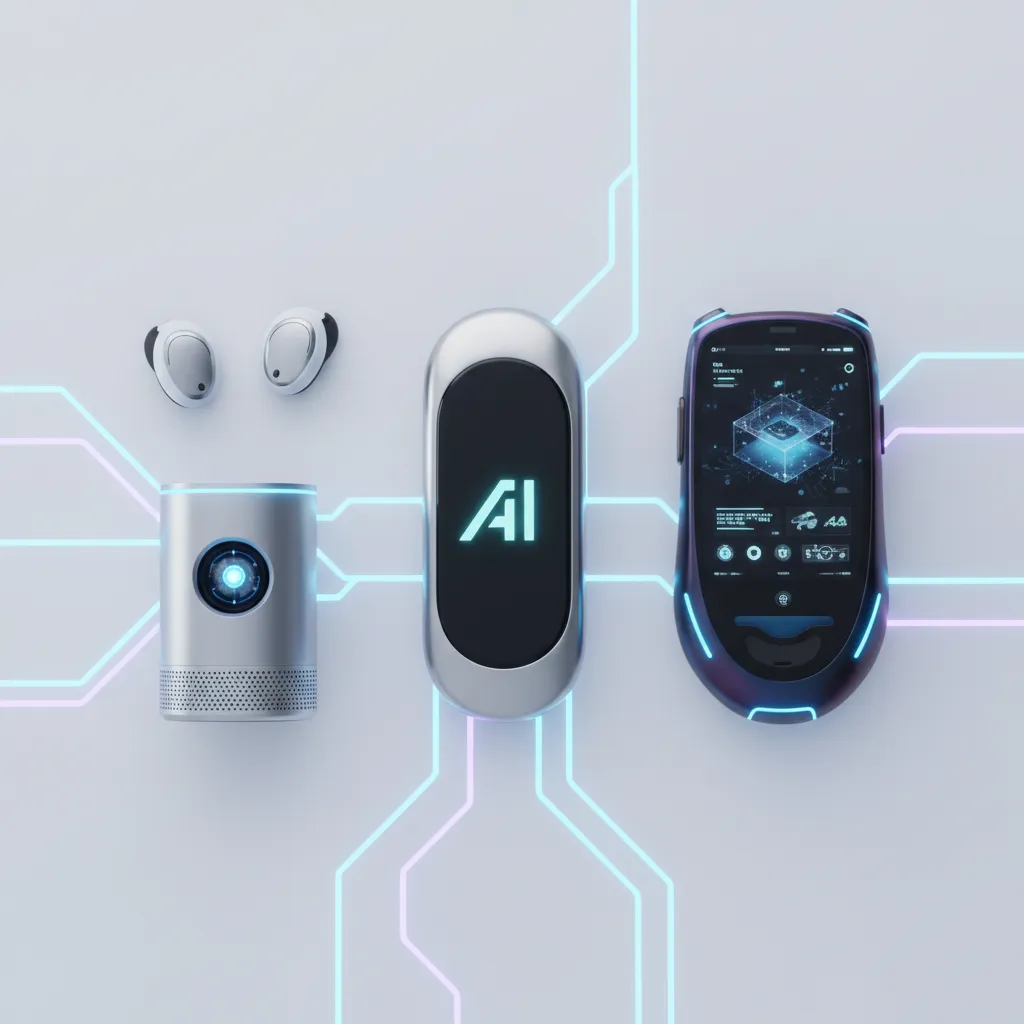
Generative AI Hardware and the Role of Edge Computing
The ability of these gadgets to perform complex, multi-step actions in real-time is dependent on two key technological advances:
- Large Action Models (LAMs): These go beyond Large Language Models (LLMs). While an LLM can tell you how to book a flight, a LAM is trained to do the booking. It learns how to interact with the existing web interfaces and APIs on your behalf.
- On-Device AI and Edge Computing Devices: While the core processing of a LAM remains cloud-based, these devices rely heavily on edge computing devices to handle immediate tasks like voice transcription, object recognition (for camera functions), and contextual awareness on the device itself. This allows for faster responses, enhanced privacy for sensitive inputs, and reduced latency. The sophisticated microphone arrays and custom silicon found in these products enable this level of on-device AI.
This technology shift is foundational to the concept of next generation technology focusing on efficiency rather than spectacle.
Deep Dive: The Humane AI Pin (The Wearable Assistant)
The Humane AI Pin is arguably the most talked-about pioneer in the wearable AI technology category. Founded by former Apple veterans, Humane aims to create a deeply personal, discrete AI assistant that integrates into daily life without a traditional screen.
Key Features and Technology
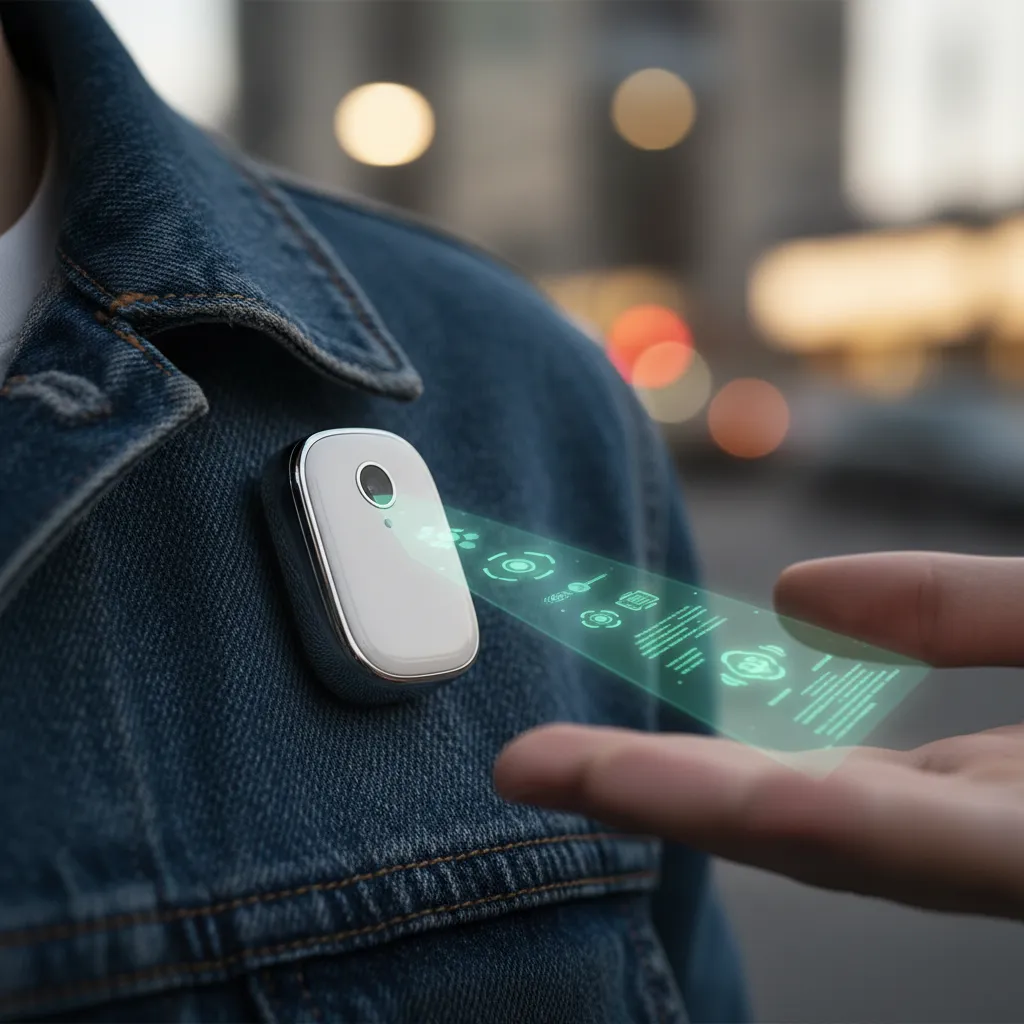
The Pin is a small, magnetic device worn on clothing, relying primarily on voice and gestures.
- Laser Ink Projection: Instead of a screen, the Pin projects a monochromatic green display onto the user’s palm, which they can interact with using gestures. This is the Pin’s solution to visual feedback, though it has proven challenging in bright light.
- Trust Light: A crucial security feature. The “Trust Light” illuminates whenever the Pin’s cameras, microphones, or sensors are actively recording or sending data to the cloud. This transparency mechanism is key to ensuring user privacy in a world of constant listening.
- AI-Powered Operating System (Cosmos): The OS is designed to be purely conversational. There are no app downloads; the Pin routes requests to the appropriate generative AI services, whether it’s for composing a text, checking the weather, or playing music.
- Camera and Computer Vision: Equipped with a camera, the Pin can “see” the world, allowing it to identify objects, translate signs in real-time, and act as a mobile computer vision assistant.
Humane Pin Review: User Experience and Early Limitations
Early Humane Pin reviews highlighted both the revolutionary potential and the practical hurdles. The core promise—a fast, frictionless interaction—was often hampered by slow processing times, inconsistent voice recognition, and the novelty (and occasional frustration) of the laser projection interface.
While the concept of smart pin technology offers unparalleled freedom from the phone screen, widespread adoption depends on three factors: immediate reliability, robust battery life, and a seamless data plan integration. The device is a bold step into the future of personal tech, but it currently serves as a testament to the complex challenge of replacing established hardware ecosystems.
Related: AI Revolutionizing Healthcare: Innovations and Future Trends
Deep Dive: The Rabbit R1 (The Personalized Operating System)
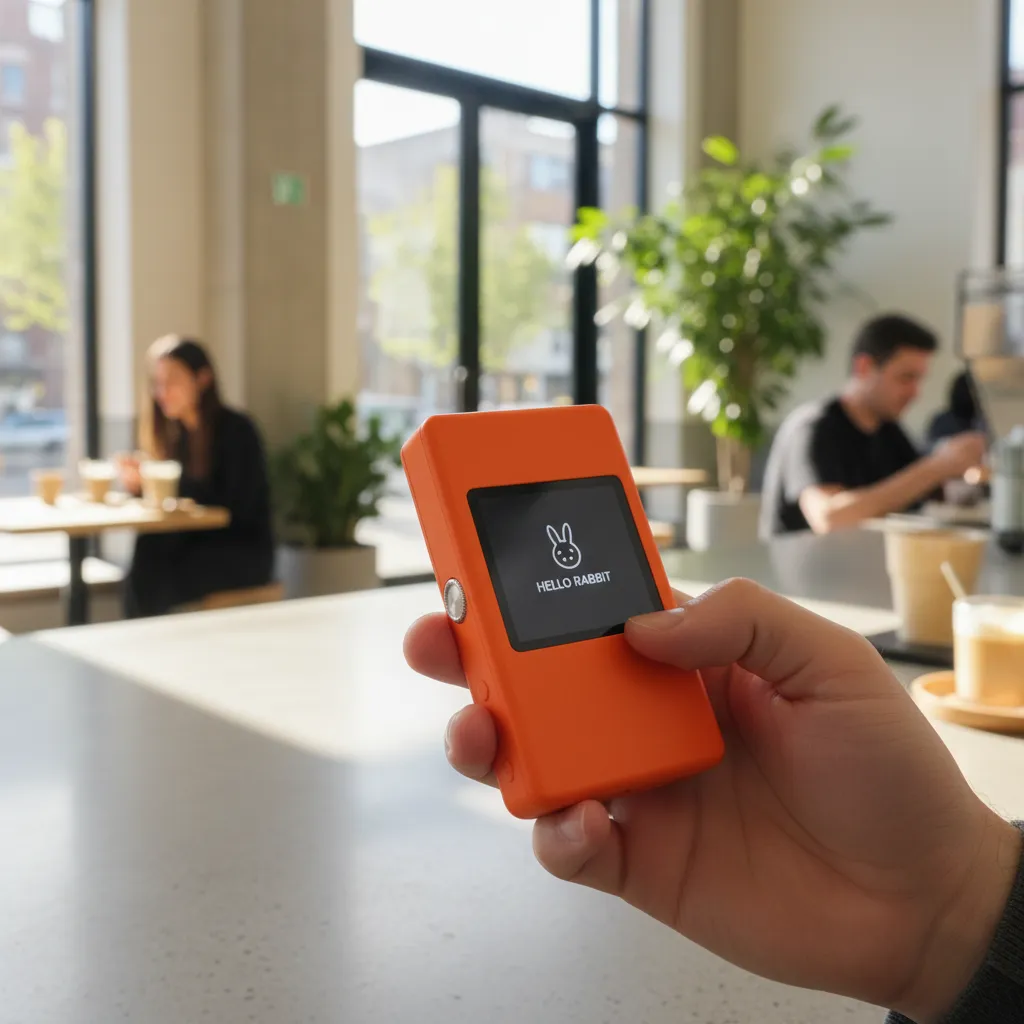
Where the Humane AI Pin focuses on ambient wearability, the Rabbit R1 takes a different approach. Designed in collaboration with Teenage Engineering, the R1 is a handheld device the size of a stack of sticky notes, featuring a small touchscreen, a scroll wheel, and a rotating camera.
How Does Rabbit R1 Work? The Large Action Model (LAM)
The R1’s brilliance lies not in its hardware, but in its software: the Large Action Model (LAM).
Unlike traditional AI models that only understand language, the Rabbit LAM is trained through “learning by demonstration.” Users can teach the R1 how to interact with their favorite apps and websites—from ordering food on DoorDash to composing images on Midjourney—by manually performing the action once. The LAM then learns to replicate this specific sequence of inputs.
This makes the R1 a true AI assistant hardware.
- Universal Interface: The R1 aims to unify the sprawling app landscape. Instead of opening 20 different apps, the user asks the device, and the LAM handles the backend interaction through proprietary ‘rabbits’ (digital assistants trained on specific tasks).
- Voice-Controlled AI: Interaction is primarily through a push-to-talk button, emphasizing speed and efficiency over navigating a complex visual interface.
Rabbit R1 Review: Functionality and Use Cases
Initial Rabbit R1 reviews were largely positive regarding its potential. The device is charming, highly portable, and offers a fun, tangible way to interact with AI. Use cases that show the R1’s power include:
- Complex Transactional Tasks: Booking a specific type of travel or finding a niche product across multiple e-commerce sites.
- Creative Generation: Instantly generating images or complex text prompts without opening a dedicated application interface.
- Cross-App Management: Consolidating music playback from multiple services or managing calendar entries and communication logs across platforms.
While it is still reliant on a screen, the R1 reduces screen time by minimizing the required steps for task completion. It focuses on delegation, making it a powerful tool for streamlining digital life.
Related: The Best AI Personal Assistants for Productivity in 2024
Head-to-Head: AI Pin vs. Rabbit R1 (A Comparison of Approaches)
The AI Pin vs Rabbit R1 debate encapsulates the divergence in the future of personal tech. Both are powerful smartphone alternatives, but they address the problem of smartphone fatigue differently.
The Humane AI Pin is an experiment in radical minimalist interaction, prioritizing being discreetly worn and entirely voice-driven. The Rabbit R1, conversely, is a handheld, fun gadget that attempts to fix the software layer (the app model) before tackling the hardware layer.
| Feature | Humane AI Pin | Rabbit R1 |
|---|---|---|
| Form Factor | Clip-on, Smart Pin Technology (Wearable) | Handheld, Small screen (Miniature Computer) |
| Core Technology | Custom OS (Cosmos), Traditional LLM, Laser Projection | Large Action Model (LAM), proprietary ‘rabbits’ |
| Interface | Voice-first, Gestures, Screenless Devices (Projection) | Voice-controlled AI, Small touch screen, Scroll wheel |
| Power | Relies heavily on on-device AI for context; Cloud heavy for processing | Primarily cloud-based processing via the LAM |
| Primary Goal | Minimize distraction and integrate ambient computing. | Automate complex tasks across multiple applications. |
| Connectivity | Built-in LTE/Data Plan required | Built-in SIM slot or Wi-Fi |
Both devices are crucial in defining the landscape of AI hardware 2024. They validate the search for a new primary device, even if neither has yet achieved true mainstream success. They serve as essential prototypes for the post-smartphone era.
The Million-Dollar Question: Are AI Gadgets the End of Smartphones?
The rise of these specialized AI-powered devices is less a death sentence for the smartphone and more a specialization event in the market. The smartphone market is mature; innovation has plateaued, and users are ready for something more focused.
However, replacing the smartphone requires overcoming significant ecosystem hurdles.
Arguments for the “End of Smartphones”
Proponents of the shift argue that the smartphone is inherently flawed because it attempts to do too much, resulting in low-quality interaction and digital addiction. The specialized approach of AI gadgets offers superior efficiency for specific functions:
- Frictionless Task Completion: For simple, frequent tasks—sending a short message, checking a fact, setting a reminder—a voice-controlled AI device like the Pin or R1 is demonstrably faster than unlocking a phone, finding an app, and typing.
- The Power of Delegation: The LAM model, perfected by the Rabbit R1, solves the app sprawl issue. If an AI can perform complex, multi-step actions (e.g., “Find the cheapest flights next month to Tokyo and text my wife the best dates”), the general-purpose smartphone becomes redundant for productivity.
- Focus on Presence: The goal of ambient computing is to free the user’s hands and eyes, allowing them to remain present in their environment, a powerful counterpoint to the phone’s addictive nature.
Related: Neurotech Revolution: Unlocking the Future of Brain-Computer Interfaces
Why Smartphones Will Endure (The Visual and Ecosystem Barrier)
While AI gadgets address distraction, they cannot replace the full functionality of a high-powered smartphone—at least not yet. The smartphone remains essential for three core reasons:
1. Visual Immersion and Media Consumption
No amount of laser projection or voice command can replace the experience of viewing a high-resolution video, editing a detailed photograph, or playing a graphics-intensive game. As long as visual media (social video, streaming, photography) remains central to digital life, a large, high-quality screen is non-negotiable.
2. Input Complexity and Creation
The smartphone is a universal input device. It supports high-speed typing, complex touch gestures, detailed sketching, and precision photo editing. While AI personal assistants excel at consumption and delegation, they struggle with creation tasks that require fine motor control, detailed visual feedback, and user-specific input customization. The tactile and visual language of software development is built around the rectangular screen.
3. Ecosystem Inertia and Trust
Apple and Google have spent a decade building massive, locked-in ecosystems (iOS and Android). These systems include payment infrastructure, security layers, cloud services, and millions of third-party apps. A new player in wearable AI technology must convince consumers not only that their product is better but that it can integrate seamlessly with or outright replace their existing digital identity—a monumental task that involves significant trust and switching costs.
The most likely outcome in the near term is a hybrid environment where specialized AI gadgets become powerful secondary edge computing devices that offload the phone’s tedious tasks, leaving the smartphone to handle media, communication, and complex creation.
Tech Trends 2024 and Beyond: The Blending of AI
The key takeaway from the rise of the Humane Pin and the Rabbit R1 is that the demand for friction-free, generative interaction is real. Even if these specific devices fail, their core technology and philosophy will be integrated into the next wave of mainstream consumer electronics.
1. The Super-Charged AI Assistant
The lessons learned from the first generation of generative AI hardware are already being applied by tech giants. Expect future versions of iOS and Android to deeply integrate Large Action Models and enhanced on-device AI. Your smartphone won’t be replaced; it will evolve, transforming its existing assistant (Siri, Google Assistant) from a reactive tool into a proactive, delegation engine.
2. Specialized AI Assistant Hardware
We are moving away from the single, multi-purpose gadget to a suite of connected, specialized tools. This is the future of personal tech.
- Health and Wellness: Ultra-sophisticated, context-aware rings and patches that continuously monitor health and provide proactive advice using specialized AI models.
- Focus and Productivity: Devices like the R1 may pave the way for a category of portable “work hubs” designed solely for professional task execution, separate from the distraction of social media and entertainment apps.
- Augmented Reality (AR): The ultimate screenless devices may not eliminate the display but move it off the hand and onto the face via AR glasses. This combines the contextual awareness of the AI Pin with the necessary visual interface of a phone.
This specialization means the best AI gadgets won’t necessarily be smartphone killers, but rather highly effective complements that redefine how and where we interact with technology. The goal is to maximize utility while minimizing the cognitive burden—the true spirit of ambient computing.

Conclusion: Coexistence, Not Annihilation
The conversation about “The End of Smartphones” is exciting, but premature. The current wave of AI gadgets—the Humane AI Pin, the Rabbit R1, and others—are crucial, but they are pioneers, not conquerors. They have successfully proved the viability of wearable AI technology and the power of the Large Action Model to handle transactional complexity.
These next generation technology experiments are vital because they force us to reconsider the human-technology interface. They highlight the inefficiencies of the app-based model and push us toward truly intelligent, context-aware computing.
In the near term, the future of mobile computing likely involves a high degree of integration: smartphones will absorb the best features of AI assistant hardware, becoming more intelligent, while niche smartphone alternatives will continue to thrive in specialized roles.
The smartphone isn’t dying; it’s evolving. But for the first time since the iPhone launched, it has serious, philosophically opposed competitors pushing the boundaries of what personal technology must look like. The goal is no longer to be always connected, but to be connected only when and how it truly matters.
Frequently Asked Questions (FAQs)
Q1. What is the main difference between an AI gadget and a smartphone?
The main difference lies in their design philosophy. A smartphone is a general-purpose device reliant on a visual app ecosystem, whereas an AI gadget (like the Humane AI Pin or Rabbit R1) is a specialized piece of generative AI hardware built around the core functionality of a voice-controlled AI or Large Action Model to execute tasks seamlessly and often without a screen, focusing on ambient computing.
Q2. How does the Rabbit R1 work, and what is a Large Action Model (LAM)?
The Rabbit R1 works using a Large Action Model (LAM). Unlike traditional AI that focuses on generating text or images, the LAM is trained to mimic human interaction with existing apps and services. When a user gives a command, the R1’s LAM acts as a universal operating system interface, automatically navigating and completing the requested task (e.g., ordering food, booking travel) across different online platforms without requiring the user to open the individual apps.
Q3. What is the Humane AI Pin primarily designed to replace?
The Humane AI Pin is designed to replace the habit of constantly interacting with a screen for quick, everyday tasks. As a piece of wearable AI technology, its goal is to integrate a seamless, screenless device into daily life, providing information and taking action using voice commands and subtle projections, thereby reducing digital distraction and promoting user presence.
Q4. Are AI gadgets already replacing smartphones in 2024?
No, AI gadgets are not currently replacing smartphones wholesale in 2024. They are defining a new category of smartphone alternatives. While devices like the Humane AI Pin and Rabbit R1 offer compelling ways to manage certain tasks, the smartphone remains essential for high-resolution visual media consumption, detailed input creation, and connectivity within vast, established app ecosystems.
Q5. What is ambient computing?
Ambient computing refers to a technological paradigm where computing power and information are woven seamlessly into the environment. Instead of requiring active user engagement through a device (like a phone or laptop), the technology is context-aware and responds proactively to the user’s needs, often relying on voice-controlled AI and edge computing devices to fade into the background.
Q6. What is the significance of on-device AI in these new gadgets?
The significance of on-device AI is twofold: speed and privacy. By processing sensitive data (like real-time voice transcription or environmental recognition) directly on the gadget—a process facilitated by edge computing devices—the device can respond much faster and avoid sending all raw data to the cloud, enhancing both user experience and security, which is critical for continuous wearable AI technology.
Q7. What are the major challenges facing the adoption of smart pin technology?
The major challenges facing the adoption of smart pin technology like the Humane AI Pin include achieving reliable and instant performance, overcoming the novelty and limitations of the interface (e.g., laser projection visibility), ensuring robust battery life, and convincing users to pay a subscription fee for AI services that are currently integrated, albeit less seamlessly, into their existing smartphones.