The Rise of AI Agents: Your 2024 Automation Guide

Introduction: Moving Beyond Simple Prompts
The early era of generative AI was defined by large language models (LLMs) answering specific, single-turn prompts. We asked them to write an email, summarize a document, or generate code snippets. They did this brilliantly, but the process was fundamentally passive, waiting for human input at every step.
Welcome to 2024, the year that paradigm fundamentally shifted.
The most transformative wave in artificial intelligence is the rise of AI agents. These are not just reactive chatbots; they are autonomous agents capable of defining goals, planning complex multi-step processes, executing actions (often involving external tools), and course-correcting based on the outcome. They move AI from being a passive tool to an active, decision-making collaborator.
This guide is your deep dive into the world of AI automation 2024. We will break down what intelligent agents are, explore the frameworks like LangChain and CrewAI that power them, and provide a clear roadmap for leveraging this technology to unlock unprecedented levels of workflow automation in your business and personal life. If you’re serious about true AI for productivity, understanding AI agents is non-negotiable.
What Exactly is an Autonomous AI Agent?
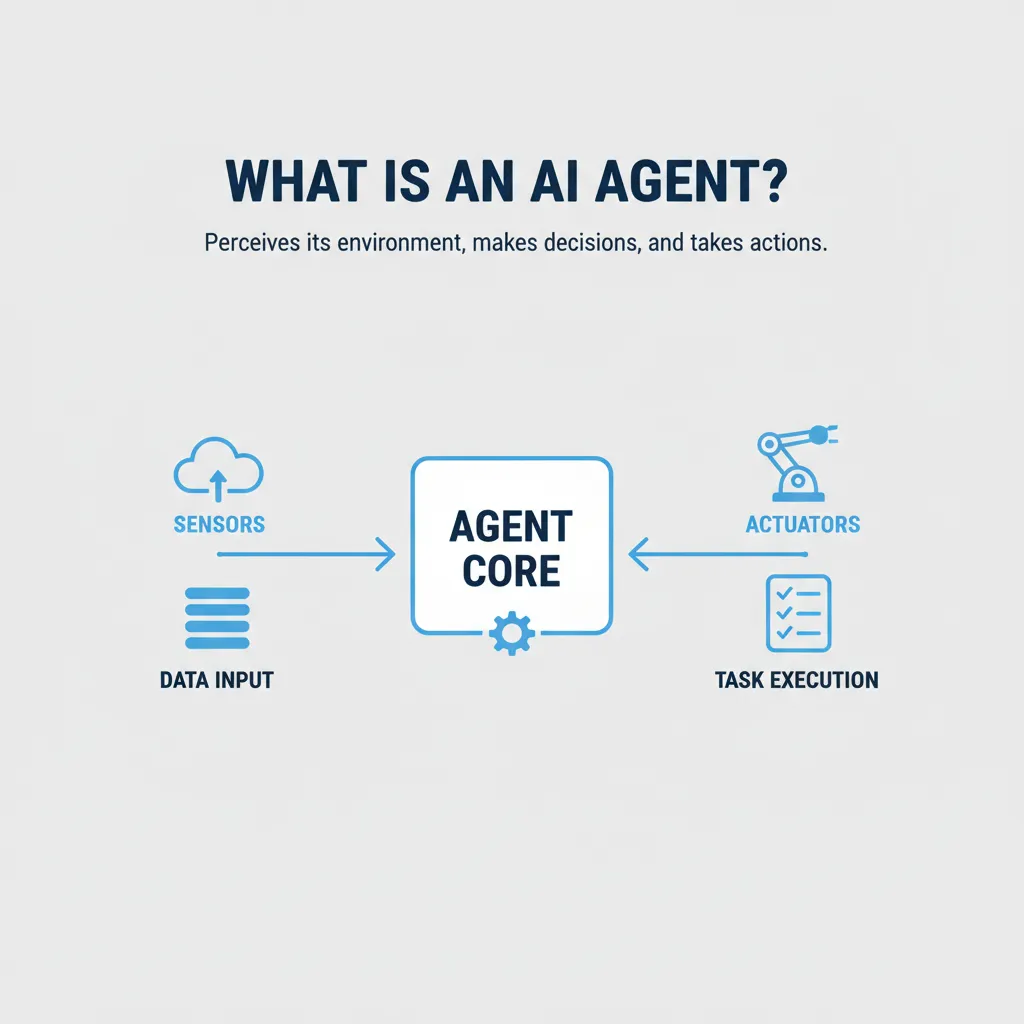
An AI agent is a software system designed to perceive its environment, make decisions, and take actions to achieve a specific goal. Unlike a traditional script or program, an autonomous agent does not follow a predefined sequence of steps; it determines the steps itself.
Think of it this way: asking an LLM to “Plan a two-week marketing campaign” requires you to define every step (research, drafting, scheduling, reporting). Asking an AI agent the same prompt gives it the autonomy to define the market research process, use search tools, draft content, interact with a project management system, and then report back—all without further human intervention.
The Agentic Architecture: Brain, Memory, and Tools
For an agent to be truly autonomous, it requires several critical components, often referred to as the cognitive agents in AI framework:
- The Core LLM (The Brain): This is the large language model (e.g., Gemini, GPT-4) responsible for reasoning, planning, and task decomposition. It breaks the main goal into smaller, manageable sub-tasks.
- Memory (Short-Term & Long-Term):
- Short-term memory (context window) holds the immediate conversational history.
- Long-term memory (often a vector database) stores past experiences, successful workflows, and knowledge gleaned from previous tasks, allowing the agent to learn and improve.
- Planning Module: This module determines the sequence of actions required to meet the goal. Crucially, it handles self-correction—if an action fails, the agent replans the remaining steps.
- Tools/Action Space (The Actuators): This is the agent’s connection to the real world. Tools allow the agent to perform actions like searching the web, running code, sending emails, or updating a database.
“The true power of AI agents lies not in their ability to generate text, but in their capacity to choose and utilize tools intelligently based on complex internal state and external context.”
The Core Difference: Agents vs. Simple AI Tools
While many companies claim to offer AI automation, it’s essential to distinguish between simple task automation with AI and true agentic systems.
1. Reactive vs. Proactive Reasoning
- Simple Tool (Reactive): Receives a prompt, executes a single function (e.g., summarizes text), and waits. This is common in basic robotic process automation (RPA) where the rules are strictly predefined.
- AI Agent (Proactive): Receives a goal, dynamically creates a plan, executes multiple steps, evaluates the result of each step, and adjusts the plan if necessary. This capability is what makes autonomous AI solutions truly groundbreaking for complex, non-linear problems.
2. Single-Turn vs. Multi-Step Execution
A basic chatbot operates in single turns. An AI agent is designed for multi-step execution. For example, if you ask a traditional system to “Find the best flight prices for a trip to Tokyo next month and book the cheapest one,” it would fail because it cannot connect to travel sites, interpret dynamic data, and execute a booking action.
An intelligent agent can:
- Search multiple flight aggregators (using its search tool).
- Filter results based on price and time (reasoning).
- Cross-reference prices with external historical data (using memory).
- If the best price is found, execute the booking API call (actuator).
- If an error occurs (e.g., credit card decline), it knows to stop and notify the user (self-correction).
This complex, goal-oriented process is the cornerstone of effective business process automation in 2024.
[Related: Unlock Peak Productivity: 10 AI Tools Revolutionizing Your Workday]
AI Agent Platforms and Frameworks: The Essential Toolkit
To transition from conceptual understanding to practical deployment, you need the right AI agent platforms and frameworks. These tools provide the necessary abstraction layers to handle memory, tool integration, and planning cycles, making AI agent development accessible.
LangChain: The Infrastructure Foundation
LangChain is arguably the most recognized AI agent framework. While it is not an agent itself, it provides the modular components necessary to build one. It acts as the “operating system” for custom AI agents.
- Chains: Connecting LLMs to data sources or other functional components.
- Agents: The core module allowing the LLM to decide which tools to use and in what order.
- Retrievers/Memory: Tools for integrating external knowledge (like documents or past conversations) into the decision-making process.
LangChain is ideal for developers starting their journey in AI agent programming and needing granular control over every architectural element. It provides the backbone for implementing sophisticated autonomous agents.
CrewAI: Powering Multi-Agent Systems
If LangChain provides the components for a single agent, CrewAI provides the components for a team of agents. This framework specifically focuses on building multi-agent systems where different AI agents, each with a defined role, collaborate to achieve a complex, shared goal.
The CrewAI Philosophy:
- Define Roles: Assign specialized roles (e.g., “Market Researcher,” “Copywriter,” “Editor”).
- Define Tasks: Specify the objective for each role.
- Define Process: Establish how the agents hand off tasks (sequential or hierarchical).
For example, a marketing crew could have:
- Agent 1 (Researcher): Gathers data on competitor activities using a search tool.
- Agent 2 (Strategist): Analyzes Agent 1’s data and drafts a high-level plan.
- Agent 3 (Copywriter): Takes the plan and generates specific content drafts.
CrewAI accelerates workflow automation by distributing cognitive load across specialized generative agents, leading to higher-quality, more comprehensive output.
Other Key Players in the Agent Space
- AutoGPT: One of the earliest open-source concepts that demonstrated the potential of autonomous goal-setting. While often requiring heavy configuration, it popularized the concept of persistent, self-driven agents.
- Microsoft Autogen: A powerful open-source framework from Microsoft that emphasizes conversation and collaboration between multiple agents using customizable interaction patterns, highly effective for rapid prototyping of multi-agent systems.
Step-by-Step: How to Build an AI Agent
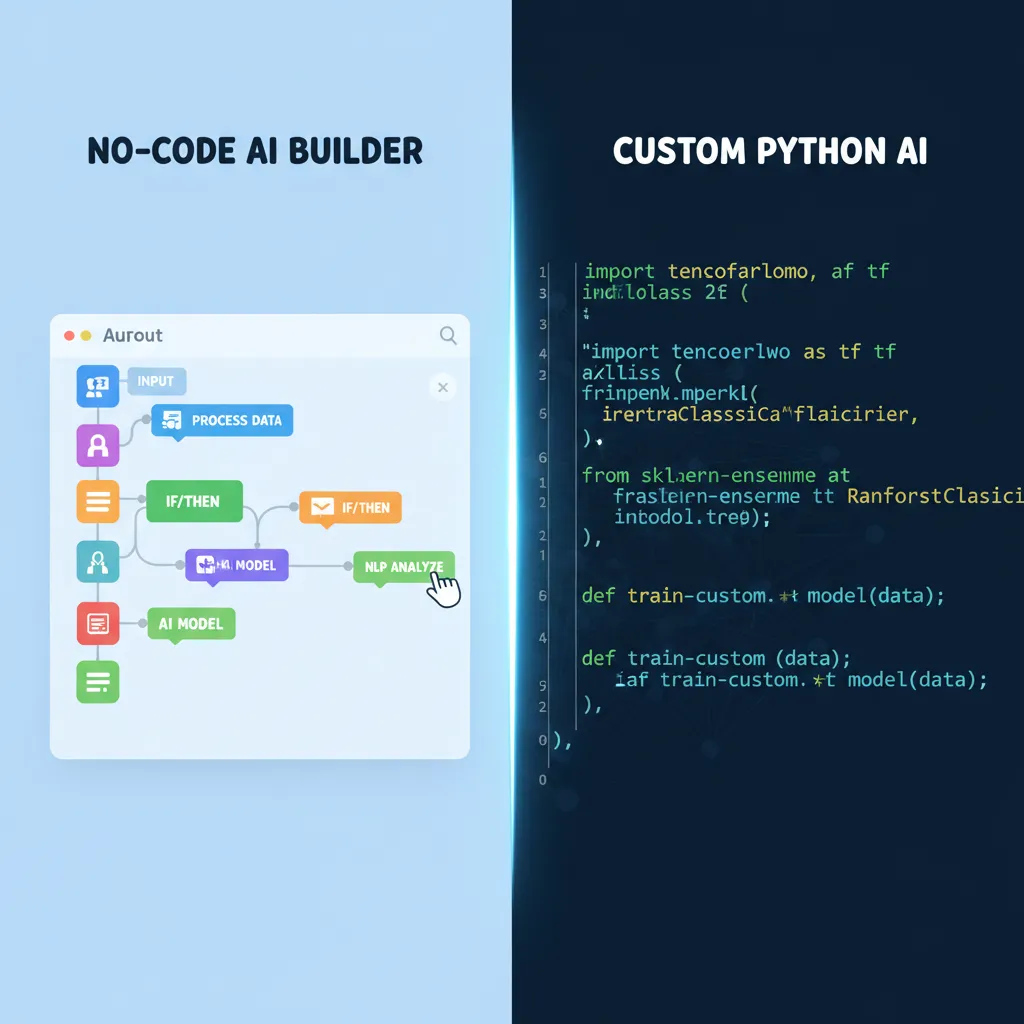
Building an AI agent, whether for personal use or business process automation, no longer requires a Ph.D. in computer science. The choice between using a no-code AI workflow builder and writing custom AI agents depends on your technical skill and the complexity of the task.
Method 1: No-Code AI Agents for Quick Wins
The rise of platforms like Zapier’s Central, Make (formerly Integromat), and dedicated no-code AI agents interfaces means you can deploy sophisticated automation flows using visual editors.
Use Case Example: Lead Qualification Automation
- Define Goal: Automatically qualify and respond to inbound leads from a contact form.
- Select Platform: Use a no-code AI workflow builder (e.g., a platform integrated with a CRM).
- Set Trigger: When a new lead is added to the CRM.
- Define Agent Persona: Create an agent (e.g., “The Qualification Specialist”) with the goal: “Analyze lead submission data to determine if the lead meets the minimum revenue criteria of $50k/year and identify their primary industry.”
- Assign Tool: Give the agent access to a web search tool to verify company details and a CRM API tool to update the lead status.
- Action Steps: Based on the agent’s output (Qualified/Unqualified), automatically send a personalized follow-up email or assign the lead to a human sales representative.
This method minimizes the complexity of AI agent programming while maximizing rapid AI for productivity gains.
[Related: Unlock Potential: AI Tools for Productivity and Creativity in 2024]
Method 2: Custom AI Agent Development with Python
For complex internal systems, highly specific data access, or the need for advanced memory management, custom AI agents built using frameworks like LangChain or CrewAI are necessary. This is the realm of true AI agent development.
Simplified Agent Development Flow (Using Python and LangChain):
- Define the Agent’s Persona and Goal: Establish the boundaries, constraints, and objective (e.g., “Financial Analyst Agent: Review quarterly reports and generate risk assessments.”).
- Tool Creation: Define the functions the agent can call. This is usually where you create Python functions to interact with APIs (e.g., a function to fetch stock data, a function to query an internal database).
- Initialize the LLM and Memory: Select a robust model (e.g., Gemini) and configure the agent’s vector store for long-term memory retrieval.
- Assemble the Agent: Combine the LLM, the tools, and the memory into the LangChain
AgentExecutor. - Run the Task: Execute the agent with the user’s prompt (e.g.,
agent.run("Analyze Q4 2024 performance metrics for the retail division.")). The agent autonomously decides when to use the database tool, when to use the calculation tool, and when to generate the final report.
Revolutionary AI Agent Use Cases in 2024
The practical application of autonomous agents is rapidly transforming every industry. Here are the most impactful AI agent use cases driving the future of AI automation.
1. Business Process Automation (BPA) and RPA Reimagined
Traditional Robotic Process Automation (RPA) is rigid; it breaks if the UI changes or the data format shifts. AI agents introduce cognitive flexibility into automation.
- Dynamic Data Migration: An agent can monitor multiple legacy systems, identify variances in data structure, use reasoning to map fields correctly, and migrate information without human oversight, even when encountering unforeseen errors. This is crucial for large-scale enterprise transformation projects.
- Customer Service Orchestration: Instead of routing customers through rigid menus, an agent can interpret the user’s emotional tone and complex query, interact with three separate internal knowledge bases (pricing, tech support, billing), and generate a custom, contextual resolution, functioning as a hyper-efficient virtual supervisor.
2. Personalized AI Personal Assistant and Task Management
For individuals, the dream of a true digital assistant is finally realized through these powerful agents.
- Proactive Scheduling and Email Management: An AI personal assistant can go beyond simple calendaring. It monitors incoming emails, recognizes actionable items (e.g., “Schedule a meeting with John,” “Draft a contract”), and autonomously initiates the multi-step process: checking calendars, sending invites, and even drafting a preliminary meeting agenda based on the conversation history. This drastically improves AI task management.
- Deep Learning and Skill Acquisition: The most advanced agents can observe how a user completes a complex task (e.g., generating monthly reports), internalize the specific steps, and then replicate that behavior autonomously in the future, effectively training themselves on your unique workflow.
[Related: Master Your Day: 10 AI Tools to Skyrocket Your Personal Productivity]
3. Generative Agents for Content and Research
In the media and research fields, agents are proving indispensable for generating and validating information at scale.
- Complex Content Generation: Instead of just generating a blog post, a crew of generative agents can execute the entire content marketing pipeline: market research (Agent 1), outline creation and SEO optimization (Agent 2), full draft writing (Agent 3), and final proofreading/fact-checking against external sources (Agent 4).
- Scientific Discovery Simulation: Agents are being used to model complex systems, search massive archives of scientific literature, hypothesize outcomes, and even design and run virtual experiments, accelerating research timelines exponentially.
The Future of Automation: Multi-Agent Systems and Collaboration
While single autonomous agents are powerful, the true step change comes from coordination—the use of multi-agent systems to solve problems that are too vast or complex for any single entity. This is the future of AI automation.
The Power of AI Collaboration: Task Orchestration
In an agentic crew, the architecture mirrors a high-performing human team:
- Role Specialization: Each agent focuses on what it does best, leading to specialized expertise and faster execution.
- Inter-Agent Communication: Agents communicate using specific message formats (like JSON or predefined protocols) to hand off context and results seamlessly.
- Orchestration and Conflict Resolution: A designated “Orchestrator Agent” manages the flow, ensures quality, and resolves disagreements or ambiguities between the specialized agents.
This collaborative approach is leading to revolutionary autonomous solutions in areas like financial trading, complex logistics planning, and massive software engineering projects where thousands of lines of code can be planned, drafted, tested, and deployed by a crew of specialized AI programmers.

Ethical Considerations and Autonomous AI Solutions
The increased autonomy of intelligent agents necessitates rigorous ethical and safety guardrails. As agents gain access to tools and external systems, the potential for unintended or harmful actions grows.
Key Safety Principles for AI Agents:
- Clear Boundaries: Agents must operate within strictly defined operational limits. If an agent’s goal requires an action outside its defined toolset or ethical constraints, it must halt and request human override.
- Explainability (XAI): Since agents make independent decisions, their reasoning process must be transparent. Developers must implement logging and tracing capabilities (often supported by frameworks like LangChain) so that human users can review the agent’s “thought process” (planning, tool calls, and outcomes).
- Human-in-the-Loop (HILT): For high-stakes tasks (e.g., financial transactions, medical diagnoses), the agent acts as an assistant that prepares the complex analysis, but a human must ultimately approve the final execution.
Adherence to these principles ensures that the transition to widespread autonomous AI solutions remains responsible and compliant.
Mastering the Shift: Your 2024 Action Plan
The transition from using simple AI tools to mastering AI agents requires a shift in mindset—from instructing to delegating.
1. Identify “Agent-Ready” Workflows
Start by analyzing your workflows for tasks that are:
- Multi-Step: Requires 3 or more distinct steps (e.g., research -> synthesize -> draft -> publish).
- Tool-Dependent: Requires external data access (web, database, email).
- Iterative: The process requires self-correction or optimization over time.
Excellent starting points include content marketing research, comprehensive customer support analysis, and specific code generation tasks.
2. Choose the Right Toolset
- If you need a simple proof-of-concept for workflow automation without coding: Use a no-code AI workflow builder integration or a specialized platform like Zapier Central.
- If you need specialized, collaborative teams: Invest time in CrewAI for building multi-agent systems.
- If you need maximum flexibility and deep integration with proprietary systems: Focus on LangChain for custom AI agent development.
3. Start Small and Iterate
Deploy a pilot agent on a non-critical workflow. Track its performance, specifically looking at its failure modes. Use this data to refine the agent’s prompts, tool access, and memory retrieval process. Effective AI agent tutorial approaches emphasize iterative testing and refinement.
The future of productivity is agent-driven. By embracing the power of autonomous agents today, you secure a decisive advantage in the competitive landscape of tomorrow.
Conclusion
The era of AI agents marks the true beginning of large-scale, intelligent workflow automation. From single-task intelligent agents built with LangChain to powerful, collaborative multi-agent systems orchestrated by CrewAI, the ability of these tools to set goals, plan, and execute tasks autonomously is reshaping how work gets done.
In 2024, mastering AI task management and business process automation means moving beyond static scripts and embracing dynamic, self-correcting autonomous AI solutions. Whether you leverage no-code AI agents for quick wins or dive into AI agent programming for custom solutions, the time to integrate this technology is now.
[Related: Spatial Computing Unveiled: The Next Frontier in Immersive Technology]
FAQs: Understanding AI Agents and Automation
Q1. What is the difference between an LLM and an AI agent?
A Large Language Model (LLM) is the brain of an AI agent, serving as the reasoning and language processing core. An AI agent is a complete system that uses the LLM, but also includes memory, a planning mechanism, and tools (actuators) that allow it to interact with the external world and execute multi-step, complex tasks autonomously.
Q2. How do multi-agent systems work?
Multi-agent systems (like those built with CrewAI) involve two or more specialized AI agents collaborating on a shared goal. Each agent is assigned a unique role (e.g., researcher, writer, editor) and communicates with the others, passing intermediate results and context until the final objective is achieved. This distributed approach leads to more reliable and comprehensive workflow automation.
Q3. Is robotic process automation (RPA) the same as AI agent automation?
No. Traditional Robotic Process Automation (RPA) relies on strictly predefined, rigid rules and sequences (if X, then Y). AI agent automation uses cognitive agents in AI that can interpret fuzzy inputs, perform complex reasoning, dynamically generate a plan, and adapt their actions if the environment or data changes, offering a much higher level of intelligence and flexibility than conventional RPA.
Q4. What is LangChain used for in AI agent development?
LangChain is an open-source AI agent framework used by developers to structure and build complex custom AI agents. It provides the modular components—like memory management, prompt templates, and standardized tool integrations—that simplify connecting LLMs to external data sources and execution environments, making advanced AI agent development more accessible.
Q5. Can non-programmers build autonomous agents?
Yes. The rise of no-code AI agents and AI workflow builder platforms has democratized agent creation. Tools from major tech providers allow users to define roles, goals, and available tools via graphical user interfaces (GUIs), enabling effective AI for productivity without needing to write complex AI agent programming code.
Q6. What is AutoGPT?
AutoGPT was one of the earliest viral open-source projects demonstrating the potential of self-governing autonomous agents. It allowed users to set a goal, and the system would recursively plan, execute tasks, and self-correct using tools like web search and code execution, laying the groundwork for many of the commercial AI agent platforms we see today.
Q7. How do generative agents differ from other AI agents?
Generative agents are typically focused on complex content creation, simulation, or data synthesis. While all intelligent agents are generative in their decision-making, the term often applies to agents specialized in producing large outputs like articles, marketing strategies, or simulated human behaviors in virtual environments. They are crucial for tasks requiring extensive creativity or complex research.