The On-Device AI Revolution: Powering Private, Fast, & Personalized Tech

Introduction
Imagine your phone instantly transcribing a meeting in real-time, even on airplane mode. Picture your laptop’s webcam flawlessly blurring your background on a video call without a stutter, using virtually no CPU power. Or consider a smart security camera that can tell the difference between a person, a pet, and a passing car, all without sending a single frame of video to a remote server. This isn’t science fiction; it’s the reality of the on-device AI revolution.
For years, the term “AI” was synonymous with massive, power-hungry data centers and a constant need for an internet connection. Our devices were merely portals, sending our data to the cloud for processing. But a fundamental shift is underway. The intelligence is moving from the distant cloud to the device in your hand, pocket, or home. This is the personal AI revolution.
This move towards device-centric AI is about more than just convenience. It’s a paradigm shift that champions privacy, delivers instantaneous speed, and unlocks a new level of deeply personalized AI experiences. In this guide, we’ll explore what on-device AI is, how it works, the game-changing benefits it offers, and why it represents the very future of personal AI.
What is On-Device AI? A Shift from the Cloud to Your Pocket
At its core, the concept is simple. On-device AI, also known as Edge AI or local AI, means that artificial intelligence computations and machine learning tasks are performed directly on your hardware—your smartphone, laptop, smartwatch, or smart speaker. The “thinking” happens locally, not on a server farm hundreds or thousands of miles away.
The Old Way: The Cloud-Centric AI Model
Think about the early days of digital assistants. You’d ask a question, and there would be a noticeable pause. In that moment, your voice command was being packaged up, encrypted, sent across the internet to a massive server, processed by a powerful AI model, and the answer was then sent back to your device.
This cloud-based model has several dependencies and drawbacks:
- Constant Connectivity: No internet, no AI.
- Latency: The physical distance data must travel creates delays, making real-time interactions feel sluggish.
- Privacy Concerns: Your personal data—voice queries, photos, location history—has to be uploaded to a third-party server, creating potential vulnerabilities.
- Data Costs: Constantly sending and receiving data can consume your mobile data plan.
The New Paradigm: Device-Centric AI
On-device AI flips this model on its head. Thanks to incredible advancements in AI chip technology and software optimization, modern devices now have the horsepower to run sophisticated local AI models by themselves. It’s the difference between having to call a chef at a restaurant for every step of a recipe versus having a master chef right in your own kitchen.
This new approach allows for AI without cloud dependency for a vast range of tasks. Your device is no longer just a microphone and a speaker for a remote brain; it has its own powerful, efficient brain built right in.
How Does On-Device AI Actually Work?
The magic behind on-device machine learning isn’t a single breakthrough but a convergence of two key areas: highly efficient software and incredibly specialized hardware.
The Magic Ingredients: Efficient Models and Specialized Hardware
1. Optimized Local AI Models: The massive AI models that live in the cloud, like those powering complex search engines, are too large and power-hungry to run on a smartphone battery. Researchers have developed techniques like quantization (using less precise but more efficient numbers) and pruning (trimming away unnecessary parts of the neural network) to create smaller, leaner, yet surprisingly powerful models that can run efficiently on mobile hardware. These models are trained in the cloud but are deployed to run locally.
2. Next-Gen AI Hardware: This is perhaps the biggest enabler of the revolution. Modern processors, or Systems-on-a-Chip (SoCs), now include dedicated cores specifically designed for AI tasks. These are called NPUs (Neural Processing Units).
- Apple’s Neural Engine: Powers features like Face ID, Live Text, and computational photography.
- Google’s Tensor Processing Unit (TPU): Enables features like Magic Eraser, real-time translation, and call screening on Pixel phones.
- Qualcomm’s AI Engine: Found in many Android devices, accelerating AI tasks for camera, voice, and gaming.
These NPUs are the workhorses of AI processing on device. They can perform trillions of AI operations per second while using a tiny fraction of the power of a traditional CPU, making complex, real-time AI on your phone a reality.
The Core Benefits: Why Local AI is a Game-Changer
The shift to device-centric AI isn’t just a technical curiosity; it provides tangible, transformative benefits for every user. These edge AI benefits fundamentally improve our relationship with technology.
1. Unbreakable Privacy and Data Security
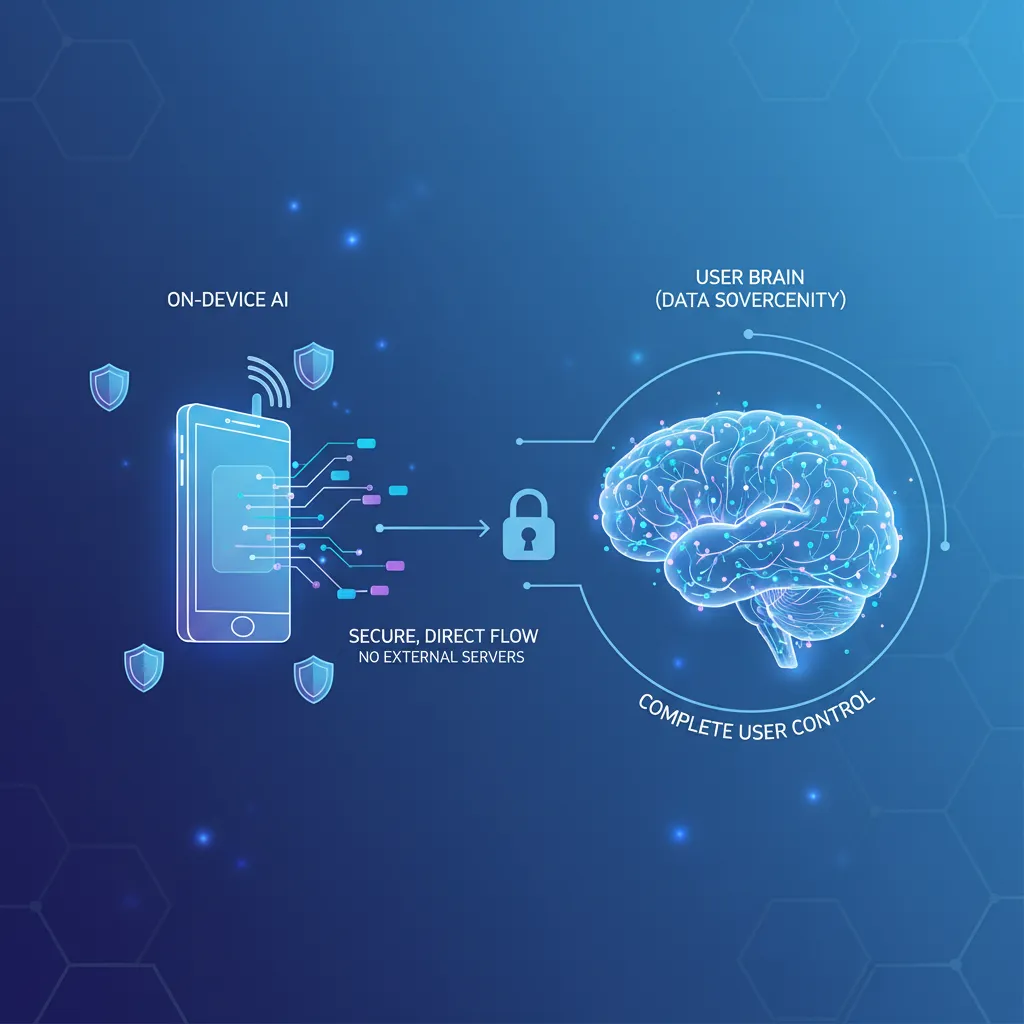
This is the most critical advantage. With on-device AI, your most personal data stays where it belongs: on your device. Facial recognition maps, voiceprints, personal photos, and sensitive health data are processed locally, never uploaded to a server where they could be vulnerable to data breaches or misuse.
This is the very essence of privacy-focused AI. It grants you data sovereignty, meaning you have ultimate control over your own information. It’s a powerful step towards building trust between users and the technology they rely on every day.

This focus on AI for data protection means you can enjoy intelligent features without sacrificing your privacy. It’s a foundational element for a more secure digital life. Related: Ethical AI for Financial Wellness: Smart Money Habits, Secure Future
2. Blazing-Fast, Real-Time AI Processing
By eliminating the round-trip journey to the cloud, on-device AI eradicates latency. The results are instantaneous. When you tap a button to apply a portrait mode effect to a photo, it happens immediately because the AI calculations are performed right there on the device’s NPU.
This is what enables seamless real-time AI on device. Think of interactive augmented reality (AR) filters on social media, live language translation that feels like a natural conversation, or a digital keyboard that predicts your next word before you even think it. This is faster AI processing at its best, making technology feel more responsive and intuitive.
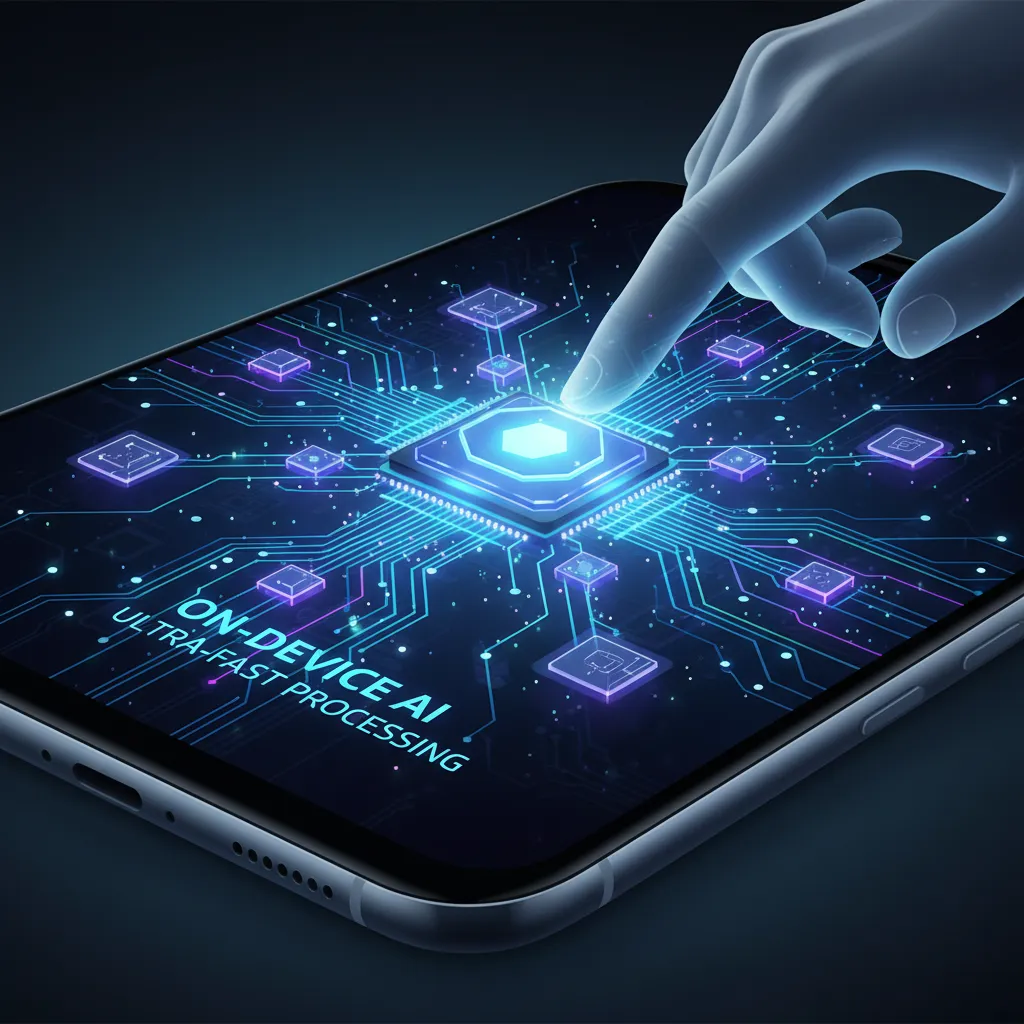
The speed is not just a luxury; it’s essential for creating fluid, natural user experiences that feel truly magical. Related: Master Your Day: 10 AI Tools to Skyrocket Your Personal Productivity
3. Uninterrupted Offline AI Capabilities
One of the most liberating benefits of local AI is its ability to function without an internet connection. Your device’s smartest features are no longer tethered to a Wi-Fi or cellular signal.
You can get real-time text transcriptions during a flight, use your phone’s camera to identify a plant species on a remote hike, or organize your photo library by people and places without using a single byte of data. These powerful offline AI capabilities make your devices more reliable, useful, and truly mobile.
4. Hyper-Personalized AI Experiences
True personalization requires an AI to understand your unique context—your habits, your vocabulary, your relationships, your daily routines. In the cloud-AI world, achieving this level of personalization meant sharing an enormous amount of sensitive data.
On-device AI solves this privacy-personalization paradox. The AI can learn your patterns locally, creating a profile that is unique to you and only you. It can learn who your most important contacts are to prioritize their notifications, understand your photo-editing style to suggest better enhancements, and learn your daily commute to proactively check traffic. This creates deeply personalized AI experiences that feel genuinely helpful because they are tailored specifically to you, without compromising your data. Related: The Future of Personal Computing: Beyond AI PCs
5. Cost-Effectiveness and Eco-Friendliness
While it might seem counterintuitive, processing AI locally can be more efficient. For businesses, it dramatically reduces the need for enormous, expensive, and power-hungry server farms. For you, the user, it means less data consumption on your mobile plan. Furthermore, the specialized NPUs are designed for maximum performance-per-watt, meaning they can perform complex AI tasks without draining your battery, contributing to a more sustainable tech ecosystem. Related: Sustainable Tech Innovations: Greener Gadgets & Eco-Smart Living
On-Device AI in Everyday Tech: Seeing it in Action
The impact of on-device AI is already all around us. You’re likely using it every day without even realizing it. Here are just a few examples of AI in everyday tech.
AI on Smartphones: The Command Center in Your Hand
The smartphone is the epicenter of the on-device AI revolution.
- Computational Photography: Features like Portrait Mode, Night Sight, and Cinematic Video rely on on-device AI to segment scenes, adjust lighting, and stabilize video in real-time.
- Face Unlock: Your phone’s secure facial recognition system is a prime example of a local AI model analyzing your face’s 3D map in a fraction of a second.
- Predictive Text & Autocorrect: The keyboard learns your personal slang, common typos, and sentence structures to offer increasingly accurate suggestions, all without sending your keystrokes to the cloud.
- Live Transcription: Apps can now convert spoken words to text instantly, entirely offline.
- Photo Curation: Your gallery app intelligently categorizes photos by faces, places, and objects, making it easy to search for “pictures of my dog at the beach.”
AI on Laptops: The New Era of AI PCs
The latest generation of laptops, often marketed as “AI PCs,” are defined by their powerful NPUs.
- Windows Studio Effects: Features like automatic background blur, voice focus to eliminate background noise, and eye contact correction during video calls are all handled by the NPU, freeing up the CPU and GPU for other tasks.
- Enhanced Performance & Battery Life: AI models run locally to optimize power allocation, predicting which apps you’ll use and directing resources accordingly for a smoother, longer-lasting experience.
AI for Smart Devices: Building a Local Ecosystem
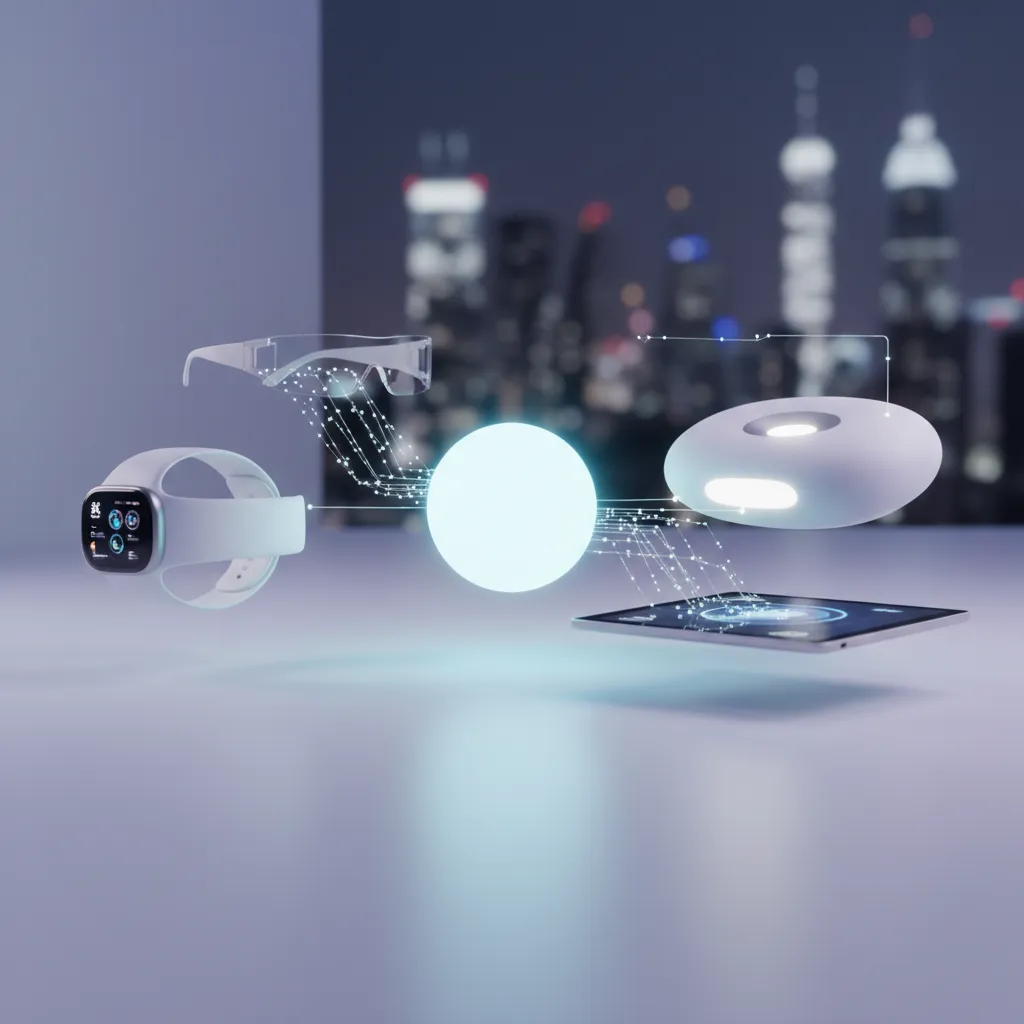
The revolution extends beyond phones and laptops into our homes.
- Smart Security Cameras: On-device person, package, and pet detection allows for more relevant notifications and reduces false alarms, all while keeping video footage private.
- Smart Speakers & Displays: Many basic commands like “set a timer” or “what time is it?” are now processed locally, resulting in faster responses.
- Smart Home Hubs: Standards like Matter are pushing for more local control, allowing your smart lights and thermostats to communicate directly without relying on a cloud server, making your smart home faster and more reliable. Related: Galaxy Ring vs. Oura: The Ultimate Smart Ring Showdown
The Challenges and the Road Ahead for Localized AI
Despite its immense potential, the path for the future of localized AI is not without its obstacles.
- Limited Resources: A device, no matter how powerful, has finite processing power, memory, and battery life compared to a virtually limitless cloud data center. This constrains the size and complexity of the local AI models that can be run.
- Model Updates: Deploying updates and improvements to an AI model running on billions of individual devices is a far more complex logistical challenge than updating a single model on a centralized server.
- The Hybrid Approach: The future isn’t a battle of on-device vs. cloud; it’s a collaboration. The most likely path forward is a hybrid model. Your device will handle all the real-time, private, and context-aware tasks locally. For massive, computationally intense queries—like a complex search query that requires indexing the entire internet—it will intelligently tap into the power of the cloud. Related: Google AI Overviews: The Future of Search
The Future of Personal AI: What’s Next?
The on-device AI revolution is just getting started. As next-gen AI hardware becomes even more powerful and efficient, we can expect to see a future where technology becomes truly proactive and ambient.
True Data Sovereignty: You Own Your Digital Self
The most profound impact will be the shift in data ownership. On-device AI empowers a future where you are the sovereign ruler of your personal data. Your devices will serve you, not a distant corporation’s data-harvesting model. This is the ultimate promise of AI data security.
Proactive and Ambient Computing
Imagine a world where your devices don’t just react to your commands but anticipate your needs. Your smart display might suggest a recipe based on the ingredients it sees in your smart fridge, or your noise-canceling earbuds could automatically adjust their settings based on your location, all processed locally. This is the dream of ambient computing, made possible by privacy-preserving, on-device intelligence. It’s the philosophy behind emerging devices like AI pins. Related: AI Pins: A Guide to the Screenless Revolution
Conclusion
The shift to on-device AI is one of the most significant technological transformations of our time. It’s a quiet revolution happening inside the devices we use every day, fundamentally reshaping our relationship with technology. By bringing intelligence from the cloud to the edge, we are entering a new era defined by unparalleled privacy, instantaneous speed, and truly meaningful personalization.
This device-centric AI movement puts control back where it belongs: in your hands. It ensures that the future of artificial intelligence is not only powerful but also private, not only smart but also secure.
As you consider your next smartphone, laptop, or smart gadget, look beyond the screen size and camera megapixels. Pay attention to the AI chip technology inside. You’re not just buying a faster device; you’re investing in a more private, responsive, and personalized digital future.
Frequently Asked Questions
Q1. What is the main difference between on-device AI and cloud AI?
The primary difference is location. On-device AI processes data and runs machine learning models directly on your local device (e.g., your smartphone). Cloud AI sends your data over the internet to a remote server for processing and then sends the result back to you.
Q2. Is on-device AI more private?
Yes, absolutely. Because your personal data is processed and stored locally, it never leaves your device. This eliminates the risk of it being exposed in a server-side data breach, making it a core technology for ai privacy solutions and data protection.
Q3. Does on-device AI work without an internet connection?
Yes. This is one of its key advantages. Features powered by on-device AI, such as real-time transcription, camera effects, and photo organization, can function perfectly even when you are offline, on a plane, or have no cellular service.
Q4. What are some examples of on-device AI in my smartphone?
Common examples include Face ID or fingerprint unlocking, real-time camera processing like Portrait Mode, predictive text on your keyboard, and the automatic categorization of photos in your gallery by people, places, and objects.
Q5. Is Siri or Google Assistant on-device AI?
It’s a hybrid. Increasingly, simple and common commands (like “set a timer for 5 minutes” or “open Spotify”) are being processed on-device for a faster response. However, more complex queries that require up-to-the-minute information from the internet are still sent to the cloud for processing.
Q6. Are local AI models less powerful than cloud-based ones?
While cloud AI models can be much larger and more complex, local AI models are highly optimized for specific tasks. For the functions they are designed for (like face detection or language translation), they are incredibly powerful and efficient, often outperforming the cloud due to the lack of network latency.
Q7. What is an NPU (Neural Processing Unit)?
An NPU is a specialized microprocessor designed to accelerate AI and machine learning tasks. It’s the dedicated “brain” for AI on a device’s main chip, allowing it to perform trillions of calculations per second with very little power consumption, making on-device AI possible without draining your battery.