The AI Symphony: Crafting Music with Artificial Intelligence

Introduction
Music, an art form as ancient as humanity itself, has always evolved with technology. From the earliest drums and flutes to the advent of synthesizers and digital audio workstations, innovation has consistently reshaped how we create, consume, and experience sound. Today, we stand on the cusp of another monumental shift: the integration of artificial intelligence into the very fabric of music creation. The “AI symphony” is no longer a futuristic dream but a present-day reality, with AI music generation rapidly transforming what’s possible in studios, on stages, and in our headphones.
Artificial intelligence music is not just about robots playing instruments; it’s a sophisticated interplay of algorithms learning, analyzing, and ultimately composing new sonic landscapes. This isn’t about replacing human creativity but augmenting it, opening up new avenues for music composition AI and democratizing the tools of music production AI. In this deep dive, we’ll explore the fascinating world of AI music technology, uncover how these intelligent systems craft melodies, harmonies, and rhythms, and examine the profound impact they’re having on artists, content creators, and the entire AI in music industry. From the best AI music generators to the ethical AI music considerations, prepare to embark on a journey through the future of sound, powered by intelligence.
Unraveling the Mechanics of AI Music Generation
At its core, AI music generation involves training intelligent systems to understand the patterns, structures, and emotional nuances of existing music, and then empowering them to create original pieces. This isn’t a simple copy-and-paste operation; it’s a complex process driven by advanced AI algorithms music that learn the rules of harmony, melody, rhythm, and timbre.
How AI Learns to Compose: From Data to Dissonance (and Harmony)
Imagine feeding an AI system a vast library of classical symphonies, jazz improvisations, rock anthems, and electronic dance tracks. Through a process called machine learning, the AI begins to identify recurring patterns:
- Melodic Contours: How do melodies typically ascend, descend, or repeat?
- Harmonic Progressions: Which chords tend to follow others in specific genres?
- Rhythmic Structures: What are the common beat patterns and tempos?
- Timbral Characteristics: How do different instruments sound and blend together?
These AI algorithms music employ various techniques, including neural networks, which are inspired by the human brain’s structure. Recurrent Neural Networks (RNNs) and their more advanced counterparts, LSTMs (Long Short-Term Memory), are particularly adept at handling sequential data like music, allowing them to predict the next note or chord based on the preceding ones.
Another groundbreaking approach involves Generative AI music models like Generative Adversarial Networks (GANs). In a GAN, two neural networks, a “generator” and a “discriminator,” compete. The generator creates new musical pieces, while the discriminator tries to determine if the music is AI-generated or human-composed. This adversarial training continually refines the generator’s ability to produce increasingly realistic and compelling music.
The Spectrum of AI-Powered Musical Creativity
How AI creates music can range from generating simple background loops to complex orchestral scores. Some systems focus on specific elements, like automatically generating drum beats or basslines, while others aim for full-fledged music composition AI, creating entire tracks from scratch based on user inputs such as mood, genre, or desired instrumentation. The power of these systems lies in their ability to explore musical possibilities far beyond what a single human composer might conceive in a lifetime, offering a truly automated music creation experience.
Navigating the Landscape of AI Music Tools and Software
The proliferation of AI music tools has made AI music generation more accessible than ever, catering to everyone from seasoned AI music for artists and producers to aspiring musicians and AI music for content creators. These platforms offer diverse functionalities, from simple background music generators to sophisticated AI music composition software with detailed control.
Top AI Music Generators and Platforms
The market for AI music software is booming, with several innovative platforms leading the charge:
- AIVA (Artificial Intelligence Virtual Artist): Known for its ability to compose emotional soundtracks for films, games, and commercials. AIVA can create music in various styles, from classical to electronic, and even registers its compositions with copyright agencies.
- Amper Music: This platform allows users to create custom music quickly by selecting mood, genre, and instrumentation. It’s particularly popular among
AI music for content creatorswho need unique, royalty-free soundtracks for videos and podcasts. - Soundraw: Offers a vast library of AI-generated music that users can customize in terms of length, instrument mix, and mood. It’s designed for ease of use, making
AI music workflowseamless for those without extensive musical training. - Mubert: Focuses on
generative AI musicfor adaptive soundtracks, providing royalty-free music tailored to specific needs, such as workout music that adjusts to your pace or background music for streaming. - Boomy: Allows users to create original songs with AI, then submit them to streaming platforms to earn royalties. It’s one of the
best AI music generatorsfor individuals looking to exploreAI songwritingand potential monetization. - Magenta Studio (Google): A suite of open-source
AI music toolsand plugins that allow musicians to experiment withAI creative tools music, extending melodies, generating drum patterns, and transforming sounds. It’s a fantastic resource forAI music researchand experimentation.
Each of these AI music apps and AI music platforms brings unique strengths, catering to different aspects of the music production AI process, from initial idea generation to final mastering.
Specialized AI Applications in Music
Beyond full composition, AI is enhancing specific facets of music creation:
- AI for Sound Design:
AI sound designtools can generate unique sound effects, textures, and ambiences, pushing the boundaries of sonic landscapes for games, films, and experimental music. - AI for Mastering and Mixing: AI-powered plugins can analyze tracks and suggest optimal EQ, compression, and reverb settings, or even automate entire mixing and mastering processes, making high-quality audio more accessible.
- AI-Powered Musical Instruments: The concept of
AI powered musical instrumentsis emerging, where instruments can adapt to a musician’s playing style, offer suggestions, or even improvise alongside them, creating dynamic and responsive musical experiences.
The Human-AI Collaboration: A New Era of Creativity
The rise of Artificial intelligence music isn’t about replacing human musicians but rather about fostering an unprecedented era of collaboration. Instead of viewing AI as a competitor, many AI music for artists are embracing it as a powerful co-creator and AI creative tools music.
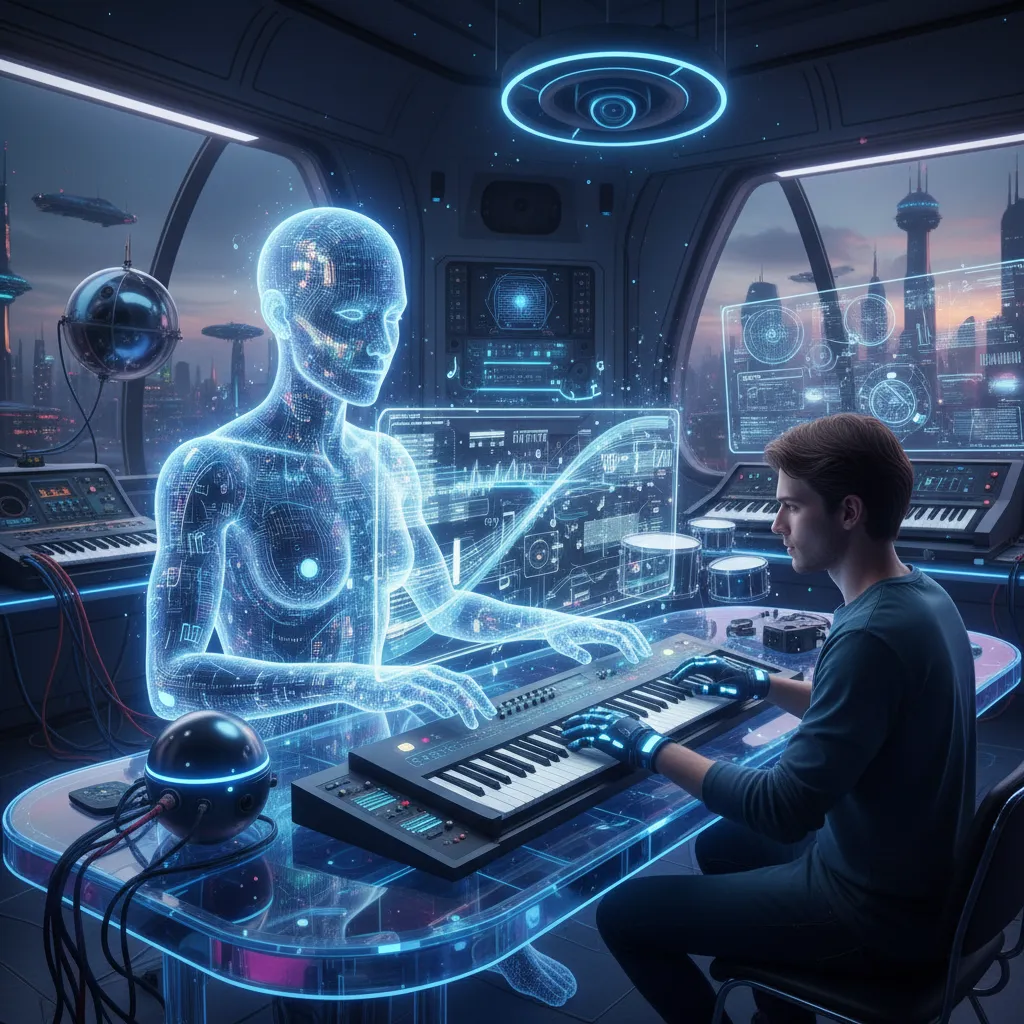 Human musician collaborating with AI in a futuristic studio
Augmenting Human Creativity
Imagine a composer struggling with writer’s block. An AI music composition software can act as a tireless brainstorming partner, generating endless melodic ideas, harmonic variations, or rhythmic patterns based on a few initial inputs. This allows the human artist to focus on curation, arrangement, and infusing the music with their unique emotional depth and artistic vision.
- Accelerated Ideation:
AI songwritingtools can quickly produce lyrical concepts or melodic hooks, giving artists a springboard for their creative process. - Genre Exploration: AI can help musicians explore genres they’re unfamiliar with, offering a blueprint for new sonic directions.
- Overcoming Technical Hurdles: For those with great musical ideas but limited instrumental proficiency, AI can bridge the gap, translating their concepts into fully realized compositions.
- Personalized Learning: AI can analyze a musician’s playing and offer tailored feedback, helping them improve technique and understanding of theory.
This synergy allows artists to push creative boundaries, experiment with new sounds, and increase their AI music workflow efficiency. It’s about combining the boundless generative capabilities of AI with the irreplaceable human touch of intuition, emotion, and storytelling.
AI’s Impact on the Music Industry and Beyond
The reverberations of Artificial intelligence music are being felt across the entire AI in music industry, from how music is made and distributed to how it’s consumed and valued. This profound AI music impact is reshaping business models, opening new revenue streams, and sparking critical discussions about the future.
Redefining Production and Distribution
Music production AI is streamlining workflows, making the process faster and more cost-effective. Independent artists and small studios can now access sophisticated tools previously reserved for major labels.
- Cost Efficiency: Automating certain aspects of
music composition AIand production reduces the need for extensive studio time or multiple session musicians. - Accessibility:
AI music appsandAI music platformsdemocratize music creation, allowing anyone with an idea to produce professional-sounding tracks, fueling an explosion of new content. - Hyper-Personalization: AI is driving
AI music trendstowards highly personalized music experiences. Imagine AI generating a unique soundtrack for your morning commute based on your mood, heart rate, and destination, or adaptive music for video games that responds dynamically to in-game action. - New Creative Roles: While some fear job displacement, AI is also creating new roles, such as “AI Music Prompt Engineers” or “AI Music Curators,” who guide AI systems to achieve specific artistic outcomes.
The Audience Experience
AI music trends are also influencing how audiences interact with music. From recommendation engines that suggest new artists based on listening habits to AI music new releases that are entirely AI-generated and garner millions of streams, the audience experience is becoming more diverse and tailored.
 Audience enjoying AI generated music in a vibrant concert setting
This expanded landscape means listeners have access to an ever-growing library of sounds, including niche genres and experimental compositions that might not have existed without Generative AI music. The very definition of what constitutes a “musical artist” is expanding, embracing human-AI collectives and fully AI-driven projects.
AI Music Innovation Driving New Frontiers
The spirit of AI music innovation is pushing boundaries in unexpected areas:
- Therapeutic Music: AI can create personalized therapeutic soundscapes to aid relaxation, sleep, or focus, adapting to an individual’s biometric data.
- Accessibility for Disabled Musicians: AI-powered interfaces can enable individuals with physical disabilities to compose and perform music using alternative input methods, unlocking creative potential.
- Archival and Restoration: AI is proving invaluable in restoring damaged historical recordings and analyzing vast musical archives to uncover patterns and influences.
[Related: Mastering Generative AI: Next-Gen Content Creation]
The Future of Music AI: Possibilities and Ponderings
The future of music AI is brimming with exciting possibilities, promising a landscape where AI music technology is seamlessly integrated into every facet of the creative process. AI music research continues to advance at a rapid pace, unlocking new levels of sophistication and creative potential.
Predictive Composition and Dynamic Soundscapes
Imagine an AI music composition software that can not only generate music but also predict audience reactions, tailoring compositions for maximum emotional impact. Future AI music platforms could offer dynamic soundscapes that evolve in real-time based on environmental factors, user input, or even collective mood data. This kind of automated music creation would transform everything from film scoring to interactive art installations.
The synergy between AI powered musical instruments and human performers will become even more profound. These instruments might anticipate a musician’s next move, offer harmonic counterpoints, or even learn and adapt to individual playing styles over time, becoming truly intelligent partners in improvisation.
The Role of AI in AI Music New Releases
We’re already seeing AI music new releases gaining traction, but this trend is expected to accelerate. Entire albums, EPs, and singles might be primarily, or even wholly, composed and produced by AI, with human artists taking on roles as curators, directors, or conceptualizers. This opens up discussions about authorship and the very definition of a “recording artist.”
 Digital waveform transforming into musical notation, showing AI music generation
AI music for content creators will become even more sophisticated, offering bespoke soundtracks for videos, podcasts, and digital experiences that perfectly match content, tone, and audience demographics. This will streamline the AI music workflow and elevate the production value for creators across all platforms.
[Related: Unleash Creativity: The Rise of AI Video Generation in Content Creation]
Ethical AI Music and the Copyright Conundrum
As Artificial intelligence music becomes more prevalent, critical ethical and legal questions arise. The most prominent among them is ethical AI music and copyright. Who owns the rights to music generated by AI? Is it the developer of the algorithm, the user who prompts it, or the AI itself? These questions are complex and require new legal frameworks.
Furthermore, concerns about originality and authenticity are valid. If AI can mimic any style, does it devalue human creativity? The consensus emerging is that AI should serve as a tool, a collaborator, rather than a replacement. The unique human experience, emotion, and cultural context remain irreplaceable aspects of compelling music. Ensuring transparency about AI’s role in music creation will be crucial to maintaining trust and valuing human artistic contribution.
Overcoming Challenges and Looking Ahead
While the AI symphony presents incredible opportunities, there are challenges to navigate:
- Data Bias: AI models are only as good as the data they’re trained on. Biased datasets can lead to AI generating uninspired or culturally insensitive music.
- Creative Control vs. Autonomy: Finding the right balance between giving AI creative freedom and retaining human control over the artistic output is key.
- Understanding Nuance: While
AI algorithms musiccan learn patterns, truly understanding human emotion and cultural nuance in music remains a complex hurdle. - Economic Impact: The potential for job displacement in certain areas of the
AI in music industryneeds to be addressed with policies that support reskilling and adaptation.
Despite these hurdles, the relentless pace of AI music innovation suggests a future where music composition AI is a standard tool in every creator’s arsenal. From fostering AI songwriting for indie artists to powering music production AI for Hollywood blockbusters, AI will continue to be a transformative force, pushing the boundaries of what we conceive as possible in the world of sound.
Conclusion
The “AI Symphony: Crafting Music with Artificial Intelligence” is no longer a distant chord but a powerful, evolving composition playing out in real-time. We’ve journeyed through the intricate mechanisms of AI music generation, explored the diverse AI music tools and AI music software that are democratizing creativity, and examined the profound AI music impact on artists, industries, and audiences alike. From generative AI music platforms aiding AI songwriting to sophisticated AI sound design solutions, the landscape of music creation is irrevocably transformed.
The future of music AI isn’t about human versus machine; it’s about a harmonious collaboration, where the boundless generative capabilities of AI algorithms music serve to amplify and inspire human artistic expression. As AI music trends continue to evolve, we will see even more seamless AI music workflow integrations and the emergence of truly intelligent AI powered musical instruments. While ethical AI music and copyright questions remain crucial considerations, the overall trajectory points towards an exciting era where AI creative tools music empower more individuals to craft their sonic stories. The AI symphony is just beginning, and its melody promises to be both innovative and inspiring.
[Related: Revolutionize Your Marketing with AI Automation]
FAQs
Q1. What is AI music generation?
AI music generation refers to the process where artificial intelligence algorithms create original musical compositions. These systems analyze vast amounts of existing music to learn patterns, structures, and styles, and then apply this knowledge to generate new melodies, harmonies, rhythms, and even full tracks, often based on user parameters like mood or genre.
Q2. How do AI music generators work?
AI music generators typically work by using machine learning models, such as neural networks (e.g., RNNs, LSTMs, or Transformers) or Generative Adversarial Networks (GANs). These models are trained on large datasets of music, allowing them to understand musical theory, structure, and emotional expression. Once trained, they can then generate new musical sequences, often responding to specific prompts or parameters provided by a human user, effectively becoming music composition AI.
Q3. Can AI replace human musicians and composers?
While Artificial intelligence music can create complex and compelling compositions, it is unlikely to fully replace human musicians and composers. AI excels at pattern recognition and generation, but the unique human elements of deep emotional expression, cultural context, personal storytelling, and intuitive improvisation remain the domain of human artists. Instead, AI is increasingly seen as a powerful AI creative tools music for collaboration, augmenting human creativity rather than replacing it.
Q4. What are some of the best AI music tools available today?
Some of the best AI music generators and AI music software include AIVA, known for film scores; Amper Music and Soundraw for AI music for content creators needing royalty-free tracks; Boomy for artists to generate and release their own AI songwriting creations; and Magenta Studio by Google for experimental AI music research and development.
Q5. Is AI-generated music copyrighted?
The copyright status of AI-generated music is a complex and evolving legal area. In many jurisdictions, copyright protection is generally granted to works created by human authors. If a human significantly influences the creative output of an AI music composition software by providing specific prompts, edits, and arrangements, they might retain copyright. However, for fully automated music creation with minimal human intervention, ownership can be ambiguous and is currently a major topic in ethical AI music discussions and legal debates.
Q6. How can content creators utilize AI music?
AI music for content creators offers significant advantages. They can use AI music apps and AI music platforms to quickly generate unique, royalty-free background music for podcasts, videos, and social media content, ensuring they avoid copyright issues and enhance their productions. This streamlines the AI music workflow, allowing creators to focus more on their primary content.
Q7. What are the current trends and future predictions for AI in music?
Current AI music trends include the rise of generative AI music for personalized soundscapes, more sophisticated AI songwriting tools, and increased AI music for artists in collaborative roles. The future of music AI is predicted to involve even more dynamic and adaptive music that responds to user emotions or environments, advanced AI powered musical instruments, and continued AI music innovation in AI sound design and audio production, pushing the boundaries of creativity and accessibility in the AI in music industry.