The AI Search Revolution: Is This the End for Google?

Introduction: The Tectonic Shift in Information Retrieval
For over two decades, Google has been synonymous with “search.” To find information, we didn’t search the internet; we “Googled it.” The traditional search engine model, built on indexing billions of web pages and returning a curated list of “10 blue links,” has been the unchallenged standard.
But the arrival of advanced Large Language Models (LLMs) has sparked a profound and potentially industry-ending challenge: the AI search engine revolution.
These next generation search engines, often called answer engines, don’t just point you to a page; they synthesize, summarize, and deliver AI-generated answers directly. This massive pivot—from link-based directory to intelligent conversational partner—is fundamentally altering user behavior.
The question is no longer if AI will change search, but how quickly it will dismantle the established hierarchy. Is this technological upheaval truly the end for Google, or can the tech giant adapt and absorb the threat?
In this comprehensive guide, we will explore the core concepts of generative AI search, compare the emerging challengers like Perplexity AI against Google’s new AI Overviews (GAO), detail how do AI search engines work, and analyze the dramatic implications for the future of search and SEO professionals alike.
The Paradigm Shift: AI Search vs. Traditional Search
To understand the revolution, we must first contrast the old way with the new.
The Traditional Search Model (Google Pre-2023)
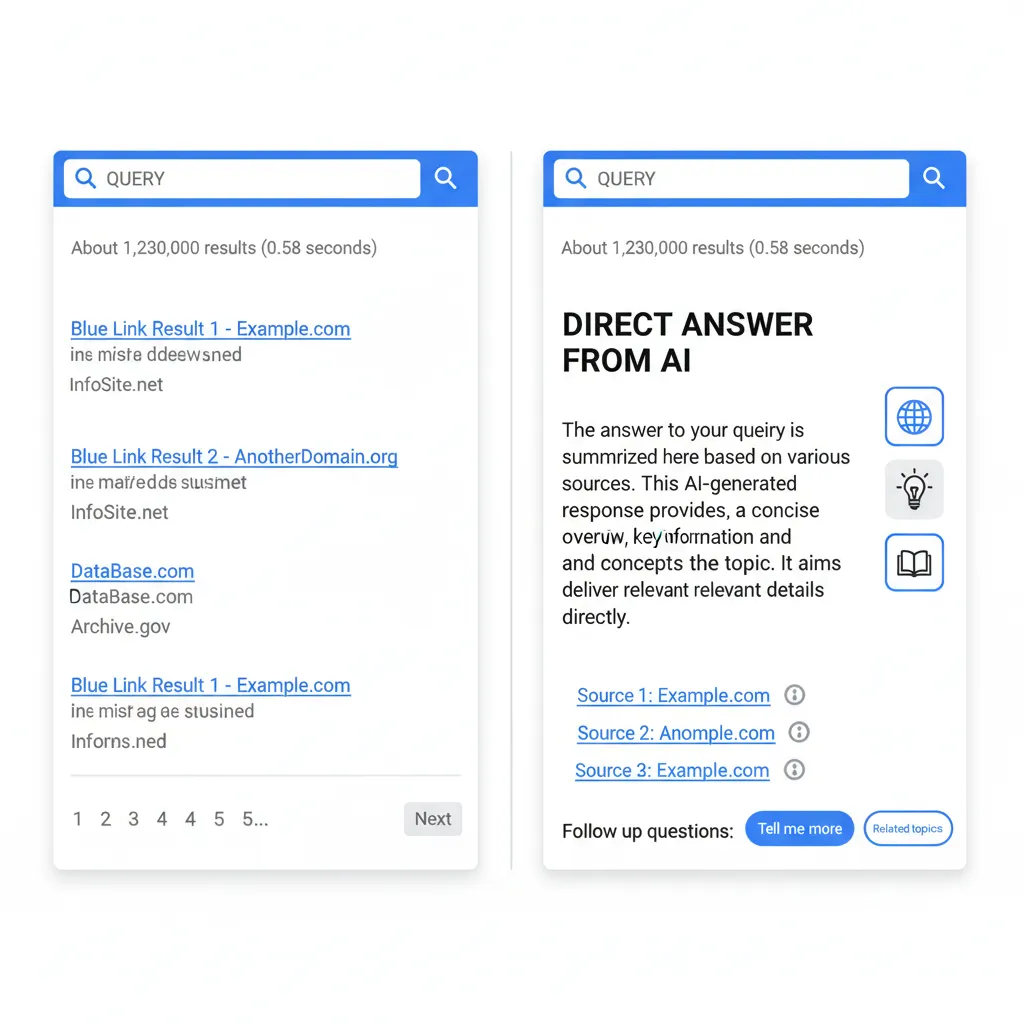
Traditional search relies on keyword matching. When you enter a query, the search engine indexes the web, matches your keywords to documents, and ranks those documents based on authority, relevance, and link structure.
The outcome: A Search Engine Results Page (SERP) designed to give you options (links) that you must then click, read, and synthesize yourself. The primary goal is information discovery, not information synthesis.
The Generative AI Search Model
The AI-powered search model shifts the goal to direct knowledge delivery. Instead of relying purely on a traditional index, these tools utilize powerful large language models in search to understand the meaning and intent behind your query (semantic search evolution).
When you ask an AI search engine, “What are the pros and cons of setting up a sustainable smart home?”, the engine:
- Accesses its real-time or near-real-time index (or API access to other search indexes).
- Retrieves relevant sources, not just links.
- Feeds those sources into an LLM.
- The LLM summarizes the findings into a coherent, cited, and conversational search response.
The outcome: A single, authoritative, and often cited summary that aims to answer your question entirely on the SERP, minimizing the need for clicks. These are true answer engines.
Visualizing the Difference
The user experience is vastly different, reflecting a change in what users expect from AI information retrieval.
/image-topic.webp
The Mechanics: How AI Search Engines Work
Understanding the inner workings reveals why AI search is more powerful for complex queries and AI for research. The process is not just about using a bigger language model; it’s about radically changing the retrieval architecture.
1. Retrieval-Augmented Generation (RAG)
This is the core innovation. Unlike early chatbots that relied only on their pre-trained knowledge base (which led to factual errors or “hallucinations”), modern generative AI search systems use RAG.
- Retrieval: The AI engine first uses sophisticated indexing and ranking algorithms (often proprietary) to find the most relevant, high-quality, and up-to-date web documents related to the user’s query.
- Augmentation: The selected text snippets are then passed to the LLM (like GPT-4, Gemini, or specialized open-source models) as context.
- Generation: The LLM uses this real-time, external context—the grounded facts—to formulate a precise, fluent, and highly accurate answer.
2. Deep Conversational Understanding
Traditional search treats each query as a separate event. Conversational search, however, maintains context across multiple turns. If you search for “best trail running shoes for beginners” and then follow up with “which one is waterproof,” the AI understands that “which one” refers to the shoes in the previous query. This natural language search capability makes the process feel more intuitive, like speaking to an expert.
3. Focus on Citation and Accuracy
One of the major weaknesses of standalone LLMs is their tendency to fabricate information. Leading AI search tools like Perplexity and Google’s own GAO place immense emphasis on verifiable sources. The ability to show cited sources in AI search is critical, as it allows users to verify the AI search accuracy and perform deeper reading if necessary. This commitment to grounding is what separates a reliable search engine from a creative chatbot.
[Related: AI ethics responsible development future]
The Contenders: AI vs. Google Search
While Google remains the dominant force, a fierce battle is underway, with specialized Google search alternative platforms carving out substantial market share among researchers and power users.
1. Perplexity AI: The Academic Answer Engine
Perplexity AI is widely considered the quintessential AI search engine challenger. Its mission is to deliver comprehensive, cited answers. It’s particularly strong for complex, nuanced, or technical queries, making it a favorite for AI for research.
- Key Feature: Its “Citations First” approach, which prominently links to all source material immediately following the generated summary.
- Strength: Excellent for breaking down complex topics and comparative analysis.
2. Microsoft Copilot (Bing Search)
Microsoft leveraged its partnership with OpenAI to integrate advanced generative capabilities into Bing, rebranding its search assistant as Microsoft Copilot search. Copilot often provides a more creative, multi-modal response, including image generation and complex problem-solving alongside search results.
- Key Feature: Seamless integration with the Edge browser and Windows ecosystem.
- Strength: Powerful access to GPT-4, offering both factual summaries and creative output.
3. You.com and Others
Platforms like You.com search focus on privacy and user control, allowing users to customize their sources and prioritize results from specific websites or platforms.
The short-lived, privacy-focused Neeva AI search (acquired by Snowflake) highlighted the demand for an ad-free, secure search experience, proving that privacy in AI search is a significant selling point, even if the business model is challenging.
/image-topic.webp
Google’s Counter-Punch: Integrating AI Overviews
The competitive landscape quickly forced Google to react. Google Search Generative Experience (SGE), now officially known as Google AI Overviews (GAO), is its primary weapon against the rising popularity of AI search engine comparison leaders.
GAOs are generative summaries that appear prominently at the top of the standard Google SERP, integrating AI-generated information directly into the traditional link structure.
The Strategy: Defending the Dominance
Google’s strategy is two-fold:
- Retention: By providing satisfactory answers instantly, they aim to prevent users from migrating to pure answer engines like Perplexity.
- Monetization: Unlike pure answer engines, Google must balance user satisfaction with advertiser revenue. GAOs typically appear above paid ads and organic links, but the fundamental structure remains oriented toward generating clicks and displaying advertisements (a critical factor for AdSense compliance).
The Challenge: Accuracy and Hallucination
Google faced significant public scrutiny when its early AI Overviews generated high-profile, erroneous, and even dangerous answers—a phenomenon often termed “hallucination.” While Google has quickly refined its models and safety guardrails, these incidents highlight the immense technical difficulty of scaling accurate, real-time RAG across billions of queries every day.
The performance of GAOs directly impacts the question: will AI replace search engines? If Google’s implementation is fast, reliable, and trustworthy, it may simply absorb the innovation, retaining its market position.
[Related: The AI revolution in healthcare transforming patient care medical innovation]
The Core Advantages and Disadvantages of AI Search
The shift to generative search is not universally beneficial. It introduces new challenges alongside its powerful capabilities.
Benefits of AI Search
| Benefit | Description | Use Case Example |
|---|---|---|
| Synthesis & Efficiency | Delivers compiled, summarized answers, saving the user the time of synthesizing data from multiple sources. | Asking for a complex comparison between three different historical events. |
| Conversational Search | Allows for natural language queries and follow-up questions, creating a smooth, iterative research path. | ”What’s the best type of insulation for a garage?” followed by “And how much does it cost in my region?” |
| Better for Research | Excels at complex, non-commercial, or deeply technical queries where simple keywords fail. | AI for research on niche scientific papers or legislative history. |
| Semantic Understanding | Understands the user’s intent rather than just matching words, leading to more relevant results. | Searching “I feel dizzy after standing up quickly” instead of “Orthostatic hypotension symptoms.” |
Drawbacks and Hurdles
| Drawback | Description | Key Risk |
|---|---|---|
| Accuracy & Hallucination | LLMs can confidently generate false or misleading information if the underlying source data is poor or context is misinterpreted. | Generating incorrect medical or financial advice. |
| Source Dependence | The quality of the output is entirely dependent on the quality and objectivity of the sources retrieved. | Bias perpetuated if the training data or retrieval algorithm is skewed. |
| Latency and Cost | Generating a comprehensive answer is computationally more expensive and time-consuming than fetching a link list. | Slower response times, higher operational costs for the provider. |
| Ecosystem Impact | By reducing clicks to source websites, the model threatens the ad revenue and business models of content creators globally. | The future of SEO with AI is uncertain for traffic-dependent publishers. |
/image-topic.webp

Deep Dive: Beyond the Answer—Accuracy, Citation, and Privacy
As consumers grow accustomed to AI-generated answers, trust becomes the most valuable currency. The true differentiator between the best AI search engine 2024 and a mediocre one lies in its handling of data verification and user privacy.
The Standard of Cited Sources in AI Search
Reliable AI search engines are not just generating text; they are generating annotated bibliographies. When an AI search tool provides cited sources in AI search, it builds trust. It shifts the burden of proof from the user (who would have to click around to verify) back to the engine.
This is a critical mechanism for maintaining AI search accuracy. If the user can easily see that the answer is derived from The Wall Street Journal, Wikipedia, and a recent academic study, the answer holds far more weight than an unsourced paragraph.
Privacy in AI Search
The early entry of Neeva AI search (before its acquisition) highlighted the strong user desire for search tools that do not track, profile, or monetize personal data through advertising.
While Google’s model is intrinsically linked to targeted advertising, newer entrants often promote a subscription model or prioritize minimal data retention. Users must weigh the convenience of a free, ad-supported AI search (like Google or Copilot) against the enhanced privacy in AI search offered by paid or specialized alternatives. This choice represents a crucial fork in the road for the future of search.
[Related: Sustainable tech innovations greener gadgets eco-smart living]
The Future of SEO: Optimizing for the Answer Box
The AI revolution isn’t just a threat to Google’s business model; it’s an existential crisis for traditional SEO. When the user gets their answer directly from the AI, the goal of getting the #1 organic link changes completely.
The future of SEO with AI will center on optimizing content not for clicks, but for trust and citation.
1. Optimize for the AI’s Context Window
The AI Overviews and summaries are hungry for clear, structured, and factual data. To be cited by an answer engine, content must:
- Be Authoritative: Demonstrate deep expertise and original research (E-E-A-T).
- Be Structured: Utilize clear H2/H3 headings, tables, bullet points, and definitions that the LLM can easily ingest and synthesize.
- Answer the Question Directly: Provide a clear, concise, snippet-optimized answer early in the content, often in a “What Is” box or a summary paragraph.
- Be Credible: Back up claims with verifiable external links and primary research.
2. The Rise of Semantic Authority
Semantic search evolution means SEO professionals can no longer rely solely on exact keyword density. Content must demonstrate comprehensive coverage of a topic, linking all related entities and concepts naturally. If you write about “energy-efficient smart homes,” the AI expects related entities like “HVAC optimization,” “smart thermostats,” and “IoT protocols” to be covered contextually.
3. Clicks Shift to Research and Verification
While the overall number of informational clicks may drop, the clicks that do happen will be of higher quality. Users will click through from a citation link to verify the AI’s summary, access graphs and data, or purchase a product. The focus shifts from generating traffic quantity to generating conversion-ready traffic quality.
[Related: energy-efficient-smart-homes-guide]
Will AI Replace Search Engines? A Nuanced Perspective
The initial question remains: Is this the end for Google? The consensus among industry experts is that the answer is a qualified “No,” but the search experience as we know it is certainly over.
The Argument Against Replacement
- Infrastructure and Scale: Google controls the massive infrastructure necessary to index the web at scale, in real-time. Replicating this, even with powerful LLMs, is a multi-trillion dollar undertaking.
- Commercial Intent: Google dominates commercial and navigational queries. When people want to buy something or navigate to a specific website, they still rely on the traditional link model, which remains Google’s bread and butter.
- Adaptation: Google is rapidly integrating AI. Google AI Overviews prove that the company understands it must evolve. The AI vs Google search battle is really Google integrating AI into its existing, dominant shell.
The Argument for Transformation
While Google may not disappear, its monopoly on information delivery is shattered.
- Specialization: Niche AI search tools will continue to thrive where they outperform Google—e.g., Perplexity for deep academic research, specialized legal AI search for case law, or You.com search for code snippets.
- User Expectation: Users are becoming conditioned to expect synthesized answers. The standard “10 blue links” SERP will feel increasingly archaic and inefficient, forcing all major players to adopt the generative model.
The future is likely a blended landscape: a world where AI and traditional methods coexist, but where the AI-generated answer becomes the primary interface for information, driven by highly capable large language models in search.
/image-topic.webp

Conclusion: Adapting to the Conversational Web
The AI search revolution is the most significant change to the internet since the invention of the search engine itself. It marks a transition from information finding to knowledge synthesizing.
The conversational search paradigm, powered by generative AI search, delivers unparalleled efficiency, especially for complex queries. While Google is fighting hard to integrate its Google AI Overviews, specialized, nimble challengers like Perplexity AI continue to set the bar for AI search accuracy and source citation.
For users, this means a more intelligent, efficient, and direct way to interact with the vastness of the internet. For content creators and SEO professionals, it demands a renewed focus on authority, structure, and providing truly valuable, citable answers that the AI search engine can trust.
The future of search is here, and while Google may not be dead, the era of unquestioned, link-driven dominance is certainly over. The game has changed from providing links to providing authoritative knowledge.
FAQs: Understanding the AI Search Ecosystem
Q1. What is a generative AI search engine?
A generative AI search engine is an AI search engine that uses Large Language Models (LLMs) to analyze multiple web sources and synthesize a direct, comprehensive answer for the user, rather than just listing links. These are often called answer engines because they aim to solve the user’s query instantly.
Q2. How is Perplexity AI different from Google Search?
Perplexity AI focuses almost entirely on providing a synthesized, highly accurate answer supported by explicit cited sources in AI search. Traditional Google Search (pre-AI Overviews) primarily lists ranked links. While Google is integrating Google AI Overviews, Perplexity’s model is built from the ground up to be a true conversational search experience, favoring synthesis over listing.
Q3. Will AI search engines like Perplexity replace Google completely?
It is highly unlikely that will AI replace search engines completely. Google dominates commercial search, mobile use, and navigational queries. However, AI search engines will replace Google for a growing number of complex, research-heavy, and informational queries. The future is likely a blended environment where both models exist, with AI driving the transformation of Google itself.
Q4. What is the biggest concern regarding AI search accuracy?
The biggest concern is hallucination. Because large language models in search are trained to be fluent and coherent, they can sometimes generate factually incorrect information with high confidence if the underlying data is flawed or misinterpreted. This is why verifiable cited sources in AI search are crucial for maintaining user trust and AI search accuracy.
Q5. What does the future of SEO look like with AI search?
The future of SEO with AI shifts focus from optimizing for clicks (traffic volume) to optimizing for citation (trust and authority). Content creators must structure their content to be easily digestible by LLMs, demonstrating E-E-A-T and providing clear, factual AI-generated answers that the AI will use in its synthesis, making content optimization about being the source, not just the link.
Q6. Is Microsoft Copilot search the same as Bing?
Microsoft Copilot search is an enhanced layer built upon the Bing search engine. It utilizes advanced LLMs (often OpenAI’s GPT models) to provide generative AI search capabilities, allowing users to ask complex questions, summarize web pages, and even generate images, all integrated into the standard Bing results page.
Q7. What are the benefits of AI for research specifically?
The benefits of AI search for research include accelerated AI information retrieval, the ability to quickly synthesize data from dozens of complex sources, and the capacity for conversational search that allows researchers to refine complex queries iteratively. This dramatically reduces the time spent compiling and summarizing findings.