Spatial Computing’s Next Leap: Redefining How We Interact with Digital Worlds

Introduction
Take a moment to look around you. Chances are, you’re reading this on a flat, glowing rectangle. Your phone, your laptop, your television—our entire digital lives are mediated through these portals. For decades, this has been the undisputed paradigm of human-computer interaction. But what if it wasn’t? What if, instead of peering into a screen, your digital world seamlessly merged with your physical one?
This is the promise of spatial computing, a transformative technological leap that’s set to fundamentally redefine our relationship with data, the internet, and reality itself. It’s a future that moves us beyond screens technology and into a world where information is not confined to a device but is woven into the fabric of our environment.
This article is your guide to this next great frontier. We’ll dive deep into spatial computing explained in simple terms, explore the new “language” of interaction—from gestures to thoughts—and uncover the real-world applications already taking shape. Prepare to understand the future of human-computer interaction and discover the profound spatial computing impact on daily life that awaits us all.
What is Spatial Computing? Moving Beyond the Flat Screen
At its core, spatial computing is the concept of giving machines a human-level understanding of three-dimensional space. It allows technology to recognize objects, understand environments, and permit users to interact with digital content as if it were physically present in the room.
Think of it this way: your smartphone knows its own location via GPS, but it has no real awareness of the room you’re in. A spatial computing device, however, maps the room—it understands where the walls, furniture, and other objects are. This environmental awareness is the key that unlocks the ability to place a real world digital overlay onto our vision, creating persistent, interactive digital objects that feel like they truly belong.
A Universe Beyond Pixels
The magic of spatial computing lies in its ability to digitize reality and blend it with virtual information. This process, often powered by a suite of sensors, cameras, and sophisticated algorithms, allows devices to:
- Localize: Understand their own position within a space.
- Map: Build a 3D model of the surrounding environment.
- Recognize: Identify objects, surfaces, and even people within that environment.
Once this digital twin of the real world is created, the possibilities for digital world interaction become limitless. A recipe’s instructions can float next to your mixing bowl, a virtual television can be anchored to your living room wall, and a 3D model of a human heart can be examined from all angles on a real classroom desk.
The Core Pillars: AR, VR, and MR Explained
You’ve likely heard the terms Augmented Reality (AR), Virtual Reality (VR), and Mixed Reality (MR). These are not interchangeable with spatial computing, but rather they are key technologies that fall under its wide umbrella.
- Virtual Reality (VR): This technology completely immerses you in a fully digital environment, blocking out the physical world. Think of VR headsets like the Meta Quest 3, used primarily for gaming and simulations. These represent significant virtual reality advancements, but they are just one piece of the puzzle.
- Augmented Reality (AR): AR overlays digital information onto the real world, typically viewed through a device like a smartphone (think Pokémon GO) or smart glasses. It enhances your current reality but doesn’t allow for deep, meaningful interaction between the digital and physical objects.
- Mixed Reality (MR): This is where things get truly interesting. MR is a more advanced form of AR where digital objects are not just overlaid but are integrated into the real world. They can be occluded by real objects (disappear behind a real-life chair) and you can interact with them using your hands. This is a cornerstone of the ar vr future.
Spatial computing is the overarching concept that encompasses all these realities. It’s the underlying system—the “operating system” for reality—that makes these immersive experiences possible and coherent.
The New Language of Interaction: How We’ll Command Digital Worlds
The departure from screens demands entirely new ways to interact with tech. The mouse, keyboard, and touchscreen are artifacts of a 2D digital world. In a 3D spatial environment, we need more intuitive, human-centric methods of control. These are the natural user interfaces that will define the next generation of computing.
Gesture Control: Conducting Reality with Your Hands
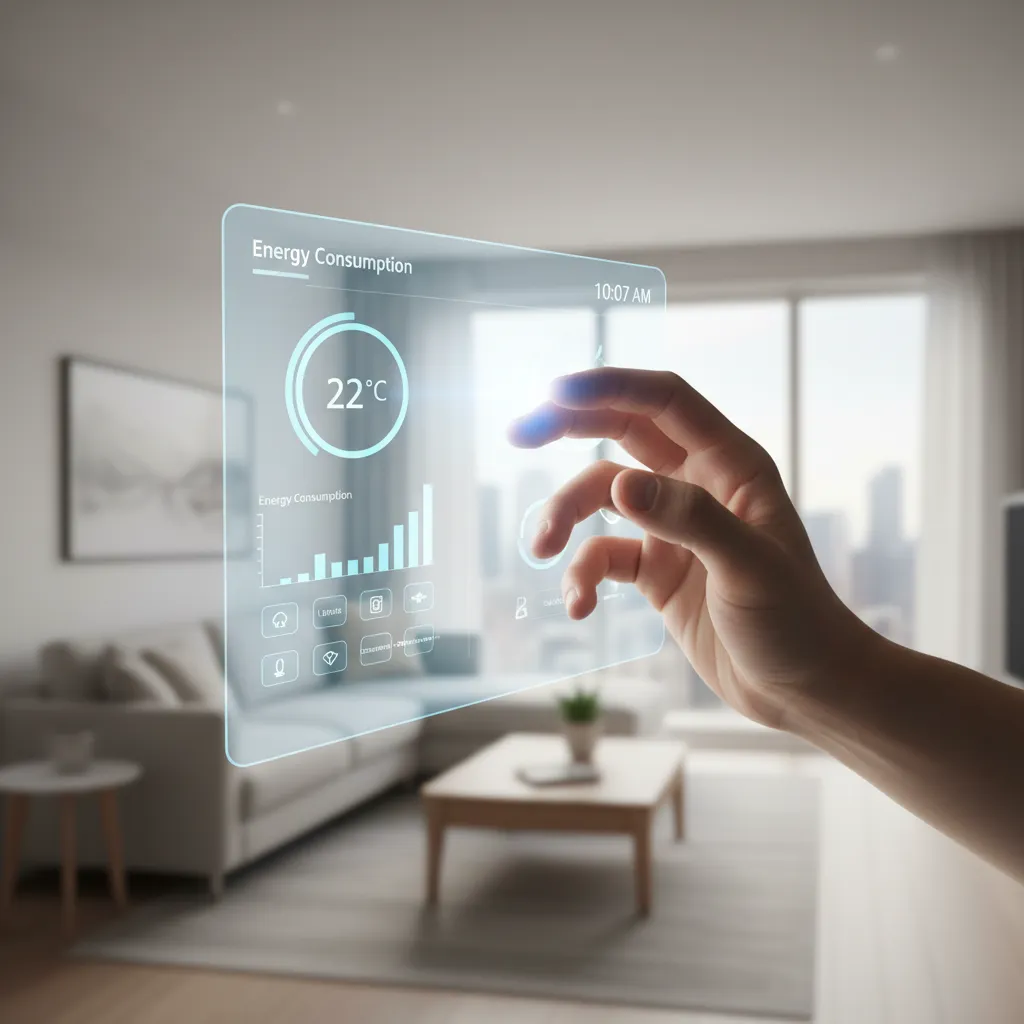
One of the most profound shifts is the rise of gesture control technology. Using advanced hand-tracking cameras and computer vision spatial computing, devices can interpret the subtle movements of your fingers and hands as commands. A pinch can select, a pull can move, and a wave can dismiss. This is interaction that feels less like operating a machine and more like magic.
This technology is already moving beyond simple commands. Imagine a mechanical engineer manipulating a complex 3D CAD model of an engine by simply reaching out and “grabbing” its components, or an architect resizing a building model on a boardroom table with a simple hand gesture.
Voice User Interfaces (VUIs): Speaking Intent into Existence
Voice commands are already part of our lives through smart speakers and digital assistants. However, voice user interfaces spatial computing takes this to a new level by adding context.
Instead of just saying “Play music,” you could look at a specific speaker in your home and say, “Play my morning playlist here.” Or, while looking at a blank wall, you could command, “Put a 65-inch TV here and show me the latest sci-fi movies.” The system understands “here” because it knows what you’re looking at, blending voice with gaze to create powerful, context-aware commands. This is a critical aspect of context aware computing.
Haptic Feedback: Feeling the Digital World
For digital objects to feel truly real, we need to be able to feel them. This is where haptic feedback spatial computing comes in. Advanced haptics, delivered through gloves, bodysuits, or even ultrasonic waves projected in mid-air, can simulate the sensation of touch.
Imagine feeling the subtle click of a virtual button, the texture of a digital fabric, or the resistance of a virtual clay model as you sculpt it. This sensory feedback closes the loop, making mixed reality interaction far more immersive and believable. It’s one of the most exciting immersive computing trends.
Eye Tracking and Gaze: The Intent Engine
Where you look is a powerful indicator of your intent. Modern spatial devices use inward-facing cameras to track your eye movements with incredible precision. This allows for foveated rendering, a technique where the device renders only what you’re directly looking at in high resolution, saving immense processing power.
But more importantly, it becomes an input method. Gaze can be used to highlight options, with a simple finger tap to select. It’s a fast, low-effort way to navigate spatial interfaces, making interaction feel almost telepathic.
Real-World Applications: Where Spatial Computing is Already Making an Impact
This isn’t just science fiction. Spatial computing innovation is already creating tangible value across numerous industries. Here are some of the key spatial computing applications changing the game today.
The Future of Work and Collaboration
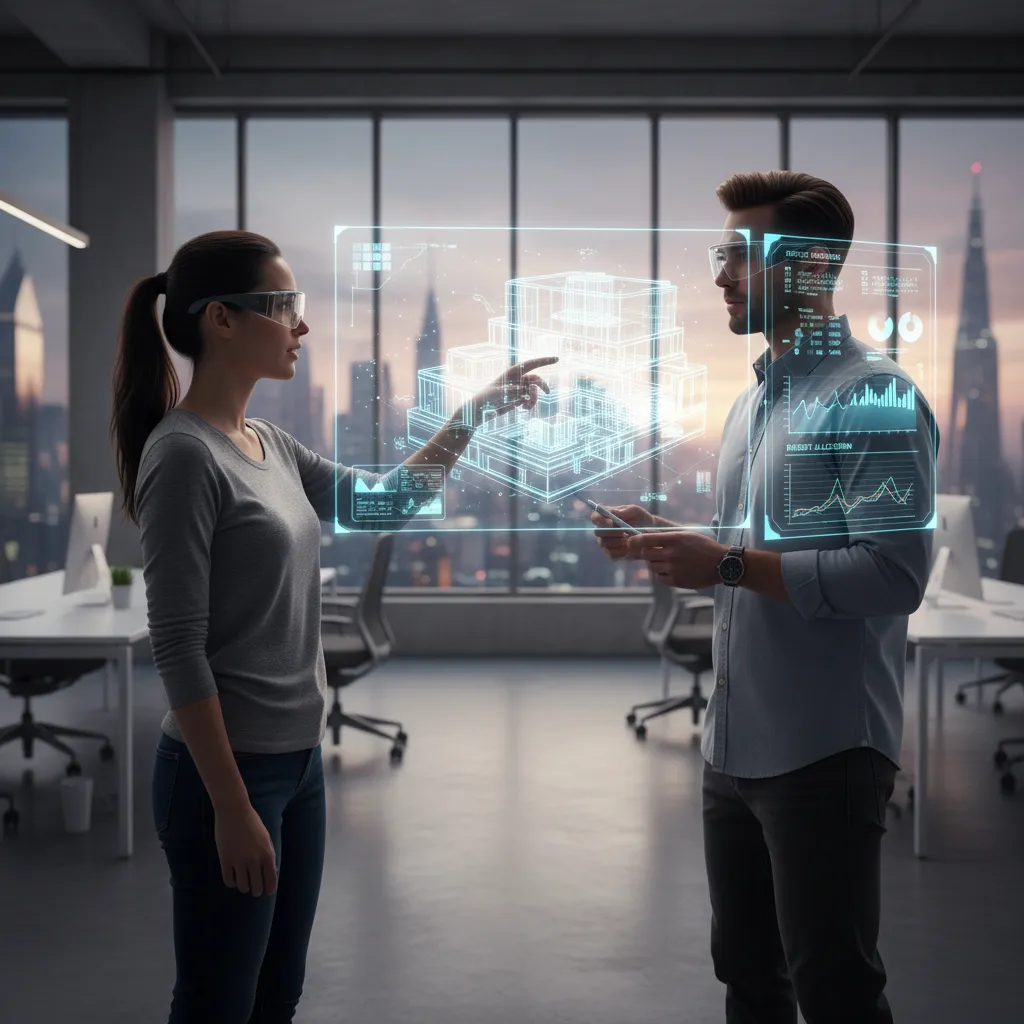
The sterile grid of faces on a video call pales in comparison to true spatial collaboration. Teams can now meet in virtual rooms, interacting with persistent whiteboards, 3D data visualizations, and product prototypes. An automotive design team in Germany can work on a virtual clay model of a new car with their engineering counterparts in Japan in real-time, with every participant seeing the same object from their own perspective. This is a game-changer for remote and hybrid work. Related: AI Tools Revolutionizing Everyday Productivity
Revolutionizing Healthcare and Education
The spatial computing benefits in training and education are immense. Medical students can perform complex surgeries on hyper-realistic digital cadavers, allowing them to practice and make mistakes without real-world consequences. History students can take a virtual field trip to ancient Rome, walking through the Colosseum as it stood in its prime. This creates augmented reality experiences that are far more engaging and memorable than any textbook. Related: AI in Healthcare: Revolutionizing Patient Care & Medical Innovation
Transforming Retail and E-commerce
Have you ever bought a sofa online only to find it doesn’t fit your space? Spatial computing solves this. Using an AR app, you can place a true-to-scale virtual model of that sofa right in your living room, walk around it, and see how it looks from every angle. Similarly, “try before you buy” is taking on a new meaning with virtual try-ons for clothing, glasses, and makeup.
Navigation and Urban Exploration
Imagine walking through an unfamiliar city with arrows projected directly onto the pavement in front of you, guiding you to your destination. Points of interest, historical facts, and restaurant reviews could appear as interactive overlays on the buildings you’re looking at. This form of augmented city navigation makes exploring new places more intuitive and enriching. Related: AI in Cars: The Co-Pilot Revolutionizing Your Drive

The Tech Powering the Leap: Under the Hood of Spatial Computing
This futuristic vision is made possible by a convergence of several powerful technologies, all advancing at an exponential rate.
- Advanced Sensors and Computer Vision: The “eyes” of spatial computing are a sophisticated array of cameras, LiDAR (Light Detection and Ranging) scanners, and depth sensors. These components work together to perform SLAM (Simultaneous Localization and Mapping), the process of building a 3D map of an environment while simultaneously tracking the device’s position within it.
- AI and Machine Learning: The “brains” of the operation are AI and ML algorithms. Machine learning spatial interaction models are what interpret the torrent of data from sensors to understand hand gestures, recognize objects, and process voice commands. This is what makes the interaction feel natural and intuitive. Related: Apple Intelligence in iOS 18: All-New AI Features Revealed
- Next-Generation Devices: The hardware is rapidly evolving. We’ve moved from bulky, tethered headsets to sleek, standalone devices like the Apple Vision Pro and Meta Quest 3. The long-term vision is for spatial computing devices to shrink down into a pair of ordinary-looking eyeglasses or even smart contact lenses, making the ubiquitous computing future a reality. Related: The Rise of Smart Rings: Your Next Wearable Tech Obsession
Navigating the Hurdles: Challenges on the Path to a Spatial Future
While the future is bright, there are significant challenges in spatial computing that must be addressed before mass adoption becomes a reality.
- Technical Barriers: The amount of processing power required to constantly map the world and render high-fidelity graphics is immense. This creates challenges for battery life and heat dissipation, especially in smaller form factors.
- The Human Element: Social acceptance is a major hurdle. Will people be comfortable wearing headsets in public? Furthermore, creating truly intuitive and non-fatiguing human centric spatial computing interfaces is a complex design challenge that is still in its infancy.
- Privacy and Security: This is perhaps the most critical challenge. A device that is constantly scanning your environment with cameras and microphones raises profound privacy questions. Securing this vast amount of personal and environmental data from bad actors is paramount for building trust.
- Content and Killer Apps: Technology is only as good as what you can do with it. Building a robust ecosystem of applications and experiences that are uniquely suited for spatial computing—and not just 2D apps floating in space—is essential for driving adoption.
The Horizon: What’s Next for Human-Computer Interaction?
Looking even further ahead, the evolution of spatial computing points toward some truly mind-bending future tech interfaces.
Interacting with the Metaverse: A More Embodied Internet
Spatial computing provides the foundational technology for the metaverse. It is the bridge that will allow us to move from a 2D internet we browse to a 3D internet we inhabit. Instead of logging into a website, you might walk into a virtual storefront. Instead of a video call, you might sit down with a photorealistic avatar of a friend in a virtual café. This is the ultimate goal of interacting with metaverse platforms.
Brain-Computer Interfaces (BCIs): The Ultimate Frontier?
The most futuristic leap in interaction may come from Brain-Computer Interfaces (BCIs). This technology aims to create a direct communication pathway between the human brain and a digital device, allowing for control through thought alone. While still highly experimental, the potential is staggering. Imagine thinking of a design and having it appear as a 3D model before you, or navigating a complex menu system with the speed of thought. This is the ultimate “natural user interface.” Related: Neurotech Revolution: Unlocking the Future of Brain-Computer Interfaces

Conclusion
We are standing at the dawn of a new computing era. The transition from the command line to the graphical user interface was a monumental shift that made computing accessible to everyone. The move from the desktop to the mobile phone put a supercomputer in every pocket.
The leap to spatial computing promises to be even more profound. It’s not just a new device or a better screen; it’s a fundamental change in our reality, dissolving the boundaries between the physical and digital. It represents the pinnacle of next generation computing, weaving technology so deeply into our world that it eventually disappears, becoming as natural and invisible as the air we breathe.
The journey will have its challenges, but the destination is a world where technology augments our abilities, connects us in deeper ways, and unlocks creativity we’ve only dreamed of. The next digital revolution won’t be in your pocket; it will be all around you. Are you ready to step into it?
FAQs
Q1. What is spatial computing in simple terms?
In simple terms, spatial computing is the act of using technology to seamlessly blend the digital and physical worlds. It allows computers to understand and interact with our 3D environment, letting us place and manipulate digital objects as if they were real things in the room with us.
Q2. Is spatial computing the same as the metaverse?
They are related but not the same. Spatial computing is the foundational technology—the hardware, software, and interaction models (like gesture and voice control)—that makes immersive 3D experiences possible. The metaverse is one of the major potential applications of spatial computing: a collective, persistent virtual shared space.
Q3. What are the main challenges facing spatial computing?
The main challenges include significant technical hurdles (battery life, processing power, device size), the need for broad social acceptance, major privacy and data security concerns, and the development of a compelling ecosystem of “killer apps” that can only be experienced through spatial computing.
Q4. What are some real-world examples of spatial computing devices?
Leading examples of spatial computing devices include the Apple Vision Pro, which excels at mixed reality and blending digital content with the real world; the Meta Quest 3, which is a popular headset for virtual reality gaming and social experiences; and Microsoft’s HoloLens 2, which is heavily used in enterprise and industrial settings for training and remote assistance.
Q5. How will spatial computing change our daily lives?
Spatial computing will change our daily lives by transforming how we work, learn, shop, and connect. It will enable more immersive remote collaboration, hands-on educational experiences, virtual “try-before-you-buy” shopping, and more intuitive ways to navigate the world. Ultimately, it aims to make our interaction with technology more natural and less dependent on physical screens.
Q6. What is the difference between AR, VR, and spatial computing?
VR (Virtual Reality) completely replaces your world with a digital one. AR (Augmented Reality) overlays digital information on top of your real world. Spatial computing is the broader technological field that encompasses AR, VR, and Mixed Reality (MR), providing the underlying ability for devices to understand and map 3D space to make all these experiences possible.
Q7. Who is leading the innovation in spatial computing?
Major tech giants like Apple (with Vision Pro), Meta (with Quest and Reality Labs), Microsoft (with HoloLens and Mesh), and Google are all investing heavily and leading innovation. Additionally, companies like NVIDIA are creating the powerful chips that power these devices, while software companies like Unity and Epic Games are building the development engines for creating spatial content.