Revolutionize Your Marketing: The Power of AI Automation

Introduction
In the rapidly evolving landscape of digital commerce, marketers are constantly seeking an edge—a way to cut through the noise, connect authentically with audiences, and drive measurable results. Enter AI marketing and marketing automation AI, a dynamic duo that is fundamentally reshaping how businesses approach customer engagement, campaign management, and strategic decision-making. No longer a futuristic concept, AI automation is a tangible, powerful force that promises to revolutionize your marketing efforts, making them more efficient, more personalized, and infinitely more effective.
This comprehensive guide will delve deep into the transformative potential of AI in digital marketing. We’ll explore what AI marketing truly means, unpack the myriad AI marketing benefits, and shine a light on the specific AI tools for marketing that are empowering businesses of all sizes. From crafting hyper-personalized experiences to optimizing every facet of your strategy with data-driven insights, prepare to discover how AI driven marketing strategies can not only streamline your operations but also unlock unprecedented growth. Whether you’re a seasoned marketing professional or a small business owner looking for a competitive advantage, understanding the power of AI automation is no longer optional—it’s essential for navigating the future of marketing.
The Evolution of Marketing: From Manual to AI-Driven
For decades, marketing was largely a manual, often intuitive, endeavor. Marketers relied on demographic data, focus groups, and creative intuition to craft campaigns. While effective to a degree, this approach was often characterized by broad strokes, limited personalization, and a heavy reliance on post-campaign analysis to understand what worked (or didn’t). The digital age brought new channels and more data, but the sheer volume quickly became overwhelming. This is where marketing automation platforms first stepped in, streamlining repetitive tasks like email scheduling and lead nurturing.
However, even traditional automation had its limits. It lacked the intelligence to adapt in real-time, predict future behavior, or truly understand the nuances of individual customer journeys. The missing piece was intelligence—the ability to learn, reason, and act with a level of sophistication previously reserved for human experts. This brings us to the present era, where machine learning marketing and sophisticated algorithms are transforming automation into intelligent automation.
What is AI Marketing?
At its core, AI marketing refers to the application of artificial intelligence technologies to analyze vast datasets, predict customer behavior, automate repetitive tasks, and personalize marketing efforts at scale. It’s about leveraging algorithms and computational power to perform tasks that traditionally required human intelligence, but with far greater speed, accuracy, and efficiency.
Think of it as having a super-intelligent assistant that can process more customer data in a second than a human team could in a year. This assistant can identify patterns, forecast trends, and even generate content, all while learning and improving over time. It’s not just about automating what you already do; it’s about doing things that were previously impossible, creating truly AI powered marketing campaigns that resonate deeply with individual consumers.
Why AI Automation is a Game-Changer for Marketers
The integration of AI into marketing isn’t just an upgrade; it’s a paradigm shift. It offers profound advantages that traditional marketing methods simply cannot match, creating a more responsive, efficient, and impactful marketing ecosystem.
Enhanced Personalization and Customer Experience
One of the most significant AI marketing benefits is its unparalleled ability to deliver personalized marketing AI experiences. In an age where consumers expect brands to understand their individual needs and preferences, generic messaging falls flat. AI analyzes customer data—browsing history, purchase patterns, interactions, demographics—to create highly specific customer segments and even individual profiles. This allows for:
- Tailored Content Recommendations: AI can suggest products, services, or content that is most relevant to each user, mimicking the experience of a personal shopper or curator.
- Dynamic Website Experiences: Websites can adapt in real-time, displaying different offers, layouts, or calls to action based on an individual’s behavior and predicted interests.
- Hyper-Segmented Campaigns: Instead of sending one email to a million people, AI enables marketers to send a million personalized emails to a million individuals, each crafted to their unique journey.
This level of personalization fosters stronger customer relationships, increases engagement, and ultimately drives higher conversion rates.
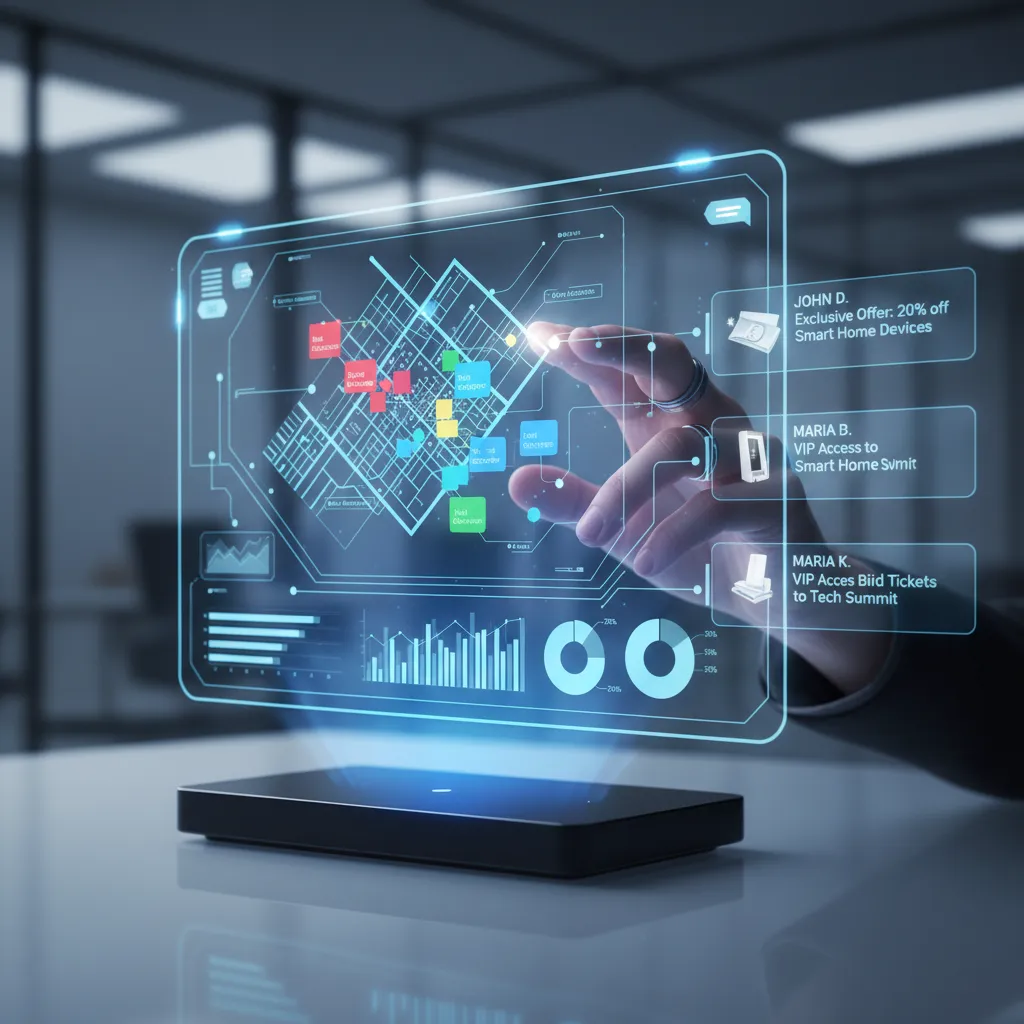 AI-powered holographic interface showing customer segmentation and personalized marketing
Unprecedented Efficiency and Scalability
Repetitive, time-consuming tasks often bog down marketing teams. AI excels at these, freeing up human marketers to focus on strategy, creativity, and complex problem-solving. Consider the time saved through:
- Automated Data Analysis: AI can process and interpret vast amounts of marketing analytics AI data in moments, identifying trends and insights that would take human analysts weeks to uncover.
- Campaign Optimization: AI can continuously monitor campaign performance, making real-time adjustments to bids, targeting, and creative elements to maximize ROI.
- Content Generation Assistance: While not replacing human creativity entirely, content creation AI marketing tools can generate drafts, headlines, and social media copy, significantly accelerating the content pipeline. [Related: Mastering Generative AI: Next-Gen Content Creation]
This efficiency not only saves money but also allows marketing efforts to scale rapidly without a proportional increase in human resources.
Data-Driven Decision Making and Predictive Insights
The “gut feeling” approach to marketing is becoming obsolete. Data driven marketing AI provides the foundation for every decision. AI can:
- Predict Future Trends: By analyzing historical data and external factors, predictive analytics marketing can forecast market shifts, consumer demand, and campaign performance with remarkable accuracy, allowing businesses to proactive ly adjust their strategies.
- Identify High-Value Customers: AI can pinpoint customers most likely to convert, churn, or make repeat purchases, enabling targeted retention and acquisition efforts.
- Optimize Ad Spend: Programmatic advertising AI automatically buys ad space and targets audiences in real-time, ensuring that ad dollars are spent on the most impactful placements for the right audience.
With AI, marketers move from reacting to trends to anticipating them, transforming marketing from an art into a more precise science.
Key Pillars of AI Marketing Automation: Tools and Applications
The practical applications of AI in marketing are incredibly diverse, touching almost every aspect of the marketing funnel. Here’s a closer look at some of the most impactful AI marketing technology and solutions.
Personalized Marketing AI
As discussed, personalized marketing is at the heart of AI’s power. Tools leveraging AI can segment audiences with granular precision, delivering highly relevant messages across various touchpoints. This extends beyond simple name-insertion in emails, moving towards dynamic content, product recommendations based on individual browsing history, and even personalized pricing models. The goal is to make every customer interaction feel bespoke, enhancing their journey and building brand loyalty.
AI-Powered Content Creation and Optimization
Content is king, but producing high-quality, engaging content consistently is a monumental task. Content creation AI marketing tools assist in various ways:
- Idea Generation: AI can analyze popular topics, search trends, and competitor content to suggest new content ideas.
- Drafting and Writing: Generative AI marketing models can produce outlines, paragraphs, social media posts, and even full articles, drastically reducing the initial drafting time. [Related: Unleash Creativity: The Rise of AI Video Generation in Content Creation]
- Content Optimization: AI content optimization analyzes existing content for readability, SEO performance, and audience engagement, suggesting improvements to maximize impact. This includes keyword suggestions, sentiment analysis, and structural advice.
 Robot arms and humans collaborating on content creation with AI tools
Predictive Analytics Marketing
Understanding what will happen next is invaluable for strategic planning. Predictive analytics marketing uses machine learning to forecast future outcomes based on historical data. This can include:
- Sales Forecasting: Predicting future sales volumes, helping with inventory management and budgeting.
- Customer Churn Prediction: Identifying customers at risk of leaving, allowing for proactive retention campaigns.
- Campaign Performance Prediction: Estimating the likely success of new marketing campaigns before they are even launched, enabling adjustments to be made upfront.
These insights allow marketers to allocate resources more effectively and make more informed decisions.
Programmatic Advertising AI
For advertisers, programmatic advertising AI has transformed how ads are bought and sold. Instead of manual negotiations, AI-powered platforms automate the bidding process for ad impressions in real-time. This ensures that ads are shown to the most relevant audiences at the optimal moment, across a multitude of channels. AI algorithms analyze audience data, context, and performance metrics to continuously optimize campaigns for maximum ROI, making AI in advertising more efficient and effective than ever before.
Customer Service AI Marketing (Chatbots and Virtual Assistants)
The line between marketing and customer service blurs with AI. Customer service AI marketing tools, particularly chatbot marketing AI, provide instant support and personalized interactions 24/7.
- Lead Qualification: Chatbots can engage website visitors, answer common questions, and qualify leads before handing them off to sales teams.
- Personalized Recommendations: During interactions, chatbots can suggest products or content based on the user’s queries and historical data.
- Support and FAQ Resolution: Automating answers to frequently asked questions frees up human support agents for more complex issues, improving overall customer satisfaction and efficiency.
- AI for customer engagement: These tools help maintain continuous, helpful interactions, enhancing the customer journey.
Social Media AI Marketing
Managing social media presence effectively requires constant monitoring and strategic engagement. Social media AI marketing tools help by:
- Audience Analysis: Identifying key demographics, interests, and behavior patterns of followers.
- Content Scheduling Optimization: Determining the best times to post for maximum reach and engagement.
- Sentiment Analysis: Monitoring brand mentions and understanding public sentiment towards products or campaigns.
- Ad Targeting: Refining social media ad campaigns to reach highly specific, engaged audiences.
Email Marketing AI
Email marketing AI takes traditional email campaigns to the next level. Beyond basic automation, AI can:
- Optimize Send Times: Determine the ideal time to send emails to individual recipients based on their past engagement patterns.
- Personalize Content: Dynamically adjust email content, subject lines, and offers for each subscriber.
- Automate A/B Testing: Continuously test different email elements to find the most effective combinations.
- Segment Audiences Intelligently: Create highly refined segments that go beyond basic demographics, ensuring greater relevance.
SEO AI Tools and Marketing Analytics AI
For organic visibility, SEO AI tools are becoming indispensable. These tools can analyze search engine results pages (SERPs), identify keyword gaps, optimize content for search intent, and even monitor competitor strategies. Coupled with marketing analytics AI, which processes vast amounts of data from websites, campaigns, and user interactions, marketers gain a holistic view of performance. [Related: AI Productivity Tools 2024] This combination allows for real-time optimization of campaigns, deeper insights into customer behavior, and a clear understanding of ROI.
 AI-driven analytics network optimizing marketing campaign performance
Crafting AI-Driven Marketing Strategies
Implementing AI in your marketing isn’t about simply adopting a few tools; it’s about developing a strategic framework that integrates AI into the very fabric of your operations. This means re-thinking processes, upskilling teams, and fostering a culture of data-driven decision-making.
Integrating AI into Your Existing Workflow
The key to successful AI adoption is integration. Start by identifying pain points or repetitive tasks where AI can offer the most immediate value.
- Audit Your Current Processes: Where are you spending the most time on manual tasks? Where are you missing personalization opportunities?
- Pilot Small Projects: Don’t try to overhaul everything at once. Start with a specific area, like automating email personalization or optimizing ad bids for a single campaign.
- Invest in Training: Your team needs to understand how to work with AI, interpreting its insights and leveraging its capabilities. This often involves developing new skills in data interpretation and AI tool management.
- Choose the Right AI Marketing Software: Not all solutions are created equal. Select platforms that integrate well with your existing tech stack and cater to your specific business needs, whether you’re looking for comprehensive marketing AI solutions or specialized AI for small business marketing.
Embracing AI driven marketing strategies means viewing AI as an augmentation of human intelligence, not a replacement. It empowers your team to be more strategic, creative, and impactful.
Data Ethics and AI in Marketing
As AI becomes more sophisticated, ethical considerations surrounding data privacy and responsible AI use become paramount. Businesses must:
- Ensure Data Security and Privacy: Adhere to regulations like GDPR and CCPA, prioritizing customer trust by safeguarding their data.
- Transparency: Be transparent about how AI is being used and how customer data is being processed.
- Bias Mitigation: Actively work to identify and mitigate algorithmic biases that could lead to discriminatory marketing practices.
- Customer Consent: Always obtain clear consent for data collection and usage.
Building trust through ethical AI practices is not just a regulatory requirement; it’s a competitive advantage in a world increasingly conscious of digital privacy.
The Future of Marketing: Embracing AI Trends
The landscape of AI is constantly evolving, and so too will the future of marketing. Staying ahead means understanding emerging marketing AI trends and preparing for what’s next.
Generative AI Marketing and Hyper-Personalization
Generative AI marketing is already demonstrating incredible potential, moving beyond simple content assistance to creating entirely new, unique content experiences. Imagine AI generating personalized video ads, interactive website elements, or even bespoke product designs based on individual preferences. This will usher in an era of unprecedented hyper-personalization, where every interaction feels uniquely crafted for the individual. The goal will be to create highly engaging, adaptive experiences that anticipate and fulfill customer desires before they even articulate them. [Related: The Future Is Now: AI Revolutionizing Personalized Learning & Education]
AI in Advertising and New Technologies
AI in advertising will continue to evolve, moving towards fully autonomous campaign management where AI systems handle everything from audience identification to creative generation and real-time bidding across all channels. We can also expect AI to play a significant role in emerging technologies like the metaverse and immersive experiences, creating new avenues for brands to connect with consumers in highly interactive ways. Furthermore, the integration of AI with IoT (Internet of Things) will open up new possibilities for contextual marketing, delivering messages and offers based on a consumer’s physical environment and real-time activities.
AI for Customer Engagement
Looking ahead, AI for customer engagement will become even more sophisticated, with virtual assistants capable of natural, empathetic conversations and AI-powered tools anticipating customer needs to offer proactive support. This will involve more predictive service models, where AI identifies potential issues before they arise and offers solutions, truly transforming the customer journey into a seamless, highly intuitive experience.
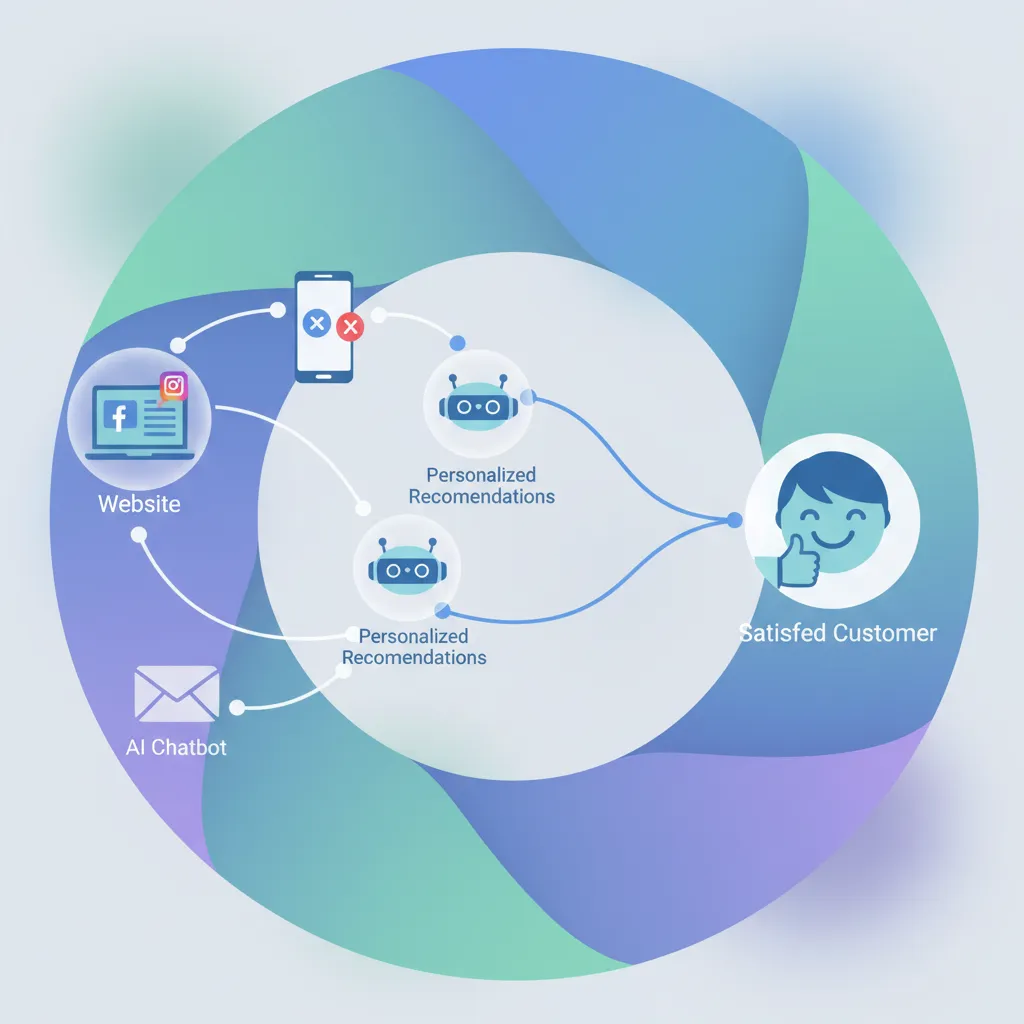 AI chatbots and personalized recommendations guiding a customer through various marketing touchpoints
Conclusion
The journey to revolutionize your marketing through the power of AI automation is not just an option—it’s a strategic imperative. From enhancing personalization and driving efficiency to providing unparalleled data-driven insights, AI marketing is transforming every facet of how businesses connect with their customers. We’ve explored the extensive AI marketing benefits, delved into critical AI tools for marketing like personalized marketing AI, predictive analytics, and content creation AI marketing, and examined how to craft effective AI driven marketing strategies.
Embracing AI in digital marketing allows businesses to move beyond traditional methods, fostering deeper customer relationships, optimizing resource allocation, and staying agile in a competitive market. As future marketing AI continues to evolve, with trends like generative AI marketing and advanced AI for customer engagement, the potential for innovation is limitless.
For any business, from a large enterprise leveraging comprehensive marketing AI solutions to a small business seeking powerful AI for small business marketing tools, the message is clear: the time to integrate AI into your marketing stack is now. By doing so, you’re not just keeping up with the competition; you’re setting the pace for the future. Start exploring the possibilities today and unlock a new era of marketing success.
FAQs
Q1. What exactly is AI marketing?
AI marketing is the application of artificial intelligence technologies to automate, optimize, and personalize marketing efforts. It involves using machine learning algorithms to analyze vast datasets, predict customer behavior, and execute marketing tasks with greater efficiency and precision than traditional methods.
Q2. How does AI help with personalized marketing?
AI enhances personalized marketing by analyzing individual customer data (browsing history, purchases, demographics, interactions) to create highly specific profiles. It then uses these insights to deliver tailored content, product recommendations, dynamic website experiences, and hyper-segmented email campaigns, making every customer interaction feel unique and relevant.
Q3. Can AI create marketing content?
Yes, content creation AI marketing tools and generative AI marketing models can assist in various stages of content creation. They can generate ideas, draft outlines, write headlines, social media posts, and even full articles, significantly speeding up the content production process. However, human oversight and creative refinement remain crucial for ensuring quality and brand voice.
Q4. What are the main benefits of using AI in marketing?
The main benefits of AI marketing include enhanced personalization, increased operational efficiency, better data-driven decision-making through predictive analytics marketing, optimized ad spend via programmatic advertising AI, improved customer service with chatbot marketing AI, and a deeper understanding of customer behavior.
Q5. Is AI marketing suitable for small businesses?
Absolutely. While large enterprises may adopt comprehensive marketing AI solutions, many AI for small business marketing tools are now accessible and affordable. These tools can help small businesses automate repetitive tasks, personalize customer interactions, optimize SEO, and analyze marketing performance without needing a large in-house data science team, leveling the playing field with bigger competitors.
Q6. How does AI help with SEO?
SEO AI tools can analyze search engine results pages (SERPs), identify high-value keywords, optimize content for search intent, and monitor competitor strategies more efficiently than manual methods. They can also provide insights into content gaps, suggesting topics that resonate with your target audience and helping improve organic visibility.
Q7. What is the difference between marketing automation and AI marketing?
Traditional marketing automation focuses on automating repetitive tasks based on predefined rules (e.g., sending a welcome email after signup). AI marketing, or marketing automation AI, adds intelligence to this process. AI learns from data, adapts in real-time, predicts outcomes, and makes autonomous decisions to optimize campaigns and personalize experiences dynamically, going beyond static rules.
Q8. What are some ethical concerns with AI in marketing?
Key ethical concerns include data privacy (ensuring compliance with regulations like GDPR), potential algorithmic bias that could lead to discriminatory targeting, and the need for transparency in how AI uses customer data. Responsible AI implementation requires prioritizing customer trust, ensuring data security, and actively working to mitigate biases.