Quantum AI Unleashed: How Quantum Computing Will Reshape Artificial Intelligence
Introduction
We are living in the golden age of artificial intelligence. From chatbots that write poetry to algorithms that can detect diseases, AI has permeated every corner of our digital lives. Yet, for all its power, classical AI is beginning to brush against the fundamental limits of the computers that run it. The most complex, world-changing problems—like designing life-saving drugs molecule by molecule or creating truly unshakeable financial models—remain just out of reach, demanding a level of computing power that conventional systems simply cannot provide.
This is where the conversation shifts from the familiar world of bits and bytes to the mind-bending realm of qubits and quantum mechanics. Enter Quantum AI, a revolutionary fusion of quantum computing and artificial intelligence. This isn’t just an incremental upgrade; it’s a paradigm shift poised to unleash an entirely new era of innovation. The impact of quantum technology on AI promises to be transformative, offering a path to solve problems currently deemed impossible.
In this deep dive, we’ll unpack the synergy between these two titan technologies. You’ll learn what quantum computing is, how it will supercharge machine learning, explore the groundbreaking QML applications on the horizon, and understand the very real challenges we must overcome. Get ready to explore the AI quantum future—it’s closer than you think.
The Computational Wall: Why Today’s AI Needs a Quantum Leap
Modern AI, particularly deep learning, is incredibly hungry for data and processing power. Training a large language model like GPT-4 requires colossal datasets and an astronomical number of calculations, consuming energy equivalent to a small city. As we push for more sophisticated and capable AI, we’re hitting a computational wall.
Classical computers, the workhorses of the digital age, store and process information using “bits,” which can be in a state of either 0 or 1. It’s a binary, black-and-white system that has served us remarkably well. However, this linear approach becomes a bottleneck when dealing with problems that have an exponential number of variables—a common scenario in AI model optimization quantum research.
Imagine trying to find the best route for a delivery service with 50 stops. A classical computer would have to calculate every single possible route one by one—a number greater than the atoms in the known universe. This is the kind of combinatorial explosion that stalls even the most powerful supercomputers, limiting the potential of AI enhanced by quantum computing.
Decoding the Quantum Realm: A Primer for the AI Enthusiast
To understand Quantum AI, we first need a basic grasp of quantum computing. You don’t need a Ph.D. in physics, just a little curiosity. The magic lies in how quantum computers handle information.
Beyond Bits: Understanding Qubits, Superposition, and Entanglement
Instead of bits, quantum computers use qubits. Thanks to a principle called superposition, a qubit can be a 0, a 1, or both at the same time. Think of a spinning coin. While it’s in the air, it’s neither heads nor tails—it’s in a superposition of both states. Only when it lands (is measured) does it settle into one state.
This ability to exist in multiple states at once allows quantum computers to explore a vast number of possibilities simultaneously. If you have two qubits, you can represent four states at once (00, 01, 10, 11). With 300 qubits, you could represent more states than there are atoms in the universe. This is the source of the exponential AI computing power that quantum promises.
Then there’s entanglement, a phenomenon Einstein famously called “spooky action at a distance.” When two qubits are entangled, their fates are linked, no matter how far apart they are. Measuring the state of one instantly influences the state of the other. This interconnectedness allows for complex information processing that is simply impossible in the classical world.
The Grand Unification: Introducing Quantum AI and Quantum Machine Learning (QML)
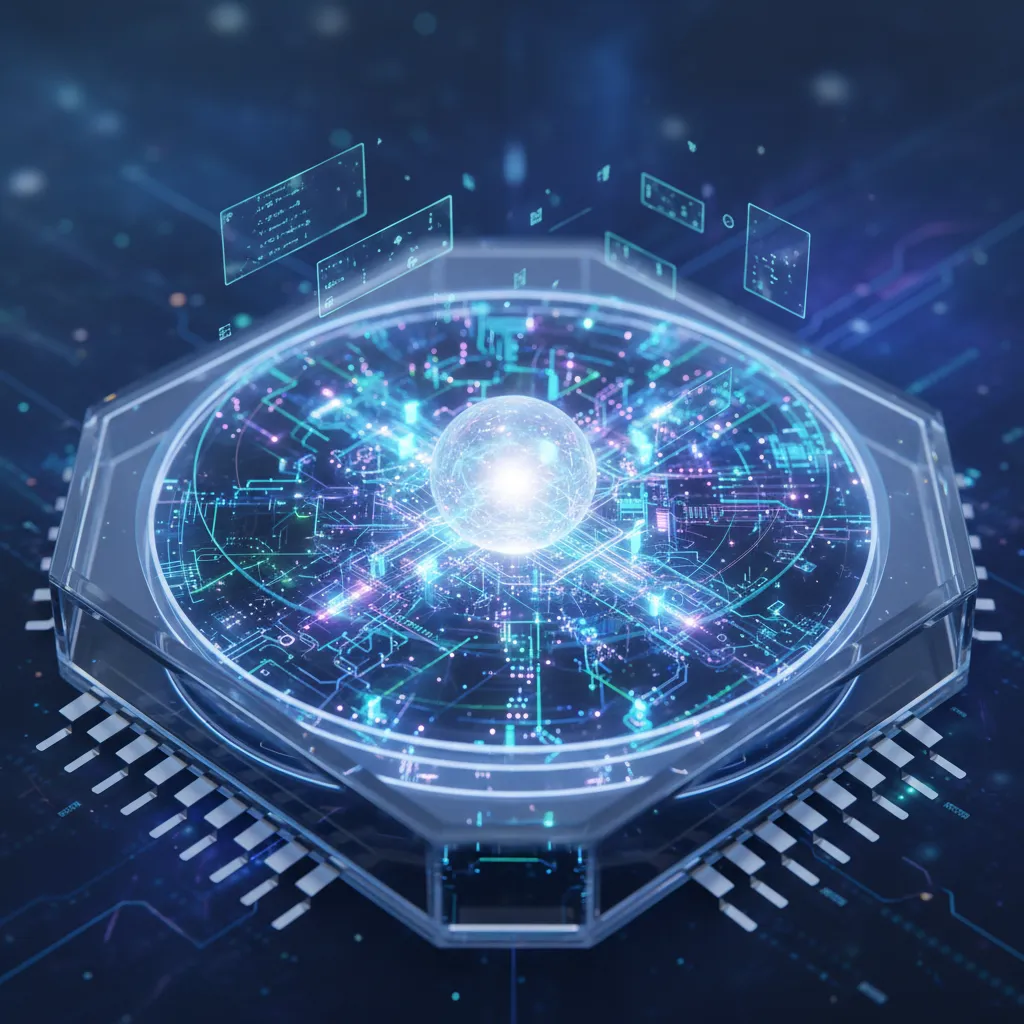
So, what happens when you combine the pattern-recognition prowess of AI with the parallel processing power of quantum computing? You get Quantum AI.
At its core, Quantum AI leverages quantum phenomena to perform computational tasks for artificial intelligence. A major subfield is Quantum Machine Learning (QML), which aims to devise and implement quantum software for machine learning tasks. The goal isn’t to replace classical AI entirely but to create a powerful synergy where quantum processors tackle the parts of a problem that are classically intractable.
This fusion opens up new avenues for Quantum AI development, enabling algorithms that can learn from data in fundamentally new ways. It’s about creating smarter, faster, and more efficient AI solutions. Related: A Guide to the Next Generation of Laptops: AI PCs
How Quantum Computing Will Supercharge Artificial Intelligence
The benefits of quantum computing for AI are not just theoretical. Researchers are actively developing Quantum algorithms AI that demonstrate significant advantages over classical methods in several key areas.
Exponential Speed-Up in AI Model Optimization
One of the most time-consuming parts of machine learning is training and optimization—finding the perfect set of parameters for a model to make accurate predictions. Quantum algorithms, like the Variational Quantum Eigensolver (VQE) and the Quantum Approximate Optimization Algorithm (QAOA), are naturally suited for these kinds of optimization problems. They can navigate through a vast landscape of possible solutions to find the optimal one exponentially faster, promising a way to speed up AI with quantum technology.
Building Deeper and More Complex Models: The Rise of Quantum Neural Networks
Classical neural networks are inspired by the human brain. Quantum Neural Networks (QNNs) take this a step further by incorporating quantum principles. This allows them to have a greater expressive power with fewer parameters, potentially leading to models that can recognize more complex patterns without requiring as much data. The field of Quantum deep learning is one of the most exciting frontiers in Quantum AI research, promising more powerful and efficient AI architectures.
Unlocking New Patterns in Data Science
Quantum computing for data science will be revolutionary. Quantum systems are uniquely equipped to handle high-dimensional data—datasets with a huge number of features. Algorithms like Quantum Principal Component Analysis (QPCA) can identify the most important patterns in this complex data much more efficiently than classical methods, unlocking insights that are currently hidden.
Enhancing AI-Powered Simulations
Simulating complex systems, especially at the molecular level, is a monumental task for classical computers. Quantum computers, however, operate on the same quantum-mechanical principles as the molecules they are trying to simulate. This makes them the perfect tool for designing new drugs, developing novel materials for batteries and solar cells, and creating more accurate climate models. Related: AI in Healthcare: Revolutionizing Patient Care and Medical Innovation
The Hybrid Quantum-Classical AI: Our Bridge to the Future
The first wave of the quantum AI revolution won’t involve purely quantum computers. Instead, the most promising near-term approach is Hybrid Quantum-Classical AI.
In this model, a classical computer handles the bulk of the workflow—data preprocessing, running parts of the AI model, and interpreting results. When it encounters a computationally intensive sub-problem perfectly suited for a quantum approach, it offloads that specific task to a Quantum Processing Unit (QPU). The QPU solves its piece of the puzzle and sends the result back to the classical computer.
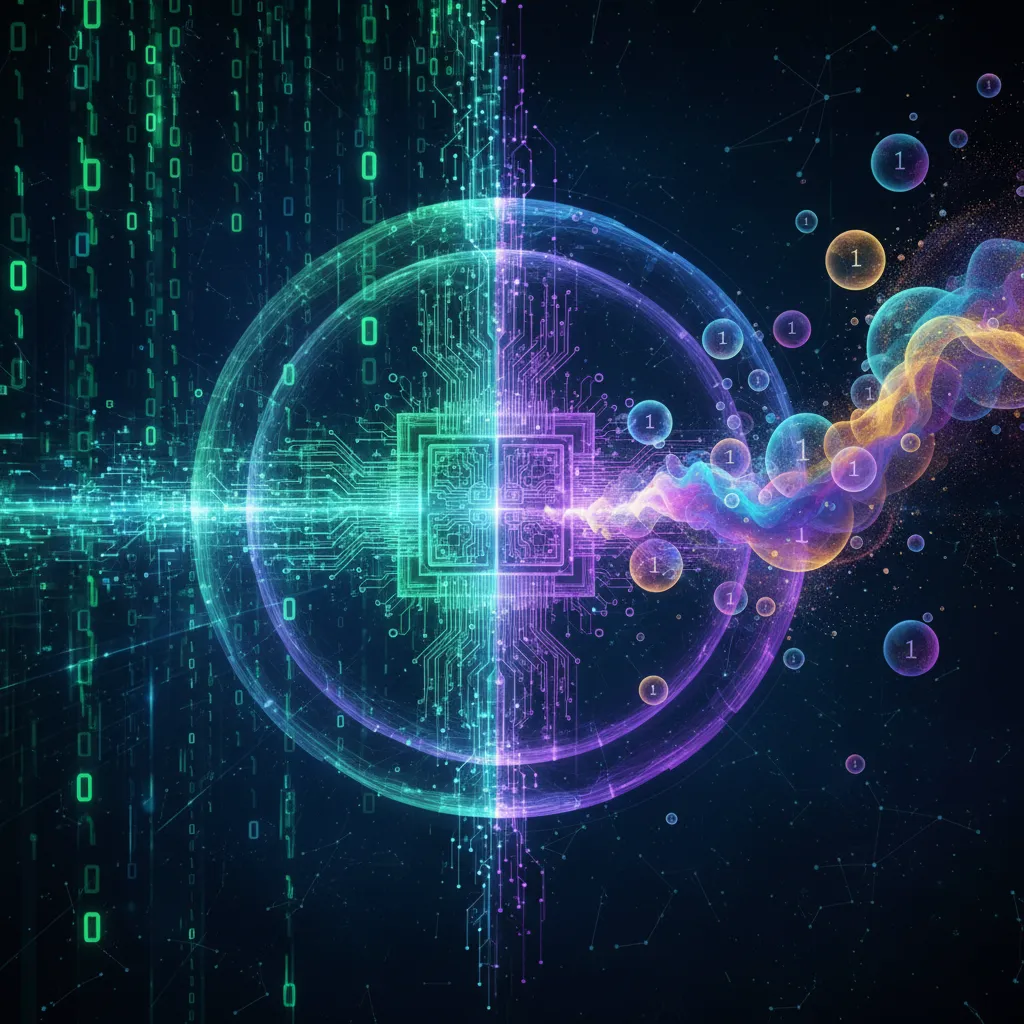
This hybrid system leverages the best of both worlds: the reliability and maturity of classical computing and the specialized power of Quantum hardware AI. It is the most practical pathway to achieving a “quantum advantage” for real-world problems in the near future.
Real-World QML Applications: Where Quantum AI Will Make Its Mark
The Quantum computing implications for AI are vast and will touch nearly every industry. Here are some of the most anticipated applications:
- Healthcare & Pharmaceuticals: Designing new drugs by accurately simulating molecular interactions. This could drastically reduce the time and cost of R&D for treatments for diseases like Alzheimer’s and cancer. Related: The Role of AI in Preventative Healthcare: A Personalized Path to Wellness
- Finance: Creating highly accurate financial models to predict market fluctuations and optimize investment portfolios. Quantum algorithms can analyze complex risk factors in real-time, providing a significant edge. Related: AI Financial Assistants: Revolutionizing Your Personal Wealth Management
- Manufacturing & Logistics: Solving complex optimization problems, such as the “Traveling Salesperson Problem,” to streamline supply chains, reduce fuel consumption, and improve factory efficiency.
- Materials Science & Energy: Discovering new materials with desirable properties, like high-temperature superconductors or more efficient catalysts for creating green hydrogen. This has huge implications for combating climate change. Related: The Ultimate Sustainable Travel Guide: How to Explore the World Responsibly and Ethically
- Cryptography: While quantum computers pose a threat to current encryption standards, they are also key to developing new, “quantum-resistant” cryptographic methods to secure our future data.

The Quantum Elephant in the Room: Overcoming the Challenges of Quantum AI
Despite the immense promise, the road to widespread transformative AI with quantum is paved with significant obstacles. It’s crucial to have a realistic perspective on the Challenges of quantum AI.
- Hardware Instability (Decoherence): Qubits are incredibly fragile. Any interaction with their environment—a stray magnetic field or temperature fluctuation—can cause them to lose their quantum state in a process called decoherence. This leads to errors in computation. Building stable, error-corrected quantum computers is the primary engineering challenge of our time.
- The Algorithm Gap: We are still in the early days of designing
Quantum software for AI. Discovering new quantum algorithms that can provide a significant advantage over classical ones is an active and intense area of research. - The Skills Shortage: There is a major talent gap. The world needs more researchers, engineers, and developers who are fluent in both quantum mechanics and machine learning to build the
Quantum AI solutionsof the future. - Integration and Accessibility: Seamlessly integrating quantum and classical systems into a hybrid workflow is a complex technical challenge. Furthermore, access to quantum hardware is currently limited and expensive.
The Horizon Beckons: The Future of Quantum AI
The journey of Quantum computing in artificial intelligence is a marathon, not a sprint. We are currently in what is known as the Noisy Intermediate-Scale Quantum (NISQ) era, where today’s quantum computers have dozens to hundreds of qubits but are still prone to noise and errors.
However, Quantum AI breakthroughs are happening at a breathtaking pace. Companies like Google, IBM, and a host of startups are making rapid progress in improving qubit stability and scale. The Future of quantum AI will likely unfold in stages:
- Near-Term (2-5 years): We’ll see more sophisticated hybrid models tackling specific, high-value optimization problems in finance, logistics, and chemistry.
- Mid-Term (5-15 years): As quantum hardware improves and error correction becomes more robust, we’ll see QML begin to outperform classical AI on a wider range of tasks, particularly in drug discovery and materials science.
- Long-Term (15+ years): The advent of large-scale, fault-tolerant quantum computers could unlock the full potential of Quantum AI, leading to the
Next generation AIthat could solve some of humanity’s greatest challenges.
The convergence of quantum computing and artificial intelligence represents one of the most exciting Quantum computing trends AI is witnessing. It’s a field brimming with potential, a testament to human ingenuity pushing the boundaries of what’s possible. Related: A Deep Dive into Apple Intelligence: Your Guide to iOS 18’s New AI Features
Conclusion
The fusion of quantum computing and AI is not a matter of if, but when. While we are still in the nascent stages of this technological revolution, the foundational work is being laid for a future where AI enhanced by quantum computing becomes the standard for solving our most complex problems. From revolutionizing medicine to reshaping global finance, the impact of quantum technology on AI will be profound and far-reaching.
The path forward is a hybrid one, combining the strengths of classical and quantum systems to push the envelope of discovery. The challenges are significant, but the potential rewards are immeasurable. As we stand on the cusp of this new computational era, one thing is clear: the quantum AI revolution has been unleashed, and it is set to reshape our world in ways we are only just beginning to imagine. Stay curious, stay informed, and watch as this incredible future unfolds.
Frequently Asked Questions (FAQs)
### Q1. What is Quantum AI in simple terms?
In simple terms, Quantum AI is the use of quantum computing for artificial intelligence tasks. It combines the advanced processing power of quantum computers—which can handle vast amounts of possibilities at once—with the learning capabilities of AI to solve extremely complex problems that are impossible for today’s regular computers.
### Q2. Can quantum computers run AI?
Yes, quantum computers can run AI, specifically algorithms designed for them. This field is called Quantum Machine Learning (QML). Instead of replacing classical AI, quantum computers are expected to work alongside them in a hybrid model, tackling the most computationally intensive parts of an AI problem to find better solutions faster.
### Q3. What is the difference between AI and quantum computing?
AI (Artificial Intelligence) is a broad field of computer science focused on creating systems that can perform tasks that normally require human intelligence, like learning and problem-solving. Quantum Computing is a new type of computing that uses the principles of quantum mechanics to process information in fundamentally different and more powerful ways than classical computers. Quantum AI is where these two fields intersect.
### Q4. What problems can Quantum AI solve?
Quantum AI is expected to excel at solving complex optimization, simulation, and sampling problems. This includes designing new drugs and materials by simulating molecules, optimizing financial models to predict market behavior, improving supply chains, and developing more powerful machine learning models like Quantum neural networks.
### Q5. Is Quantum AI a reality yet?
Yes, Quantum AI is a reality, but it’s in its very early stages. Researchers are currently using small-scale, “noisy” quantum computers (NISQ-era devices) to run QML algorithms and demonstrate a “quantum advantage” for specific problems. Widespread, practical applications are still some years away, pending advances in Quantum hardware AI.
### Q6. Who is leading in the development of Quantum AI?
Major tech giants like Google, IBM, and Microsoft are leading the charge in building quantum hardware and developing Quantum software for AI. Alongside them, numerous startups (like Rigetti, IonQ, and Xanadu) and university research labs are making significant contributions to both the hardware and the Quantum algorithms AI that will power the future.
### Q7. How does Quantum AI impact data science?
Quantum computing for data science promises to revolutionize the field by enabling the analysis of much larger and more complex datasets. Quantum algorithms can identify patterns and correlations in high-dimensional data that are invisible to classical methods, leading to more powerful predictive models and deeper business insights.