Private AI: Safeguarding Your Data with On-Device Processing
We live in a world powered by artificial intelligence. It recommends our next binge-worthy show, helps us navigate through traffic, and even translates languages in real time. But have you ever paused to think about where your data goes to make this magic happen? For years, the answer has been “the cloud”—distant, powerful servers owned by tech giants. This model, while effective, has created a growing tension between innovation and personal privacy.
The constant headlines about data breaches and the unsettling feeling that our devices are always listening highlight a fundamental problem. We want smart, personalized experiences, but we’re increasingly uncomfortable with the idea of our personal photos, private messages, and sensitive information being sent across the internet.
What if there was a better way? A way to get all the benefits of powerful AI without sacrificing control over your most personal data? This is the promise of Private AI, a revolutionary shift that brings artificial intelligence out of the cloud and directly into your hands through on-device processing.
In this comprehensive guide, we’ll explore the world of private AI. You’ll learn what it is, how it works to protect you, the tangible benefits it brings to your daily life, and why this move towards local AI processing is one of the most significant developments in modern technology and personal ai security.
The Cloud Conundrum: Why Traditional AI Puts Your Data at Risk
Before we dive into the solution, it’s crucial to understand the problem with the standard AI model. For the past decade, most AI applications have operated on a simple principle: collect data from your device, send it to a powerful cloud server for analysis, and send the result back.
Think about asking a smart speaker a question. Your voice command isn’t understood by the speaker itself. It’s recorded, encrypted, and sent to a data center hundreds or thousands of miles away. There, massive AI models process the audio, figure out what you asked, find the answer, and send the spoken response back to your device.

While this cloud-based system has enabled incredible advancements, it comes with inherent risks concerning user data privacy ai:
- Data Breach Vulnerability: Every time your data travels to the cloud, it creates a potential point of failure. Centralized servers holding information from millions of users are high-value targets for hackers.
- Privacy Concerns: Who has access to your data once it leaves your device? While companies have privacy policies, your data is still being stored and potentially analyzed on their infrastructure, creating valid ai privacy concerns.
- Latency Issues: The round-trip journey to the cloud and back takes time. This delay, or latency, can make real-time applications like augmented reality or instant photo editing feel sluggish.
- Dependence on Connectivity: If you don’t have an internet connection, most cloud-based AI features simply stop working.
This model forces a trade-off: to get smarter features, you must surrender a degree of control over your ai personal data. But the rise of private AI is rewriting that contract.
What is Private AI? The Shift to On-Device Processing
Private AI, often used interchangeably with terms like on-device AI or edge AI, is a paradigm shift in how artificial intelligence operates. The core concept is simple yet profound: instead of sending your data to the cloud, the AI processing happens directly on your personal device—your smartphone, laptop, or smart watch.
The AI models are small, efficient, and powerful enough to run locally, right there in your hand. Your personal data never leaves the physical confines of your device. It’s the digital equivalent of thinking an idea through in your own head versus shouting it across a crowded room to get an opinion.
This approach is the foundation of a new era of trusted AI, where users don’t have to blindly trust a corporation’s data handling policies. Trust is built into the architecture itself. This move towards ai processing local is a cornerstone of modern ai and data protection, putting you back in control.
Related: The Rise of Edge AI: Unleashing Intelligence at the Device Frontier
How Does On-Device AI Actually Work? A Look Under the Hood
Making AI models—which can be notoriously large and power-hungry—run efficiently on a battery-powered device is a remarkable feat of engineering. It’s made possible by the convergence of two key advancements: specialized hardware and sophisticated software.
Specialized Hardware: The “Brain” in Your Device
Modern smartphones and laptops are no longer just equipped with a CPU (Central Processing Unit) and a GPU (Graphics Processing Unit). They now include a third, highly specialized processor called an NPU, or Neural Processing Unit.
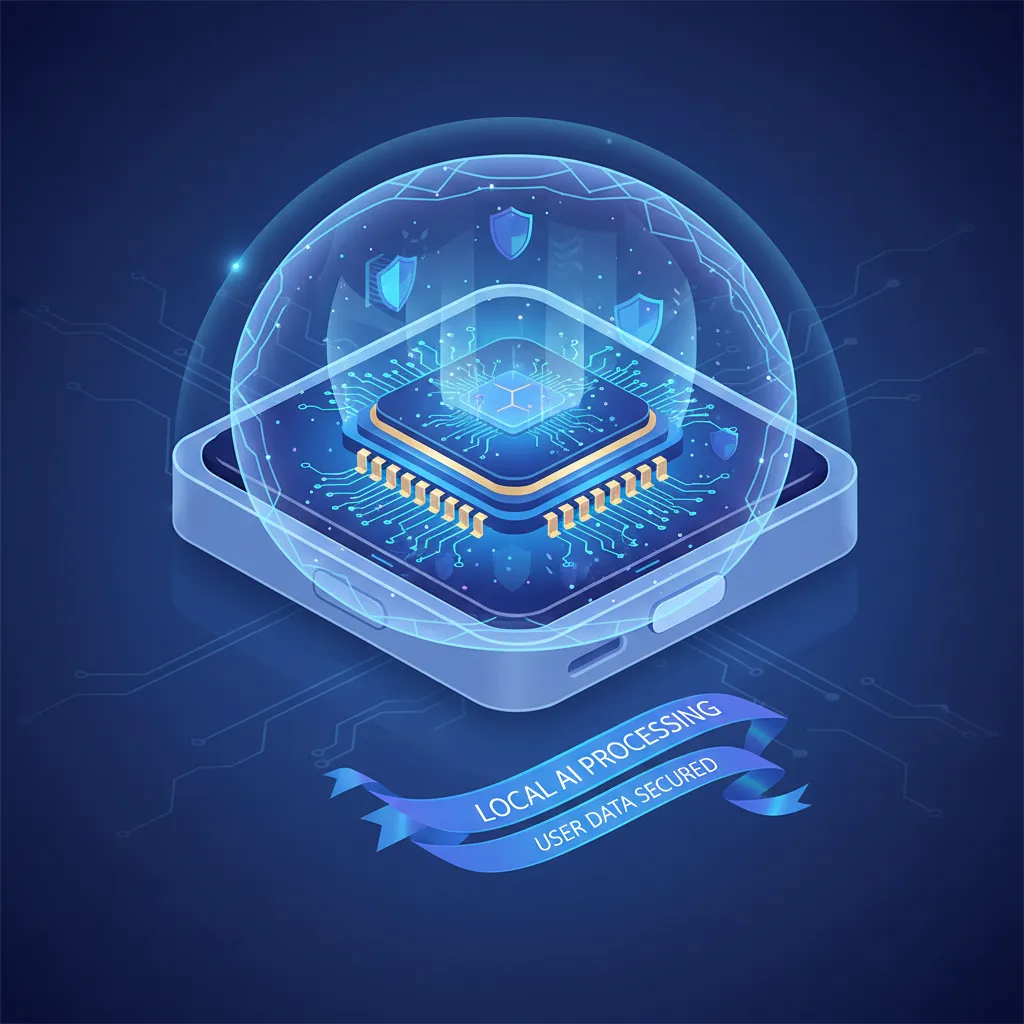
Companies have their own names for these chips:
- Apple: The A-series and M-series chips feature the “Neural Engine.”
- Google: The Tensor chips are custom-built for AI and machine learning tasks.
- Qualcomm: The Snapdragon chips include a dedicated “AI Engine.”
These NPUs are designed from the ground up to perform the specific types of mathematical calculations required for AI tasks with incredible speed and energy efficiency. They are the engine that makes powerful on-device ai possible without draining your battery in minutes.
Software and Model Optimization
Alongside hardware advancements, data scientists have developed techniques like quantization and pruning to shrink massive AI models into smaller, more efficient versions that can run on an NPU. They trim the “fat” from the model without significantly compromising its accuracy, allowing a powerful secure machine learning model to fit and function within the resource constraints of a personal device.
This combination of purpose-built hardware and optimized software creates a powerful ecosystem for privacy preserving ai to thrive directly on the devices we use every day.
Related: Apple Intelligence & iOS 18: All The New AI Features Unveiled
The Tangible Benefits of On-Device AI: More Than Just Privacy
While enhanced data security is the flagship benefit, the move to on-device processing brings a cascade of other advantages that improve our daily digital experience.
1. Unbreakable Data Security and Privacy
This is the most critical benefit. With on-device ai, sensitive information like your biometric data (Face ID), personal photos, health metrics, and private messages are processed locally. They are never uploaded to a server or seen by the device manufacturer. This fundamentally changes the ai consumer privacy landscape, minimizing the attack surface for breaches and giving you true ownership of your digital life. It is the ultimate ai privacy solution.
2. Lightning-Fast Speed and Responsiveness
By eliminating the need to send data to and from the cloud, on-device AI is incredibly fast. Actions happen almost instantaneously. Consider Live Text on an iPhone; you can point your camera at text, and it’s recognized and ready to be copied in real-time. This low latency is crucial for applications that require immediate feedback, such as computational photography, real-time translation, and augmented reality filters.
3. Uninterrupted Offline Functionality
Have you ever tried to use a navigation app or a voice assistant in an area with poor or no internet? With cloud-based AI, they become useless. On-device AI, however, works perfectly offline. You can still organize your photos by content, get smart text suggestions, and use many other AI features whether you’re on a plane, in the subway, or hiking in a remote area.
4. Personalization Without Compromise
True personalization requires an AI to learn your unique habits, preferences, and vocabulary. On-device AI can do this in a privacy-preserving way. For example, your phone’s keyboard can learn the slang you use and the names of your friends by analyzing your typing locally, without sending your conversations to a server. This creates a deeply personal and helpful experience that is tailored specifically to you, without exposing your private life.

Private AI in Action: Everyday Examples You’re Already Using
The concept of private AI might sound futuristic, but it’s already integrated into many of the devices you use every day. Companies like Apple have made on-device processing a core pillar of their privacy strategy.
Your Smartphone is the Epicenter
The modern ai on smartphone is a hotbed of on-device processing:
- Biometric Authentication: Features like Apple’s Face ID or Android’s Face Unlock create a mathematical model of your face and store it in a secure enclave on the device itself. When you unlock your phone, the comparison happens locally. Your face data never goes to the cloud.
- Computational Photography: When you take a Portrait Mode photo, the AI that separates the subject from the background and creates the beautiful blur effect runs directly on the device’s NPU in real time.
- Intelligent Photo Search: On iOS and Google Photos, you can search for “beach” or “dog,” and the app will find relevant pictures. This image analysis and tagging happen on your phone, not on a server.
- Predictive Text and Smart Replies: The keyboard suggestions that seem to read your mind are generated by an on-device model that has learned your personal writing style.
- Live Transcription and Translation: Apps can now transcribe spoken words into text or translate conversations in real time, with all the processing handled securely on the device.
Related: Boost Your Productivity: 10 Essential AI Tools for Work and Life
Beyond the Smartphone
The private AI future extends well beyond phones:
- Laptops: The latest generation of laptops, often marketed as “AI PCs,” includes powerful NPUs. These enable features like enhanced background blur in video calls, real-time noise cancellation, and battery optimization, all handled locally.
- Smartwatches: Wearables that monitor your heart rate, detect falls, or track your sleep cycles often perform initial data analysis on the device itself for speed and privacy before syncing encrypted summaries to the cloud.
- Smart Home: Some voice commands for smart speakers are now being processed locally, allowing you to turn lights on or off without an internet connection and with greater privacy.
The Challenges and Limitations: Is On-Device AI a Perfect Solution?
While the benefits are immense, on-device ai is not a silver bullet for every AI task. It’s important to have a balanced perspective on its limitations.
- Processing Power: Even the most powerful NPU in a smartphone is no match for the near-infinite computing power of a massive cloud data center. The most complex, large-scale AI models (like those behind advanced chatbots or image generators) still require the cloud.
- Battery Life: Running intensive AI tasks locally can consume significant battery power. Engineers are constantly working on improving efficiency, but it remains a constraint.
- Model Updates: Updating an on-device AI model requires a software update for the device, whereas cloud models can be updated continuously and instantly.
Because of these limitations, the future is likely a hybrid model. This approach uses on-device AI for tasks that are privacy-sensitive, require low latency, or need offline capability. For heavy-duty tasks that require immense computational power, it intelligently reaches out to the cloud, often using privacy-preserving techniques to anonymize the data.
Related: How AI is Revolutionizing Personal Finance
The Future is Private: What’s Next for On-Device AI and Data Protection?
The trend towards private AI and on-device processing is only accelerating. It represents a fundamental rethinking of ai data governance and ai ethics data, putting power back into the hands of the user.

Here’s what to expect in the near future:
- More Powerful NPUs: Device chipsets will continue to evolve, with NPUs capable of handling increasingly complex AI models locally.
- Advanced Personalization: Expect AI assistants that have a deep, nuanced understanding of your personal context—your schedule, relationships, and habits—all while keeping that context securely on your device.
- Proactive Assistance: Your devices will move from being reactive to proactive, anticipating your needs based on on-device learning. Imagine your phone suggesting you leave for the airport early because it analyzed local traffic patterns and knows your flight time, all without sending that data to a server.
- Enhanced AI for Personal Security: On-device AI will power more sophisticated security features, such as detecting phishing attempts in your messages or identifying malicious app behavior in real-time.
Conclusion: Taking Back Control of Your Digital Self
The shift from the cloud to the device is more than just a technical change; it’s a philosophical one. For years, we accepted that advanced technology required us to give up a piece of our privacy. Private AI challenges that notion head-on, proving that we can have both intelligent features and robust data privacy ai.
By running AI models directly on your smartphone, laptop, and other personal devices, on-device processing creates a secure, fast, and reliable experience. It keeps your personal data where it belongs: with you. This move towards a more decentralized, user-centric AI is not just a feature—it’s the foundation for a more trusted ai and a safer digital future for everyone.
The next time your phone instantly recognizes a face in your photos or suggests the perfect reply, take a moment to appreciate the silent, secure work happening right in the palm of your hand. That is the power and promise of private AI.
Frequently Asked Questions (FAQs)
Q1. What is private AI?
Private AI refers to artificial intelligence systems that perform their data processing and machine learning tasks locally on a user’s device (like a smartphone or laptop) rather than sending data to a centralized cloud server. This approach prioritizes user privacy and data security by ensuring personal information never leaves the device.
Q2. Is on-device AI more secure than cloud AI?
Yes, generally speaking, on-device AI is more secure for personal data. Because the processing happens locally, it drastically reduces the risks associated with data transmission and storage on external servers. This minimizes vulnerabilities to data breaches, unauthorized access, and corporate data mining, making it a cornerstone of ai security.
Q3. What is an example of on-device AI?
A common example is Face ID on Apple iPhones. The entire process of scanning your face, creating a mathematical model, and authenticating you happens within a secure part of the phone’s chip. Your facial data is never sent to Apple’s servers, making it a prime example of secure, on-device ai. Other examples include real-time language translation and predictive keyboard suggestions.
Q4. What are the disadvantages of on-device AI?
The main disadvantages are limitations in computational power and battery life. Devices have finite resources compared to vast cloud data centers, so the most complex and largest AI models cannot run locally. Additionally, intensive on-device processing can consume more battery power, though this is constantly being improved with more efficient hardware like NPUs.
Q5. Can AI run without the internet?
Yes, AI designed for on-device processing can run perfectly without an internet connection. This is one of its key advantages. Features like photo organization, live text recognition from your camera, and smart keyboard replies will continue to function seamlessly whether you are online or offline.
Q6. How does Apple Intelligence use on-device processing?
Apple Intelligence is designed with a “private by default” approach. It runs as much as possible on the device’s own chip. For more complex requests that need larger models, it uses a system called Private Cloud Compute, which sends only the necessary data to secure Apple silicon servers in a way that is cryptographically protected and cannot be accessed by Apple, ensuring user privacy is maintained.