Inside Out 2: A Guide to the New Emotions Shaping Riley’s Teenage Mind

Introduction: Welcome to Adolescence, Where Emotions Get Complicated
When Pixar released Inside Out in 2015, it didn’t just give us a beautiful animated film; it gave us a profound, accessible vocabulary for discussing the human mind. The Headquarters, once operated by a core team—Joy, Sadness, Fear, Anger, and Disgust—represented the relatively simple emotional landscape of an 11-year-old girl named Riley.
Now, Riley is 13. She’s transitioning from elementary school certainty to the volatile, self-conscious world of adolescence.
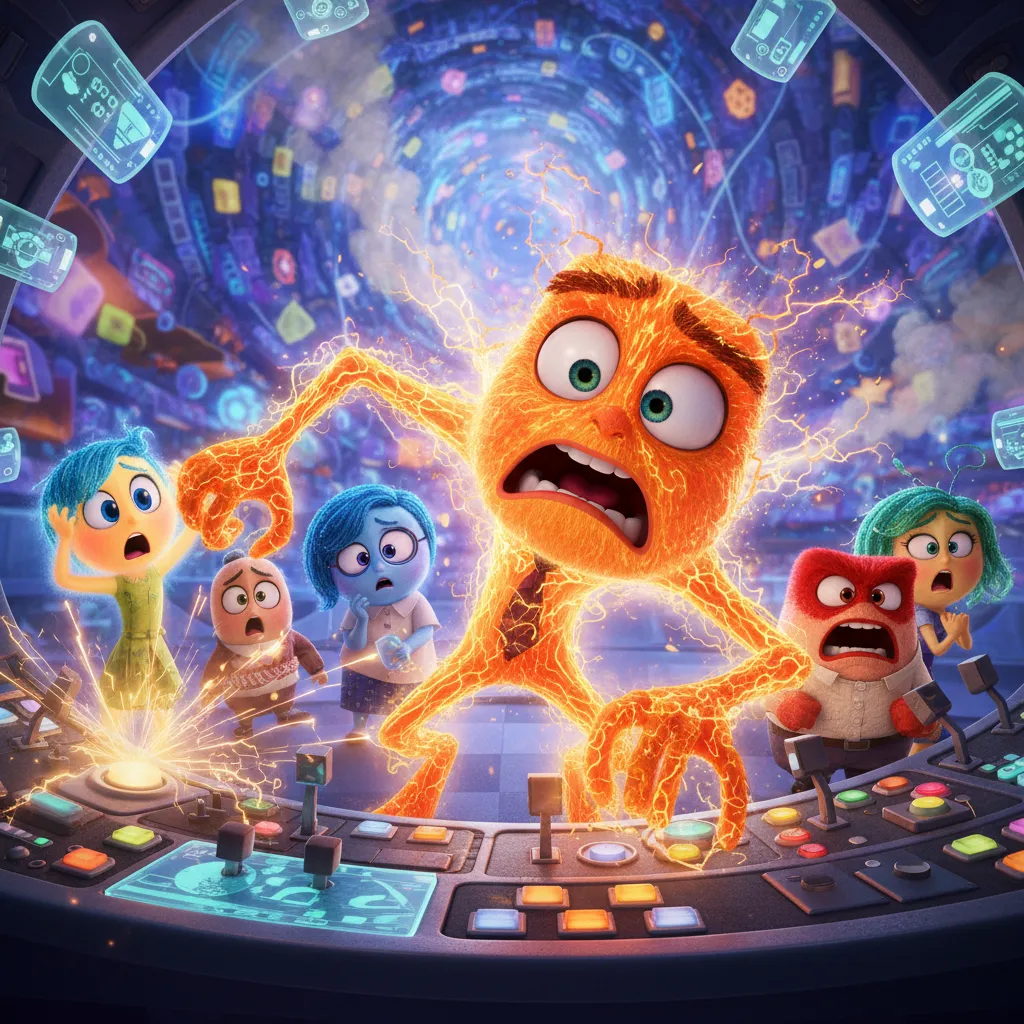
Inside Out 2 understands this shift perfectly. It shows that as we mature, our emotional operating system requires a major upgrade—or, as the movie portrays it, a sudden, chaotic demolition and subsequent remodel of the control panel. The simple, primary colors of childhood feelings are replaced by a tumultuous, complex palette dominated by self-awareness and social pressure.
This transition introduces a new squad of core Inside Out 2 characters: Anxiety, Ennui, Envy, and Embarrassment.
These newcomers aren’t just quirky sidekicks; they are essential figures in the psychology of Inside Out 2, representing the necessary, albeit difficult, emotional tools required to navigate social hierarchies, self-image, and the overwhelming fear of the future. This guide dives deep into what new emotions are in Inside Out 2, why they arrived, and how they reshape the very foundation of Riley’s sense of self.
The Emotional Remodel: Why Riley’s Mind Needs an Upgrade
The primary conflict of Inside Out 2 stems from Riley hitting puberty. This isn’t just about physical changes; it’s a massive cognitive and social overhaul.
The Teen Brain: A Construction Zone
In psychological terms, adolescence is marked by two critical developments that necessitate the arrival of the new emotions Inside Out 2:
- The Shift to Abstract Thinking: Riley stops thinking only about the present moment and starts obsessing over the future. This is where long-term planning, and long-term worrying, comes from.
- Increased Self-Consciousness: The teenage mind becomes intensely focused on external validation and social fitting. What others think is suddenly paramount, leading to feelings of inadequacy, desire, and intense social discomfort.
The film visually represents this shift with the introduction of “Beliefs” (a glowing, tree-like structure representing Riley’s sense of self) and the installation of a new, complex, and overwhelmingly orange control panel—a stark contrast to the small, simple panel the original five emotions managed.
The original emotions, particularly Joy, believe that to be happy, Riley must stick to her established, comfortable “Core Beliefs.” The new emotions, led by Anxiety, argue that to survive the social minefield of high school, Riley must adapt, plan for every worst-case scenario, and, sometimes, suppress her authentic self.
This psychological depth is why the Inside Out 2 review consensus has been overwhelmingly positive, celebrating its nuanced depiction of mental health themes in Inside Out 2.
[Related: The Ultimate Guide to a Digital Detox: Reclaim Your Focus]
Meet the New Crew: The Core Quartet of Adolescence
The new team that storms Headquarters is a highly coordinated, if slightly dysfunctional, unit determined to help Riley build a better, “safer” future—even if that means destroying her present happiness.
1. Anxiety: The Architect of Catastrophe (Voice: Maya Hawke)
Anxiety is arguably the most dominant and crucial new emotion Inside Out 2. Voiced brilliantly by Maya Hawke, Anxiety is depicted as a frantic, tightly-wound, orange nerve ending. She doesn’t just worry; she plans for every conceivable catastrophe, often seeing potential danger lurking in mundane events.
The Psychology of Anxiety in Inside Out 2
In the film, Anxiety’s motive is presented as protective: she wants Riley to be prepared for the future. Her methods, however, are disruptive and dangerous. She hijacks the control panel, deeming the original emotions too focused on temporary happiness, and starts constructing intricate, negative narratives about Riley’s potential failure (e.g., losing her friends, failing at hockey camp).
- Key Behavior: Anxiety seeks to create a “perfect” version of Riley for the future, forcing the creation of “false beliefs” that prioritize external acceptance over internal happiness. She literally bottles up the old emotions to prevent them from interfering with her “better plans.”
- Visual Representation: Her frenetic energy, sharp lines, and constant pacing perfectly capture the feeling of stress and impending doom that defines adolescent worry.
- Keyword Tie-in: Anxiety Inside Out 2, who is Anxiety in Inside Out 2, Maya Hawke Inside Out 2.
The movie uses Anxiety to explore how obsessive planning can actually be detrimental, creating unnecessary stress and disconnecting a person from their true, core self. This resonates deeply with modern struggles with overthinking and anticipatory stress.
2. Ennui: The Spirit of Apathy (Voice: Adèle Exarchopoulos)
Ennui is perhaps the most relatable emotion for anyone who remembers the crushing weight of boredom and indifference during their mid-teens. Depicted as a lanky, purple figure, Ennui is defined by her profound lack of interest.
The Psychology of Ennui in Inside Out 2
French for “weariness and dissatisfaction resulting from a lack of occupation or excitement,” Ennui operates as the ultimate teenager. She handles the console with extreme minimal effort, usually lying horizontally on a couch, glued to her smartphone, manipulating the controls with her toe via a remote control.
- Key Behavior: She contributes to the “too cool for school” persona. When Ennui is in control, Riley projects an air of sophistication, disinterest, and world-weariness—a mechanism often used by teens to shield themselves from vulnerability or appearing overly eager.
- Visual Representation: Her tired eyes, purple palette (often associated with mystery and melancholy), and reliance on tech perfectly capture the modern teenage slump.
- Keyword Tie-in: Ennui Inside Out 2, Riley’s new emotions.
Ennui serves a protective function: if you don’t care, you can’t be disappointed. But her presence also highlights the struggle teens face in finding genuine passion and meaning amidst social posturing.
3. Envy: The Green-Eyed Admirer (Voice: Ayo Edebiri)
Envy is small, cyan, and has wide, admiring eyes. Voiced by Ayo Edebiri Envy is less malicious resentment and more pure, unadulterated desire for what someone else possesses.
The Psychology of Envy in Inside Out 2
Unlike Anger or Disgust, Envy doesn’t hate the other person; she simply wants their qualities. In the context of Riley’s adolescence, Envy is driven by social comparisons. When Riley sees the “cool older kids” at hockey camp, Envy pushes the idea that Riley needs to emulate them, or acquire their popularity, skill, or aesthetic.
- Key Behavior: Envy is crucial in fueling Riley’s social climbing and superficial desires. She works closely with Anxiety, constantly highlighting Riley’s shortcomings relative to her peers, providing a powerful motivator for change—even negative change.
- Visual Representation: Her small size and big eyes suggest an eternal yearning or gaze upward. The cyan color contrasts sharply with the traditionally “green” color of envy, perhaps symbolizing a quieter, more pervasive social desire than outright malice.
- Keyword Tie-in: Envy Inside Out 2, Ayo Edebiri Envy.
The film positions Envy as the emotional engine behind social media comparison and the pressure to achieve an impossible standard of perfection—a core challenge for modern adolescents.
[Related: AI Wearable Tech: Revolutionizing Health & Wellness]
4. Embarrassment: The Gentle Giant of Shame (Voice: Paul Walter Hauser)
Embarrassment is the largest of the new emotions, a massive, soft, gentle giant with a pink hue who is constantly blushing and perpetually trying to hide inside his oversized hoodie.
The Psychology of Embarrassment in Inside Out 2
Embarrassment is the physical manifestation of shame and self-consciousness. His primary function is to protect Riley from social ridicule, usually by causing her to shut down, hide, or blush furiously.
- Key Behavior: When Riley experiences a cringe-worthy moment or social failure, Embarrassment takes over, usually by literally trying to hide the entire control panel from view. He operates silently, his size representing the overwhelming weight of social shame.
- Visual Representation: His pink color suggests a flushed face, and his gentle, non-verbal demeanor contrasts with the frantic energy of Anxiety. He is a wall built against public humiliation.
- Keyword Tie-in: Embarrassment Inside Out 2, all 9 emotions in Inside Out.
Embarrassment is the heavy-hitter that keeps teens from taking risks. While necessary to enforce social norms, too much of him can lead to paralyzing social anxiety and avoidance behavior.

The Conflict and Synthesis: The Story of Inside Out 2
The central Inside Out 2 plot summary revolves around the conflict between the two generations of emotions.
When Anxiety arrives, she declares the original five emotions—Joy, Sadness, Anger, Fear, and Disgust—“unfit” for the complexities of teenage life. She sees Joy’s endless optimism as naive, Fear’s warnings as insufficient, and Sadness as useless baggage.
Anxiety literally bottles up the core five emotions and banishes them to the deep recesses of Riley’s mind, creating a high-stakes adventure where the originals must race back to Headquarters before Anxiety completely rewrites Riley’s Sense of Self with her catastrophic planning.
The Sense of Self and Core Beliefs
The most significant psychological element introduced is the Sense of Self. This glowing structure is built from Riley’s Core Beliefs—the foundational truths she holds about herself (“I am a good friend,” “I am a loving daughter”).
Anxiety’s dangerous plan is to replace these authentic, often complicated core beliefs with simplified, aspirational “false beliefs” that prioritize external approval (“I must be cool,” “I must be flawless”). This manipulation is what drives the deep mental health themes in Inside Out 2, showing how self-doubt can lead to identity crises and a disconnection from one’s authentic self.
The film’s resolution doesn’t involve vanquishing Anxiety. Instead, it argues for coexistence. Riley’s mind ultimately realizes that the new emotions are essential tools for growth, but they cannot operate unchecked. True mental wellness comes when Joy and Sadness work with Anxiety and Envy to create a rich, complex, and nuanced sense of self, accepting both the messy, contradictory feelings of adolescence.
[Related: The AI Revolution in Your Wallet: How AI is Reshaping Personal Finance]
Beyond the Core: Nostalgia and the Other Cameos
While Anxiety, Ennui, Envy, and Embarrassment dominate the screen time, a few other emotional concepts make brief, often humorous, appearances, fueling many Pixar movie theories.
Is There a Nostalgia Emotion?
The question, Is there a Nostalgia emotion?, is a popular one. The film introduces a character named Nostalgia—a sweet, elderly figure wearing a grandmotherly cardigan. However, she is shown to be too early for Riley’s mind.
Nostalgia’s cameo suggests that while the capacity for deeply sentimental memory exists, it is not yet an active, governing emotion for a 13-year-old who is obsessed with the future. Nostalgia is something that develops later, perhaps in early adulthood, when the past holds a significant, rose-tinted significance. She is briefly shooed away, told to “come back later,” perfectly encapsulating her psychological role.
Other Potential Concepts
The film subtly alludes to other concepts, particularly in the sequences where the original emotions are trapped. These fleeting glimpses suggest the sheer volume of subtle emotional states that populate the mind, paving the way for future sequels or deeper dives into all 9 emotions in Inside Out (the original 5 plus the 4 new ones).
Inside Out 2: A Critical and Commercial Success
Inside Out 2 wasn’t just a heartwarming film; it was a phenomenon, proving that Pixar still holds the crown for blending family entertainment with profound philosophical concepts.
Box Office and Cultural Impact
The film’s release was strategically timed to capture the summer family movies 2024 market, and it paid off massively. The Inside Out 2 box office figures shattered expectations, becoming one of the highest-grossing films of the year globally. Its success is a testament not only to the nostalgia for the original but to the universal resonance of its themes.
The film’s cultural impact extends beyond the theater. It has sparked countless conversations between parents and teenagers, providing a valuable framework for discussing difficult topics like social anxiety and self-worth.
The Reviews Are In
Critically, Inside Out 2 maintained Pixar’s high standard. Inside Out 2 review critics praised:
- The Nuance of Anxiety: The decision to make Anxiety a complex, well-intentioned character rather than a simple villain.
- Visual Storytelling: The clever and kinetic visual metaphors used to depict abstract concepts like the “Sense of Self” and the various “mind spaces.”
- Voice Acting: The exceptional performances, particularly Maya Hawke’s portrayal of Anxiety, which perfectly captured the jittery, fast-talking chaos of teenage overthinking.
The film successfully broadened the scope of the original, proving that even as Riley gets older (how old is Riley in Inside Out 2 is confirmed to be 13), her internal life remains fascinating and educational for viewers of all ages.
[Related: Budget Travel Hacks 2024: Explore More, Spend Less]
A Parent’s Guide to Inside Out 2: Navigating Mental Health Themes
For parents, Inside Out 2 offers a crucial parent’s guide to Inside Out 2 and a valuable tool for initiating conversations about mental health.
Understanding the Teenage Emotional Toolkit
The film normalizes the complexity of teen feelings. It teaches parents (and teens) that:
- Anxiety is Normal, Dominance is Not: It’s okay for teens to worry, plan, and feel anxious. The problem arises when Anxiety takes complete control and forces the suppression of other healthy emotions like Joy and Sadness.
- Social Comparison (Envy) is a Feature, Not a Bug: Envy exists because social bonding and group identification are critical during adolescence. It becomes problematic when it leads to self-betrayal.
- The “Sense of Self” is Malleable: The film visually demonstrates that a person’s identity is not fixed. It is a structure constantly being built and rebuilt by memories and beliefs. This is a powerful metaphor for teens struggling with “who they are.”
The movie encourages the idea that a healthy mind is one where all 9 emotions in Inside Out can contribute, even Sadness and Embarrassment, to create a rounded, imperfect, and ultimately resilient individual.
Post-Credit Scene Implications
For those wondering, the Inside Out 2 post credit scene provides a humorous callback to the original film’s structure, offering a fun glimpse into Riley’s subconscious. While not crucial to the main plot, it reinforces the playful and observational tone of the Pixar Inside Out 2 universe, leaving the door open for future exploration of Riley’s evolving mental state (perhaps even dealing with complex adult emotions like Apathy, Guilt, or even Love).
Conclusion: The Enduring Legacy of the Mind
Inside Out 2 is more than just a successful sequel; it is a vital piece of animated cinema that contributes significantly to the ongoing discussion about adolescent mental health. By personifying emotions like Anxiety, Ennui, Envy, and Embarrassment, Pixar provides viewers with a safe, visually stunning way to understand the chaotic and often overwhelming experience of growing up.
The film’s ultimate message is one of acceptance: Riley’s mind is healthier when Joy learns to make space for the darker, more complicated feelings. Joy realizes that a truly mature, multifaceted sense of self cannot be built only on positive memories; it must integrate the awkwardness, the desire, the boredom, and the frantic worrying that define teenage life.
If you haven’t seen it yet, or if you’ve been looking for a way to talk about the tumultuous feelings of your own teenage years (or those of a loved one), diving into the detailed story of Inside Out 2 provides a rich, rewarding experience. It reminds us all that feeling everything—the good, the bad, and the embarrassingly awkward—is what makes us whole.
[Related: Top AI Tools for Creativity and Productivity in 2024]
FAQs: Your Questions About the New Emotions Answered
Q1. Who are the new emotions in Inside Out 2?
The four main new emotions Inside Out 2 are Anxiety, Ennui, Envy, and Embarrassment. They arrive in Riley’s mind as she turns 13 and enters the volatile, socially conscious world of adolescence.
Q2. How old is Riley in Inside Out 2?
Riley is confirmed to be 13 years old in Inside Out 2. The movie centers around her navigating the transition to high school, attending a key hockey camp, and experiencing the onset of puberty, which triggers the emotional “demolition” and the arrival of the new emotions.
Q3. Is there a Nostalgia emotion in Inside Out 2?
Yes, Nostalgia makes a brief appearance. She is an elderly character who pops up briefly, only to be told by the others that she is “too early” for Riley’s current stage of life, suggesting that Nostalgia is a feeling that becomes operational later on.
Q4. Who voices the new character Anxiety in Inside Out 2?
The character Anxiety, the main catalyst for the plot’s conflict, is voiced by actress Maya Hawke, known for her roles in Stranger Things and other contemporary projects. Her energetic and quick-witted delivery perfectly captures the frantic nature of Anxiety Inside Out 2.
Q5. What is Ennui, and how does she affect Riley?
Ennui (voiced by Adèle Exarchopoulos) represents weariness, boredom, and apathy. She is the emotion that makes Riley act distant, cool, and unresponsive, often manipulating the control panel with her toe from a position of profound disinterest. She embodies the classic teenage “slump.”
Q6. Are the new emotions villains?
No. While they disrupt the Headquarters and suppress the original emotions, the story of Inside Out 2 makes it clear they are not villains. They are necessary, if overwhelming, parts of the emotional toolkit needed for survival in the social complexities of adolescence. Anxiety’s goal is protection, even if her methods are harmful.
Q7. When is Inside Out 2 streaming release date?
While the exact Inside Out 2 streaming release date varies based on the theatrical run, as a Pixar film, it will eventually be available to stream exclusively on Disney+ after its initial window, typically a few months after its cinematic debut.
Q8. What does the “Sense of Self” represent?
The “Sense of Self” is a new structure in Riley’s mind, depicted as a glowing, tree-like formation built from her most important “Core Beliefs.” It represents her identity and the narratives she tells herself about who she is. Anxiety attempts to corrupt this structure by replacing authentic beliefs with fear-based, external ones.