Humane AI Pin Review: Fad or Future of Phones?

Introduction: The Dawn of Ambient Computing
For years, the smartphone has been the undisputed king of our digital lives, a necessary extension of our minds and hands. But what if the next leap in personal technology wasn’t about a better screen, but no screen at all?
Enter the Humane AI Pin, the quintessential wearable AI device that promises to fundamentally change how we interact with technology. Launched by Humane Inc., a company founded by former Apple executives, the AI Pin is championed as the first true smartphone replacement, ushering in an era of “ambient computing.”
But is this sleek, clip-on gadget a genuinely disruptive force, or just an expensive footnote in the history of wearable technology 2024?
In this in-depth AI Pin review, we cut through the hype to explore the reality of this ambitious device. We will investigate what is the Humane AI Pin, detail the Humane AI Pin specs, analyze the confusing AI Pin user experience, and ultimately answer the most crucial question for consumers and tech enthusiasts alike: Given the significant AI Pin price and required Humane AI Pin subscription, is the AI Pin worth it?
Prepare for a deep dive into the future of mobile technology and how the Humane AI Pin attempts to solve a problem we didn’t know we had—smartphone addiction—by replacing it with a new kind of reliance on a voice-activated AI assistant.
Deconstructing the Humane AI Pin: Hardware Meets AI
The Humane AI Pin isn’t merely a smart accessory; it’s a standalone, cellular-connected computer designed to live on your clothing. Its design philosophy is rooted in minimalism and immediacy, intending to fade into the background until summoned.
The Core Technology: How Does Humane AI Pin Work?
The AI Pin consists of two primary components: the main device and a battery booster (which attaches magnetically). The entire system is designed around voice input, gesture control, and a unique projection system.
1. The Voice-Activated AI Assistant
Unlike traditional voice assistants (Siri, Alexa), the AI Pin is built on a custom AI platform called Cosmos, which integrates multiple large language models (LLMs) and specialized AI tools. This proprietary system is designed to provide immediate, contextually aware responses and proactive assistance.
The primary mode of interaction is the “Trust Light.” The device is always listening for its activation phrase (or a tap), but the Trust Light illuminates green when the mic is active and data is being sent to the cloud, aiming to address privacy concerns inherent in an ambient computing device.
2. The Laser Ink Display (The Novelty Factor)
The most visually striking Humane AI Pin feature is its “Laser Ink Display.” This tiny projector uses green monochromatic light to cast interactive text, graphics, and notifications directly onto the user’s palm.
/image-topic.webp
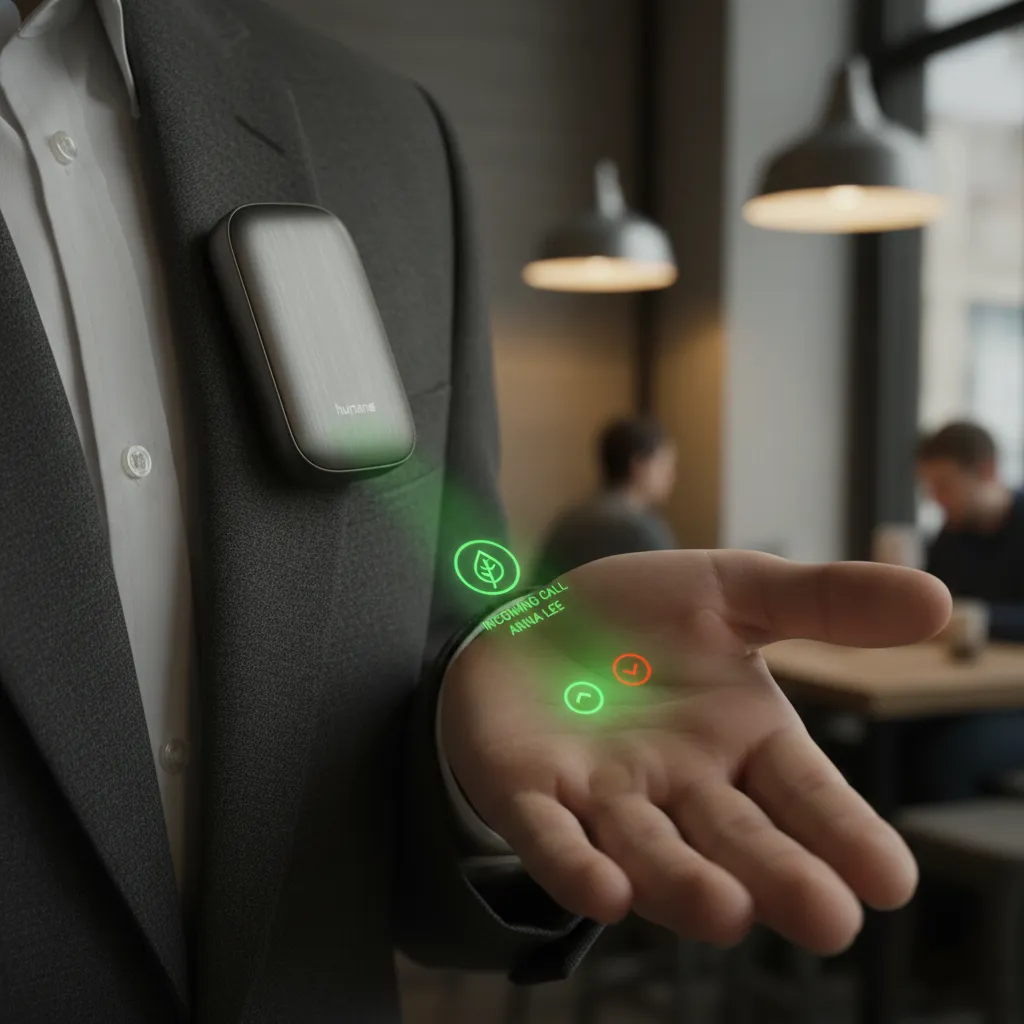
This AI Pin laser display is the Humane team’s answer to the traditional screen. It requires specific light conditions and palm curvature to work optimally, making it a spectacular piece of engineering but a finicky element of the AI Pin user experience. Hand gestures (tilting the hand, pinching fingers) serve as the navigation inputs, attempting to mimic the natural feel of a mouse or touchscreen.
3. Capture and the AI Pin Camera
The device includes a built-in wide-angle AI Pin camera capable of capturing 13-megapixel photos and video. This feature, known as “Capture,” is central to the Pin’s contextual awareness. Users can point the device at an object, and the AI can identify it, translate text, or analyze context—a critical feature for a wearable personal assistant.
[Related: ai-tools-revolutionizing-everyday-productivity]
Humane AI Pin Specs at a Glance
| Feature | Detail | Impact on User Experience |
|---|---|---|
| Processor | Qualcomm Snapdragon (Custom) | Designed for efficiency, but not raw speed. |
| Storage | 32 GB eMMC | Minimal local storage; relies heavily on the cloud. |
| Connectivity | 4G LTE (T-Mobile), Wi-Fi, Bluetooth 5.1 | Standalone operation requires the $24/month subscription. |
| Projector | 720p Laser Ink Display | Low-power, monochromatic, interactive UI on palm. |
| Sensors | Accelerometer, Gyroscope, Magnetometer, Ambient Light | Critical for gesture control and contextual awareness. |
| Weight | Pin: 34g, Battery Booster: 20g | Extremely light, reinforcing the concept of a seamless wearable AI device. |
The Promise vs. The Reality: Humane AI Pin Features and Functionality
The marketing positioned the Humane Inc AI Pin as a revolutionary product that would save us from the tyranny of the screen. It proposed a life where technology enhances reality without dominating attention.
Humane AI Pin Benefits: The Best-Case Scenario
When the Pin works as intended, it offers genuinely impressive glimpses into the future of mobile technology.
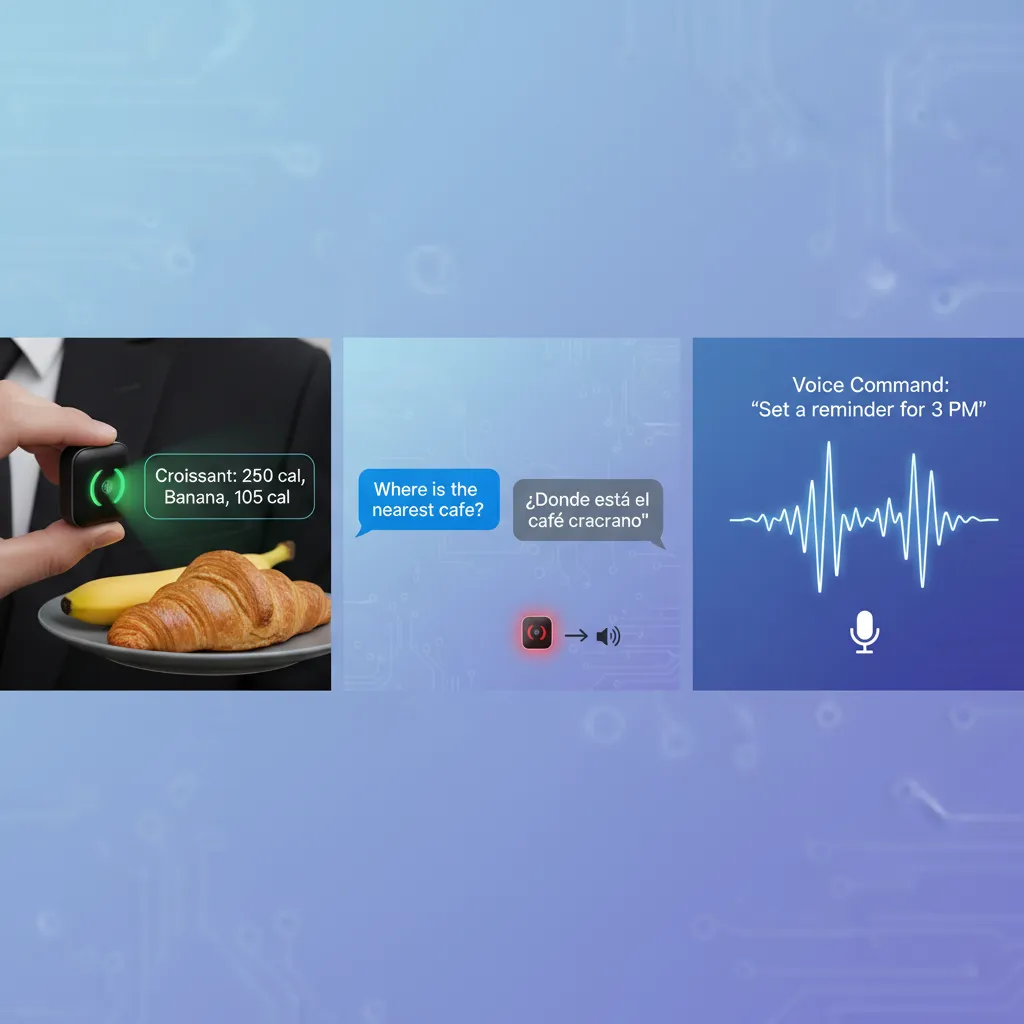
- Real-Time Contextual Search: The Pin excels at asking contextual questions. For example, pointing the camera at food and asking, “Is this safe for my dog?” The AI’s ability to pull information and deliver a precise, synthesized answer via voice is superior to current smartphone assistants.
- Live Translation: One of the most praised Humane AI Pin features is its real-time translation capability. This hands-free, seamless translation is highly effective for travelers, making it a strong selling point for this kind of next generation wearables.
- Digital Detox Potential: The core thesis—reducing screen time—is appealing. As a screenless phone, the Pin forces users to minimize interaction, making it one of the most intriguing best AI gadgets for those seeking balance.
/image-topic.webp
AI Pin Problems: Where Ambition Fails Execution
Unfortunately, the early consensus is that the Pin suffers from significant functional limitations that drastically hinder its goal of being a smartphone replacement. The gap between promise and delivery is often cited in comprehensive tech gadget reviews.
1. Performance and Responsiveness
The biggest hurdle for the Humane AI Pin user experience is latency. Because every query must be processed by powerful LLMs in the cloud, simple requests often take several agonizing seconds. Asking “What’s the weather?” shouldn’t take five to ten seconds on a device designed for immediacy.
2. Power and Battery Life
Humane’s decision to use swappable, magnetic battery boosters is a workaround for poor base battery life. The Pin requires frequent swapping to get through a full day, disrupting the supposed “ambient” feel. Users often find themselves tethered to the charging pad or swapping batteries multiple times, adding friction rather than removing it.
3. Reliance on the Subscription Model
To access basic functionality, including cellular service and the proprietary AI features, users must pay the high Humane AI Pin subscription fee (typically $24/month). This adds a significant long-term cost burden on top of the already steep AI Pin price of $699. This model is a major consideration when deciding is the AI Pin worth it.
4. The Laser Display Drawbacks
While technologically fascinating, the AI Pin laser display is highly sensitive to light. Using it outdoors, under bright lights, or even just walking down a sunny street makes the projection faint or unusable. This limitation severely undermines its utility as a reliable wearable personal assistant in real-world environments.
The Cost of the Future: Price and Subscription Breakdown
Understanding the total investment is essential when evaluating any new hardware in the AI hardware trends space. The Humane AI Pin is positioned as a premium product, and its pricing reflects that.
The Upfront Cost
The base unit AI Pin price is $699. This includes the device itself, one battery booster, and a charging pad. Additional accessories, such as extra battery boosters or cases, drive the initial investment higher.
The Required Monthly Fee
The most debated aspect is the required subscription.
- Cost: $24 per month (T-Mobile service + AI access).
- What it covers: Dedicated 4G LTE service for the Pin (it cannot simply use your smartphone’s Wi-Fi or hotspot for core functionality), and access to the proprietary AI models (Cosmos).
If you keep the device for two years, the total cost looks like this:
| Component | Cost | Notes |
|---|---|---|
| Device (AI Pin) | $699 | One-time purchase |
| Subscription (24 months) | $576 | $24/month fee |
| Total 2-Year Cost | $1,275 | Excludes tax and optional accessories |
This positions the Humane AI Pin financially closer to a high-end flagship smartphone, despite offering significantly less versatile functionality. This high barrier to entry fuels skepticism about its widespread adoption as a smartphone replacement.
The Competition: AI Pin vs. Rabbit R1 and Traditional Smartphones
The wearable AI device space is small but growing, dominated by the Humane AI Pin and another highly anticipated device: the Rabbit R1. Both aim for screenless interaction, but they approach the problem differently.
AI Pin vs. Rabbit R1
The comparison between these two best AI gadgets is inevitable, as they represent the leading edge of AI hardware trends.
| Feature | Humane AI Pin | Rabbit R1 |
|---|---|---|
| Form Factor | Magnetic clip-on, wearable AI device | Handheld, plastic slab with a scroll wheel |
| Display | AI Pin laser display (projection) | 2.88-inch small touchscreen |
| Price | $699 + $24/month subscription | $199 (No required monthly subscription) |
| Core AI | Cosmos (Proprietary LLMs) | LAM (Large Action Model) |
| Goal | Smartphone replacement / Ambient computing | AI companion / Interface for existing apps |
| Connectivity | Built-in 4G LTE (required) | Wi-Fi and optional SIM card |
| Portability | Superior, designed for constant wear | Decent, but meant to be held or pocketed |
The crucial difference is intent: The Rabbit R1 is a low-cost, smart interface designed to execute complex tasks (the “Action” in LAM) through a single interface, integrating with existing services. The Humane AI Pin attempts to provide a fundamentally new, autonomous experience, aiming for full disconnection from the phone.
The Rabbit R1 is a secondary device designed to make digital life easier. The AI Pin is an attempted primary device designed to make digital life disappear.
[Related: ai-personal-assistants-revolutionizing-productivity]
AI Pin vs. The Smartphone Ecosystem
Can the AI Pin truly serve as a smartphone replacement? For most people, the answer is currently no.
The modern smartphone isn’t just a communication device; it’s an integrated ecosystem:
- Visual Interface: Apps, maps, complex data displays, and video consumption rely on high-resolution screens. The screenless phone approach severely limits complex tasks (like navigating dense spreadsheets or viewing detailed maps).
- Productivity Suite: Typing, detailed editing, and multitasking are impossible on the Pin. While the Pin is designed AI Pin for productivity via voice, it fails when the task requires visual confirmation or text input.
- App Utility: Every specialized industry—banking, transport, social media, health—has an app. The Humane AI Pin lacks this open platform access, limiting its real-world utility compared to even a budget smartphone.
The Pin is a fantastic wearable personal assistant for immediate, simple tasks (weather, basic messaging, quick search), but it cannot handle the complexity of modern life that smartphones effortlessly manage.
/image-topic.webp

Deep Dive: The AI Pin User Experience in Daily Life
To determine if the Pin is a fad or the future of mobile technology, we must analyze its performance in core daily use cases.
Communication and Messaging
The Pin supports basic messaging and calling via its T-Mobile SIM. Interactions are entirely hands-free.
- Pros: Truly hands-free communication. Excellent for short voice notes or quick replies when driving or exercising.
- Cons (AI Pin Problems): The transcriptions, while generally good, can struggle in noisy environments. Crucially, the Pin doesn’t support mainstream messaging apps like WhatsApp or Signal, forcing users back onto their traditional smartphones for social communication. This fragmentation undermines the smartphone replacement goal.
Photography and Visual Search
The AI Pin camera offers a powerful tool for visual understanding. Pointing it at a nutritional label or a foreign sign and instantly receiving a verbal summary or translation is magical.
- Pros: Highly effective real-time translation and object identification. The contextual awareness is industry-leading among wearable AI devices.
- Cons: As a primary camera, it is frustrating. There is no viewfinder, meaning framing shots is guesswork. Furthermore, the Pin only captures when explicitly commanded, making quick, spontaneous photography impossible compared to a smartphone.
The “Catch Me Up” Feature (Breathe)
Humane’s proprietary feature, “Breathe,” acts as an AI summary tool, analyzing your messages and notifications to give you a quick digest of what you missed while you were “offline.”
- Pros: Genuine AI Pin for productivity boost. It synthesizes information intelligently, prioritizing what the user needs to know.
- Cons: The underlying challenge remains: if you haven’t granted the Pin access to your full communication stack (email, calendar, all messaging apps), its summary will always be incomplete and unreliable.
Evaluating the Verdict: Is the Humane AI Pin Worth the Investment?
After reviewing the Humane AI Pin specs, its performance, and the high financial commitment, we can address the central question: is the AI Pin worth it?
Who Is the AI Pin For? (The Early Adopter)
The Humane AI Pin, in its current iteration, is not for the mass market. It is strictly for:
- Wealthy Early Adopters: Individuals with disposable income eager to participate in AI hardware trends and tolerate the bugs and limitations of a 1.0 product.
- Tech Reviewers and Developers: Those needing to test the limits of next generation wearables and ambient computing device concepts.
- The Digital Minimalist: Someone who truly values being disconnected but needs a lifeline for essential, hands-free communication and assistance.
Why It’s a “Fad” (Currently)
The current state of the Humane AI Pin leans heavily toward “fad” territory for the general public, primarily due to:
- Immature Software: Latency issues, high rate of inaccurate responses, and the inability to handle complex multi-step instructions.
- High Total Cost: The combined AI Pin price and non-negotiable Humane AI Pin subscription make it too expensive for the limited functionality it provides.
- Unresolved Core Issues: The poor battery life and the unreliability of the AI Pin laser display in varied environments prevent it from being a seamless, always-on device.
Why It Represents the “Future” (The Concept)
Despite its flaws, the Pin provides a critical roadmap for the future of mobile technology.
- The Interface is the Intent: Humane successfully demonstrated that powerful AI can live off-screen, interacting with the world naturally through voice, context, and environment.
- Ambient Computing: The core idea of having a wearable AI device that anticipates needs rather than waiting for finger taps is the direction all personal technology is moving. The Pin is an ambitious proof-of-concept for the true wearable personal assistant.
- AI Hardware Trends: The investment in a custom device optimized solely for LLMs signals a new wave of devices where specialized AI chips will replace generalized CPU dependency.
[Related: ai-revolutionizes-gaming-future-immersive-play]
The Humane AI Pin is less a viable product today and more a crucial stepping stone. It’s a prototype of what a true screenless phone could be five years from now, once hardware miniaturization, power efficiency, and AI responsiveness improve exponentially. For now, it remains one of the most intriguing but flawed tech gadget reviews subjects of the decade.
Conclusion: A Visionary Device Awaiting its Time
The Humane AI Pin review reveals a product of staggering ambition, built by some of the sharpest minds in consumer technology. It seeks to liberate us from the tyranny of the screen by providing a seamless, voice-activated AI assistant integrated into our daily lives.
We asked if the Humane AI Pin is a fad or the future. The answer is nuanced: it is a 1.0 product of the future.
The current version is marred by the reality of current technology limitations—slowness, high cost, and practical AI Pin problems like battery drain and the unreliable AI Pin laser display. It cannot yet function as a credible smartphone replacement for 99% of consumers. It is a fantastic showcase of AI hardware trends but an impractical daily device.
If you are fascinated by wearable technology 2024 and want to witness the birth of ambient computing devices firsthand, the Humane AI Pin offers an unparalleled, albeit expensive, window into that world. For everyone else, hold on to your smartphone—the true, functional future of the screenless phone is still a few generations away, learning vital lessons from the bold experiment that is the Humane Inc AI Pin.
[Related: best-ai-personal-assistants-productivity]
FAQs: Humane AI Pin
Q1. What exactly is the Humane AI Pin designed to do?
The Humane AI Pin is a standalone, cellular-connected wearable AI device designed to serve as a smartphone replacement by using a voice-activated AI assistant for communication, search, and contextual assistance (like real-time translation or object identification). It aims to minimize screen reliance, promoting an experience known as ambient computing device.
Q2. How much does the Humane AI Pin cost, including the subscription?
The upfront AI Pin price is $699. Additionally, it requires a mandatory Humane AI Pin subscription of $24 per month to cover cellular connectivity and access to the proprietary AI services. Over two years, the total cost exceeds $1,275.
Q3. What is the Laser Ink Display and how does it work?
The AI Pin laser display is a miniature projector that casts a green, monochromatic, interactive interface onto the user’s palm. It allows the user to view notifications, navigate menus, and see contextual information using hand gestures. However, one of the frequently cited AI Pin problems is that the display is hard to see in bright sunlight.
Q4. Is the Humane AI Pin a true replacement for a modern smartphone?
No, not in its current iteration. While the Pin offers strong voice-activated features and acts as a wearable personal assistant for simple tasks, it lacks the crucial functionality of a smartphone, such as third-party app support, visual map navigation, and the ability to handle complex data entry or detailed productivity tasks.
Q5. What are the main limitations or “AI Pin problems” according to early reviewers?
Major limitations include significant latency (slowness) when querying the AI, poor battery life requiring constant use of swappable battery boosters, the unreliability of the projected display in varied light, and the high total cost stemming from the mandatory Humane AI Pin subscription.
Q6. How does the Humane AI Pin compare to the Rabbit R1?
The AI Pin vs Rabbit R1 comparison shows that the Pin is a more expensive ($699 + subscription), screenless, clip-on wearable AI device aiming for full smartphone replacement. The Rabbit R1 is cheaper ($199, no required subscription), handheld, has a small screen, and is designed to be an AI companion that uses a Large Action Model (LAM) to control apps on your behalf.
Q7. Does the Humane AI Pin have a camera, and what is it used for?
Yes, it has a built-in wide-angle AI Pin camera (13 megapixels) called “Capture.” It’s primarily used for visual identification and contextual awareness, allowing the AI to analyze objects, translate text in real-time, or identify landmarks. It is not designed to be a replacement for a smartphone’s general-purpose camera.
Q8. What does “Ambient Computing Device” mean in the context of the AI Pin?
An ambient computing device refers to technology that is pervasive, always present, and integrated seamlessly into the environment without demanding the user’s conscious attention (unlike a screen). The Humane AI Pin embodies this by being worn on clothing and only activated by voice or gesture, attempting to integrate AI assistance naturally into the background of daily life.