Google’s AI Overviews: The Future of Search?

Introduction: The Ground Shifts Beneath Google Search
For decades, the standard Google search results page was sacrosanct: a clean list of ten blue links, often prefaced by a small Featured Snippet or a few ads. But the digital landscape is being rapidly reshaped by generative AI, and Google is responding with its most profound overhaul in over a decade: the introduction of AI Overviews.
Announced as the full-scale replacement for what was previously known as the Search Generative Experience (SGE), these summaries are no longer experimental. They are quickly becoming the default way millions of users worldwide interact with Google.
At the core of this transformation is a singular question: Are AI Overviews truly the future of search, or are they a disruptive experiment that will fundamentally alter the web ecosystem as we know it?
This article dives deep into the mechanisms of Google AI search, analyzes the severe criticisms regarding AI Overviews accuracy and reliability, and provides a clear roadmap for adapting SEO for AI. We will explore the technical change, the significant impact of AI on SEO, and offer practical Google search tips for navigating this new era, whether you are a user, a content creator, or a digital marketer.
Decoding the AI Overview: What is Google’s Generative Search?
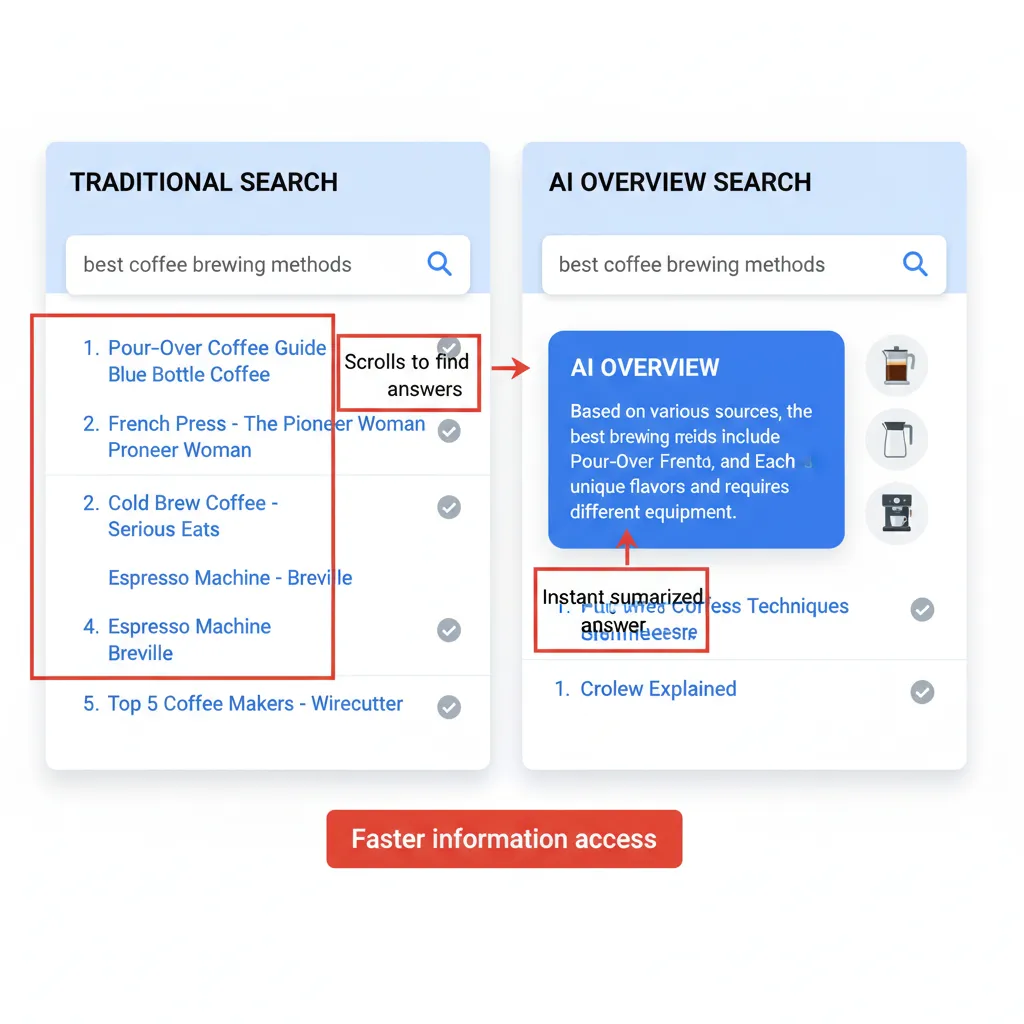
To understand the shift, we must first define the technology. AI Overviews are summaries generated by Google’s large language models (LLMs)—specifically tuned versions of models like Gemini—that appear at the very top of Google search results. Instead of just pointing you to a source, the AI attempts to synthesize information from multiple sources on the web to provide a direct, coherent, and often detailed answer to your query.
This move marks a departure from classical information retrieval to generative AI search. It’s designed not just to index the web, but to understand the intent behind complex, conversational queries.
From Featured Snippets to Generative AI Search
For years, the closest Google came to providing direct answers was the Featured Snippet. This box pulled content from a single, highly authoritative source. However, AI Overviews are fundamentally different:
- Scope and Depth: Featured Snippets are brief; AI Overviews can be long, multi-paragraph, and even multi-step explanations or comparisons.
- Source Aggregation: While a snippet relies on one source, AI Overviews synthesize and cite data from three to five different URLs, blending them into a single response.
- User Intent: AI Overviews excel at complex, multi-faceted, or exploratory questions that previously required several distinct searches.
The official launch, prominently highlighted at Google IO 2024, signaled that Google sees this as a long-term, structural change, not a temporary feature.
The Mechanics: How AI Overviews Work
The process behind how AI Overviews work involves several layers of sophisticated Google search algorithm engineering:
- Query Understanding (Semantic Search): When a user enters a query, Google uses semantic search and AI to understand the meaning and intent rather than just matching keywords. This allows the system to handle long, conversational, or ambiguous searches.
- Information Retrieval: The system retrieves thousands of relevant documents from its index, similar to a traditional search.
- Synthesis and Generation: The generative AI model takes the top-ranking, high-quality sources, reads them, and constructs a completely new, coherent summary. This generated text is the AI Overview.
- Citation and Grounding: Crucially, Google attempts to “ground” the AI’s response by linking back to the original source pages (usually 3 to 5 links displayed directly below the generated text).
This grounding mechanism is Google’s defense against poor AI search results quality and hallucination, but as we’ll see, it is not always effective.
The Roller Coaster of Accuracy: Why Trust is the Main Hurdle
While the promise of instant, comprehensive answers is alluring, the actual rollout of AI Overviews has been fraught with controversy, prompting significant AI Overviews criticism. The inherent weaknesses of large language models—namely, the tendency to “hallucinate” or confidently present false information—have led to high-profile, embarrassing Google AI mistakes.
High-Profile Google AI Mistakes and “Hallucinations”
Immediately following the widespread rollout, the internet exploded with examples of nonsensical or dangerous AI-generated answers. Examples included:
- Suggesting users use non-toxic glue to keep cheese stuck to pizza.
- Providing dangerous chemical formulas derived from obscure forum posts.
- Falsely claiming that certain historical figures were fictional characters.
These mistakes underscore a fundamental challenge: AI models prioritize coherence and confidence in their output. When faced with conflicting, satirical, or low-quality data in the training set or search index, the model can generate plausible-sounding but factually incorrect information. This directly compromises the goal of providing high AI search results quality.
[Related: ai-ethics-responsible-development-future]
The Criticism: Safety, Trust, and the Integrity of Information
The public’s trust in Google is largely built on the assumption that its search results reflect the relative quality and authority of the indexed web. When a highly authoritative, automatically generated answer appears at the top, but contains errors, it damages user confidence.
This is why AI Overviews accuracy remains the single biggest challenge. When information relates to sensitive topics—like health, finance, or safety—the stakes are too high for reliance on generative outputs that are not meticulously vetted. Search Quality Raters, who assess the quality of Google search changes, are now paying unprecedented attention to the reliability of these generative AI search outputs.
Google’s Response and the Phased Rollout
Google has repeatedly adjusted the system, focusing on “guardrails” and improving the grounding process. The company has acknowledged that it needs to handle low-frequency and highly creative queries differently from straightforward, factual questions.
The latest Google AI update 2024 efforts involve:
- Restricting AIO for YMYL Topics: Reducing the frequency or complexity of AI Overviews for queries related to Your Money or Your Life (YMYL—health, safety, finance).
- Improving Citation Quality: Trying to prioritize highly authoritative sources within the summary generation process.
- Faster Feedback Loops: Using user feedback to quickly address and remove problematic answers.
Despite these efforts, the existence of easily visible Google AI mistakes introduces volatility into the user experience with AI search.

The Seismic Shift for SEO and Content Strategy
The integration of AI Overviews has created an existential crisis for many content creators and businesses reliant on organic search traffic. When Google answers the query directly, why would a user click through to the source website? This is the crucial aspect of the impact of AI on SEO.
The Zero-Click Phenomenon and Traffic Loss
AI Overviews dramatically accelerate the trend toward zero-click searches. If the AI provides a comprehensive answer—a recipe, a definition, a short history—the user’s need is satisfied immediately on the search engine results page (SERP).
Initial studies indicate that websites, particularly those focused on factual or explanatory content, could see a significant drop in organic click-through rate (CTR). This traffic displacement forces a pivot in content strategy:
- Focusing on Complexity: Moving away from easily answerable, simple queries (the kind the AI is great at summarizing).
- Driving Action and Utility: Creating content that requires user interaction, tools, unique data, or deep dive analysis that an AI summary cannot replicate.
- Branding and Authority: Users might trust AI-generated answers for simple facts, but they trust established brands for solutions, reviews, and detailed guidance.
Adapting SEO for AI: New Ranking Factors and Visibility Strategies
The key to surviving and thriving in this new environment is AI search engine optimization. We must stop optimizing only for the ten blue links and start optimizing for AI visibility.
The Goal: Becoming a Cited Source in the AI Overview
The primary new SEO objective is to be one of the three to five sources cited by the AI Overview. This means traditional ranking factors are still vital, but they are viewed through a new lens: authority and clarity.
H3. Entity Optimization and Semantic SEO
AI Overviews rely heavily on Google’s understanding of entities (people, places, things, concepts) and their relationships.
- Move Beyond Keywords: Instead of stuffing keywords, focus on establishing clear, rich connections between the entities on your page. Use schema markup to explicitly define what your content is about.
- Answer Related Questions: Comprehensive content that addresses peripheral questions about a core entity is more likely to be seen as a strong, authoritative source by the generative model. This is the heart of effective semantic search and AI.
H3. The Reinforcement of Authority and EEAT
Google’s need to counter the AI Overviews criticism means it is doubling down on the quality guidelines established by the Search Quality Rater guidelines.
EEAT—Experience, Expertise, Authoritativeness, and Trustworthiness—is no longer just a helpful guideline; it’s a required defense mechanism against generative inaccuracy. Websites must demonstrate:
- Experience: Showcasing first-hand knowledge (photos, videos, case studies).
- Expertise: Having verifiable authors or credentials (author biographies, organization history).
- Authority: Earning mentions and links from other recognized experts.
- Trustworthiness: Ensuring technical security, transparent policies, and factual accuracy.
If the generative model can’t confidently assign a high EEAT score to a source, it is less likely to be used in the AI Overview, especially for high-stakes queries.
[Related: ai-productivity-tools-2024]
H3. Moving Beyond Traditional Keywords: The Long-Tail Semantic Query
The introduction of AI search changes the very nature of the query. Users are learning they can ask Google longer, more complex, and conversational questions.
- Old Strategy: Optimize for “best lightweight hiking boots.”
- New Strategy: Optimize for conversational queries like, “What are the pros and cons of Gore-Tex versus eVent materials in lightweight hiking boots for winter climates?”
Content creators must write comprehensive guides that directly address these long-tail, comparative, or solution-focused queries in detail. These are the kinds of complex questions where the AI-generated answers will rely heavily on highly structured content.

User Control and Experience: Can You Disable AI Overviews?
For users uncomfortable with the volatility of AI-generated answers or who simply prefer the traditional blue links, the question of user control is paramount. Many searches now focus on “how to turn off AI Overviews” or “disable AI Overviews”.
How to Turn Off AI Overviews (For Now)
As Google pushes AI Overviews into the default search experience, there is no simple, universal “off” switch for all users at the system level. However, users can employ several strategies:
- Using Specific Search Operators: Adding terms like
redditorforumto your query often forces Google to display traditional link results, as the AI struggles to synthesize opinions or subjective experience. - Browser Extensions: Some third-party browser extensions have emerged specifically to detect and hide the AI Overview element on the SERP, restoring the classical layout.
- Using the “Web” Filter: In some regions, selecting the “Web” filter (instead of “All”) above the search results can occasionally suppress the AI Overview, though this is inconsistent and subject to change based on the Google AI update 2024 schedule.
- Refining the Query: Queries that are inherently navigational (“login to Amazon”) or transactional (“buy running shoes”) are less likely to trigger a generative AI response.
The Future of User Experience with AI Search
Despite the pushback, Google is committed to the long-term vision of an AI-enhanced experience. The user experience with AI search is ultimately heading toward greater personalization and utility.
Imagine an AI Overview that doesn’t just summarize a topic but helps you plan a weekend trip based on your known preferences, budget, and real-time data—all aggregated seamlessly. This task-completion capability is the true endpoint of SGE and the reason Google is investing so heavily.
[Related: ai-wearable-tech-revolutionizing-health-wellness/]
The Final Countdown: Featured Snippets vs AI Overviews
The evolution from Featured Snippets to AI Overviews represents a fundamental shift in Google’s responsibility.
| Feature | Featured Snippet (Old Paradigm) | AI Overview (New Paradigm) |
|---|---|---|
| Source Count | Typically one single source. | Multiple sources (3-5 citations). |
| Content Type | Direct extract, short, factual. | Synthesized, generated text, conversational. |
| Underlying Tech | Information Retrieval & Extractive QA. | Large Language Models (LLMs) & Generative AI. |
| Risk Profile | Lower risk (directly citing source). | Higher risk (prone to “hallucination”). |
| SEO Impact | Massive positive impact for single winner. | Diluted clicks; optimization requires becoming one of many sources. |
The key takeaway is that where the Featured Snippet elevated one page, the AI Overview dilutes the spotlight across several, demanding greater overall EEAT and quality from all top-ranking sites.
What Comes Next? The Future of Search Generative Experience
The current generation of AI Overviews is likely just the beginning. Google is leveraging its massive computational resources to move search from a place where you find answers to a place where you get things done.
Personalized and Multi-Modal Search
Future iterations will incorporate deeper levels of personalization, blending results with your Gmail, Maps history, and other services. Furthermore, multi-modal capabilities—searching with images, video, and spoken word—will make the AI Overview an evolving, interactive answer rather than a static text box.
Imagine asking Google, “What is the best way to compost kitchen scraps given the dry climate in my zip code?” The AI Overview won’t just generate a generic answer; it will pull local climate data, check local regulations, and synthesize that information into a personalized, actionable plan.
The Convergence of Search and Task Completion
The ultimate future of search is one where the query is not just answered, but completed. We are moving towards a system where the generative AI helps you draft an email, book an appointment, or summarize a long document directly within the search interface.
For publishers and marketers, this convergence means that content must be geared toward task enablement. If your content is solely informational, it risks being summarized away. If it leads to a service, a unique tool, or a proprietary database, it maintains its essential value and click-through potential.
[Related: future-of-ai-search-technology-88264]

Conclusion: Navigating the AI Frontier
Google’s introduction of AI Overviews fundamentally changes the contract between search engine and user, and between search engine and publisher. It is a powerful, albeit imperfect, step into a future of search defined by instant synthesis and direct answers.
While concerns about AI Overviews accuracy and the looming threat of zero-click searches are valid, the transition also presents opportunities. The new era of AI in search engines rewards quality, authority, and deeply structured content. Adapting SEO for AI is not about fighting the change, but about mastering the rules of generative visibility.
For content creators, the path forward involves investing heavily in EEAT, focusing on unique primary research, and structuring content to be easily digestible yet profoundly authoritative. For users, it means exercising a healthy skepticism toward AI-generated answers and actively refining your Google search tips to get the best, most reliable information possible. The future of search is here, and it demands constant vigilance and intelligent adaptation.
FAQs: Understanding Google’s AI Overviews
Q1. What is Google’s Search Generative Experience (SGE)?
SGE (Search Generative Experience) was the initial, experimental name for Google’s integration of generative AI directly into its search engine, designed to provide comprehensive, synthesized answers at the top of the search results page. It has now been officially rolled out and rebranded as AI Overviews.
Q2. How is a Featured Snippet different from an AI Overview?
A Featured Snippet extracts a short, direct answer from one single, high-ranking source. An AI Overview uses a Large Language Model to synthesize and generate a new, often multi-paragraph summary from multiple high-authority sources, citing each one beneath the answer.
Q3. How does the AI Overview impact website traffic?
The primary impact of AI on SEO is the acceleration of zero-click searches. If a user’s query is fully answered by the AI Overview, they may not click through to the source website, potentially leading to a decrease in organic traffic for informational content.
Q4. Can I permanently disable AI Overviews?
Currently, there is no permanent, universal setting to disable AI Overviews across your Google account, as the feature is integrated into the core search experience. However, using specific search operators, browser extensions, or selecting the “Web” filter may temporarily suppress them.
Q5. Why are AI Overviews sometimes inaccurate?
AI Overviews accuracy suffers because the underlying large language models (LLMs) prioritize generating coherent text, which can lead to “hallucinations”—confidently presenting factually incorrect information based on errors or ambiguities found in low-quality or satirical training data.
Q6. What is the biggest challenge for SEO with AI Overviews?
The biggest challenge for SEO and AI is optimizing to be the authoritative source cited within the generated response, rather than just ranking on the first page. This requires rigorous attention to EEAT, content depth, and structured data, moving beyond traditional keyword ranking.
Q7. Does Google use AI Overviews for all searches?
No. Google selectively deploys AI Overviews based on the complexity and sensitivity of the query. They are less likely to appear for navigational (e.g., “Facebook login”), transactional (e.g., “buy tickets”), or highly sensitive YMYL (Your Money or Your Life) topics where factual precision is critical.