Future-Proof Your Career: Essential Skills for the AI-Driven Workforce

Introduction
The conversation around Artificial Intelligence has shifted from a distant, sci-fi curiosity to a daily headline reality. From generating code to composing music, AI is reshaping industries at a pace that feels both exhilarating and unnerving. For many professionals, this raises a critical question: “Will my job be here in five years?” The truth is, the old career playbook is obsolete. The concept of a linear, stable career path is giving way to a dynamic, ever-evolving landscape.
The good news? The future isn’t about humans versus AI. It’s about humans with AI. The fear of replacement is being overshadowed by the massive opportunity for augmentation. This new era, the AI-driven workforce, doesn’t demand that we all become data scientists or machine learning engineers. Instead, it calls for a strategic blend of uniquely human skills and a new level of digital fluency.
This guide is your comprehensive roadmap to navigating this transition. We’ll move beyond the hype and dive deep into the tangible, essential AI skills you need to not just survive, but thrive. You’ll learn how to cultivate a mindset of continuous learning, master the art of human-AI collaboration, and ultimately, future-proof your career for the exciting decades to come.
The New Reality: Why “Future-Proofing” is Now a Critical Career Strategy
For generations, “job security” meant finding a stable role in a solid company and climbing the corporate ladder. Today, that stability is an illusion. The AI impact on jobs is not a simple story of automation and elimination; it’s a complex narrative of transformation and redefinition. Repetitive, process-driven tasks—from data entry to basic customer service—are increasingly being handled by AI with superior speed and accuracy.
According to a report by Goldman Sachs, generative AI could expose the equivalent of 300 million full-time jobs to automation. But “expose” isn’t the same as “eliminate.” The same report highlights the potential for massive productivity gains and the creation of entirely new job categories we can’t yet imagine.
This is the core of the workforce evolution AI is driving. It’s a shift from valuing employees who can perform tasks to valuing those who can solve novel problems, think critically, and leverage technology creatively. Your value is no longer in what you can do repetitively, but in how you can think, adapt, and collaborate with intelligent systems. This makes career adaptation AI a non-negotiable skill for anyone serious about long-term professional relevance and career growth in the AI era.
The Unbeatable Core: Human Skills in the Age of AI
As technology becomes more sophisticated, our most human qualities become more valuable, not less. These “soft skills” are the bedrock of a future-proof career because they address the inherent limitations of AI. While AI can process data, it cannot understand context, feel empathy, or navigate complex human dynamics.
Critical Thinking & Complex Problem-Solving
An AI can analyze a million data points and identify a correlation. But it takes a human to ask why that correlation exists, whether it’s meaningful, and what strategic decision should be made based on that insight. In the critical thinking AI age, your job is to be the chief interrogator of the data. You must question the outputs of AI, spot potential biases in its training data, and solve problems that don’t have a pre-existing playbook.
- In Practice: A marketing manager uses an AI tool that suggests reallocating the entire ad budget to a new social media platform based on raw engagement data. A critical thinker would dig deeper: Is this engagement from our target demographic? What is the conversion rate? What are the long-term brand implications? This is the kind of problem solving in the AI era that machines can’t do alone.
Creativity & Innovation
Contrary to popular fear, AI is not the end of creativity; it’s a powerful new tool for it. Generative AI can produce drafts, images, and musical scores, but it operates on patterns it has learned from existing data. True, groundbreaking creativity in the AI world comes from connecting disparate ideas, imagining something entirely new, and pushing cultural boundaries.
Professionals who can use AI as a creative partner—a brainstorming assistant, a rapid prototyping tool, or a way to overcome creative blocks—will be the innovators of tomorrow. This symbiotic relationship amplifies human ingenuity, allowing us to explore more ideas faster than ever before. Related: Unleash Your Inner Composer: The Best AI Music Generators of 2024
Emotional Intelligence (EQ) & Communication
Emotional intelligence in AI contexts is perhaps the most durable human skill. The ability to lead a team, negotiate with a client, mentor a colleague, and build trust are all rooted in empathy and nuanced communication. An AI can draft an email, but it can’t sense the mood in a boardroom or deliver difficult feedback with compassion.
As routine communication tasks get automated, the premium on high-level interpersonal skills will skyrocket. Leadership in the AI age will be defined by one’s ability to inspire and guide teams through constant change, fostering psychological safety and a culture of collaboration.
Adaptability & Continuous Learning
The single most important skill for the future is not a specific technical ability, but a mindset: the commitment to continuous learning. The tools, platforms, and even the fundamental principles of AI are evolving at a breathtaking rate. What’s cutting-edge today will be standard tomorrow and obsolete the day after.
Adapting to the AI workforce means embracing a state of “perpetual beta.” It requires intellectual curiosity and the humility to know that your skillset needs constant updating. The future belongs to the lifelong learners who actively seek out new knowledge and are not afraid to upskill for AI, even if it means stepping outside their comfort zone. This is the essence of future of learning skills.
The Technical Toolkit: Essential AI Skills for Every Professional
While human skills are your foundation, you can’t build a future-proof career without a functional toolkit. This doesn’t mean you need a Ph.D. in machine learning. It means developing a practical understanding of the technology that is reshaping your industry. These are the technical skills for AI jobs of all kinds, not just for engineers.
Digital & AI Literacy
At its core, digital literacy in the AI era means understanding the fundamental concepts of how AI works. You should be able to grasp terms like machine learning, neural networks, large language models (LLMs), and generative AI.
This isn’t about knowing how to code the algorithms; it’s about understanding what they can and cannot do. This knowledge demystifies the technology, helps you identify opportunities to use AI in your role, and protects you from falling for hype. It’s one of the most fundamental AI readiness skills.

Data Literacy
AI is fueled by data. Therefore, the ability to read, interpret, analyze, question, and communicate data is no longer a niche skill for analysts—it’s a universal requirement. You need to be comfortable looking at a dashboard and drawing meaningful conclusions, spotting anomalies, and using data to support your decisions. In the jobs in the AI economy, every role is, to some extent, a data role.
Mastering AI Tools & Prompt Engineering
This is where the rubber meets the road. The most immediate way to boost your value is to become a power user of the AI tools for professionals that are relevant to your field.
- Marketers: Using generative AI for ad copy variations, SEO analysis, and content ideation.
- Developers: Using AI code assistants like GitHub Copilot to write, debug, and document code faster.
- Designers: Using AI image generators for mood boards and concept art.
- Managers: Using AI assistants to summarize meetings, draft reports, and manage schedules.
A critical component of this is learning prompt engineering—the art and science of communicating with AI to get the desired output. A well-crafted prompt can be the difference between a generic, useless response and a brilliant, insightful one. It’s a new form of communication, and mastering it is a core skill for the AI era. Related: Mastering Generative AI for Next-Gen Content Creation
The Synergy Skillset: Mastering Human-AI Collaboration
The ultimate goal is not to have a set of human skills and a separate set of technical skills. The real magic happens when you merge them into a seamless, synergistic workflow. This is the essence of human-AI collaboration skills.
Think of AI as the most capable intern you’ve ever had. It’s incredibly fast, has access to nearly all public information, and can handle immense amounts of grunt work without complaint. But it needs direction, context, and critical oversight. Your job is to be the brilliant manager of this intern.
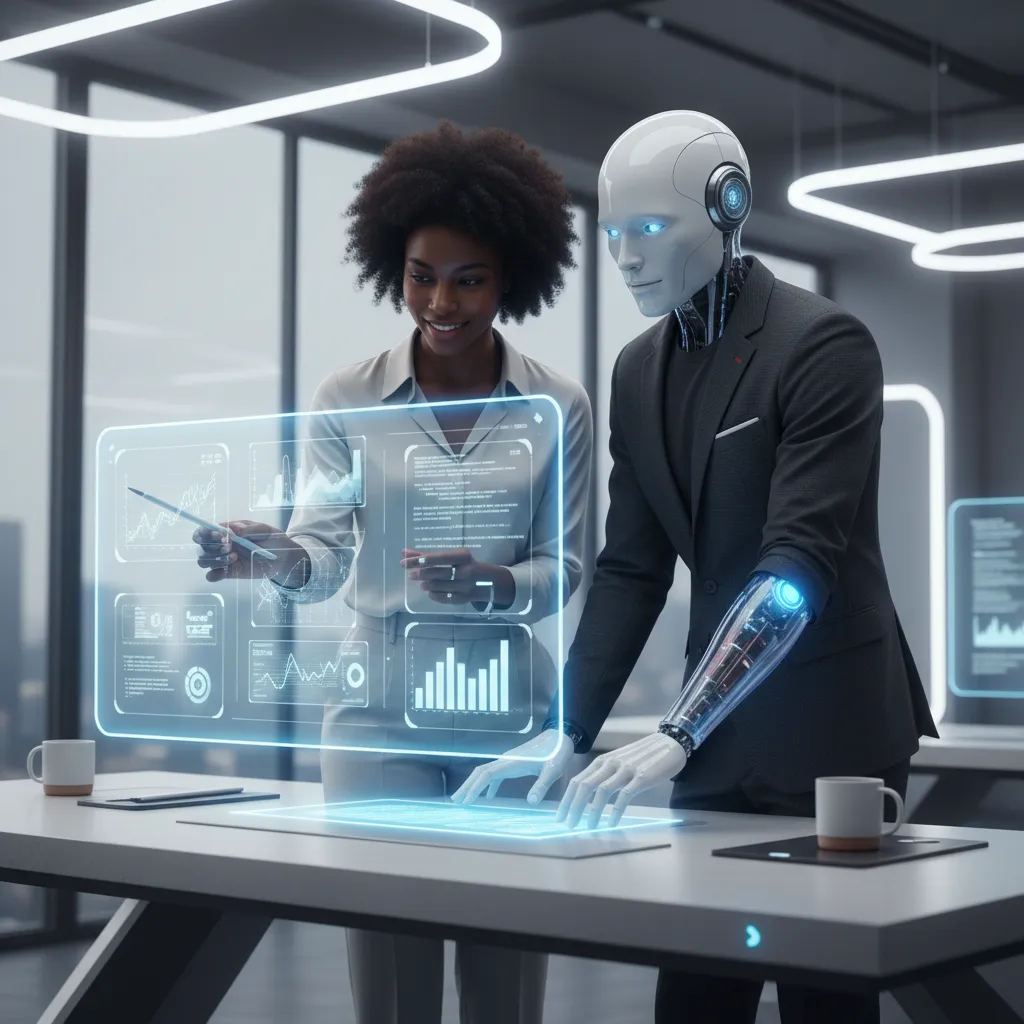
This collaborative model redefines productivity.
- Old Model: A researcher spends 8 hours finding and summarizing 20 academic papers.
- New Model: The researcher spends 10 minutes prompting an AI to find and summarize the papers, then spends the next 7.5 hours analyzing the insights, cross-referencing the findings, and developing a novel hypothesis—the high-value work that only a human can do.
Becoming an “AI Shepherd”
A crucial aspect of this collaboration is auditing and guiding AI systems. AI models can have biases, make factual errors (or “hallucinate”), and lack common sense. A skilled professional acts as a shepherd, validating the AI’s output, correcting its course, and ensuring its use is ethical and responsible. This requires a sharp, critical eye and a deep understanding of your subject matter.
Leadership in the AI Age
For those in management, this means learning to lead hybrid teams of people and AI agents. It involves redesigning workflows to integrate AI, training your team on how to best leverage these new tools, and fostering a culture of experimentation and psychological safety. Leaders must set the strategy and the ethical guardrails for AI use within their organizations. Related: The Future of Personal Computing Beyond AI PCs
Your Action Plan: A Roadmap for Reskilling and Upskilling for AI
Understanding these skills is the first step. Building them is the journey. Here is a practical roadmap for reskilling for AI and future-proofing your career.

Step 1: Assess Your Current Skills and Identify Gaps
Be honest with yourself. Where do you stand on the skills listed above?
- Create two columns: “Strengths” and “Areas for Growth.”
- Rate yourself on a scale of 1-10 for skills like data literacy, prompt engineering, critical thinking, and adaptability.
- Identify the 2-3 skills that would have the most immediate impact on your current role or desired career path.
Step 2: Leverage Online Courses and Certifications
The resources for learning AI for a career are abundant and often free or low-cost.
- Foundational Knowledge: Look at courses like “AI for Everyone” by Andrew Ng on Coursera or Google’s “Introduction to Generative AI.”
- Platform-Specific Skills: Major tech companies like Microsoft, Google, and Amazon offer certifications for their AI platforms.
- Role-Specific Training: Look for courses on platforms like LinkedIn Learning or Udemy that are tailored to your profession (e.g., “AI for Marketers”).
Step 3: Embrace Project-Based Learning
Reading about AI is not the same as using it. The fastest way to learn is by doing.
- Pick a Project: Choose a small project in your current job that you can tackle with an AI tool. It could be automating a weekly report, generating social media content, or analyzing customer feedback.
- Document Your Process: Note what worked, what didn’t, and how you refined your prompts and workflow. This hands-on experience is invaluable.
- Build a Portfolio: Even if they are just personal projects, having tangible examples of how you’ve used AI to solve a problem is a powerful asset for your resume and career narrative.
Step 4: Network and Stay Informed on AI Job Market Trends
The landscape is changing monthly. Staying current is a skill in itself.
- Follow the Experts: Follow AI leaders, researchers, and publications on LinkedIn and X (formerly Twitter).
- Read Newsletters: Subscribe to industry-leading newsletters that curate the most important AI news.
- Join Communities: Participate in online forums or local meetups to discuss AI job market trends and learn from your peers. Related: GPT-4o: The Future of AI is Here and It’s Free
Conclusion
The rise of AI is not a threat to be feared but a paradigm shift to be embraced. The future of work skills are not about out-competing machines at their own game of speed and processing power. Instead, they are about elevating our most human capabilities: our ability to think critically, to create, to connect with others, and to constantly adapt.
By focusing on a dual mastery of timeless human skills and modern technical literacy, you can transform AI from a potential disruptor into your most powerful career accelerant. The journey to future-proof your career is not a one-time fix but a continuous process of learning, experimenting, and evolving.
Start today. Pick one tool to master, one concept to learn, one project to start. The future of work isn’t something that happens to you; it’s something you actively build, one skill at a time.
Frequently Asked Questions (FAQs)
Q1. What are the most important skills for the future with AI?
The most important skills are a hybrid of human-centric abilities and technical competencies. The key human skills include critical thinking, complex problem-solving, creativity, emotional intelligence, and adaptability. These are complemented by essential technical skills like digital and AI literacy, data literacy, and the practical ability to use AI tools, including prompt engineering.
Q2. Will AI replace my job?
For most professions, AI is more likely to transform jobs rather than replace them entirely. It will automate repetitive and predictable tasks, allowing humans to focus on more strategic, creative, and interpersonal aspects of their roles. Roles that require deep critical thinking, creativity, and empathy are the most resilient. The key is to adapt by learning to work alongside AI.
Q3. How can I start learning AI skills without a technical background?
You don’t need to be a coder to acquire ai skills for the future. Start with foundational, non-technical courses like Coursera’s “AI For Everyone” to understand the concepts. Then, begin actively using free AI tools like ChatGPT, Gemini, or Microsoft Copilot for daily tasks. Focus on learning prompt engineering—how to ask the right questions to get the best results. This practical application is one of the fastest ways to build your skills.
Q4. What are some examples of human-AI collaboration in the workplace?
Human-AI collaboration is already happening everywhere. A marketing team might use AI to generate dozens of ad copy ideas, with a human copywriter selecting and refining the best ones. A software developer uses an AI assistant to write boilerplate code, freeing them up to focus on complex architecture. A financial analyst uses AI to process huge datasets, while they interpret the findings and present the strategic story to stakeholders.
Q5. Are soft skills really more important than technical skills in the AI era?
They are not more important; they are powerfully complementary. Technical skills, like knowing how to use an AI tool, allow you to get the job done. Soft skills, like critical thinking and problem-solving, allow you to know what job needs to be done and to validate the quality of the AI’s output. In the AI era, your unique value lies at the intersection of both.
Q6. What is the single most important skill to future-proof a career?
If you had to choose just one, it would be adaptability and a commitment to continuous learning. The technology and its applications are changing so rapidly that any specific technical skill could become outdated. However, the mindset and ability to constantly learn, unlearn, and relearn will ensure you can always adapt to the next wave of change.