The Future of Personal Computing: Beyond AI PCs
Introduction
The term “AI PC” is the tech buzzword of the moment, promising a new era of smarter, more capable laptops and desktops. While the integration of powerful neural processing units (NPUs) is a significant step, it’s crucial to see it for what it is: a foundational layer, not the final destination. The AI PC as we know it today is merely the prologue to a much grander story about the future of computing.
We are standing on the precipice of the post AI PC era, a time when the very concept of a “personal computer” will be radically redefined. The future isn’t about a slightly smarter box on your desk; it’s about dissolving the box entirely. It’s a future built on ubiquitous computing, where technology seamlessly integrates into the fabric of our lives, creating a world of ambient intelligence.
This article explores what lies beyond the current hype. We’ll journey past the AI PC to explore the converging technologies that will shape the next gen personal computing landscape. From spatial computing and neural interfaces that will change how we interact with data, to proactive AI systems that anticipate our needs, we are moving toward a state of true human computer synergy. Get ready to discover a future that is more intuitive, personalized, and deeply interconnected than ever before.
The End of the “Box”: Why the AI PC Is a Stepping Stone, Not the Destination
For decades, the personal computer has been a distinct object—a tool we sit in front of, command, and then walk away from. The AI PC, for all its power, still largely operates within this paradigm. It’s a reactive machine that waits for our input.
The fundamental shift happening now is a move away from this device-centric model to a human-centric one. The ultimate goal of technology isn’t to make us better at using computers; it’s to make computers better at understanding and assisting us. This is the core idea behind ubiquitous computing (also called “ubicomp”), a concept where processing power is embedded invisibly into the environment and everyday objects.
Imagine a world where your environment itself is the computer. Your office knows your schedule and adjusts the lighting and temperature for optimal focus. Your kitchen suggests recipes based on the ingredients you have and your health goals. This is ambient intelligence in action—a state of seamless tech integration where the technology is so well-integrated that it effectively disappears.
This vision requires a new way of thinking about hardware and software. It’s not about faster processors in a laptop; it’s about a distributed network of edge AI devices—smart glasses, advanced wearables, intelligent sensors—all working in concert. The AI PC is a vital step because it’s popularizing the on-device AI processing necessary for this future, but it’s just one node in a much larger, more personal network.
The New Interface Layer: How We’ll Interact with Tomorrow’s Tech
The keyboard and mouse have been our primary tools for digital interaction for nearly half a century. The touchscreen revolutionized mobile, but the next leap forward will be far more profound, moving beyond screens to create more natural and intuitive interfaces.
Spatial Computing and Mixed Reality: Blending Digital and Physical Worlds
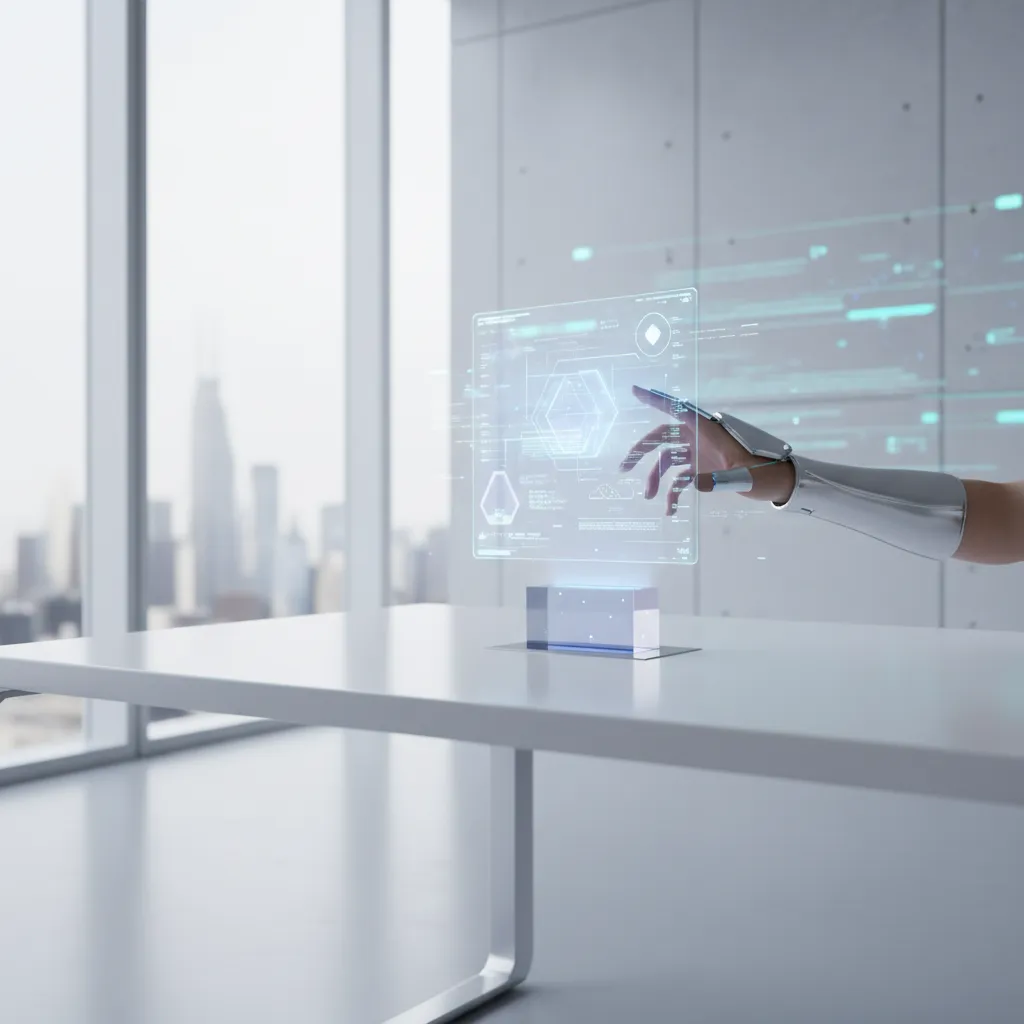
The most immediate evolution is the rise of spatial computing. Devices like Apple’s Vision Pro are early glimpses into a future where digital information is no longer confined to a 2D screen. Instead, it’s layered onto the world around us, creating a blended or “mixed reality.”
The spatial computing future isn’t just about entertainment. Imagine an architect walking through a full-scale holographic blueprint on a construction site, or a surgeon viewing a patient’s real-time vitals overlaid on their field of vision during an operation. This is made possible by sophisticated mixed reality interfaces that can understand and map the physical environment. We will move beyond simple data displays to fully interactive holographic interfaces, fundamentally changing collaboration, design, and education. Related: Spatial Computing Unveiled: The Next Frontier in Immersive Technology
Neural Interfaces and BCIs: The Ultimate Human-Computer Synergy
Perhaps the most radical shift in interaction will come from neural interfaces, also known as Brain-Computer Interfaces (BCIs). This technology aims to create a direct communication pathway between the human brain and an external device.
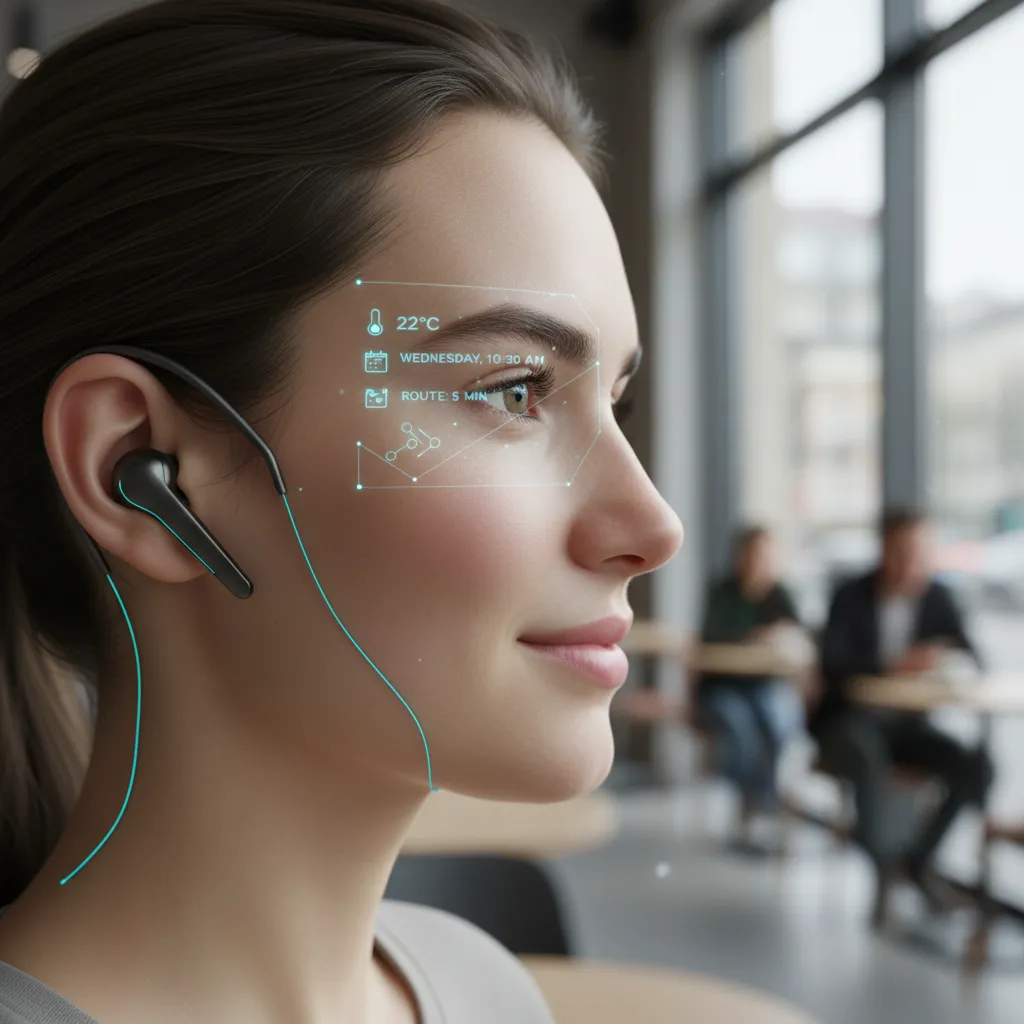
While invasive implants like those from Neuralink capture headlines, the more immediate impact will likely come from non-invasive wearables—advanced earbuds, headbands, or smart patches that can interpret neural signals. The potential is staggering:
- Silent Communication: Composing a message or issuing a command simply by thinking it.
- Enhanced Creativity: Translating abstract thoughts directly into music, art, or design.
- Cognitive Augmentation: Accessing information or performing complex calculations as a seamless extension of your own thought process.
This represents the pinnacle of human computer synergy, where the boundary between human thought and digital computation begins to blur, leading to a new level of augmented human intelligence.
The Evolution of Voice and Gestures: Truly Intuitive Interfaces
While spatial and neural interfaces are on the horizon, our most natural communication methods—voice and gestures—are also getting a massive AI-powered upgrade. The future of voice assistants isn’t about asking for the weather; it’s about having a context-aware conversation.
We’re seeing the first experiments with devices like the Humane AI Pin and Rabbit R1. Though their initial launches have been rocky, they represent a critical push towards proactive, conversational AI that doesn’t live inside a specific app. The future is an AI that understands the context of your situation, your previous conversations, and your overarching goals to provide truly helpful assistance. Related: Humane Ai Pin: Future or Flop? A Deep Dive
The Engine of Tomorrow: Proactive, Personalized, and Pervasive AI
If new interfaces are how we’ll interact with technology, a new kind of AI is what we’ll be interacting with. The shift from reactive to proactive intelligence is the engine that will drive the entire post-PC era.
From Reactive to Proactive: The Rise of Predictive Computing
Today, our AI assistants wait for a command. A proactive AI system doesn’t. It uses contextual computing and predictive computing to anticipate your needs before you’re even aware of them.
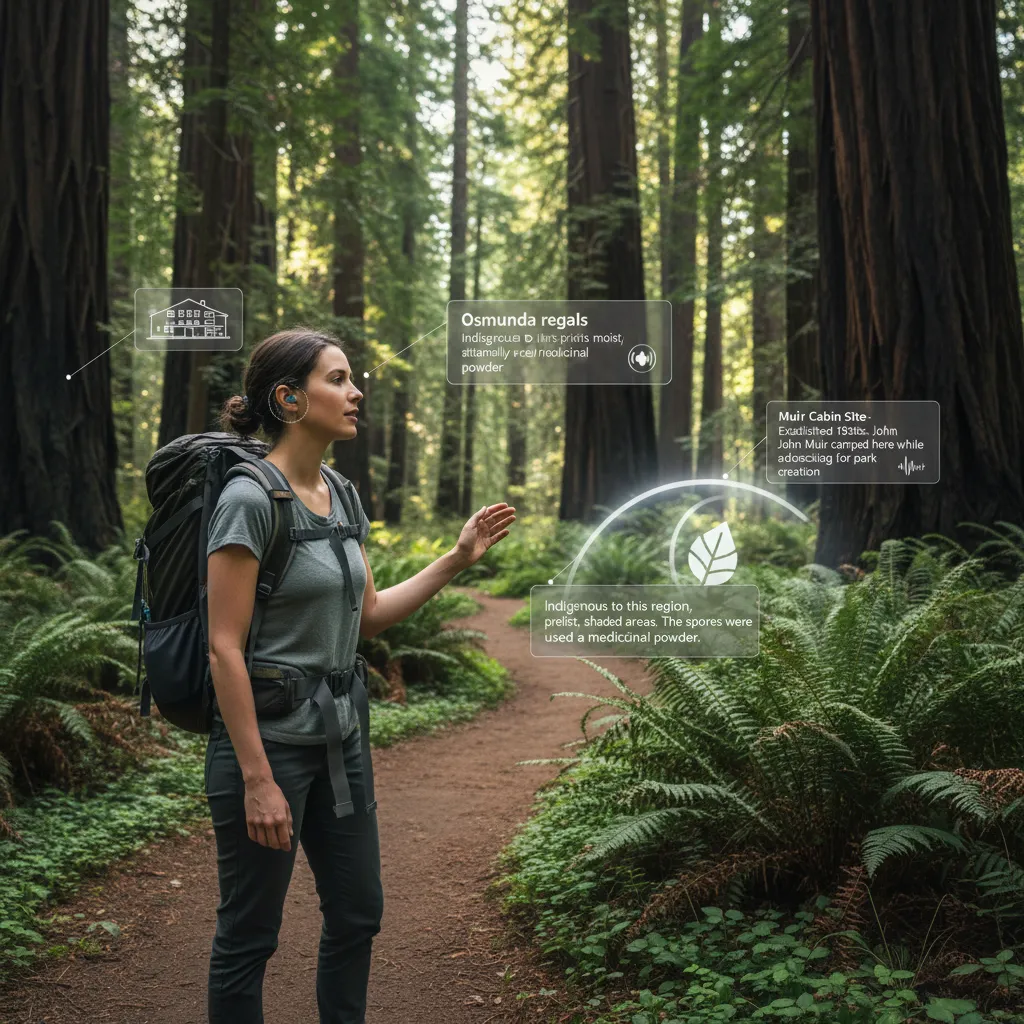
Consider these scenarios:
- Your AI, aware of your project deadline and your collaborators’ schedules, proactively finds and books a 30-minute meeting slot that works for everyone.
- Based on your heart rate data from your smartwatch and your upcoming travel schedule, your AI suggests a specific workout to minimize jet lag and maintain your fitness goals.
- While you’re driving, your AI reroutes you not just based on current traffic, but on predictive models of where traffic will be in 15 minutes.
This is the future of AI driven productivity, where technology becomes a true partner, managing the complexities of modern life and freeing up our cognitive bandwidth for more important tasks. Related: Mastering Generative AI for Next-Gen Content Creation
Personal Digital Twins: Your AI Counterpart
One of the most powerful concepts in this new era is the personal digital twin. This is a dynamic, AI-powered virtual model of you. It’s not just a profile with your likes and dislikes; it’s a sophisticated simulation that understands your biology, behavior, finances, relationships, and goals.
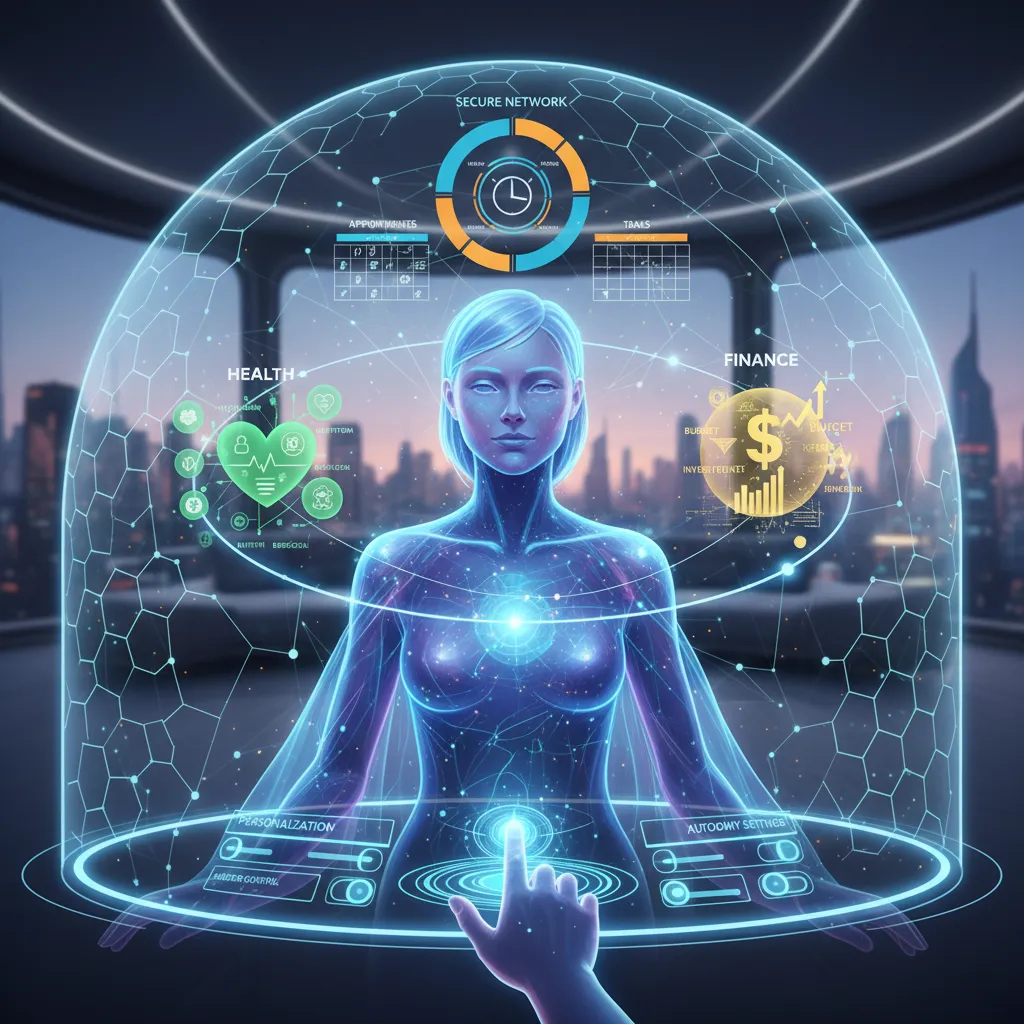
The applications for a digital twins personal model are transformative:
- Healthcare: A doctor could test the efficacy of a new medication on your digital twin before ever prescribing it to you, predicting potential side effects and optimizing the dosage. Related: Future Fitness: How AI is Personalizing Your Health Journey
- Finance: Your digital twin could run thousands of investment scenarios to find the optimal strategy for your retirement goals, automatically adjusting for market changes.
- Life Decisions: You could ask your twin to simulate the outcome of a career change or a move to a new city, providing data-driven insights to inform your biggest life choices.
Ambient Intelligence: The Smart Environment That Adapts to You
Bringing it all together is ambient intelligence. When proactive AI is combined with ubiquitous computing, the environment itself becomes intelligent and adaptive. The distinction between your “devices” and your “surroundings” dissolves.

Your home, car, and office become a cohesive, intelligent system that fluidly adapts to your presence and context. You walk into a room, and the lighting, temperature, and ambient sound adjust to your current state—whether you’re preparing for a focused work session or winding down for the evening. This is adaptive computing at its most seamless, an environment that works in perfect harmony with its inhabitant.
The Hardware Revolution: Powering the Post-PC Era
This intelligent, integrated future requires a complete rethinking of the hardware that powers it. The AI hardware evolution is moving away from a one-size-fits-all CPU model towards a diverse ecosystem of specialized, efficient, and interconnected processors.
Edge AI and Personalized Hardware: Intelligence Where You Need It
To be truly personal and responsive, AI needs to run locally. Relying on the cloud for every small interaction introduces latency and significant privacy concerns. This is why edge AI devices are so critical. By processing data directly on your glasses, watch, or personal server, information stays in your control.
We’ll see a rise in personalized AI hardware—custom silicon designed for specific tasks. Your audio-processing AI might live in your earbuds, your visual-processing AI in your glasses, and your long-term planning AI in a home hub. This distributed model is more efficient and resilient. The wearable AI next gen will be less about counting steps and more about becoming a primary interface for your personal AI. Related: Galaxy Ring vs. Oura: The Ultimate Smart Ring Showdown
Sustainable and Energy-Efficient AI: A Greener Future for Computing
The computational demands of training and running large AI models are immense, raising serious concerns about energy consumption. The future of computing must be a sustainable one. There is a massive industry-wide push for energy efficient AI. This involves developing new chip architectures (like neuromorphic chips that mimic the human brain) and creating more efficient AI algorithms. Sustainable computing isn’t just a buzzword; it’s an absolute necessity for this technology to scale globally. Related: Pack Smart, Travel Green: Your Guide to Eco-Friendly Gear for Sustainable Adventures
The Quantum Leap: How Quantum Computing Changes Everything
Looking further ahead, the quantum computing impact promises to be revolutionary. While classical computers process information in bits (0s or 1s), quantum computers use qubits, which can exist in multiple states at once. This allows them to solve certain types of problems millions of times faster than even the most powerful supercomputers today.
For personal computing, quantum’s impact will likely be indirect at first, powering breakthroughs in AI model development, materials science for new hardware, and drug discovery for personalized medicine. In the long term, it could crack challenges currently considered impossible, completely rewriting the rules of what computation can achieve.
The Human Element: Ethical Considerations and the Path Forward
This hyper-personalized, proactive future is filled with promise, but it also walks a fine line. The amount of personal data required to power these systems is staggering, making privacy, security, and consent paramount. We must demand and build ethical AI hardware and software from the ground up.
Key questions we must address include:
- Data Ownership: Who owns your personal digital twin and the data it generates?
- Algorithmic Bias: How do we ensure that the AI systems managing our lives are fair and unbiased?
- Autonomy: Where do we draw the line between helpful suggestions and manipulative control?
- The “Sentient” Question: While true sentient AI hardware remains science fiction, how do we prepare for increasingly sophisticated AI that can convincingly mimic emotion and consciousness?
Building a positive future requires a proactive approach to these ethical dilemmas, focusing on transparency, user control, and human values. Related: Ethical AI for Financial Wellness: Smart Money Habits for a Secure Future
Conclusion
The AI PC is an exciting and necessary evolution, but it’s the first step on a much longer and more transformative journey. The future of personal computing is not about a single device but a decentralized, intelligent ecosystem that melts into the background of our lives.
We are moving from a world where we command technology to one where we collaborate with it. Through advances in spatial computing, neural interfaces, and truly proactive AI systems, we are building a future of unprecedented human computer synergy. This post AI PC era will be defined by ambient intelligence and powered by a new generation of efficient, secure, and sustainable hardware.
The path ahead is complex and fraught with ethical challenges, but it also holds the potential to unlock a new level of human creativity, productivity, and well-being. The conversation is just beginning, and it’s up to all of us to help shape a future where technology truly serves humanity.
FAQs
Q1. What is the next big thing after AI PCs?
The next big thing isn’t a single device but a paradigm shift towards ubiquitous and ambient computing. This involves technology being embedded into our environment (smart homes, offices) and wearables (glasses, neural interfaces), moving computation away from a central “box” and making it a seamless, proactive part of our lives through spatial and intuitive interfaces.
Q2. What is ubiquitous computing?
Ubiquitous computing (or “ubicomp”) is the concept of processing power being embedded everywhere in our environment and in everyday objects, rather than being concentrated in standalone devices like laptops or phones. The goal is to make technology so integrated and intuitive that it effectively becomes invisible to the user.
Q3. How will brain-computer interfaces change our lives?
Brain-Computer Interfaces (BCIs) or neural interfaces will fundamentally change how we interact with technology by allowing for thought-based control. In the near term, this could mean controlling devices without physical touch or voice commands. In the long term, it could lead to augmented intelligence, silent communication, and the ability to translate thoughts directly into creative or digital output.
Q4. What is a personal digital twin?
A personal digital twin is a highly complex, dynamic AI model of an individual. It uses your personal data (health, behavioral, financial) to run simulations and make predictions. This could revolutionize personalized medicine by testing treatments on your digital model first or help with major life decisions by simulating potential outcomes.
Q5. Is quantum computing a threat to current technology?
Quantum computing presents both a threat and an opportunity. Its immense power could break many of the encryption standards that secure our digital world today, which is a significant threat. However, it also enables the creation of new, quantum-resistant encryption. Its primary impact will be as a massive accelerator for scientific discovery, AI development, and solving complex optimization problems.
Q6. What are the main ethical concerns with the future of computing?
The primary ethical concerns include data privacy and security, as these future systems will collect vast amounts of personal information. Other major issues are algorithmic bias (ensuring AI makes fair decisions), user autonomy (preventing manipulation by proactive AI), and the societal impact of augmented intelligence and automation on employment and human identity.