Ethereum ETF Impact: Strategies for Smart Crypto Investors

Introduction
The world of digital finance just experienced a seismic shift. After months of speculation and intense debate, the U.S. Securities and Exchange Commission (SEC) has officially given the green light to spot Ethereum ETFs. This landmark decision isn’t just a minor regulatory update; it’s a foundational moment that bridges the gap between traditional finance and the burgeoning world of decentralized assets. For years, investors have viewed cryptocurrencies as a high-risk, high-reward frontier, accessible only to the tech-savvy. The ETH ETF approval changes everything.
This move validates Ethereum as a mainstream, investable asset class, opening the floodgates for a wave of new capital from both retail and institutional players. But what does this really mean for you, the smart investor? How do you navigate this new landscape?
This comprehensive guide will break down the Ethereum ETF impact from every angle. We’ll explore the immediate and long-term effects on Ethereum’s price, dissect the core benefits and inherent risks, and, most importantly, provide actionable strategies to help you make informed decisions. Whether you’re a seasoned crypto enthusiast or a traditional investor looking to diversify, understanding the nuances of this new investment vehicle is crucial for capitalizing on the cryptocurrency trends of 2024 and beyond.
The Dawn of a New Era: Understanding the Spot Ethereum ETF
Before diving into complex strategies, it’s essential to grasp what a spot Ethereum ETF is and why its approval is such a monumental event in blockchain finance.
What Exactly is a Spot Ethereum ETF?
Think of a Spot Ethereum Exchange-Traded Fund (ETF) as a stock that mirrors the real-time price of Ethereum (ETH). Instead of buying ETH directly from a cryptocurrency exchange, storing it in a digital wallet, and managing complex private keys, you can now buy shares of an ETF through your standard brokerage account—just like you would buy shares of Apple or Tesla.
The fund’s manager (like BlackRock, Fidelity, or Grayscale) is responsible for purchasing and holding the actual ETH in secure, institutional-grade custody. Each share of the ETF represents a small piece of the Ethereum they hold. This structure provides a regulated crypto product that makes digital asset investing incredibly simple and accessible for the average person.
The SEC’s Green Light: A Milestone for Digital Asset Investing
The road to the SEC Ethereum ETF decision was long and fraught with uncertainty. The approval of spot Bitcoin ETFs in January 2024 set a precedent, but Ethereum’s unique features, particularly its use of staking and smart contracts, presented new regulatory hurdles.
The SEC’s approval of the 19b-4 forms for several major applicants signifies a crucial acknowledgment of Ethereum’s legitimacy as a commodity, not an unregistered security. This classification is vital, as it removes a massive cloud of regulatory risk that has hovered over the asset for years. The final step involves the approval of S-1 registration statements, after which trading can officially begin. This two-step process has paved the way for a new era of mainstream institutional crypto adoption.
Analyzing the ETH ETF Market Impact: What Investors Can Expect
The approval of a spot ETH ETF is expected to have profound and lasting effects on the market. By examining the precedent set by Bitcoin ETFs and understanding Ethereum’s unique value proposition, we can formulate a clear picture of the potential ETH ETF market impact.

Short-Term Volatility vs. Long-Term Growth
In the short term, expect significant crypto market volatility. The initial launch will likely see a surge of “buy the news” activity, followed by potential corrections as early investors take profits. However, the long-term outlook is overwhelmingly positive.
The Bitcoin ETF launch provides a powerful case study. After an initial dip, the influx of institutional capital propelled Bitcoin to new all-time highs. A similar trajectory is anticipated for Ethereum. The ease of access provided by ETFs will unlock trillions of dollars in capital from wealth managers, pension funds, and retail investors who were previously hesitant to enter the crypto space. This sustained demand is a core component of any long-term Ethereum price prediction.
The Floodgates Open: Paving the Way for Institutional Crypto Adoption
For years, institutional investors have been crypto-curious but deterred by regulatory uncertainty and the operational complexities of direct ownership. ETFs solve this problem. They are familiar, regulated financial instruments that fit neatly into existing portfolio models.
This new accessibility allows wealth advisors to allocate a small percentage of their clients’ portfolios to digital assets, dramatically broadening the investor base. This influx isn’t just about price; it’s about stability. As more long-term, institutional money enters the market, it can help dampen the wild price swings that have historically characterized crypto, leading to a more mature and stable Ethereum market analysis.
A Balanced View: Weighing the Benefits and Risks of Ethereum ETFs
No investment is without its trade-offs. While the ETH ETF presents a fantastic opportunity, smart investors must weigh the advantages against the potential downsides. Understanding the ETH ETF benefits risks is the cornerstone of a solid Ethereum investment strategy.
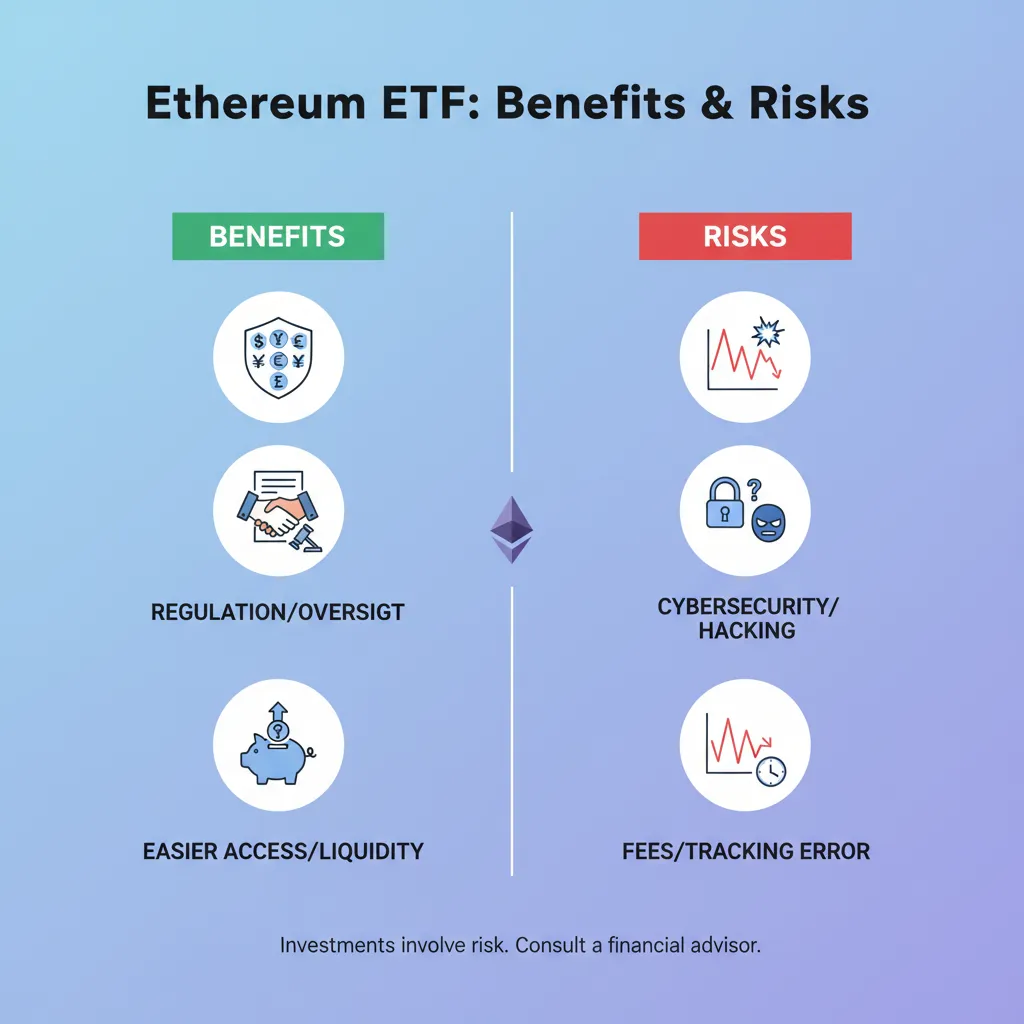
The Upside: Why an ETH ETF is Appealing
- Unmatched Accessibility: Anyone with a brokerage account (like a Fidelity, Schwab, or Robinhood account) can now gain exposure to Ethereum. This removes the technical barriers of using crypto exchanges and managing digital wallets.
- Enhanced Liquidity: ETFs trade on traditional stock exchanges, which boast deep liquidity. This means you can easily buy and sell shares during market hours without significant price slippage.
- Regulatory Oversight: ETF issuers are regulated entities, and the funds are traded on regulated exchanges. This provides a layer of investor protection and confidence that is absent in many corners of the crypto world.
- Simplified Tax Reporting: The tax implications of a crypto ETF are far simpler than those of direct ownership. Gains and losses are reported on a standard 1099-B form from your broker, just like stocks, eliminating the need for complex transaction tracking. Related: AI Investing: Smart Strategies for Wealth Growth in 2024.
- Effortless Diversification: For traditional investors, adding an ETH ETF is a straightforward way of diversifying with crypto ETFs and gaining exposure to the high-growth potential of the Web3 and DeFi sectors.
The Downside: Critical Risks to Consider
- Management Fees: ETFs come with expense ratios, which are annual fees charged by the fund manager. While expected to be competitive, these fees will slightly reduce your overall returns compared to holding ETH directly.
- No Staking Rewards: This is a crucial distinction. When you hold ETH directly, you can “stake” it to help secure the network and earn rewards, often yielding a 3-5% APY. ETF holders do not receive these staking rewards, which constitutes a significant opportunity cost. This is a key factor when considering a passive income crypto ETF strategy.
- Not Your Keys, Not Your Crypto: Owning ETF shares means you don’t actually hold the underlying Ethereum. You are trusting the fund custodian to secure the assets. This goes against the core crypto ethos of self-sovereignty and exposes you to counterparty risk.
- Limited Utility: You cannot use your ETF shares to interact with the vibrant Ethereum ecosystem growth. This means no participating in decentralized finance (DeFi) protocols, buying NFTs, or engaging with dApps—all key drivers of Ethereum’s value.
Crafting Your Ethereum Investment Strategy for 2024 and Beyond
With a clear understanding of the landscape, it’s time to build a strategy. The right approach depends on your risk tolerance, investment horizon, and financial goals.

Strategy 1: The Long-Term Visionary (The HODLer)
This strategy is for those who believe in the long-term Ethereum outlook and its role as a foundational technology for Web3. The debate of Digital Gold vs. Ethereum often frames Bitcoin as a store of value and Ethereum as a decentralized computing platform or “digital oil.” If you subscribe to this view, the ETF offers a simple “set it and forget it” approach.
- Action Plan: Allocate a specific percentage of your portfolio to an ETH ETF and hold it for the long term (5+ years). Use dollar-cost averaging (DCA)—investing a fixed amount regularly—to mitigate the impact of volatility.
- Best For: Investors who want exposure to Ethereum’s growth without the complexity of self-custody.
Strategy 2: The Prudent Portfolio Diversifier
For most traditional investors, the ETH ETF is best used as a tool for diversification. Modern portfolio theory suggests that adding a small allocation of an uncorrelated, high-growth asset can improve overall risk-adjusted returns.
- Action Plan: Allocate a small, defined portion (e.g., 1-5%) of your overall investment portfolio to a mix of Bitcoin and Ethereum ETFs. Rebalance periodically to maintain your target allocation. This provides exposure to the future of crypto investing while containing risk.
- Best For: Traditional investors in stocks and bonds looking to enhance their portfolio’s growth potential.
Strategy 3: The Hybrid Approach (ETF + Direct Ownership)
This is perhaps the most sophisticated strategy, designed for those who want both the convenience of an ETF and the utility of holding the actual asset.
- Action Plan: Use the ETH ETF for the portion of your crypto holdings held in tax-advantaged accounts like an IRA or 401(k). Simultaneously, hold a separate position of actual ETH in a self-custody wallet. This allows you to use your self-custodied ETH to explore DeFi, earn staking rewards, and truly engage with the ecosystem, while your ETF holding grows passively.
- Best For: Tech-savvy investors who believe in both the financial and technological potential of the Ethereum network.
ETF vs. Direct Ownership: A Quick Comparison
To help you decide, here’s a table summarizing the key differences:
| Feature | Spot Ethereum ETF | Direct ETH Ownership |
|---|---|---|
| Ease of Purchase | Very Easy (any brokerage account) | Moderate (requires crypto exchange) |
| Custody | Held by a third-party custodian | Self-custody (you control keys) |
| Staking Rewards | No | Yes (typically 3-5% APY) |
| DeFi/Web3 Access | No | Yes, full access |
| Security | Custodian risk | User responsibility (high) |
| Management Fees | Yes (expense ratio) | No (only network/exchange fees) |
| Tax Reporting | Simple (1099-B) | Complex (track every transaction) |
The Ripple Effect: How Ethereum ETFs Reshape the Broader Crypto Ecosystem
The impact of the ETH ETF extends far beyond its price. This event will catalyze growth and innovation across the entire digital asset landscape.

Fueling Ethereum Ecosystem Growth and Web3 Investment
The massive influx of capital from ETFs will indirectly fund the next generation of decentralized applications. As the value and legitimacy of ETH grow, so does the incentive for developers to build on the network. This creates a positive feedback loop, enhancing Ethereum smart contracts and driving innovation in DeFi, gaming, and NFTs. This presents a wealth of Web3 investment opportunities for those willing to look beyond the ETF itself. Related: AI-Powered Wearables: Enhanced Living and the Future of Tech.
The Future of Crypto Investing: What’s Next?
With both Bitcoin and Ethereum ETFs now a reality, the question becomes: which asset is next? The industry is already looking towards potential ETFs for other major cryptocurrencies like Solana (SOL) or Ripple (XRP), though they face steeper regulatory challenges. The success of the ETH ETF will serve as a critical test case and could pave the way for a diverse family of best crypto ETFs, allowing investors to build entire portfolios of digital assets within the traditional financial system.
Conclusion: A New Chapter for Digital Finance
The approval of a spot Ethereum ETF is not the finish line; it’s the starting gun for a new race. It marks a pivotal moment in the maturation of cryptocurrency, transforming it from a niche, speculative asset into a legitimate component of the global financial system.
For the smart investor, this presents a world of opportunity. The ETF vehicle democratizes access to Ethereum’s immense potential, but it’s not a one-size-fits-all solution. The best Ethereum investment strategy is one that aligns with your personal financial goals, risk tolerance, and level of engagement with the underlying technology.
Whether you choose the simplicity of an ETF, the sovereignty of direct ownership, or a hybrid approach, the key is to stay informed, think long-term, and never invest more than you are willing to lose. The bridge between traditional and decentralized finance has been built. Now it’s up to you to decide how you want to cross it.
FAQs
Q1. What is a spot Ethereum ETF?
A spot Ethereum ETF (Exchange-Traded Fund) is a financial product that allows investors to gain exposure to the price of Ethereum without owning the cryptocurrency directly. It trades on a traditional stock exchange, and shares of the ETF are backed by real ETH held in custody by the fund manager.
Q2. Is an Ethereum ETF a good investment?
Whether an ETH ETF is a good investment depends on your individual financial goals and risk tolerance. It offers a regulated, accessible, and simple way to invest in Ethereum’s growth potential. However, it also involves risks like market volatility and management fees, and it doesn’t provide staking rewards like holding ETH directly.
Q3. How is a spot ETH ETF different from a futures ETF?
A spot ETH ETF holds actual Ethereum as its underlying asset, so its price directly tracks the real-time market price of ETH. A futures ETF, on the other hand, holds Ethereum futures contracts, which are agreements to buy or sell ETH at a predetermined price on a future date. Spot ETFs are generally considered a more direct and accurate representation of the asset’s value.
Q4. When can I buy a spot Ethereum ETF?
While the SEC has approved the initial 19b-4 filings, the S-1 registration statements must also be approved before trading can begin. Most market analysts expect the spot Ethereum ETFs to be available for trading on major stock exchanges within a few weeks to a couple of months following the final approvals.
Q5. Can I earn staking rewards with an Ethereum ETF?
No, investors in the current spot Ethereum ETFs will not be able to earn staking rewards. Staking involves participating in the network’s consensus mechanism, which is a function of direct token ownership. The ETH held by the ETF custodian is not staked on behalf of the shareholders.
Q6. What are the main risks of investing in an ETH ETF?
The primary risks include the high crypto market volatility inherent to Ethereum, management fees (expense ratios) that reduce returns, and counterparty risk associated with the fund’s custodian. Additionally, you do not have the benefits of direct ownership, such as participating in DeFi or earning staking rewards.
Q7. How will the ETF affect the price of Ethereum?
The general consensus is that the ETF will have a positive long-term effect on Ethereum’s price. By making it easier for retail and institutional investors to buy in, the ETF is expected to significantly increase demand and capital inflow into the ecosystem, similar to what was observed after the launch of spot Bitcoin ETFs.
Q8. Do I need a special account to buy an ETH ETF?
No, you do not need a special account. You can buy shares of a spot Ethereum ETF through any standard brokerage account that allows you to trade stocks and other ETFs, such as those from Fidelity, Charles Schwab, Robinhood, or E*TRADE.