Edge AI: Boosting Your Privacy & Performance On-Device

Introduction
Have you ever wondered what happens when you ask your phone a question, apply a portrait mode filter to a photo, or get a real-time language translation? For years, the answer was simple: your device sent a request to a massive, distant data center—the “cloud”—which did the heavy lifting and sent the result back. This process, while powerful, opened a Pandora’s box of concerns about data privacy, security, and lag. What if your most personal information didn’t have to travel across the internet at all?
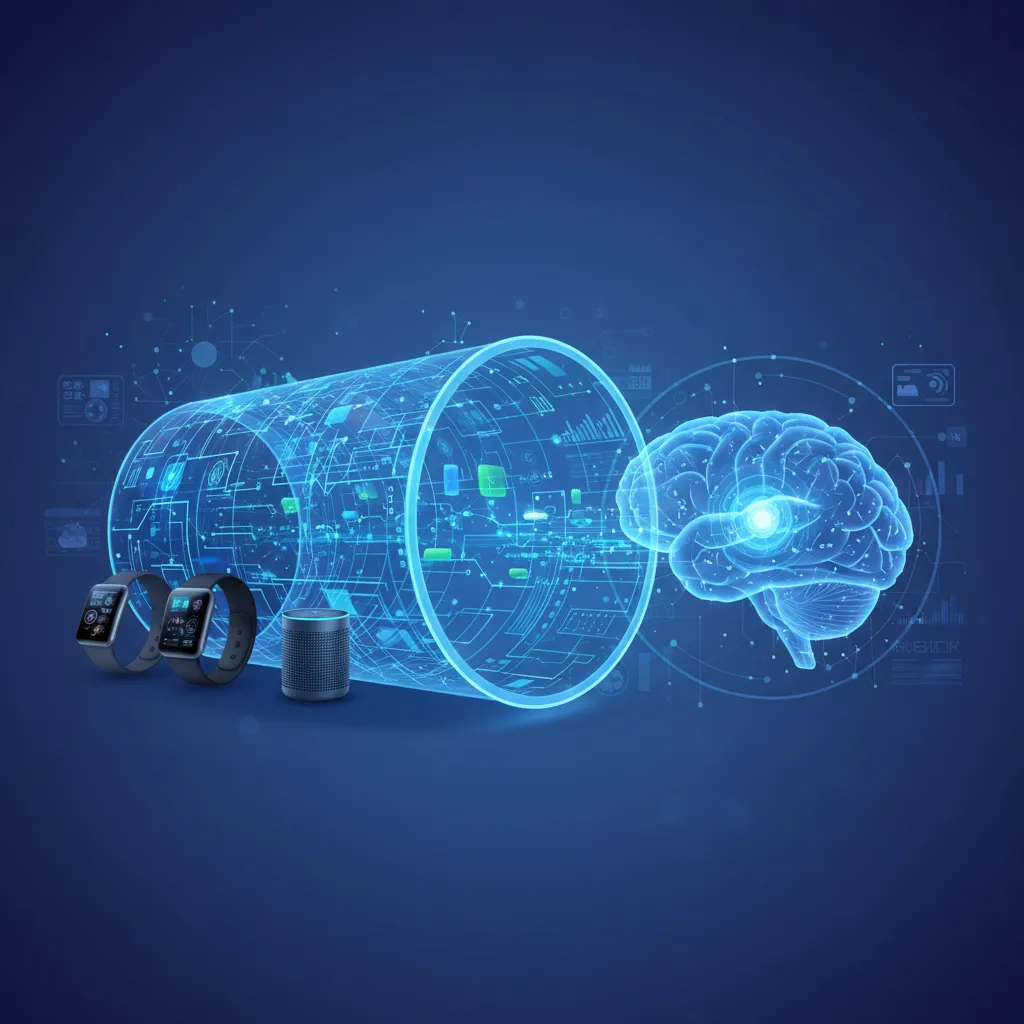
Enter Edge AI, a revolutionary approach that’s quietly transforming our gadgets from simple messengers into powerful, self-contained thinkers. This isn’t a far-off future concept; it’s happening right now, inside the smartphone in your pocket, the watch on your wrist, and the smart speaker in your living room. By performing artificial intelligence tasks directly on your device, Edge AI is creating a new paradigm of technology that is faster, more reliable, and, most importantly, fundamentally more private.
This deep dive will unravel the world of on-device AI. We’ll explore how this shift towards localized AI is giving you unprecedented control over your personal data, why it delivers blazing-fast AI performance, and how it’s becoming the cornerstone of next-gen AI privacy and security.
What Exactly is Edge AI? The Revolution Inside Your Device
At its core, Edge AI is a simple yet profound concept: it’s about bringing the power of artificial intelligence computation from centralized cloud servers to the local device where the data is actually created. The “edge” refers to the edge of the network—your smartphone, laptop, car, or IoT device—rather than a remote data center.
Think of it like this: Cloud AI is akin to ordering from a restaurant. You send your order (data) to a central kitchen (cloud server), they prepare it (process it), and a delivery driver brings the meal (result) back to you. It works, but there’s a delay, a potential for the order to get lost, and you’re trusting a third party with your request.
Edge AI, on the other hand, is like having a master chef right in your own kitchen. The ingredients (your data) never leave your house. The meal (the AI task) is prepared instantly, exactly to your specifications, with complete privacy. This is the essence of AI without cloud dependency. The intelligence is built directly into the hardware, enabling powerful computations to happen in the palm of your hand.
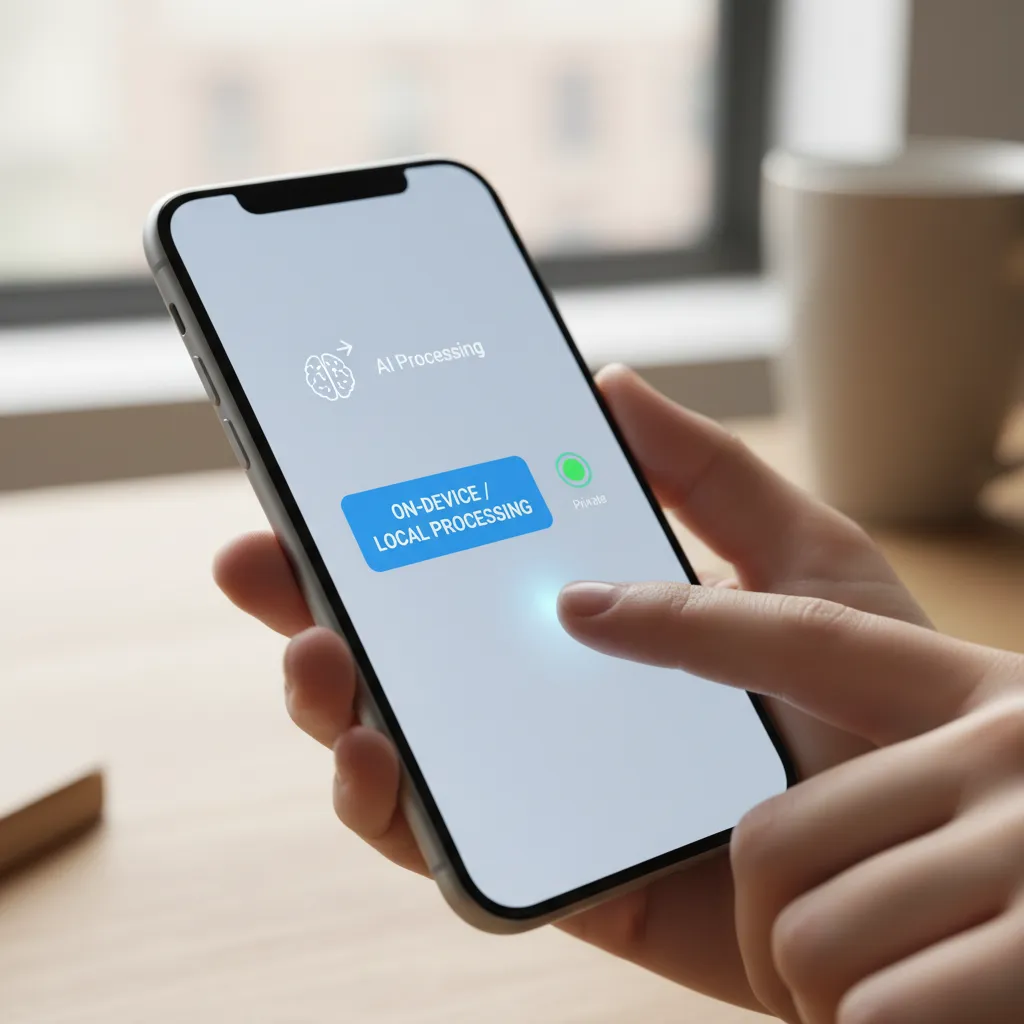
This shift is made possible by the development of highly efficient, specialized processors known as edge AI chips. Companies like Apple (A-series Bionic with Neural Engine), Google (Tensor), and Qualcomm (Snapdragon with AI Engine) are in an arms race to create chips that can handle complex machine learning models with minimal power consumption. This allows for sophisticated secure AI processing without draining your battery or turning your device into a pocket warmer.
The Core Principle: Why Keeping Data Local is a Game-Changer
The fundamental promise of Edge AI revolves around a single, critical idea: your data should belong to you. In an era of constant data breaches and growing concerns over how companies use our information, the ability to process data locally is more than a convenience—it’s a massive leap forward for personal AI security.
When AI tasks are processed in the cloud, your personal data—photos of your family, private messages, voice commands, location history, health metrics—must be sent to a server owned by someone else. Even with encryption, this creates multiple points of vulnerability:
- In Transit: Data can be intercepted as it travels over the internet.
- On the Server: The server itself can be hacked, leading to massive data leaks.
- Policy Changes: The company owning the server could change its data usage policies, potentially using your data in ways you never agreed to.
Secure local AI eliminates these risks by design. If the data never leaves your device, it can’t be intercepted in transit or stolen from a server. This is the ultimate form of AI data protection. It means you can use powerful AI features with the confidence that your most sensitive information remains under your control, creating a truly private AI experience. This principle is becoming a major selling point for consumer electronics, as users become more educated about their digital footprint.
Edge AI vs. Cloud AI: A Head-to-Head Privacy and Performance Showdown
To truly appreciate the benefits of Edge AI, it’s helpful to compare it directly with its cloud-based counterpart. While both have their place, they are designed for very different priorities. As brands like Apple lean heavily into on-device processing with features like Related: Apple Intelligence: The Personal AI Revolution Across Your Devices, understanding this distinction is key.
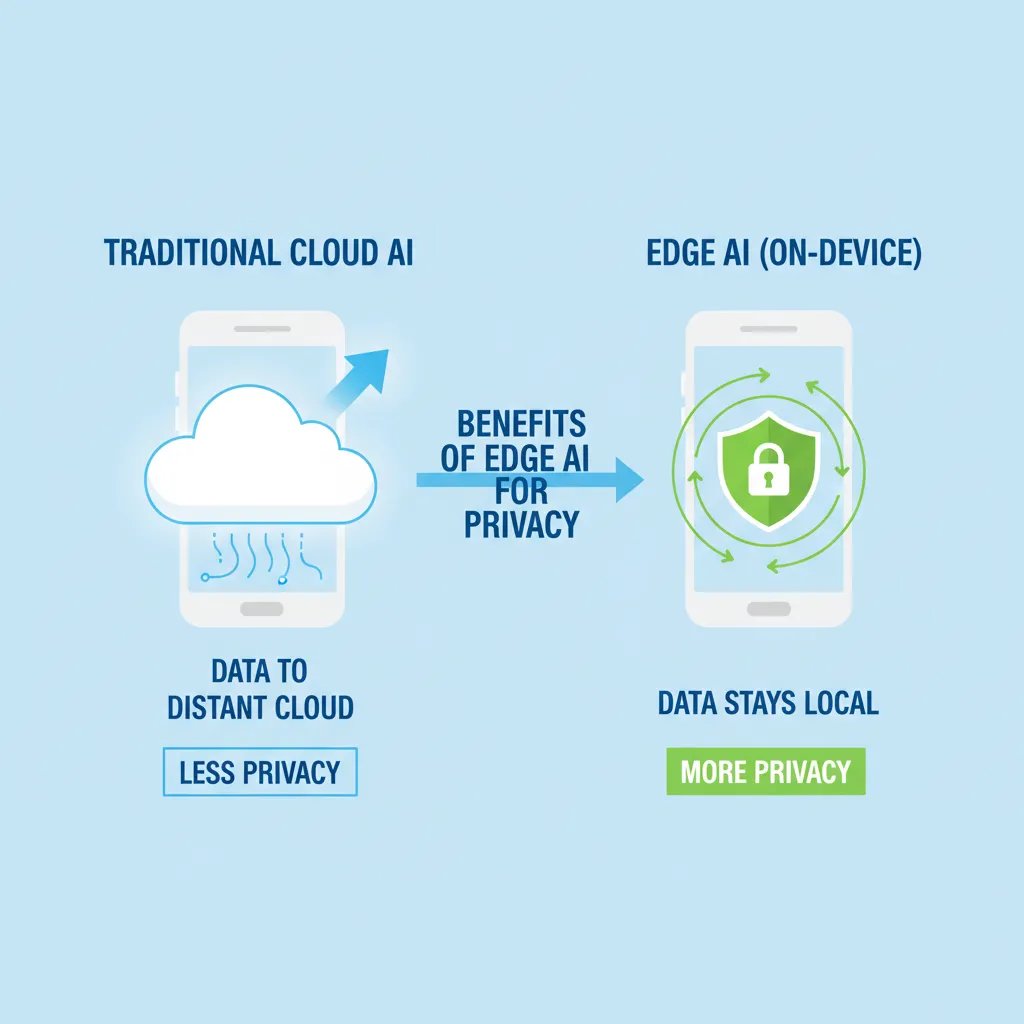
Here’s a breakdown of how they stack up:
| Feature | Edge AI (On-Device) | Cloud AI (Data Center) |
|---|---|---|
| Data Privacy | Maximum. Data never leaves the device, providing exceptional user privacy AI. | Lower. Data is transmitted and stored on third-party servers, creating potential vulnerabilities. |
| Performance/Speed | Instantaneous. Processing happens locally, resulting in low latency AI and real-time AI processing. | Slower. Latency is introduced by the round-trip data travel to and from the server. |
| Connectivity | Works Offline. A key edge computing benefit, as it’s independent of internet access. | Requires Internet. Useless without a stable connection. |
| Reliability | High. Not affected by network congestion or server outages. | Variable. Dependent on network quality and server uptime. |
| Cost | Low Operational Cost. No data transmission or cloud processing fees for the user. Higher initial hardware cost. | High Operational Cost. Can incur significant costs for data transfer and cloud computing resources. |
| Scalability | Limited. Constrained by the processing power and memory of the local device. | Virtually Unlimited. Can leverage massive, scalable computing power for extremely complex tasks. |
This comparison makes it clear that the choice is not about which is “better” overall, but which is better for a specific task. For tasks requiring immense computational power (like training a large language model from scratch), the cloud is indispensable. But for the vast majority of personal AI applications that prioritize enhanced data privacy and instant results, Edge AI is the clear winner.
Unpacking the Tangible Benefits of On-Device AI
The theoretical advantages of Edge AI translate into real, noticeable improvements in our daily interactions with technology. Let’s break down the core AI device benefits.
Unbreachable Privacy: Your Data, Your Fortress
This is the most significant benefit. With on-device AI, features that handle your most personal information become fundamentally more secure.
- Biometric Data: Face ID and fingerprint unlocking happen entirely on your device. Your biometric template is stored in a secure enclave on the chip and never sent to a server.
- Health and Wellness: Data collected by your smartwatch—heart rate, sleep patterns, blood oxygen levels—can be analyzed locally to provide health insights without exposing your medical information.
- Photos and Messages: AI features like photo categorization (“show me pictures of my dog at the beach”) or predictive text can run directly on your phone, analyzing your personal content without uploading it. This is a cornerstone of smartphone AI privacy.
Blazing-Fast Performance: The End of Lag
By cutting out the round-trip to the cloud, AI computing at the edge delivers an incredibly responsive experience. This is the power of low latency AI.
- Real-Time Camera Effects: Portrait mode, live video filters, and 4K video stabilization require immense processing. Doing this on-device means the effect is applied instantly as you see it on the screen, with no frustrating delay.
- Instant Language Translation: Point your camera at a sign in a foreign language, and an Edge AI application can overlay the translation in real-time, without needing to send images to the cloud.
- Responsive Voice Assistants: While some complex queries still need the cloud, many basic commands (“set a timer,” “what’s the weather?”) can be processed locally for an immediate response, even if you’re offline.
Uninterrupted Reliability: AI That Works Anywhere
One of the biggest frustrations of cloud-dependent services is their reliance on an internet connection. Offline AI is a game-changer for reliability.
- Navigation: Your GPS app can continue to provide turn-by-turn directions and reroute you even if you drive through an area with no cell service.
- Smart Home: With an edge-powered smart home hub, you can still control your lights, thermostat, and security cameras during an internet outage. The intelligence is in your house, not in a data center.
- Accessibility: On-device dictation and voice control features can work flawlessly on an airplane or in a remote location, providing crucial accessibility without depending on a connection.
Cost-Efficiency: Saving Money and Battery Life
While less obvious, the efficiency of Edge AI can save you money and extend your device’s battery life.
- Reduced Data Usage: Every piece of data processed locally is data you don’t have to send over your cellular plan, potentially saving you from overage charges.
- Improved Power Efficiency: Transmitting data via cellular or Wi-Fi radios is one of the most power-hungry tasks a device can perform. By keeping processing local, modern edge AI chips can often perform tasks using significantly less energy than it would take to send the data to the cloud and back.
Edge AI in Action: Real-World Applications You’re Already Using
Edge AI isn’t just a buzzword; it’s a technology integrated into countless features we use every day. Recognizing these edge AI applications highlights how pervasive and essential this technology has become.
Your Smartphone: The Epicenter of Personal AI
Modern smartphones are the quintessential AI for consumer devices, packed with on-device intelligence.
- Computational Photography: Features like Night Mode, Portrait Blur, and Scene Detection analyze image data directly on the device’s image signal processor and neural engine to produce stunning photos that would have required a DSLR just a few years ago.
- Live Text & OCR: Point your camera at text on a poster or in a document, and your phone can instantly recognize and let you copy it. This entire process happens offline.
- Proactive Suggestions: Your device learns your habits locally to suggest apps you might want to open, people you might want to call, or automatically create calendar events from messages, all without sending your behavioral data to the cloud.
Wearables & Smart Home: Intelligent and Intimate
The intimate nature of data collected by wearables and smart home devices makes them perfect candidates for Edge AI, ensuring smart device privacy.

- AI for Wearables: Your smartwatch or smart ring performs on-device analysis for fall detection, irregular heart rhythm notifications, and sleep stage tracking. This ensures that your highly sensitive health data remains private and provides real-time alerts without relying on a connection.
- Smart Security Cameras: Instead of streaming constant video to the cloud, modern cameras use Edge AI to analyze footage locally. They can distinguish between a person, a pet, and a passing car, sending you a notification (and only the relevant clip) when a specific event occurs. This drastically reduces false alarms and protects your privacy.
Automotive and Beyond: The Future is at the Edge
The applications of Edge AI extend far beyond personal gadgets, playing a critical role in industries where real-time decisions and data security are paramount.
- Automotive: Advanced Driver-Assistance Systems (ADAS) in modern cars use Edge AI to process data from cameras and sensors in real-time to detect obstacles, stay in lanes, and perform emergency braking. You can’t afford cloud latency when a split-second decision can prevent an accident.
- Healthcare: On-device AI is revolutionizing medical devices, from portable ultrasound machines that can analyze images at a patient’s bedside to wearable sensors that predict seizures. This local processing is crucial for both speed and patient data confidentiality. Related: AI in Healthcare: Revolutionizing Patient Care and Medical Innovation.
- Manufacturing: Factories use Edge AI on their equipment to predict maintenance needs, detect defects in real-time on the assembly line, and improve worker safety without sending proprietary operational data off-site.
The Challenges and Future of Edge AI
Despite its immense benefits, the path for on-device AI is not without its hurdles. A balanced perspective requires acknowledging its current limitations and looking toward its exciting future.
The Hurdles: Hardware, Power, and Model Size
- Limited Resources: An iPhone, for all its power, is not a data center. Edge devices have finite processing power, memory, and storage, which limits the complexity of the AI models they can run.
- Power Consumption: While more efficient than data transmission, running complex neural networks can still be power-intensive and impact battery life. Optimizing models for performance-per-watt is a constant engineering challenge.
- Model Management: Updating AI models on billions of edge devices is a more complex logistical challenge than updating a model on a centralized server.
The Road Ahead: Smarter Chips and Hybrid Models
The industry is rapidly innovating to overcome these challenges, paving the way for an even more powerful and private future of personal data.
- Hyper-Efficient Chips: The development of next-generation edge AI chips and neural processing units (NPUs) is the primary driver of progress. These chips are specifically designed to execute AI tasks with maximum speed and minimal energy use.
- Model Optimization: Researchers are developing new techniques like model quantization and pruning to shrink massive AI models so they can run efficiently on edge hardware without sacrificing significant accuracy.
- The Hybrid Approach: The future is likely not a battle of Edge vs. Cloud, but a seamless integration of both. A hybrid model, like Apple’s Private Cloud Compute, uses on-device AI for most tasks. For more complex requests, it can send only the necessary, anonymized data to a secure, purpose-built cloud server for processing, offering the best of both worlds. This represents the next frontier for decentralized AI. This approach could accelerate progress in many fields, including Related: The AI Revolution in Scientific Discovery: Accelerating Breakthroughs.
Conclusion
Edge AI is more than just a technical trend; it’s a fundamental re-architecting of our relationship with technology. It’s a move away from a world where our personal data is a commodity to be harvested and processed in distant clouds, and toward a future where our devices are trusted, intelligent partners that respect our privacy.
By bringing AI processing directly to our gadgets, we gain a trifecta of benefits: the unshakeable data privacy AI that comes from keeping information local, the instant responsiveness of real-time AI processing, and the steadfast reliability of offline AI. From the photos we take to the health data we track, on-device AI empowers us with cutting-edge features without demanding our privacy in return.
The next time you use a live camera filter or ask your offline voice assistant for help, take a moment to appreciate the silent revolution happening inside your device. That is the power of Edge AI—smarter, faster, and more secure technology, designed with your privacy at its very core.
Frequently Asked Questions (FAQs)
Q1. What is the main purpose of Edge AI?
The main purpose of Edge AI is to run artificial intelligence algorithms locally on a hardware device—like a smartphone, sensor, or vehicle—instead of sending data to a remote cloud server for processing. This brings computation closer to the source of the data, primarily to improve speed, enhance data privacy, and ensure reliable operation even without an internet connection.
Q2. Is Edge AI more secure than Cloud AI?
Yes, Edge AI is generally considered more secure for handling personal and sensitive data. Because the data is processed directly on the device (on-device AI), it never has to be transmitted over the internet to a third-party server. This eliminates the risks of data interception during transit and potential data breaches on the server, making it a cornerstone of personal AI security.
Q3. What is a common example of Edge AI?
A very common example is the Portrait Mode feature on modern smartphone cameras. When you take a picture, the phone’s internal AI chip instantly analyzes the scene, distinguishes the person from the background, and applies the blur effect. This entire complex computation happens in a fraction of a second, right on your device, without sending your photo anywhere.
Q4. Can Edge AI work without the internet?
Absolutely. The ability to function without an internet connection is a key advantage of Edge AI. This is why features like on-device voice dictation, real-time language translation via your camera, and GPS navigation can continue to work seamlessly even when you are on an airplane or in an area with no cellular service. This is often referred to as offline AI.
Q5. What is the key difference between Edge AI and Cloud AI?
The key difference is the location of the AI processing. In Edge AI, the processing happens locally on the end-user’s device (the “edge” of the network). In Cloud AI, data from the device is sent to powerful, centralized servers in a data center for processing, and the results are then sent back to the device.
Q6. What are the disadvantages of Edge AI?
The main disadvantages of Edge AI are related to the physical limitations of the device. These include limited processing power and memory compared to cloud servers, which can restrict the complexity of AI models. Additionally, running intensive AI tasks can consume more of the device’s battery life.
Q7. How does Edge AI protect user privacy?
Edge AI protects user privacy by creating a “data fortress” on your device. By processing sensitive information like your biometric data, private messages, photos, and health metrics locally, it ensures this information is never shared with the device manufacturer or any third party. The data stays with you, radically reducing the surface area for cyberattacks and unauthorized data usage, fulfilling the promise of enhanced data privacy.