DeFi for Beginners: Your Ultimate Guide to Decentralized Finance

Ever felt frustrated by the traditional banking system? The slow transaction times, the endless paperwork, the high fees, and the feeling that you’re not really in control of your own money. For decades, this has been the only option. But what if there was another way? A global, open, and transparent financial system being built from the ground up on the internet.
Welcome to the world of Decentralized Finance, or DeFi.
DeFi is more than just another buzzword in the crypto space; it’s a fundamental reimagining of our financial infrastructure. It’s an ecosystem of financial applications built on blockchain technology that operates without any central authority, like a bank or government. Think of it as finance, but with the middlemen cut out.
This guide is designed for the absolute beginner. We’ll break down the complex concepts of Web3 finance basics into simple, understandable terms. By the end of this article, you will have a solid grasp of what DeFi crypto is, understand its core components, and possess a clear, step-by-step roadmap on how to start with DeFi safely and confidently.
What is Decentralized Finance (DeFi)? A Simple Explanation
At its heart, Decentralized Finance is a system that aims to build a transparent, permissionless, and inclusive financial system using the power of blockchain and smart contracts.
Let’s break that down:
- Decentralized: Instead of a single company or bank controlling everything, the system is run by a distributed network of computers. No single entity can shut it down or change the rules.
- Permissionless: Anyone with an internet connection and a crypto wallet can access DeFi services. There are no gatekeepers, no credit checks, and no geographical borders.
- Transparent: Every transaction is recorded on a public blockchain (like Ethereum), meaning they are visible and verifiable by anyone. This creates a level of transparency unheard of in traditional finance.
The engine that powers DeFi is the smart contract. A smart contract is essentially a self-executing contract with the terms of the agreement directly written into code. They are automated agreements that execute when certain conditions are met, removing the need for intermediaries like brokers or lawyers. Think of it like a vending machine: you put in money (input), and the machine automatically gives you a snack (output). Smart contracts do this for complex financial transactions like loans, trades, and insurance.
This powerful combination of blockchain and smart contracts allows developers to create decentralized applications, or DApps, that replicate—and often improve upon—traditional financial services.
DeFi vs. Traditional Finance (TradFi): The Financial Revolution
To truly grasp the significance of DeFi, it’s helpful to compare it directly with the system we all know: Traditional Finance (TradFi). While both aim to manage assets, their approach and philosophy are worlds apart.

| Feature | Traditional Finance (TradFi) | Decentralized Finance (DeFi) |
|---|---|---|
| Control | Centralized (Controlled by banks, institutions, governments) | Decentralized (Managed by code and distributed networks) |
| Accessibility | Permissioned (Requires ID, credit checks, bank account) | Permissionless (Open to anyone with a wallet and internet) |
| Transparency | Opaque (Internal operations are private) | Transparent (Transactions are on a public blockchain) |
| Operations | Manual (Requires human intermediaries and paperwork) | Automated (Runs on self-executing smart contracts) |
| Speed | Slow (Transactions can take days, bound by business hours) | Fast (Near-instant, operates 24/7) |
| Custody | Custodial (The bank holds and controls your assets) | Non-Custodial (You have full control of your assets in your wallet) |
| Innovation | Slow and bureaucratic | Rapid and open-source (“Money Legos”) |
The core benefits of DeFi stem directly from these differences. It offers financial sovereignty, greater accessibility for the unbanked, lower costs by removing intermediaries, and a more efficient, composable system where new products can be built by combining existing ones like LEGO bricks.
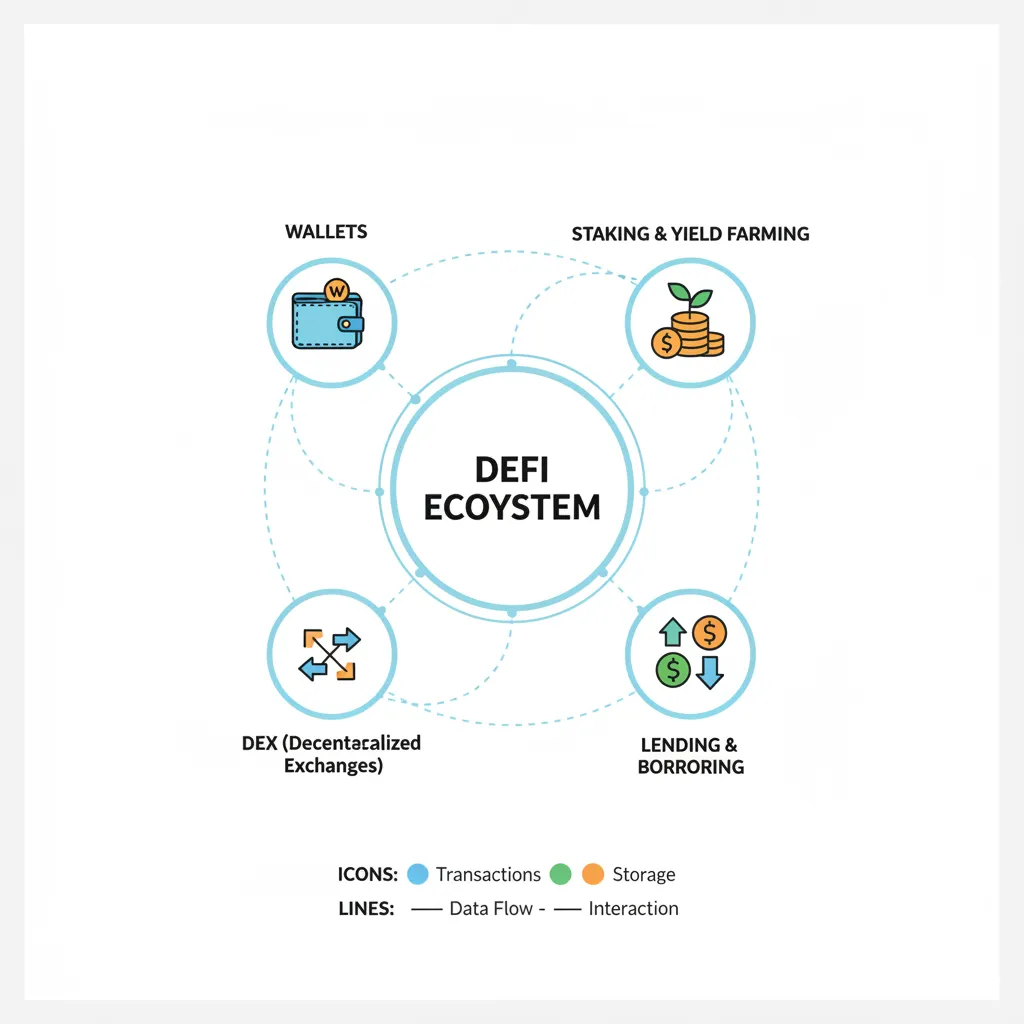
The Core Components of the DeFi Ecosystem
The DeFi world can seem vast, but it’s built on a few key pillars that form the foundation for almost everything else. Understanding these components is the first step to navigating the landscape.
H3: Decentralized Exchanges (DEXs) Explained
A decentralized exchange (DEX) is a peer-to-peer marketplace where users can trade cryptocurrencies directly with each other without a middleman. Unlike centralized exchanges (like Coinbase or Binance), you never give up custody of your funds.
The magic behind most modern DEXs is the Automated Market Maker (AMM) model. Instead of matching buyers and sellers, users contribute their tokens to liquidity pools. A smart contract then uses a mathematical formula to determine the price of the assets in the pool. When you want to trade, you trade against this pool, not another person. This system ensures there’s always liquidity available for trading.
- Popular Examples: Uniswap (Ethereum), PancakeSwap (BNB Chain), Raydium (Solana).
H3: Lending and Borrowing in DeFi
DeFi has revolutionized lending by creating open marketplaces for crypto loans DeFi.
- Lenders: You can deposit your crypto into a lending protocol and earn interest on it. Your assets are pooled with others’ and lent out to borrowers, and you earn a portion of the interest paid. It’s a powerful way to generate passive income with DeFi.
- Borrowers: You can borrow assets instantly by providing other crypto assets as collateral. This is typically “over-collateralized,” meaning you must lock up more value than you borrow (e.g., deposit $150 worth of ETH to borrow $100 worth of USDC). This protects lenders in case of a price drop.
This entire process is handled by smart contracts, with interest rates adjusting automatically based on supply and demand. Related: Ethical AI for Financial Wellness: Smart Money Habits for a Secure Future
- Popular Examples: Aave, Compound.
H3: Staking and Yield Farming: Earning Passive Income with DeFi
Beyond simple lending, DeFi offers more advanced ways to put your assets to work.
-
DeFi Staking for Beginners: Staking is the process of locking up your cryptocurrency to help secure and validate transactions on a Proof-of-Stake (PoS) blockchain. In return for your contribution, you receive rewards, typically in the form of more of that same cryptocurrency. It’s often compared to earning interest in a savings account.
-
DeFi Yield Farming Guide: Yield farming is a more complex and higher-risk strategy. It involves actively moving your crypto assets between different DeFi protocols to find the highest possible returns, or “yield.” This could involve lending, staking, providing liquidity to a DEX, and then staking the resulting tokens, all to maximize profits. It requires more active management and a deeper understanding of the risks of DeFi investing.
H3: More Advanced Concepts Briefly Explained
As you go deeper, you’ll encounter more concepts:
- Decentralized Autonomous Organizations (DAOs): These are like internet-native companies with no central leadership. They are governed by a community of token holders who vote on proposals.
- DeFi Insurance: Protocols that allow you to buy coverage against specific risks, such as a smart contract getting hacked.
- Bridging Crypto Assets: The process of moving a token from one blockchain network to another (e.g., from Ethereum to Polygon).
How to Get Started with DeFi: A 5-Step Beginner’s Guide
Ready to dive in? Here’s a practical, safety-first guide for getting started with DApps and the broader DeFi world.
Step 1: Educate Yourself (The Risks Are Real)
Before you invest a single dollar, understand the risks. DeFi is a new frontier, and it’s not without its dangers.
- Smart Contract Risk: Bugs in the code can be exploited by hackers, leading to a loss of funds. Look for protocols that have undergone auditing by DeFi projects from reputable firms.
- Impermanent Loss: A risk specific to providing liquidity in DEXs, where the value of your deposited assets can decrease compared to simply holding them.
- Scams: Phishing attacks, fake airdrops, and “rug pulls” (where developers abandon a project and run off with investor funds) are common.
- Volatility: The crypto market is notoriously volatile. The value of your assets can swing dramatically.
Step 2: Get a DeFi Wallet
Your wallet is your key to the DeFi universe. For beginners, it’s crucial to understand the concept of a non-custodial wallet. This means you control the private keys—the secret password to your funds.
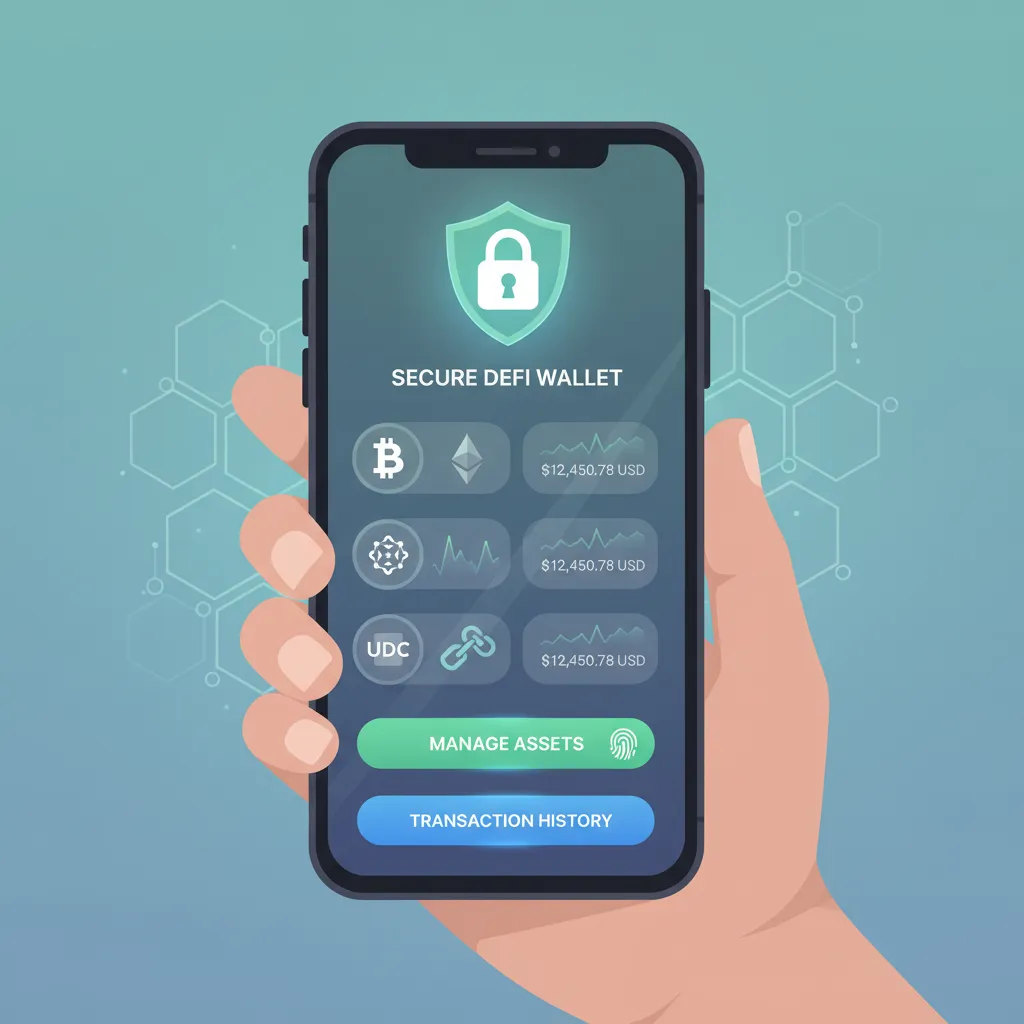
The golden rule of DeFi security tips: NEVER, EVER share your seed phrase (recovery phrase) with anyone. Write it down on paper and store it in a secure, offline location. Anyone with this phrase can access your funds.
- Recommended Beginner Wallets: MetaMask (browser extension and mobile), Trust Wallet (mobile-focused).
Step 3: Buy Some Cryptocurrency
You’ll need some crypto to interact with DApps. The easiest way to start is by buying a major cryptocurrency like Ethereum (ETH) from a reputable centralized exchange (CEX) like Coinbase, Kraken, or Binance. ETH is the native currency of the Ethereum blockchain, where most DeFi activity happens, and it’s used to pay for transaction fees (gas). You can then send this crypto from the exchange to your personal DeFi wallet.
Step 4: Connect to a Decentralized Application (DApp)
With crypto in your wallet, you’re ready to explore. Let’s say you want to use Uniswap, a popular DEX.
- Go to the official Uniswap website.
- Click “Connect Wallet.”
- A prompt from your MetaMask or Trust Wallet will appear, asking for permission to connect.
- Approve the connection.
That’s it! Your wallet is now connected to the DApp, and you can begin interacting with its smart contracts.
Step 5: Start Small and Experiment
Your first foray into DeFi should be an educational one. Don’t invest your life savings. Start with an amount you are fully prepared to lose—perhaps $50 or $100.
- Try a Simple Swap: Use a DEX like Uniswap to swap a small amount of ETH for a stablecoin like USDC. This will help you get comfortable with the process and understand how gas fees work.
- Try a Small Deposit: Deposit a small amount of that USDC into a lending protocol like Aave to see how you can start earning interest in real-time.
Navigating the DeFi Landscape: Best DeFi Platforms for Beginners
The DeFi ecosystem is massive. To help you get started, here is a short DeFi protocols list of some of the most reputable and user-friendly platforms.
- Decentralized Exchanges (DEXs):
- Uniswap: The original and one of the largest AMM-based DEXs on Ethereum. A must-know for any DeFi user.
- Sushiswap: A community-driven alternative to Uniswap with additional features.
- Lending and Borrowing:
- Aave: A leading decentralized lending protocol where you can lend and borrow a wide variety of assets.
- Compound: Another foundational lending protocol that helped pioneer the concept of yield farming.
- Portfolio Trackers:
- Zapper & Zerion: These are dashboard DApps that allow you to track all your DeFi investments, debts, and liquidity pool positions in one place.
Understanding the Economics: DeFi Tokenomics and Gas Fees
Two economic concepts are critical for any beginner to understand: gas fees and tokenomics.
H3: What are Gas Fees in DeFi?
Gas fees DeFi are the transaction fees you pay to use a blockchain network like Ethereum. Every action—a swap, a deposit, a vote—requires computational energy, and gas is the fee you pay to the network validators who perform this work.
These fees can fluctuate wildly based on network congestion. When many people are using the network, the fees go up. This can be a major pain point for beginners. To combat high fees, consider using “Layer 2” scaling solutions like Polygon, Arbitrum, or Optimism, which offer much cheaper and faster transactions.
H3: A Quick Look at DeFi Tokenomics
DeFi tokenomics refers to the economic structure of a specific cryptocurrency token. It answers questions like:
- What is the token’s purpose? Is it for governance (voting rights), utility (paying fees), or something else?
- How many tokens are there (supply)? Is it fixed, or does it inflate over time?
- How were the tokens distributed? Was it a fair launch, or did early investors and the team get a large portion?
Understanding the tokenomics of a project is crucial before investing, as it can help you gauge its long-term viability and potential.
The Future of Decentralized Finance
DeFi is still in its early innings, but its potential is staggering. The future of decentralized finance points towards a system that is more integrated with the real world. We are seeing trends like the tokenization of real-world assets (like real estate and stocks), improved user interfaces that make DeFi as easy to use as a banking app, and a multi-chain world where value flows seamlessly between different blockchains.
As technology evolves, the lines between traditional and decentralized finance will continue to blur, creating a more efficient, open, and accessible financial system for everyone. Related: AI Revolutionizes Content Creation: The Ultimate Guide
Conclusion: Your Journey into Web3 Finance Begins Now
We’ve covered a lot of ground, from the fundamental question of what is DeFi crypto to the practical steps for making your first transaction. You’ve learned about DEXs, lending, staking, and the critical importance of security.
Decentralized Finance is a paradigm shift. It hands the power and control of finance back to the individual. While it offers incredible opportunities for earning passive income and accessing innovative financial tools, it also comes with significant responsibilities. The most important of these is the security of your own assets.
Your journey into this new financial frontier has just begun. The key is to approach it with a mindset of curiosity and caution. Start small, never stop learning, and always prioritize security above all else. Welcome to the future of finance.
Frequently Asked Questions (FAQs)
Q1. What is a simple example of DeFi?
A simple example is using a decentralized exchange (DEX) like Uniswap. You can connect your personal crypto wallet and swap one token for another (e.g., Ethereum for USDC) directly with a smart contract, without needing a bank or centralized company to process the trade.
Q2. Can you really make money with DeFi?
Yes, it is possible to make money in DeFi through methods like lending your assets to earn interest, staking your tokens to earn rewards, or providing liquidity to trading pools. However, these activities carry significant risks, including smart contract vulnerabilities and market volatility, and profits are never guaranteed.
Q3. Is DeFi safe for beginners?
DeFi can be risky for beginners if they dive in without proper education. The primary risks include scams, smart contract hacks, and the high volatility of crypto assets. However, by starting small, using reputable and audited platforms, and prioritizing security (especially protecting your wallet’s seed phrase), beginners can safely explore the ecosystem.
Q4. How much money do you need to start with DeFi?
There is no official minimum, but it’s wise to start with a small amount you are comfortable losing, such as $50 to $100. This is enough to experiment with basic transactions like a token swap or a small deposit into a lending protocol. Be mindful of gas fees, which can be high on networks like Ethereum, potentially eating into a small starting capital.
Q5. What is the difference between DeFi and crypto?
Cryptocurrency (like Bitcoin or Ethereum) is the asset itself—a digital currency secured by cryptography. DeFi (Decentralized Finance) is the financial system and applications built using these cryptocurrencies on a blockchain. In short, crypto is the money, and DeFi is what you can do with it.
Q6. Do I need to pay taxes on DeFi?
In most jurisdictions, yes. Activities in DeFi that generate income—such as earning interest from lending, receiving staking rewards, or realizing a profit from a token swap—are generally considered taxable events. Tax laws for crypto are complex and evolving, so it is highly recommended to consult with a qualified tax professional in your country.
Q7. What is a DeFi wallet?
A DeFi wallet is a non-custodial cryptocurrency wallet that gives you full control over your private keys and, therefore, your assets. Unlike a wallet on a centralized exchange, no third party can freeze or access your funds. Examples include MetaMask, Trust Wallet, and Phantom. They act as your passport to interact with DeFi applications (DApps).