Claude 3.5 Sonnet: A Deep Dive Into Its New Features

Introduction: The New Standard for Intelligent Assistants
In the rapidly evolving landscape of generative AI, breakthroughs are announced almost monthly, redefining what we expect from large language models. Yet, few releases carry the weight and immediate impact of a new flagship model from a major player. The launch of Claude 3.5 Sonnet by Anthropic AI is exactly one such moment.
Historically positioned as a high-performance, safer alternative, Anthropic has consistently pushed the boundaries of artificial intelligence news. With the 3.5 generation, they have done something surprising: the mid-tier model, Sonnet, has surpassed the performance of its own previous top-tier model, Claude 3 Opus. This is not just a marginal upgrade; it represents a significant structural leap in efficiency and intelligence, fundamentally changing the AI model comparison landscape.
This deep dive into Claude 3.5 Sonnet features will unpack why this model is being hailed as the new benchmark. We will explore its blistering speed, its enhanced vision capabilities, and, most importantly, the transformative new workspace feature called “Artifacts.” If you are a developer, an enterprise decision-maker, or simply interested in the future of next generation AI, understanding what is Claude 3.5 Sonnet and how it functions is critical to staying ahead of the curve.
[Related: https://blog.hifistudio.in/blog/unlock-potential-ai-tools-productivity-creativity-2024/ - Unlock the Potential of AI Tools for Productivity and Creativity in 2024]
Unpacking the Raw Power: Speed and Intelligence Benchmarks
Anthropic designed Claude 3.5 Sonnet to sit at the intersection of power and efficiency. It aims to deliver elite performance at a speed and cost that makes it accessible for routine, high-volume tasks. The resulting performance metrics show that Anthropic has successfully shifted the power dynamic in the LLM race, delivering an AI breakthrough that is both faster and more capable than its predecessor.
A Leap Beyond Claude 3 Opus
For context, the Claude 3 family consisted of Haiku (fastest, smallest), Sonnet (mid-tier), and Opus (most capable). The 3.5 generation saw Sonnet jump dramatically, effectively inheriting the intelligence crown while maintaining its competitive speed profile.
Key performance improvements highlighted by Anthropic include:
- General Intelligence: Significant gains in general reasoning, complex instruction following, and nuance interpretation.
- Coding Proficiency: A major uplift in tasks requiring code generation, debugging, and review (scoring highly on HumanEval and other coding benchmarks).
- Data Analysis: Enhanced capacity for parsing complex datasets, generating insights, and creating visual representations of data.
This performance surge means that tasks previously requiring the highest-cost models (like the original Opus) can now be handled by Sonnet, providing substantial efficiency gains for enterprise AI solutions.
Setting New Records in the AI Model Comparison
When examining AI performance benchmarks, Claude 3.5 Sonnet demonstrates compelling results across industry-standard tests, firmly establishing it as a leading large language model.
| Benchmark Category | Claude 3 Opus (Previous Top) | Claude 3.5 Sonnet (New Standard) | Significance |
|---|---|---|---|
| MMLU (Massive Multitask Language Understanding) | High 80s | Low 90s | Superior knowledge and general reasoning |
| HumanEval (Coding) | Mid 80s | High 80s | Improved code generation and problem-solving |
| GSM8K (Math) | Low 90s | Mid 90s | Advanced mathematical reasoning and accuracy |
| Speed | Baseline | Up to 2x faster than Opus | Ideal for low-latency, real-time applications |
The combined increase in intelligence and the faster processing speed makes the AI model speed test results for Claude 3.5 Sonnet highly attractive for developers using the Claude 3.5 API. Low latency is crucial for creating smooth, integrated user experiences, solidifying Sonnet’s role as a potent intelligent assistant engine.
The Power of Velocity
The emphasis on speed—up to twice as fast as Claude 3 Opus—is not just a technical footnote. It’s a fundamental feature that enables new classes of applications. Real-time customer support, instant document summarization in virtual meetings, and dynamic content generation all rely on minimal latency. This acceleration makes Claude 3.5 Sonnet a powerful force in the AI tools 2024 market, particularly when compared to other high-tier models.
[Image Placement: An abstract visualization of data processing at high speed, representing Claude 3.5 Sonnet’s performance.]

The Game-Changer: Exploring the “Artifacts” Feature
While raw performance metrics are essential, the defining feature that truly sets Claude 3.5 Sonnet apart is the introduction of AI Artifacts feature. This innovation moves the interaction with an AI from a purely conversational, back-and-forth chat interface to a dynamic, iterative workspace.
What Exactly Are AI Artifacts?
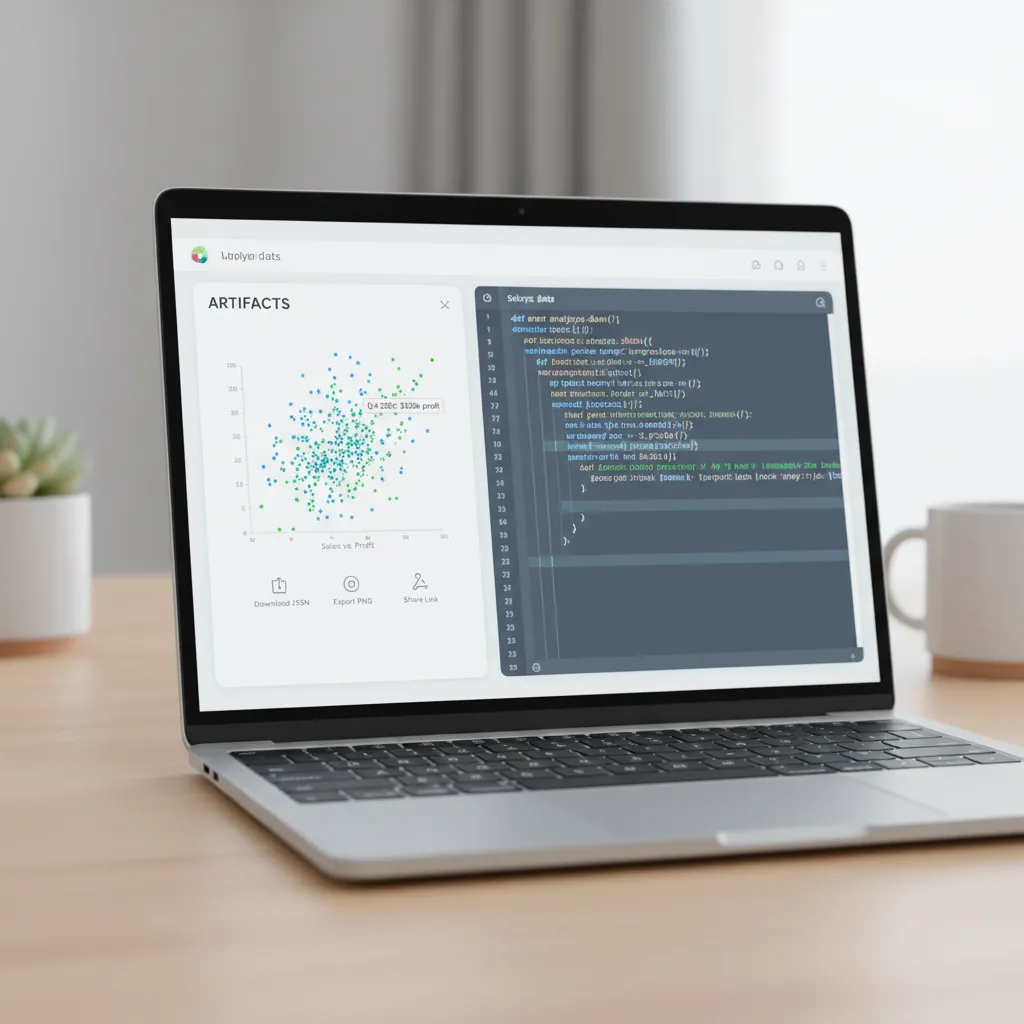
The Artifacts feature is a dedicated, interactive window that appears alongside the main chat. When Claude generates a piece of content that can be executed, viewed, or edited—such as a snippet of code, a simple website design, a document layout, or a data visualization—it renders this output directly in the Artifacts window.
Instead of just getting text describing a solution, the user gets the solution itself in an accessible format. This transforms the AI from a sophisticated answering machine into a collaborative partner.
A Collaborative Workspace for Generative AI
Think of Artifacts as a dynamic sandbox. If you ask Claude to “build a simple Python script for web scraping,” the code appears in the chat, and the interactive output, ready to run or modify, appears simultaneously in the Artifacts window.
This feature directly addresses a major friction point in using generative AI for complex tasks: the difficulty of moving the AI’s output into a usable environment. By blurring the line between generation and execution, Anthropic provides a seamless pathway from idea to deployment.
Revolutionizing the Coding Workflow
The most immediate and obvious beneficiary of Artifacts is the developer community. For those seeking the best AI for coding, Claude 3.5 Sonnet offers an unparalleled experience.
- Instant Feedback Loops: Developers can instantly see the rendered output of HTML, CSS, JavaScript, or even data plots generated by Claude. If the code is buggy or needs refinement, they can ask Claude to adjust the code while simultaneously viewing the results update in real-time.
- Iterative Design: Instead of copying code to a local IDE, running it, reviewing errors, and then pasting the error back into the chat, the entire loop happens within the Anthropic interface. This significantly reduces context switching and speeds up the development cycle.
- Complex Debugging: When debugging, the Artifacts window can display relevant visualizations or state changes, helping the developer and the AI pinpoint the source of the issue faster.
This integrated environment moves Claude beyond being just an AI assistant and positions it as a true programming co-pilot, greatly enhancing developer productivity.
[Related: https://blog.hifistudio.in/blog/ai-for-developers-2024-tools/ - AI for Developers in 2024: Essential Tools and Trends]
Use Cases Beyond Code: Content and Design
While the coding potential is vast, Artifacts also enhances general content creation:
- Design Prototyping: A user might ask Claude to “create three different newsletter templates based on a sustainable technology theme.” Claude generates the HTML/CSS and displays the live-rendered templates in Artifacts, allowing the user to select and refine their preferred design visually.
- Data Visualization: When dealing with large datasets, Claude 3.5 Sonnet can generate complex graphs (scatter plots, heatmaps, bar charts) and display them in the Artifacts window, allowing for immediate analysis and iteration on the visualization style.
- Document Preview: For long-form content, Artifacts could potentially display the formatted document (e.g., a PDF or presentation structure) as it’s being written, giving users immediate visual context for the flow and layout.
The ability to interact with the output in a visual, immediate way makes the AI Artifacts feature one of the most exciting innovations in the tech industry trends this year.
[Image Placement: A diagram showing the ‘Artifacts’ feature in Claude 3.5 Sonnet, with code on one side and an interactive output on the other.]
Enhanced Vision Capabilities: Seeing is Understanding
The intelligence of a modern LLM is often judged by its multimodal capacity—its ability to process and reason across text, image, and sometimes audio inputs. Claude 3.5 Sonnet vision capabilities have received a significant boost, enabling it to interpret complex visual data with much greater fidelity and accuracy than previous models.
Superior Visual Reasoning
Anthropic emphasizes that Claude 3.5 Sonnet isn’t just better at recognizing objects in an image; it excels at visual reasoning. This means it can:
- Analyze Charts and Graphs: Extract detailed, accurate data from handwritten notes, complex financial reports, or intricate scientific diagrams. It can then summarize the trends or extrapolate information into a textual report.
- Interpret Spatial Data: Process architectural blueprints, schematic diagrams, or geographical maps, understanding the relationships and spatial constraints shown.
- OCR and Document Comprehension: Provide near-perfect optical character recognition (OCR) even on poor-quality or stylized documents, coupling the text extraction with deep contextual understanding of the document’s purpose.
This makes Claude 3.5 Sonnet an incredibly powerful tool for tasks requiring high-stakes document processing and detailed image analysis, contributing significantly to its utility as a powerful intelligent assistant.
Practical Applications of Claude 3.5 Vision
The enhanced vision capabilities open the door to numerous practical Claude 3.5 Sonnet use cases across various sectors:
- Manufacturing and Quality Control: Analyzing high-resolution images of manufactured parts to identify defects or inconsistencies, providing real-time feedback.
- Healthcare and Diagnostics: Assisting in interpreting medical scans (X-rays, MRIs—though requiring human oversight), reading handwritten prescriptions, or digitizing historical medical records.
- Data Analytics: Taking a screenshot of a dashboard from a legacy system and instantly generating a modern, customizable JSON or Python representation of the underlying data structure.
This sophisticated vision processing makes the model highly relevant for enterprise AI solutions where processing unstructured data (like scans and images) is commonplace.
[Image Placement: An AI’s point-of-view analyzing a complex architectural blueprint, demonstrating advanced vision capabilities.]

Claude 3.5 Sonnet vs GPT-4o: The Head-to-Head Showdown
In the current AI chatbot review cycle, the inevitable comparison is between Anthropic’s new contender and its chief rival, GPT-4o from OpenAI. Both models represent the pinnacle of generative AI, but they have distinct strengths and architectural philosophies that cater to different user needs. Understanding this AI model comparison is crucial for making informed deployment decisions.
Performance and Speed Test: Intelligence at Velocity
While both models score exceptionally well on standardized benchmarks (MMLU, HumanEval), the nuances in their performance and speed profile are what truly differentiate them:
| Feature | Claude 3.5 Sonnet | GPT-4o | Key Differentiator |
|---|---|---|---|
| Intelligence | Top-tier; excels in complex reasoning and safety protocols. | Top-tier; strong multimodal integration. | Claude often shows deeper reasoning; GPT-4o is hyper-optimized for speed and multimodal synthesis. |
| Speed (AI Model Speed Test) | Very fast (2x Opus); optimized for sustained throughput. | Extremely fast; designed for near-instant conversational latency. | GPT-4o might edge out in raw conversational speed; Sonnet offers elite intelligence rapidly and consistently. |
| Unique Feature | Artifacts: Integrated, interactive workspace for code and content generation. | Seamless audio/vision/text switching (voice assistant capability). | Sonnet targets the creation workflow; GPT-4o targets the real-time interaction workflow. |
| Vision Capabilities | Highly accurate data extraction and visual reasoning (e.g., charts, complex scans). | Excellent general visual understanding and real-time image description. | Sonnet leans toward analytical depth; 4o leans toward instantaneous, conversational analysis. |
For developers prioritizing an integrated, iterative environment for coding and design, the AI Artifacts feature provides a massive advantage for Sonnet. For those building real-time voice applications or multimodal customer service bots, GPT-4o’s native speed and seamless multimodal switching might be more attractive.
Architectural Differences: Safety vs. Modality
Anthropic, founded on principles of responsible scaling and safety, often imbues its models with powerful guardrails and ethical constraints. This makes Claude a preferred choice for organizations dealing with highly sensitive data or operating in regulated industries seeking robust safety assurances—a key concern for enterprise AI solutions.
GPT-4o, an OpenAI competitor, demonstrates a highly unified architecture where text, vision, and audio are processed natively by a single model, resulting in lightning-fast response times for multimodal inputs.
The competition between Claude 3.5 Sonnet vs GPT-4o is not about one being strictly “better,” but about which tool is optimal for a specific task. Sonnet excels in complex, multi-step tasks requiring deep reasoning and iterative development, particularly making it the best AI for coding in a structured environment.
[Image Placement: Symbolic image of two powerful AI entities facing off, representing the comparison between Claude 3.5 Sonnet and GPT-4o.]

Practical Use Cases for Developers and Enterprises
The true measure of a large language model lies in its utility. Claude 3.5 Sonnet’s combination of high intelligence, speed, and the Artifacts feature unlocks powerful new capabilities for both solo developers and large organizations.
Developers and AI Assistant Integration
The Claude 3.5 API provides a robust, developer-friendly interface that allows integration of Sonnet’s power into custom applications.
- Automated Code Review Systems: Deploying Sonnet for advanced static analysis, identifying subtle logic flaws, and suggesting high-quality, idiomatic fixes—going beyond simple syntax checks.
- Sophisticated Data Pipelines: Utilizing its visual reasoning to ingest massive amounts of unstructured data (reports, scanned invoices, images) and output structured JSON, XML, or database entries, drastically reducing manual data entry time.
- Creating Interactive Tutorials: Using the Artifacts feature in a controlled environment to help users learn programming by instantly generating and rendering example code within the learning platform.
[Related: https://blog.hifistudio.in/blog/ai-ethics-responsible-development-future/ - AI Ethics: Responsible Development and the Future of Technology]
Enterprise AI Solutions
For large corporations, Anthropic’s new model offers scalable solutions that improve efficiency across departments:
- Hyper-Personalized Customer Service: Sonnet’s enhanced ability to maintain long context windows and reason deeply allows it to power sophisticated AI chatbot review systems that provide highly personalized, accurate, and context-aware customer support, resolving complex queries without human intervention.
- Knowledge Management: Indexing vast internal document repositories, including images and diagrams, and allowing employees to query the entire corpus using natural language. Its superior visual and analytical skills ensure accurate retrieval from complex sources like engineering manuals or legal documents.
- Strategic Market Analysis: Processing real-time news feeds, market reports, and social media data, then generating actionable summaries and predictions for executive teams.
The blend of cutting-edge performance and Anthropic’s established focus on safety makes Claude 3.5 Sonnet a preferred backbone for mission-critical enterprise AI solutions.
The Future of Interaction: From Chatbot to Intelligent Assistant
The evolution of LLMs is moving past the “chat” interface. The Artifacts feature signals a shift towards models becoming proactive, integrated partners in creative and technical workflows. Claude 3.5 Sonnet functions not merely as a conversational tool, but as a genuine intelligent assistant capable of executing tasks within a unified digital environment. This trend underscores the direction of natural language processing—moving from comprehension to direct, executable contribution.
Access, Pricing, and the Road Ahead
The accessibility and cost structure of a new model are crucial for its adoption rate. Claude 3.5 Sonnet pricing is structured to position it as the optimal blend of power and cost-efficiency.
How to Access Claude 3.5 Sonnet
Anthropic has ensured broad availability for their new model:
- Free Web Access: Claude 3.5 Sonnet is available for free use on Anthropic’s web platform (Claude.ai), replacing the older Sonnet model. This allows casual users and researchers to experience its power immediately.
- Paid Subscriptions (Claude Pro/Team): Subscribers to Claude Pro and Team tiers receive increased usage capacity and priority access to the model, ensuring high-volume users can rely on the service during peak times.
- API Availability: The model is available via the Claude 3.5 API, making it readily available for AI for developers building commercial applications. It is priced to be competitive against other mid-to-high-tier models in the market.
Understanding Claude 3.5 Sonnet Pricing
While exact figures fluctuate based on market conditions and specific use case contracts, the key takeaway regarding Claude 3.5 Sonnet pricing is its strategic positioning. It is typically priced significantly lower than the previous flagship, Claude 3 Opus, yet it offers superior performance. This provides a clear cost-benefit analysis for businesses that were previously constrained by the expense of using the top-tier Opus model for all tasks.
Its affordability relative to its power makes it an ideal candidate for scaling applications where cost per token is a major consideration. This aggressive pricing strategy is a key part of how Anthropic aims to capture market share in the fiercely competitive tech industry trends.
[Related: https://blog.hifistudio.in/blog/best-ai-personal-assistants-productivity/ - The Best AI Personal Assistants for Productivity in 2024]
Conclusion: Defining the Next Generation AI
The release of Claude 3.5 Sonnet is a defining moment in the current wave of artificial intelligence news. It is more than just a model upgrade; it is a paradigm shift towards integrated, iterative, and exceptionally fast intelligent systems. By making its mid-tier model smarter than its previous top-tier one, Anthropic has raised the bar for efficiency and performance in the large language model space.
The introduction of the AI Artifacts feature marks a genuine leap forward in human-computer collaboration, transforming the AI assistant from a simple dialogue partner into a co-creator and executor of tasks. For developers seeking the best AI for coding and enterprises demanding robust, safe, and cost-effective enterprise AI solutions, Claude 3.5 Sonnet offers compelling capabilities that demand attention.
The ongoing rivalry between Anthropic and its competitors, particularly the nuanced differences observed in the Claude 3.5 Sonnet vs GPT-4o comparison, fuels innovation that benefits all users. As we look ahead, models like Sonnet are not just tools; they are foundational building blocks for the next generation AI applications that will redefine how we live, work, and create. Explore the Claude 3.5 Sonnet use cases today and see how this powerful, original model can accelerate your digital future.
FAQs
Q1. What is the difference between Claude 3.5 Sonnet and Claude 3 Opus?
Claude 3.5 Sonnet is the successor to the Claude 3 model family’s mid-tier offering, but it demonstrates performance that significantly exceeds the previous top-tier model, Claude 3 Opus, across key benchmarks like MMLU, coding (HumanEval), and visual reasoning. Additionally, Sonnet 3.5 is up to twice as fast as Opus and introduces the groundbreaking AI Artifacts feature.
Q2. Is Claude 3.5 Sonnet free to use?
Yes, Claude 3.5 Sonnet is available for free use through the Claude.ai web interface, replacing the older Sonnet model for general users. Paid subscribers (Claude Pro and Team) receive expanded usage limits and priority access to the model, as well as access to the new Artifacts feature.
Q3. How does the ‘Artifacts’ feature benefit non-developers?
The AI Artifacts feature benefits non-developers by creating an interactive, visual workspace for content. If you ask Claude to generate a complex table, a simple design draft (HTML/CSS), or a data visualization, the Artifacts window displays the live, rendered output, allowing non-technical users to immediately see and refine the result without needing external tools.
Q4. Which model is better for coding: Claude 3.5 Sonnet or GPT-4o?
Both are excellent, but they have different strengths. Claude 3.5 Sonnet, thanks to its superior performance on coding benchmarks and the integrated, iterative environment provided by the AI Artifacts feature, is often considered the best AI for coding workflows that require complex iteration and debugging within a unified workspace. GPT-4o offers extremely fast conversational speed, which is great for quick code snippets.
Q5. What are the main limitations of Claude 3.5 Sonnet compared to a model like Opus 3.5 (when released)?
While Claude 3.5 Sonnet is extremely powerful, it remains the mid-tier model. Future top-tier models from Anthropic (like a potential Claude 3.5 Opus) are expected to feature even higher reasoning capabilities, larger context windows, and potentially even more advanced training for highly niche, safety-critical tasks, though at a higher cost.
Q6. What are the key elements of Claude 3.5 Sonnet pricing for developers?
Claude 3.5 Sonnet pricing is set to make it an economically efficient powerhouse. It offers high intelligence and fast processing speed at a much lower cost per token compared to older premium models, making it the preferred choice for applications requiring high volume throughput while maintaining top-tier performance quality via the Claude 3.5 API.