AI Revolutionizes Gaming: The Future of Immersive Play
Introduction
Gaming has always pushed the boundaries of technology, transforming from simple pixelated adventures into vast, hyper-realistic digital worlds. Yet, even as graphics improve and processing power soars, a fundamental shift is underway that promises to redefine interactive entertainment: the AI revolutionizes gaming. Artificial Intelligence, once relegated to predictable enemy patterns and basic scripting, is now emerging as the core engine driving the future of immersive play.
From the subtle nuances of intelligent NPCs that learn and adapt, to generative AI in games that crafts unique quests and landscapes on the fly, AI in games is no longer just a supporting character; it’s becoming the director, the playwright, and even the player’s most formidable opponent or trusted ally. This article delves deep into how gaming AI is fundamentally transforming every facet of the industry, exploring how AI enhances gaming experiences, shapes AI game development trends, and offers personalized AI gaming experiences that were once the stuff of science fiction. Join us as we explore the profound impact of AI on gaming industry and peer into the exhilarating, sometimes challenging, landscape of next-gen gaming AI.
The Evolution of AI in Gaming: From Scripted Foes to Intelligent Companions
To truly appreciate where AI gaming is headed, it’s essential to understand its journey. For decades, “AI” in video games was a term often used loosely, referring primarily to pre-programmed behaviors and decision trees. Early video games, while revolutionary for their time, featured enemies with predictable movements and limited responses, offering a finite set of challenges.
Early AI: Simple Scripts and Pattern Recognition
Think back to the classic arcade games or early console titles. Enemies followed fixed paths, attacked in predictable sequences, or reacted only to direct player proximity. This rudimentary game AI relied on simple “if-then” statements. While effective for the era, it lacked true intelligence or adaptability. Players quickly learned patterns, leading to a sense of repetition once the initial challenge was overcome. Even early open-world games struggled with generating genuinely dynamic interactions; NPCs often felt like cardboard cutouts with a few lines of dialogue.
Advancements in Machine Learning in Gaming
The real turning point arrived with the widespread adoption of machine learning in gaming. This wasn’t about simply coding every possible scenario, but about creating systems that could learn from data, identify patterns, and make decisions dynamically. Modern gaming AI leverage techniques like:
- Reinforcement Learning: AI agents learn through trial and error, receiving rewards for desired actions and penalties for undesirable ones. This is how AI can learn to play complex games like Go or Chess, or even navigate intricate 3D environments more effectively than human players.
- Neural Networks: Inspired by the human brain, these algorithms can process vast amounts of data to recognize complex patterns, leading to more human-like decision-making in AI virtual characters.
- Fuzzy Logic: Allows AI to make decisions based on imprecise or ambiguous inputs, mimicking human intuition and allowing for more nuanced character behaviors.
These advancements paved the way for more sophisticated intelligent NPCs, capable of reacting to unforeseen circumstances, cooperating with teammates, or strategically outmaneuvering players in ways that feel far more organic and less scripted. This foundational shift has been pivotal in answering the question of how AI enhances gaming, moving from rigid logic to fluid, responsive interaction.
How AI Enhances Gaming Experiences: A Deep Dive
The integration of advanced AI in games is not just a technical upgrade; it’s a paradigm shift in how we interact with digital worlds. The benefits ripple through every aspect of gameplay, from the characters we meet to the very environments we explore.
Intelligent NPCs and Dynamic Worlds
Gone are the days of non-player characters that feel like static props. Modern intelligent NPCs powered by gaming AI can exhibit complex behaviors, emotional responses, and even develop unique personalities. In games like Red Dead Redemption 2 or The Last of Us, companion NPCs don’t just follow; they react to environmental cues, offer tactical advice, and engage in context-sensitive dialogue, making them feel like genuine participants in the narrative.
Furthermore, AI driven game narratives are becoming a reality. Instead of linear stories, AI can introduce emergent plotlines, character relationships that evolve based on player choices, and dynamic world events that make each playthrough unique. Imagine a game where your past actions influence how an AI character perceives you, leading to different questlines or alliances. This level of responsiveness creates an unparalleled sense of immersion, where the world feels alive and reactive.
Adaptive AI: Tailoring Challenges to Every Player
One of the most profound contributions of AI in games is its ability to adapt. Adaptive AI in games can analyze a player’s skill level, play style, and even emotional state to dynamically adjust difficulty, pacing, and content. If a player is struggling, the AI might subtly reduce enemy aggression or offer more hints. If a player is dominating, the AI could introduce new AI game challenges, more complex enemy formations, or unexpected environmental hazards.
This continuous adjustment ensures that the game remains engaging and appropriately challenging for everyone, from casual players to seasoned veterans. AI for game personalization extends beyond difficulty, offering curated content, suggesting missions based on player preferences, or even procedurally generating new content that aligns with a player’s preferred activities. This makes every AI gaming experience feel tailor-made.
Generative AI: Crafting Limitless Content
Perhaps the most exciting frontier in AI gaming is generative AI in games. This technology allows AI to create new content autonomously, from landscapes and character models to entire quests and dialogue trees. Instead of relying solely on human designers, generative AI can:
- Create vast, unique worlds: Imagine exploring a game where every forest, cave, or city is distinct and has never been seen before, even by the developers.
- Develop emergent narratives: AI can generate new story branches, character backstories, and quest objectives, making each playthrough truly unique. This is a game-changer for AI game storytelling, offering endless replayability.
- Populate worlds with diverse elements: From unique fauna and flora to randomized loot and enemy types, generative AI ensures freshness and surprise.
This capability not only reduces the immense workload on developers but also promises an endless stream of novel experiences for players, ensuring that games remain fresh and unpredictable for years to come.
Realistic Graphics and Physics
While often associated with traditional rendering engines, AI is increasingly playing a crucial role in pushing visual and physical realism. AI for realistic graphics in games can be seen in techniques like:
- DLSS (Deep Learning Super Sampling): NVIDIA’s AI-powered rendering technology uses machine learning to upscale lower-resolution images to higher resolutions, significantly improving visual quality and frame rates without increasing GPU load.
- Procedural Generation of Textures and Models: AI can assist artists by generating highly detailed textures, materials, and even 3D models based on reference data, streamlining asset creation.
In terms of simulation, AI game physics can create more believable interactions, from complex fluid dynamics to realistic cloth movement and destruction. This isn’t just about looking good; it’s about making game worlds feel more tangible and responsive to player actions.
AI in Esports: Training and Analysis
The competitive gaming scene, or esports, is also benefiting immensely from AI gaming. AI agents can be trained to play games at superhuman levels, serving as invaluable sparring partners for professional players. They can identify weaknesses in strategies, predict opponent movements, and even simulate various match scenarios.
Beyond direct play, AI analytics tools are revolutionizing how teams prepare. They can:
- Analyze player performance: Identifying strengths, weaknesses, and common mistakes.
- Scout opponents: Dissecting rival team strategies and player tendencies.
- Optimize team compositions: Recommending character picks or team setups based on data.
This level of detailed, data-driven insight is transforming esports training and strategy, making competitive gaming more sophisticated and data-intensive than ever before. [Related: The AI Revolution: How Artificial Intelligence is Transforming Healthcare]
AI Game Development Trends and Innovations
The influence of AI extends far beyond the player’s screen, fundamentally reshaping the very process of creating games. AI game development trends are focused on efficiency, innovation, and pushing creative boundaries.
Streamlining Development with AI Tools
Game development is notoriously complex and resource-intensive. AI game design tools and AI game engines are emerging as powerful allies for developers, automating tedious tasks and accelerating creative processes:
- Automated Asset Generation: AI can quickly create variations of 3D models, textures, and sound effects, significantly reducing the manual labor involved in populating game worlds.
- Procedural Level Design: Instead of hand-crafting every level, AI can generate vast, intricate environments, which human designers can then refine.
- Animation and Motion Capture Enhancements: AI can smooth out animations, generate realistic facial expressions, and even help in retargeting motion capture data to different character rigs.
One crucial area where AI is making a massive difference is AI for game testing. Traditional game testing is a laborious, often repetitive task performed by human testers. AI agents can be trained to autonomously play games, identify bugs, test edge cases, and even provide detailed reports on game stability and performance, saving countless hours and resources. This ensures a more polished and enjoyable experience for the end-user.
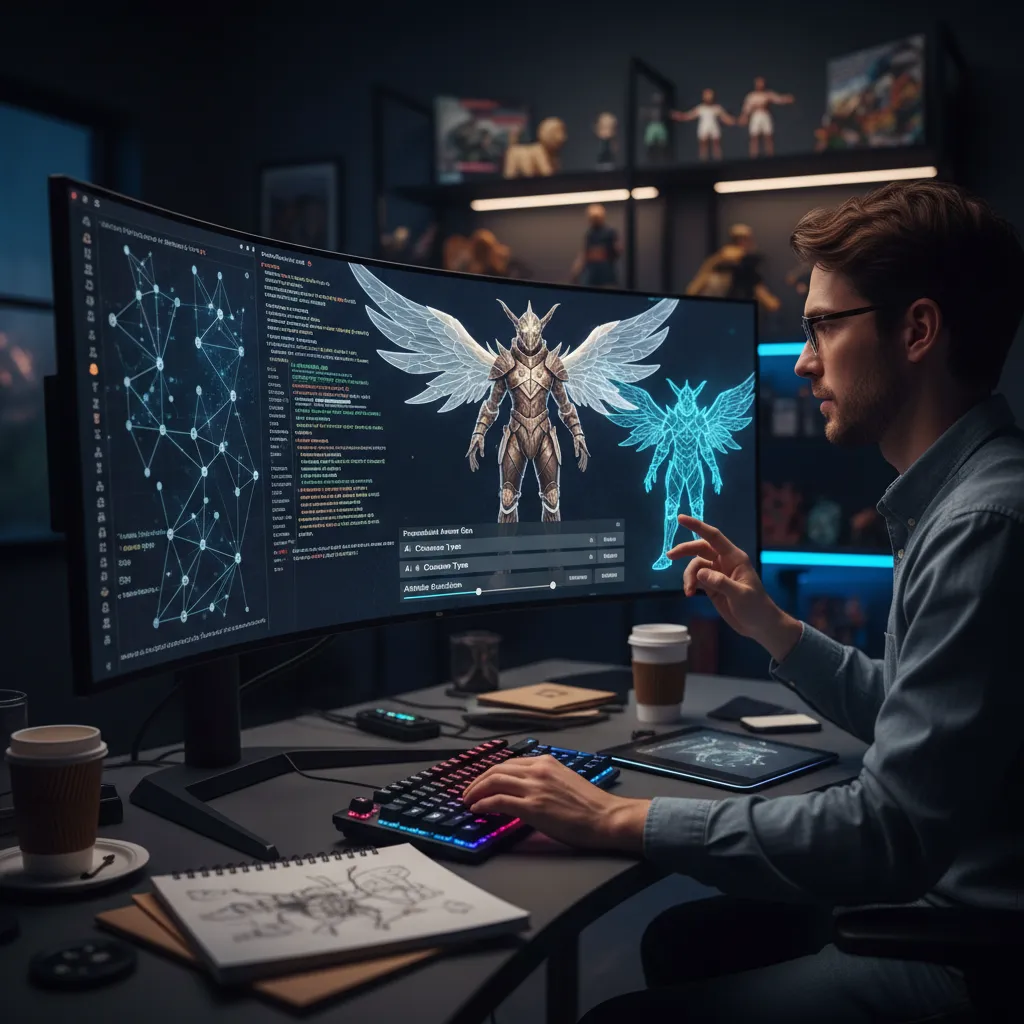 Game developer using AI tools: Streamlining workflows for faster, more innovative game creation.
The Rise of AI-Powered Game Mechanics
Beyond making existing mechanics better, AI powered game mechanics are introducing entirely new ways to play. Imagine:
- Dynamic Difficulty Scaling: As mentioned, but beyond simple number tweaks, AI could introduce new enemy types or alter objectives based on performance.
- Emergent Puzzle Solving: Puzzles that adapt to the player’s problem-solving style, offering different clues or solutions based on how they approach challenges.
- Living Economies: In-game economies driven by complex AI agents representing merchants, crafters, and consumers, reacting to supply and demand in real-time.
These innovations create richer, more dynamic gameplay loops that constantly surprise and challenge players, moving beyond static systems towards living, breathing game worlds. This is truly the essence of AI gaming innovations.
The Impact of AI on the Gaming Industry
The transformative power of AI is not confined to gameplay mechanics and development tools; it has a profound impact of AI on gaming industry as a whole, influencing business models, accessibility, and ethical considerations.
New Revenue Streams and Business Models
The rise of personalized AI gaming experiences opens up avenues for new revenue streams. Imagine games that offer AI-generated expansions tailored to your play history, or subscription services that provide access to dynamically evolving narrative content. AI can also optimize monetization strategies in free-to-play games by identifying player preferences and offering relevant cosmetic items or boosts. [Related: Revolutionize Marketing: AI Automation]
Furthermore, the efficiency gained through AI game design tools and AI for game testing can reduce development costs, allowing smaller studios to compete with larger ones and fostering a more diverse gaming landscape. This could lead to a proliferation of unique, niche experiences that were previously too expensive to produce.
Accessibility and Inclusivity Through AI
AI has the potential to make gaming more accessible to a wider audience. For players with disabilities, AI in games can offer:
- Adaptive Controls: AI can learn player input patterns and suggest optimized control schemes or even automate certain complex actions.
- Dynamic Subtitling and Audio Descriptions: AI-powered speech-to-text and text-to-speech can provide real-time captions or descriptive audio for visually impaired players.
- Personalized Difficulty: As discussed, AI can adjust challenges to suit players with varying motor skills or cognitive abilities, ensuring everyone can enjoy the game.
By lowering barriers to entry, AI helps foster a more inclusive gaming community where everyone can participate and experience the joy of interactive entertainment.
Ethical AI in Gaming: Navigating the Future
As AI in gaming becomes more sophisticated, ethical considerations become paramount. The industry must grapple with questions such as:
- Bias in AI: If AI learns from human data, it can inherit and perpetuate biases. Ensuring fairness in AI virtual characters’ behaviors, AI game challenges, and content generation is crucial.
- Player Manipulation: Adaptive AI could potentially be used to exploit player psychology, encouraging excessive play or monetization. Ethical guidelines are needed to prevent such misuse.
- Job Displacement: While AI streamlines development, there are concerns about its long-term impact on jobs in areas like art, testing, and even design. The focus must be on augmentation rather than replacement, allowing humans to focus on higher-level creative tasks.
- Player Autonomy and Agency: As AI driven game narratives become more complex, how do we ensure players still feel agency and control over their experience, rather than feeling manipulated by an unseen AI hand?
Addressing ethical AI in gaming proactively is vital to ensure that the future of AI in gaming benefits all stakeholders and maintains a positive, healthy relationship between players and technology.
The Future of AI in Gaming: Beyond the Horizon
Looking ahead, the potential for AI gaming is nothing short of revolutionary. We are only scratching the surface of what’s possible, and the next-gen gaming AI promises experiences that will blur the lines between reality and simulation.
Hyper-Realistic Worlds and Unprecedented Immersion
Imagine stepping into game worlds that are indistinguishable from reality, not just visually, but in their responsiveness and detail. AI for realistic graphics in games will continue to evolve, with AI not just upscaling images but generating entire environments with photo-realistic fidelity on the fly, customized to player expectations. The seamless integration of AI game physics will mean every interaction feels natural and grounded. [Related: Quantum AI: The Next Frontier in Intelligent Computing]
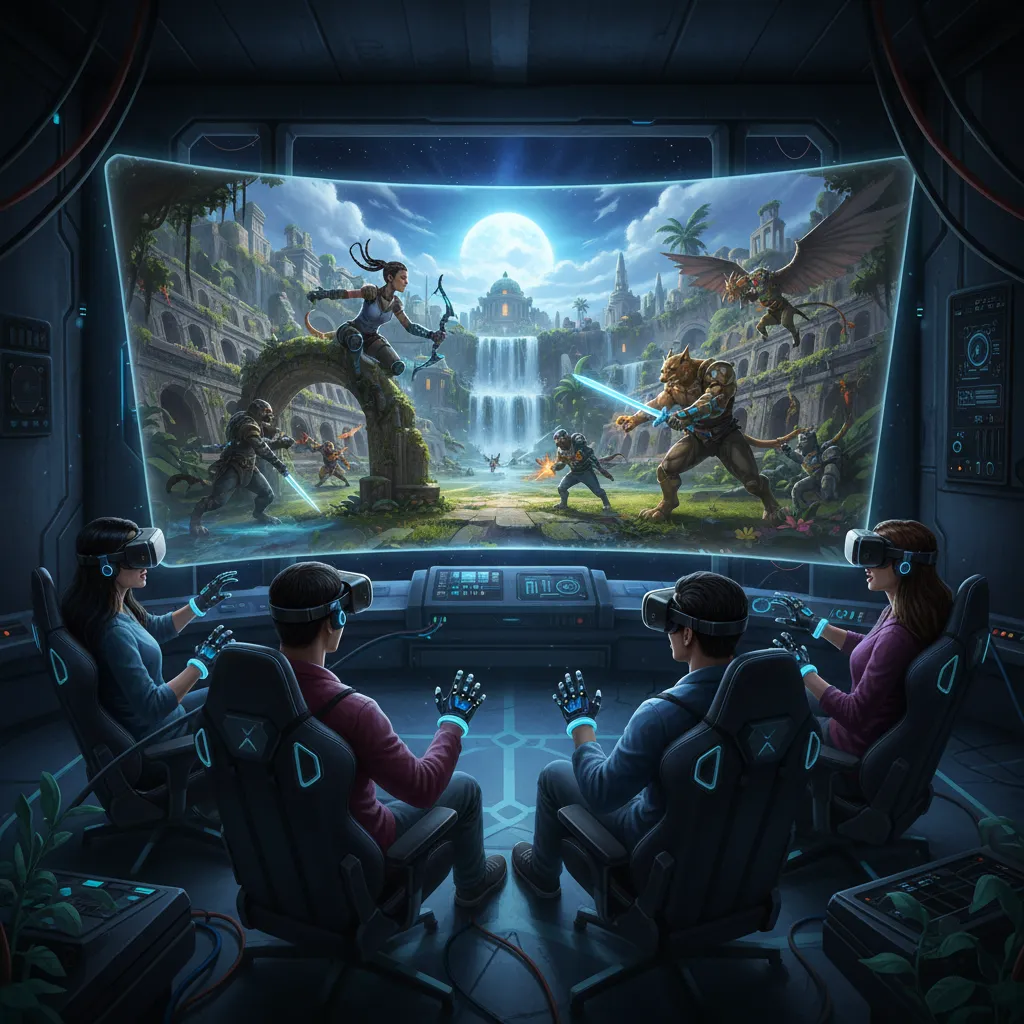 Gamers in AI-driven virtual world: Experience unparalleled realism and interaction in AI-powered digital realms.
The sensory immersion will extend beyond sight and sound. Haptic feedback driven by AI could simulate textures, resistance, and even temperature, creating truly holistic experiences. Virtual reality and augmented reality, powered by advanced gaming AI, will cease to be niche technologies and become mainstream portals to infinitely dynamic digital universes.
Truly Dynamic and Evolving Narratives
The dream of a truly living, breathing story that adapts to every choice, every conversation, every failure, and every triumph will become a reality. AI game storytelling will move beyond branching narratives to emergent ones, where the plot isn’t pre-written but rather co-created by the player and the AI.
AI virtual characters will possess genuine memory, learning from past interactions, developing long-term relationships (or rivalries) with players, and making decisions that impact the world in meaningful, unpredictable ways. Imagine a world where your actions against a minor NPC in the early game could lead to unforeseen consequences and a powerful antagonist emerging chapters later. This level of dynamic reactivity will make every playthrough a unique epic.
AI Companions and Adversaries with Emotional Depth
The concept of intelligent NPCs will reach new heights. AI companions won’t just follow commands; they’ll understand your intentions, anticipate your needs, and offer unsolicited advice or support based on your play style and their own developing “personalities.” Adversaries won’t just be difficult; they’ll be cunning, learning from your tactics, exploiting your weaknesses, and displaying realistic emotional responses to victory or defeat.
This will lead to highly personalized AI gaming experiences where the connections forged with AI characters feel as genuine and impactful as those with human players. The emotional stakes will be higher, and the sense of camaraderie or rivalry will be more profound.
AI for Game Testing and Optimization at Unprecedented Scales
On the development side, AI for game testing will become even more sophisticated, with AI agents capable of testing billions of scenarios in a fraction of the time it takes humans. This will lead to games launched with unprecedented levels of polish and stability. AI game engines will incorporate self-optimization algorithms, dynamically adjusting game performance based on hardware capabilities and player preferences, ensuring a smooth experience for everyone. [Related: Supercharge Your Content: Top AI Tools for Creators in 2024]
 AI algorithms optimizing game performance: Ensuring seamless gameplay and efficiency across diverse hardware configurations.
Ultimately, the future of AI in gaming isn’t about AI replacing human creativity, but augmenting it. It’s about empowering developers to build worlds of unimaginable scope and depth, and enabling players to explore experiences that are uniquely their own. The collaboration between human ingenuity and artificial intelligence will unlock new dimensions of play, pushing the boundaries of what interactive entertainment can be.
Conclusion
The journey of AI in games from simple scripts to sophisticated, adaptive, and generative systems marks a true revolution in interactive entertainment. We’ve explored how AI enhances gaming through intelligent NPCs, adaptive AI in games, and generative AI in games, crafting personalized AI gaming experiences that were once pure fantasy. The impact of AI on gaming industry is undeniable, streamlining development with AI game design tools, optimizing performance, and opening new frontiers in accessibility and immersive storytelling.
As we look towards the future of AI in gaming, the possibilities are limitless: hyper-realistic worlds, truly dynamic narratives driven by AI driven game narratives, and companions that feel genuinely alive. While challenges like ethical AI in gaming and job displacement require careful navigation, the promise of next-gen gaming AI is too compelling to ignore. The marriage of human creativity with advanced artificial intelligence is set to usher in an era where games are not just played, but truly lived, offering unparalleled immersion and endless adventures. Embrace the AI gaming revolution—the future of play is here, and it’s more intelligent than ever before.
FAQs
Q1. What is AI in gaming?
AI in gaming refers to the use of artificial intelligence technologies to create more intelligent, responsive, and dynamic elements within video games. This includes everything from the behavior of non-player characters (NPCs) to adaptive difficulty systems, procedural content generation, and advanced graphics and physics simulations.
Q2. How does AI enhance gaming experiences?
AI enhances gaming experiences by creating intelligent NPCs, personalizing gameplay through adaptive difficulty and content, generating unique worlds and narratives, improving graphics and physics realism, and providing sophisticated training tools for esports. This leads to more immersive, engaging, and replayable games.
Q3. What are intelligent NPCs in games?
Intelligent NPCs (Non-Player Characters) are game characters controlled by AI that exhibit complex behaviors, learn from player actions, make dynamic decisions, and can even display emotional responses. Unlike scripted characters, they react to the game world and player choices in more organic and believable ways, enhancing immersion and narrative depth.
Q4. What is generative AI in games?
Generative AI in games uses AI models to create new content autonomously, such as unique landscapes, character models, quest lines, dialogue, and textures. This technology allows for limitless content generation, providing fresh experiences with every playthrough and significantly aiding game developers in asset creation.
Q5. How does adaptive AI work in gaming?
Adaptive AI in gaming analyzes a player’s performance, skill level, and play style to dynamically adjust the game’s difficulty, pacing, and content. It can make enemies smarter if a player is performing well, or offer assistance and simpler challenges if they are struggling, ensuring a personalized and balanced experience for every player.
Q6. What are the ethical considerations of AI in gaming?
Ethical considerations for AI in gaming include ensuring fairness and preventing bias in AI systems, avoiding player manipulation through overly personalized or addictive mechanics, addressing potential job displacement in the development cycle, and maintaining player autonomy in AI-driven narratives.
Q7. How does AI impact game development?
AI significantly impacts game development by streamlining workflows through automated asset generation, procedural level design, and enhanced animation. It also revolutionizes game testing by allowing AI agents to quickly identify bugs and optimize performance, leading to faster development cycles and more polished games.
Q8. Will AI replace human game developers?
Most experts believe AI will augment rather than replace human game developers. AI tools will automate repetitive tasks, allowing developers to focus on higher-level creative design, storytelling, and innovation. The collaboration between human creativity and AI efficiency is expected to lead to richer, more complex games.
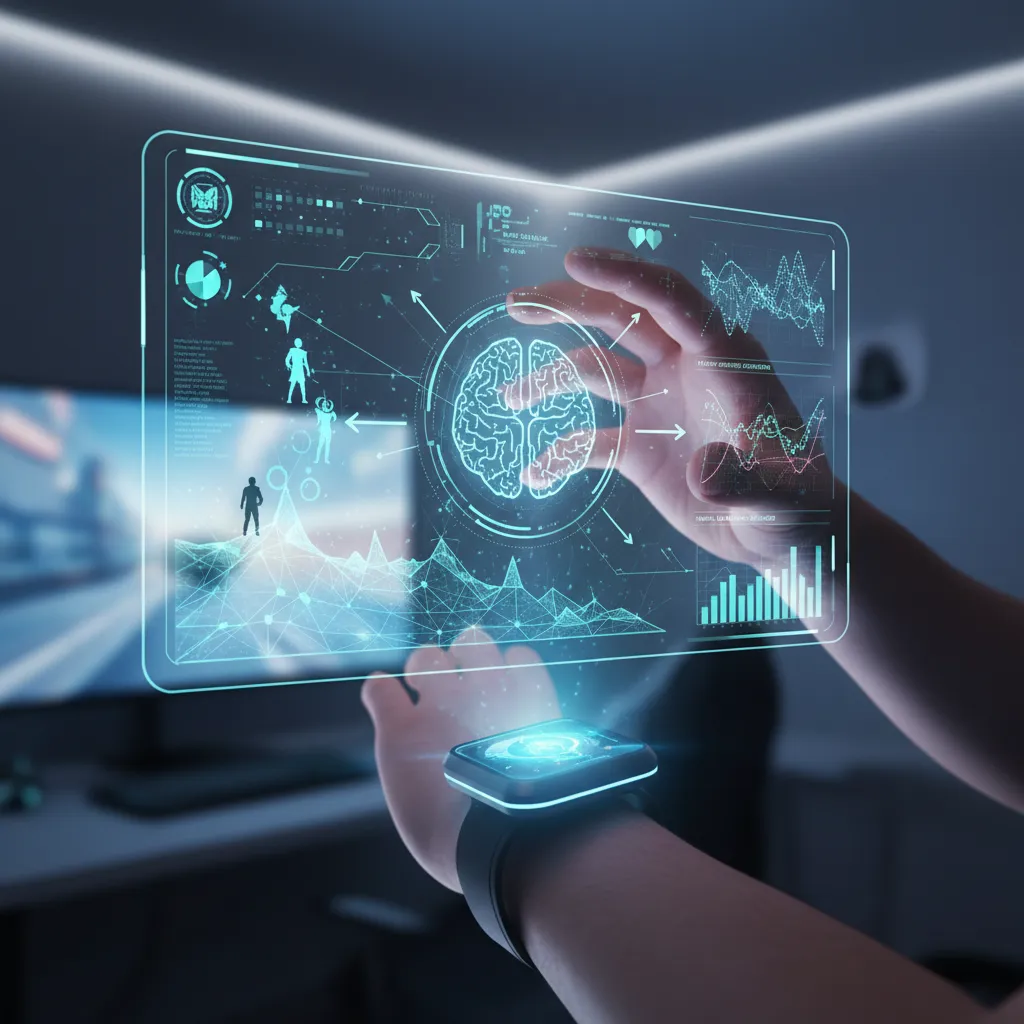 AI adapting to player behavior: Dynamic game systems respond to your choices, creating a unique journey every time.