AI Unleashed: Personalized Healthcare & Wellness Revolution

Introduction
For centuries, medicine has operated on a one-size-fits-all model. A diagnosis led to a standard treatment protocol, a proven pathway that worked for most people. But what about those it didn’t work for? What if your unique genetic makeup, lifestyle, and environment could dictate a treatment crafted just for you? This isn’t science fiction anymore; it’s the new reality being forged by Artificial Intelligence.
We are standing at the precipice of a seismic shift in how we manage our health. The broad strokes of traditional medicine are being replaced by the fine-tipped pen of AI personalized medicine. This revolution, powered by machine learning diagnostics and predictive analytics healthcare, promises a future where illness is not just treated, but anticipated and prevented.
From your DNA to the data on your smartwatch, AI is connecting the dots in ways a human mind never could. This article delves into the heart of the AI healthcare innovations that are transforming our lives. We’ll explore how AI-driven treatment plans are becoming the new standard, how wearable AI health tech is putting a guardian on your wrist, and how this smart health technology is paving the way for a proactive, hyper-personalized approach to your well-being.
The Dawn of Precision: What is AI-Driven Personalized Healthcare?
At its core, AI precision health is the departure from the “average patient” model. It’s an approach that considers individual variability in genes, environment, and lifestyle for each person. Think of it as the difference between buying a suit off the rack and having one tailored to your exact measurements. The off-the-rack suit might fit okay, but the tailored one is perfect.
Traditional healthcare often relies on reactive treatments. You feel sick, you see a doctor, you get a diagnosis, and then you receive a standardized treatment. Data-driven healthcare AI flips this script. It leverages vast datasets—from electronic health records (EHRs) and medical images to genomic information and real-time data from wearables—to build a unique health profile for you.
This allows for:
- Predictive Insights: Identifying individuals at high risk for diseases like cancer or diabetes long before symptoms appear.
- Precise Diagnostics: Analyzing complex data to deliver faster, more accurate diagnoses.
- Customized Treatments: Designing therapies and drug regimens that are most likely to be effective for a specific individual’s genetic and molecular profile.
- Proactive Wellness: Offering personalized recommendations for diet, exercise, and lifestyle changes to prevent illness.
This isn’t just a minor upgrade; it’s a fundamental re-imagining of the patient journey, moving from a system of sickness to a culture of wellness, all orchestrated by intelligent algorithms.
The Diagnostic Revolution: Seeing the Unseen with AI
One of the most immediate and impactful applications of AI in healthcare is in diagnostics. AI algorithms, particularly deep learning models, are now capable of analyzing medical data with a level of speed and accuracy that can surpass human experts, acting as an invaluable partner to clinicians.
AI Medical Imaging: A Superhuman Second Opinion
Radiologists and pathologists spend their careers training their eyes to spot subtle anomalies in scans and tissue samples. It’s a high-pressure job where a small oversight can have massive consequences. AI medical imaging is emerging as a powerful ally.
AI models can be trained on millions of images (X-rays, CT scans, MRIs) to recognize patterns indicative of diseases like cancer, stroke, or Alzheimer’s. They can:
- Detect tumors in mammograms with higher accuracy than a human radiologist alone.
- Identify signs of diabetic retinopathy, a leading cause of blindness, from retinal scans.
- Highlight potential strokes on brain scans in minutes, dramatically speeding up time-to-treatment.
This technology doesn’t replace the radiologist. Instead, it acts as a tireless, incredibly precise assistant, flagging areas of concern and allowing doctors to focus their expertise where it’s needed most.
From Symptoms to Signals: AI for Disease Prediction
What if your doctor could tell you that you had a high risk of developing heart disease in the next five years, giving you a crucial window to make preventative changes? This is the promise of AI for disease prediction.
By analyzing your entire health record—including lab results, doctor’s notes, family history, and lifestyle factors—machine learning models can identify complex patterns that precede disease. This field of preventative healthcare AI is critical for managing population health and reducing the burden of chronic illness. It allows healthcare systems to shift resources from costly, late-stage treatments to affordable, early-stage interventions.

Decoding Our Blueprint: The Power of Genomic Sequencing AI
Our genome is the instruction manual for our body, but it’s written in a language of three billion letters. Manually interpreting this data is impossible. Genomic sequencing AI is the key that unlocks this information.
AI algorithms can rapidly sift through an individual’s genetic data to:
- Identify mutations linked to hereditary diseases.
- Predict how a person will respond to a particular drug.
- Guide personalized genomics-based cancer treatments that target the specific mutations driving a tumor’s growth.
This is the essence of patient-specific care AI, where treatments are no longer based on the location of a cancer (e.g., lung, breast) but on its unique genetic signature.
Crafting Cures: AI’s Role in Treatment and Drug Discovery
Once a diagnosis is made, the next challenge is determining the best course of action. AI is reshaping this landscape, creating highly effective, individualized therapeutic strategies and dramatically accelerating the search for new medicines.

Beyond Protocols: AI-Driven Treatment Plans
Creating a treatment plan is a complex puzzle. A clinician must weigh a patient’s diagnosis, age, comorbidities, genetic profile, and personal preferences. AI-driven treatment plans act as a sophisticated decision-support system.
These intelligent health platforms can analyze all of a patient’s data against a massive database of clinical trial results, medical literature, and treatment outcomes from similar patients. The system can then recommend a customized treatment AI pathway with the highest probability of success and the lowest risk of side effects. For instance, in oncology, AI can help select the most effective combination of chemotherapy drugs based on a tumor’s specific molecular markers. For a deeper look at how AI is changing our physical capabilities, check out our post on Related: AI’s Role in Neuro-Prosthetics and Restoring Human Function.
Accelerating Breakthroughs: AI in Drug Discovery and Clinical Trials
Developing a new drug can take over a decade and cost billions of dollars, with a high failure rate. AI drug discovery is set to change that equation. AI can:
- Identify Targets: Analyze biological data to find new potential targets for drugs.
- Design Molecules: Generate novel molecular structures from scratch that are likely to be effective against a target.
- Predict Efficacy: Simulate how a drug will behave in the human body, reducing the need for failed lab experiments.
Furthermore, AI is optimizing AI in clinical trials by identifying the most suitable patient candidates, monitoring participants remotely, and analyzing trial data in real-time to get life-saving therapies to market faster.
The Wellness Frontier: Proactive Health with Smart Technology
The healthcare revolution isn’t just happening in hospitals and labs; it’s happening in our daily lives. The rise of smart devices and digital health AI is empowering individuals to take unprecedented control over their well-being.
Your 24/7 Health Guardian: Wearable AI Health and Monitoring
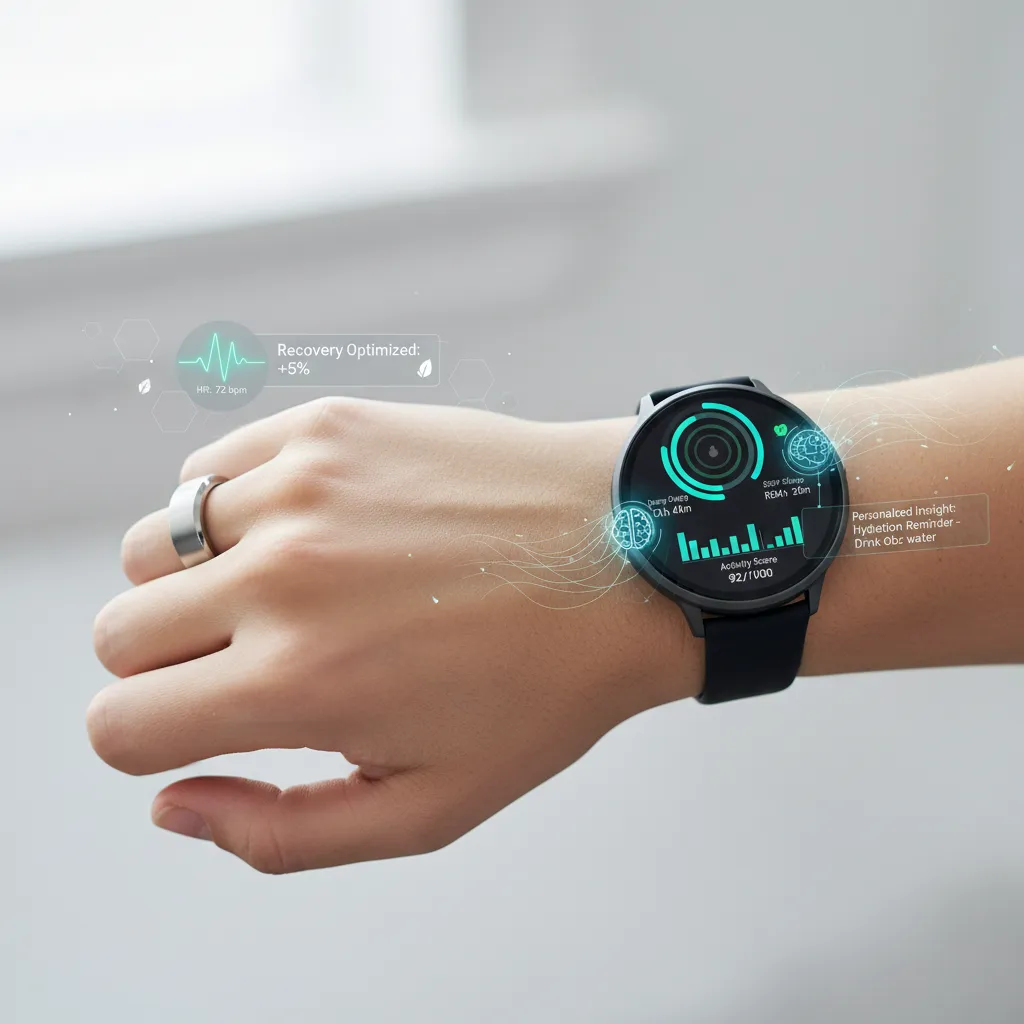
Your smartwatch, smart ring, or fitness tracker is no longer just a step counter. These devices are sophisticated biosensors collecting a constant stream of data about your heart rate, sleep patterns, blood oxygen levels, and activity.
However, raw data is useless without interpretation. This is where wearable AI health comes in. AI algorithms running on your device or in the cloud analyze these data streams to provide actionable insights. They can alert you to an irregular heart rhythm, detect early signs of a respiratory infection, or provide personalized feedback to improve your sleep quality. This continuous AI health monitoring creates a powerful feedback loop for AI-enhanced wellness. The technology behind this is evolving fast; learn more about Related: The AI Pin and the Future of Wearable AI.
The Rise of Virtual Health Assistants and Telemedicine AI
Access to healthcare remains a challenge for many. Virtual health assistants, powered by conversational AI, can provide 24/7 support, answering health questions, helping manage medications, and scheduling appointments.
Simultaneously, Telemedicine AI solutions are making remote consultations more effective. AI can help a doctor by summarizing a patient’s history before a call or even analyzing a patient’s voice for signs of stress or cognitive decline. This use of remote patient monitoring AI is especially transformative for AI in chronic disease management, allowing doctors to track patients with conditions like diabetes or hypertension from afar and intervene before a crisis occurs.

AI-Enhanced Wellness: Beyond Medicine
The principles of AI personalization extend far beyond treating disease. AI is becoming a central part of our daily wellness routines.
- Personalized Fitness: AI can create dynamic workout plans that adapt to your progress and recovery. Explore this further in our article, Related: The AI Fitness Revolution: Personalized Workouts and Recovery.
- Mental Wellness: AI-powered apps offer personalized cognitive behavioral therapy (CBT) and mindfulness exercises. See how in Related: AI for Mental Wellness: A Personalized Path to a Healthier Mind.
- Nutrition: AI can analyze your dietary habits and health goals to create personalized meal plans and recipes.
This is the era of personalized prevention AI, where technology empowers us to build a healthier life, one data-driven decision at a time.
Navigating the New Normal: AI Healthcare Ethics and Challenges
With great power comes great responsibility. The integration of AI into our most personal data—our health—raises critical ethical and logistical questions that we must address thoughtfully.
The Data Dilemma: Privacy and Security
The effectiveness of AI personalized medicine hinges on access to vast amounts of sensitive health data. This creates a massive target for cyberattacks. Protecting this data is paramount. Robust encryption, secure data storage, and strict access controls are non-negotiable. The same AI that powers healthcare can also be used to protect it, a topic we cover in Related: AI in Cybersecurity: Advanced Threat Detection.
The Bias in the Machine
An AI model is only as good as the data it’s trained on. If historical health data reflects existing societal biases (e.g., certain demographics being underrepresented in clinical trials), the AI can learn and even amplify these biases. This could lead to AI healthcare innovations that work better for some populations than others, widening health disparities. Ensuring fairness, transparency, and accountability in AI algorithms is a crucial ongoing challenge.
The Human Element: Will AI Replace Doctors?
This is a common fear, but the most likely future is one of collaboration, not replacement. AI is brilliant at data processing, pattern recognition, and computation. However, it lacks the empathy, intuition, and holistic understanding of a human physician. The future of healthcare isn’t about choosing between a doctor and an algorithm; it’s about empowering a doctor with an algorithm. AI will handle the data-intensive tasks, freeing up clinicians to do what they do best: connect with, listen to, and care for their patients.
The Road Ahead: The Future of Healthcare AI
The revolution is only just beginning. The future of healthcare AI points towards a system that is more integrated, predictive, and patient-centric than ever before. We can expect to see AI medical breakthroughs accelerate as intelligent health platforms seamlessly connect data from wearables, genomic tests, electronic records, and environmental sensors.
The ultimate goal is a world where healthcare isn’t a place you go when you’re sick, but a continuous, personalized stream of insights that keeps you well. It’s a future where your personal AI health assistant knows you better than any single doctor could and works with your care team to chart the optimal path for your long-term health. As AI continues to reshape how we access information, as seen with Related: Google AI Overviews and the Future of Search, its impact on our personal lives will only grow.
Conclusion
The era of one-size-fits-all medicine is fading. The fusion of artificial intelligence with healthcare is launching a new age of personalized medicine and precision health, one that is predictive, preventative, personalized, and participatory. From decoding our DNA with genomic sequencing AI to receiving AI-driven treatment plans, the technology is empowering both patients and clinicians with unprecedented insights.
While significant challenges in AI healthcare ethics and implementation remain, the trajectory is clear. The AI healthcare innovations we’re witnessing are not just incremental improvements; they are foundational shifts that promise a future of longer, healthier, and more vibrant lives. The revolution is here, and it’s being tailored just for you.
What part of this AI-driven health revolution excites you the most? Share your thoughts in the comments below!
FAQs
Q1. How is AI revolutionizing personalized medicine?
AI revolutionizes personalized medicine by analyzing massive, complex datasets for each individual, including their genetics, lifestyle, and environment. This allows AI-driven treatment plans and preventative healthcare AI to create therapies and wellness strategies that are uniquely tailored to a person’s specific biological and contextual profile, moving beyond the traditional one-size-fits-all approach.
Q2. What is an example of AI in diagnostics?
A prominent example is in AI medical imaging. AI algorithms, particularly deep learning models, can analyze medical scans like MRIs, X-rays, and mammograms to detect signs of disease, such as cancerous tumors or early indicators of neurological disorders, often with a speed and accuracy that matches or exceeds human experts.
Q3. What are the main ethical concerns with AI in healthcare?
The main AI healthcare ethics concerns include patient data privacy and security, the potential for algorithmic bias leading to health disparities if training data is not diverse, a lack of transparency in how AI models make decisions (the “black box” problem), and establishing clear accountability when an AI-driven recommendation leads to a negative outcome.
Q4. Can AI predict my future health?
Yes, to an extent. Predictive analytics healthcare uses AI to analyze your health records, genetic predispositions, and lifestyle data to identify your risk for developing certain conditions like heart disease, diabetes, or some cancers. This AI for disease prediction allows for early, preventative interventions to mitigate those risks.
Q5. How do AI-driven wellness apps work?
AI-driven wellness apps, a form of AI enhanced wellness technology, collect data from your smartphone or wearable AI health devices (like activity levels, sleep patterns, and heart rate). They use machine learning algorithms to interpret this data, providing personalized feedback, coaching, and recommendations for fitness routines, stress management, and nutritional choices.
Q6. What is the difference between precision health and personalized medicine?
While often used interchangeably, there’s a subtle difference. Personalized medicine typically refers to tailoring treatments to an individual, often after they are already sick (e.g., using personalized genomics to choose a cancer drug). AI precision health is a broader term that includes personalized medicine but also emphasizes preventative healthcare AI and maintaining wellness by understanding an individual’s unique health risks and needs before they get sick.
Q7. Will AI make healthcare more affordable?
In the long run, AI has the potential to make healthcare more affordable. By enabling earlier disease detection, optimizing AI in drug discovery, automating administrative tasks, and reducing the rate of diagnostic errors, AI can significantly lower the high costs associated with late-stage treatments, lengthy hospital stays, and inefficient processes.