AI Neuro-Prosthetics: The Future of Human Augmentation & Restored Function

Introduction
Imagine a world where paralysis is no longer a life sentence, where a lost limb can be replaced by one that feels and functions like the original, and where human capabilities can be safely and seamlessly enhanced. This isn’t a scene from a sci-fi blockbuster; it’s the rapidly approaching reality of AI neuro-prosthetics. We stand at the precipice of one of the most profound technological shifts in human history, where the lines between biology and machine are blurring, driven by the incredible power of artificial intelligence.
For decades, prosthetics were largely passive tools—functional, but often clumsy and disconnected from the user’s intent. Today, the fusion of neuroscience, robotics, and AI is creating a new generation of devices that listen to the body’s own signals. This revolution, centered on brain-computer interface prosthetics and ai-powered bionics, is not just about replacing what was lost; it’s about restoring function, dignity, and hope.
In this deep dive, we’ll explore the groundbreaking landscape of neuroprosthetic technology. We will decode how AI translates thoughts into action, examine the latest prosthetic advancements in 2024, and witness how these innovations are restoring mobility and sensation. We will also confront the complex ethical questions that arise from this unprecedented level of human-machine integration. Get ready to discover the future—a future where AI doesn’t just augment computers, but humanity itself.
What Are Neuro-Prosthetics? A Leap Beyond Traditional Devices
To understand the revolution, we must first appreciate the evolution. Traditional prosthetics, from the simple peg leg to more modern myoelectric arms, operate on a limited principle. They often rely on the user manually adjusting the device or using remaining muscle groups to trigger a set of pre-programmed movements. While transformative for their time, they lack the intuition and fluidity of a natural limb.
Enter neuro-prosthetics.
A neuroprosthetic is a device that bypasses damaged or missing parts of the nervous system to create a direct communication link between the brain and an external device. Instead of relying on secondary muscle twitches, it taps directly into the source code of movement: the neural signals fired by your brain and nerves.
This direct connection is the key differentiator. It transforms a prosthetic from a tool to be operated into an extension of the self. The goal is no longer just to mimic function but to restore it with a degree of control and sensation that was once thought impossible. This is the very essence of restoring function with AI, moving from approximation to true integration.
The AI Engine: How Artificial Intelligence is Revolutionizing Bionics
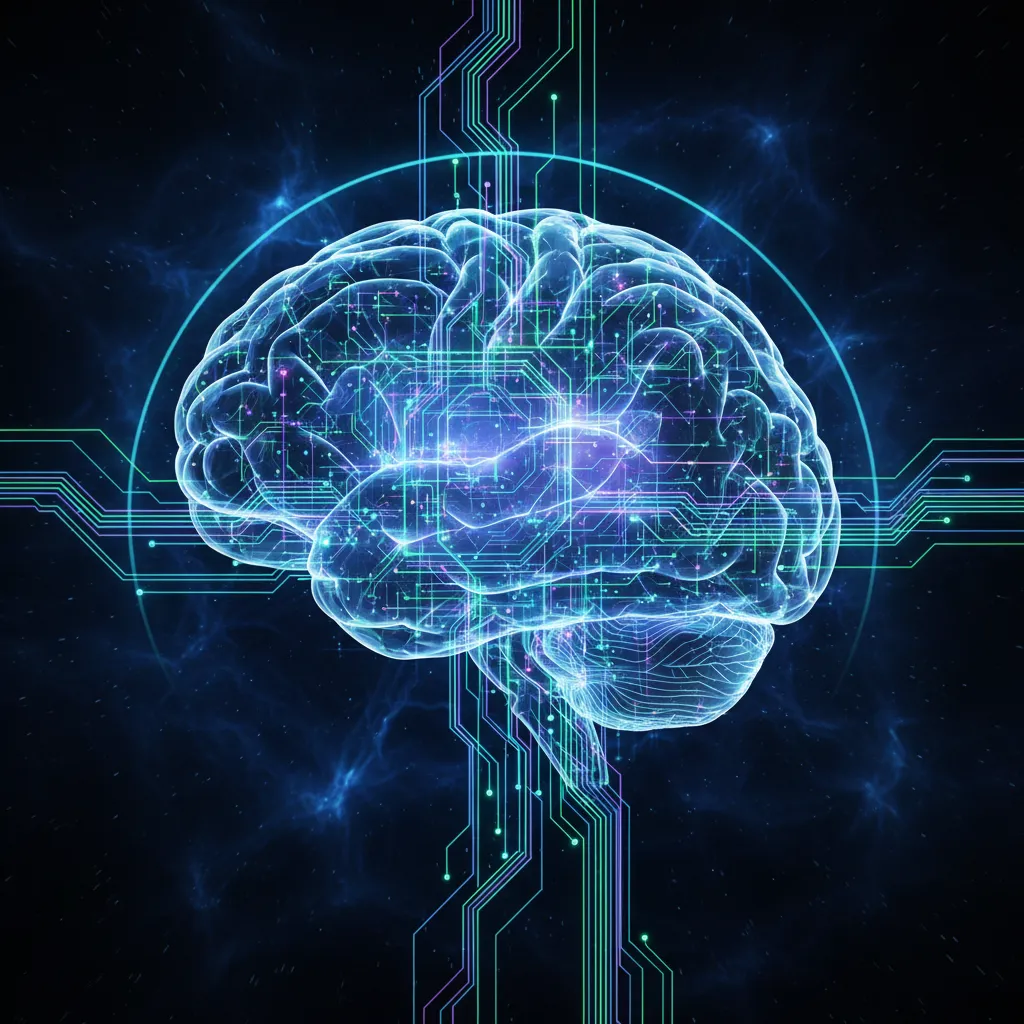
If neuro-prosthetics are the advanced hardware, artificial intelligence is the sophisticated operating system that brings them to life. AI, specifically machine learning and deep learning algorithms, acts as the master translator, decoding the impossibly complex language of the human nervous system.
Decoding Neural Signals with Machine Learning
When you decide to move your hand, your brain sends a cascade of intricate electrical signals through your spinal cord and nerves. For individuals with limb loss or spinal cord injury, this pathway is interrupted. Neural implants for movement can pick up these signals, but they are incredibly “noisy” and complex.
This is where AI excels. Machine learning models are trained on vast datasets of neural activity. They learn to identify the subtle patterns associated with specific intentions—the unique neural signature for “open hand,” “make a fist,” or “pick up that cup.” Over time, the AI becomes incredibly adept at filtering out the noise and translating thought into a precise digital command for the prosthetic. This is the magic behind mind-controlled prosthetics.
Creating Adaptive and Intuitive Control
The true breakthrough of AI in medical devices like these is their ability to learn and adapt. Early systems required extensive, repetitive calibration. With modern AI, the system learns with the user. These adaptive prosthetics constantly refine their algorithms based on the user’s feedback and usage patterns.
If the AI initially misinterprets a signal, the user’s corrective attempt provides new data. The system learns, “Ah, when this pattern appears, the user actually wants to do this.” This continuous learning loop makes the prosthetic feel more intuitive and responsive over time, reducing the cognitive load on the user and making movements feel more natural and second-nature.
The Power of Predictive Algorithms
The most advanced robotic prosthetics with AI are now incorporating predictive capabilities. By analyzing a user’s movements, gaze (sometimes with a paired camera), and the context of the environment, the AI can anticipate the next likely action. For example, as a user reaches for a water bottle, the AI can predict the type of grip needed and pre-shape the hand accordingly. This predictive assistance makes actions faster, smoother, and more efficient, further closing the gap between artificial and biological limbs. Related: Boosting Productivity: Top AI Tools Revolutionizing Workflows and Creativity.
The Brain-Computer Interface (BCI): Bridging Mind and Machine
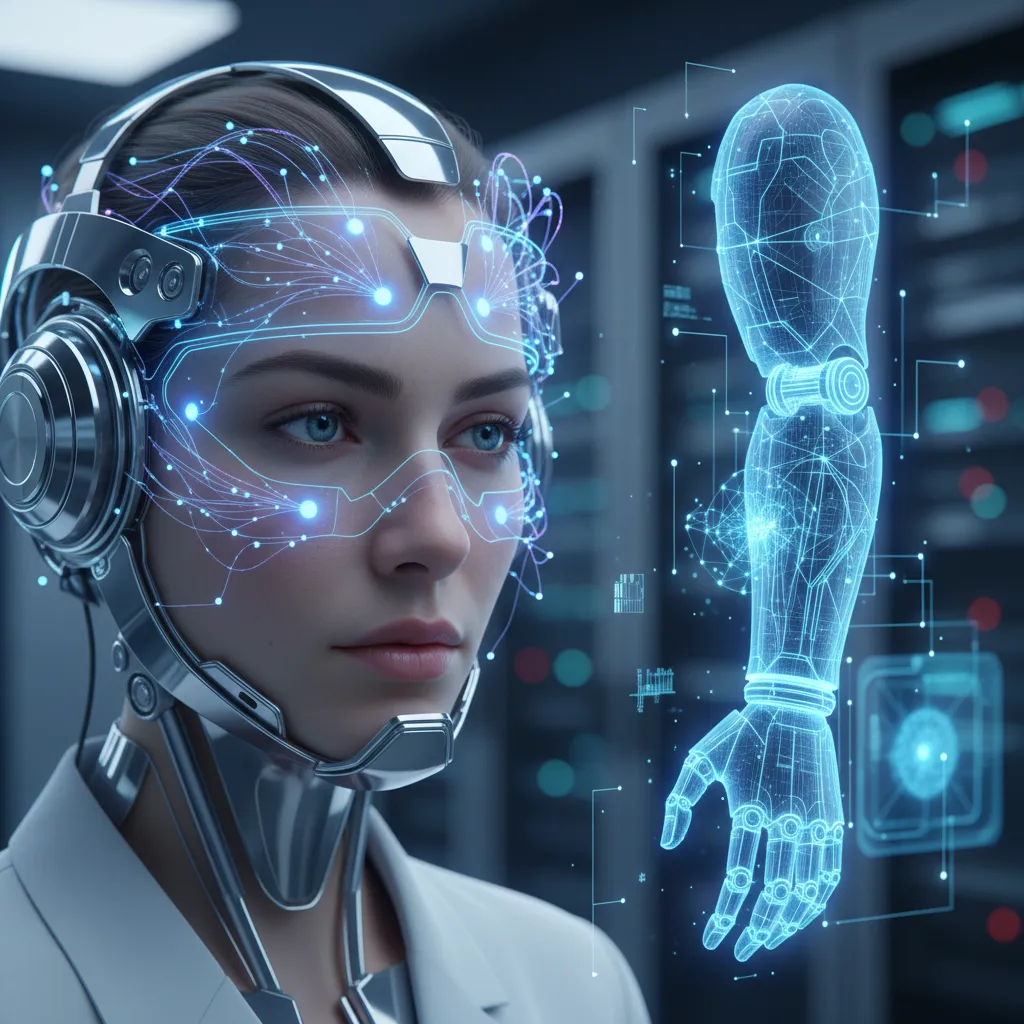
The conduit for this entire process is the Brain-Computer Interface (BCI). A BCI is the hardware that captures the neural signals for the AI to interpret. This prosthetic innovation with AI is perhaps the most critical component in the entire system, and it comes in two primary forms.
Invasive vs. Non-Invasive BCIs
1. Invasive BCIs: These devices require surgery to place electrodes directly onto or into the brain’s tissue (e.g., cortical implants like the Utah Array).
- Pros: They provide the highest-resolution signals, capturing the activity of individual neurons. This “high-fidelity” data allows for incredibly precise and multi-dimensional control over advanced prosthetics.
- Cons: They carry the risks associated with brain surgery, including infection and tissue damage, and the longevity of the implants is still an area of active research.
2. Non-Invasive BCIs: These devices are worn externally and read brain signals from outside the skull, most commonly through an electroencephalography (EEG) cap fitted with sensors.
- Pros: They are completely safe, easy to use, and require no surgery. This makes them accessible for research and a wider range of applications.
- Cons: The skull, scalp, and hair diffuse and distort the brain’s electrical signals, making the data much “noisier” and less precise. While AI is getting better at cleaning up these signals, the level of control is generally less sophisticated than with invasive methods.
The choice between them depends on the specific application and the level of control required, but both are central to the future of prosthetics. Related: Apple Intelligence Guide: A Deep Dive into iOS 18’s New AI Features.
Restoring Function: Landmark Applications and Breakthroughs
The theoretical promise of neuro-prosthetics and AI is being realized in incredible ways, changing lives today and offering hope for tomorrow. These are not just lab experiments; they are tangible AI medical breakthroughs.
Restoring Mobility for Spinal Cord Injury
Perhaps the most dramatic application is in overcoming paralysis. For individuals with an AI for spinal cord injury solution, a BCI can read the intention to walk from the brain’s motor cortex. Those signals are then wirelessly transmitted to a stimulator on the spinal cord below the injury or to a powered exoskeleton. The AI decodes the brain’s signals and orchestrates the complex sequence of muscle or motor activations needed to produce a walking gait. In 2023, a paralyzed man, Gert-Jan Oskam, was able to walk naturally again using a “digital bridge” of brain and spine implants, a landmark achievement in the field. This is the pinnacle of restoring mobility with AI.
Advanced Prosthetic Limbs: More Than Just Movement
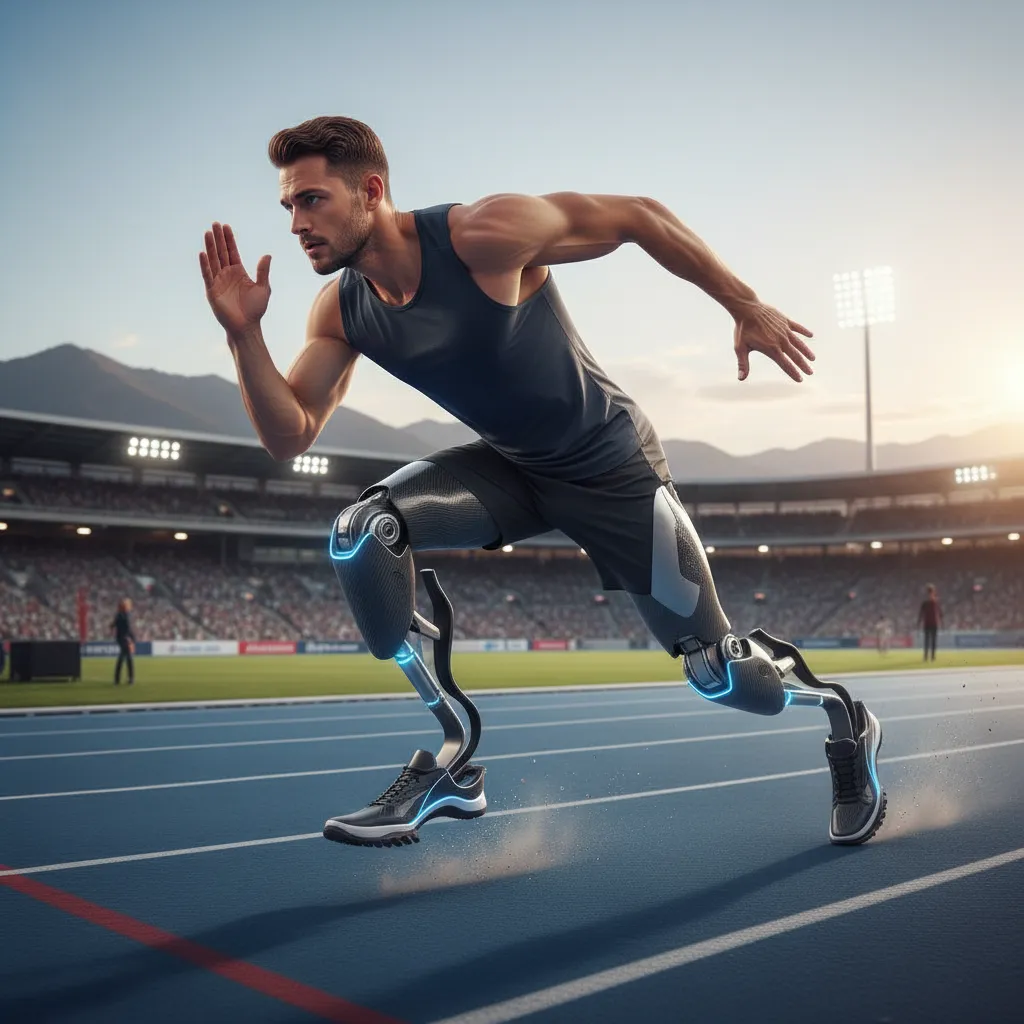
The bionic limbs future is not just about movement; it’s about sensation. Modern advanced prosthetic limbs with AI are now bidirectional.
- Motor Control: The user’s brain controls the limb’s movement.
- Sensory Feedback: Sensors in the prosthetic fingertips detect pressure, texture, and temperature. This information is encoded by an AI into a pattern of electrical stimulation that is sent back to the user’s peripheral nerves.
This prosthetic sensation AI allows the user to “feel” what the prosthetic is touching. They can tell the difference between a hard and soft object, hold a delicate object like an egg without crushing it, and feel the warmth of a coffee cup. This closes a crucial feedback loop, making the prosthetic feel less like a tool and more like a true part of the body. Related: The Future of Medicine: How AI is Revolutionizing Healthcare.
The Gift of Sight and Sound
The principles of neuro-prosthetics extend beyond limbs.
- Bionic Eyes (AI): Retinal implants are helping individuals with certain types of blindness to perceive light and shapes. A camera mounted on a pair of glasses captures the visual scene, an AI processor simplifies the image into patterns of electrical stimulation, and an implant on the retina delivers these signals to the brain, which learns to interpret them as a form of vision.
- AI Hearing Implants: Modern cochlear implants use AI to filter out background noise and enhance speech clarity, allowing users to have conversations in crowded rooms—a major challenge for older devices.
The Frontier of Innovation: What’s Next in Neuro-Prosthetics?
The pace of prosthetic innovation with AI is staggering. As we look at prosthetic advancements 2024 and beyond, several key trends are emerging that promise an even more integrated future.
Smart, Personalized Prosthetics
The future is personal. Using AI, doctors and engineers can create truly personalized prosthetics with AI. By analyzing an individual’s gait, neural patterns, and lifestyle, they can design and program a smart prosthetics technology that is perfectly tailored to them. This goes beyond just physical fit; it’s about creating a synergistic relationship where the AI in the device is tuned to the user’s unique neurobiology.
The Rise of Regenerative Prosthetics
One of the most exciting frontiers is regenerative prosthetics. This field aims to merge biological tissue with robotic components. Imagine a prosthetic limb that is surgically attached to the bone (osseointegration) and has nerve endings that are encouraged to grow directly into a bio-compatible electronic interface. This would create a truly seamless and stable connection, eliminating many of the issues with current sockets and electrodes and offering unparalleled control and sensation.
Neuromodulation for Therapy and Enhancement
The same technology used to control prosthetics can also be used to modulate neural activity for therapeutic purposes. Neuromodulation devices, such as deep brain stimulators, are already used to treat conditions like Parkinson’s disease and epilepsy. In the future, AI-driven neuromodulation could offer highly targeted therapies for depression, chronic pain, and even memory enhancement, pushing the boundaries from restoration into AI human augmentation. Related: AI’s Green Revolution: How Sustainable Tech is Creating a Smarter Planet.
The Human Element: Ethical Considerations and Societal Impact
As with any powerful technology, the rise of AI neuro-prosthetics brings a host of complex ethical questions that we must address thoughtfully and proactively. The conversation around the ethical AI in prosthetics is just as important as the technological development itself.
Accessibility and Cost
These groundbreaking medical devices are incredibly expensive, often running into the hundreds of thousands of dollars. Who gets access to this technology? There is a significant risk of creating a “bionic divide,” where only the wealthy can afford to overcome disabilities, exacerbating existing societal inequalities. Ensuring equitable access must be a priority for developers, policymakers, and healthcare systems.
Data Privacy and Neural Security
When your brain is connected to a device—which may in turn be connected to the internet for updates and diagnostics—your neural data becomes a new frontier for privacy and security. Could your brain signals be hacked? Could your most private thoughts be decoded and monetized? Establishing robust “neuro-security” protocols and clear data ownership rights is paramount before these technologies become widespread.
Defining “Human”: The Augmentation Debate
The line between restoration and enhancement is blurry and subjective. Today, we use this technology to restore lost function. Tomorrow, could it be used to give a healthy individual a third arm, night vision, or a direct link to the internet? This is the core of the AI human augmentation debate. Where do we draw the line? What does it mean to be human in a world where our biological limitations can be overcome by technology? These are profound philosophical questions with no easy answers.
Conclusion
We are witnessing the dawn of a new era. AI neuro-prosthetics are irrevocably changing what it means to have a disability, challenging our definitions of health, and pushing the boundaries of human potential. Through the powerful synergy of brain-computer interfaces, sophisticated robotics, and adaptive artificial intelligence, we are moving from merely replacing limbs to truly restoring lives with unprecedented levels of function and feeling.
The journey ahead is filled with both immense promise and significant challenges. The technological hurdles, while steep, are being overcome at a breathtaking pace. The more difficult tasks lie in navigating the ethical maze, ensuring equitable access, and deciding as a society how we want to integrate this technology into our lives.
The future of human-machine integration is no longer a distant dream. It is being built in labs and clinics around the world, one neural signal at a time. The result will be a world where technology heals, restores, and ultimately, redefines what is possible.
What are your thoughts on the future of AI-powered human augmentation? Share your perspective in the comments below.
FAQs
Q1. How do mind-controlled prosthetics work?
Mind-controlled prosthetics, or neuro-prosthetics, work by using a Brain-Computer Interface (BCI) to detect neural signals from the brain or nerves. An AI algorithm then decodes these signals to understand the user’s intended movement. This decoded command is sent to the prosthetic limb, causing it to move in the way the user imagined, creating an intuitive link between thought and action.
Q2. What is the difference between a prosthetic and a neuroprosthetic?
A traditional prosthetic is a mechanical device that replaces a missing body part and is often controlled by the user’s remaining muscles or manual adjustments. A neuroprosthetic is a more advanced device that directly interfaces with the user’s nervous system, allowing for control via brain signals (thought) and, in some cases, providing sensory feedback like touch or pressure.
Q3. Can bionic limbs feel?
Yes, some of the most advanced bionic limbs can provide a sense of touch. They use sensors in the prosthetic fingertips to detect pressure and texture. This information is then translated into electrical signals that are sent back to the nerves in the residual limb, allowing the user to “feel” what the prosthetic is touching. This is a key area of prosthetic sensation AI research.
Q4. What are the ethical concerns surrounding AI in prosthetics?
The main ethical concerns include the high cost and accessibility, which could create a divide between those who can and cannot afford them. Other major issues are neural data privacy and the risk of “brain-hacking.” Finally, there is a broader philosophical debate about the line between restoring function and enhancing human capabilities beyond the biological norm.
Q5. How is AI used to restore mobility for paralysis?
For individuals with paralysis from a spinal cord injury, AI is used to create a “digital bridge.” A BCI reads the movement signals from the brain, and an AI decodes these intentions. The commands are then sent wirelessly to a second implant on the spinal cord (below the injury) or to a powered exoskeleton, which stimulates the muscles or motors to execute the walking motion as intended by the user.
Q6. What is the future of prosthetic technology?
The future of prosthetics lies in deeper integration and personalization. We can expect to see advancements in regenerative prosthetics that merge with human tissue, smarter AI that adapts perfectly to each user, and less invasive, more powerful BCIs. The long-term vision is to create prosthetics that are indistinguishable from, or even superior to, biological limbs in both function and feel.