AI & Interactive Storytelling: Crafting Immersive Worlds

Introduction
From ancient myths told around a crackling fire to the dog-eared pages of “Choose Your Own Adventure” books, humanity has always craved stories that feel like our own. We yearn to be more than passive observers; we want to be participants, to see our choices echo through the narrative. For decades, interactive entertainment has chased this dream, primarily through pre-written branching narratives. But what if a story could do more than just branch? What if it could grow, adapt, and evolve in real-time, uniquely for you?
This is the paradigm-shifting promise of AI interactive storytelling. We stand at the precipice of a new narrative frontier, where artificial intelligence is no longer just a tool for creating assets but a dynamic co-author, a world-builder, and a master storyteller. By leveraging generative AI, machine learning, and advanced language models, we are beginning to craft truly immersive experiences with AI that were once the exclusive domain of science fiction.
This article will guide you through the fascinating world of AI-driven interactive fiction. We’ll explore the core technologies making it possible, from dynamic plot generation AI to sophisticated AI character development. We will dissect its impact across gaming, virtual reality, and other immersive media, examine the powerful new AI tools for writers, and confront the complex challenges of AI narrative design and ethics. Prepare to discover how the future of storytelling AI is not just about telling stories, but about living them.
The Dawn of a New Narrative Era: What is AI Interactive Storytelling?
At its core, AI interactive storytelling is the use of artificial intelligence to generate and manage narrative experiences that respond dynamically to a user’s actions, choices, and even emotions. It represents a monumental leap beyond traditional interactive media.
Beyond Branching Paths: The Leap from Pre-Scripted to Generative
For years, “interactive” meant branching narratives AI. Think of games like Telltale’s The Walking Dead or Netflix’s Black Mirror: Bandersnatch. A writer scripts out Path A, Path B, and Path C. Your choice leads you down one of these pre-determined routes. While effective, this model is finite. The story is a tree with many branches, but a limited number of leaves. The narrative is discovered, not created.
Generative AI stories, on the other hand, are fundamentally different. They don’t rely on a pre-written script. Instead, they use AI models to create story elements—dialogue, plot points, character behaviors, even entire environments—on the fly. This is the difference between exploring a map and having a world materialize around you as you walk. The narrative becomes a living, breathing entity. This approach enables truly adaptive narratives AI, where the story fabric itself is rewoven based on player input, resulting in an experience that is deeply personal and endlessly replayable.
Key AI Technologies Fueling the Revolution
This narrative revolution is powered by a confluence of advanced AI technologies:
- Natural Language Processing (NLP) & Large Language Models (LLMs): These are the brains behind realistic dialogue and coherent plot generation. Models like GPT-4 and Claude allow players to interact with characters using natural language, and for the AI to understand intent and generate contextually relevant responses.
- Generative AI: This is the creative engine. It goes beyond text to generate images, sounds, 3D assets, and music, enabling the AI procedural generation stories that can build vast, unique worlds from a set of rules and parameters.
- Reinforcement Learning (RL): Often used in game development, RL allows AI characters to learn and adapt their behavior. An AI companion might learn a player’s preferred combat style, or a villain might adapt their strategy based on the player’s repeated tactics, creating a more challenging and organic experience.
- Affective Computing: This emerging field focuses on developing AI that can recognize and interpret human emotions. Imagine a story that adjusts its tone—becoming more tense, hopeful, or somber—based on your vocal inflections or even biometric feedback. This is the cutting edge of achieving true AI and emotional engagement.
How AI Crafts Your Personal Odyssey: The Mechanics of Immersive Worlds
Understanding the technologies is one thing, but seeing how they combine to create a cohesive experience is where the magic happens. The goal is to move beyond procedural randomness and into the realm of meaningful, personalized storytelling AI.

The Role of Generative AI in Building Story Worlds
Generative AI acts as a tireless world-builder. In game development, this is often called Procedural Content Generation (PCG), but AI has supercharged it. Instead of just generating random dungeons, AI game development storytelling uses these tools to create content with narrative purpose.
For instance, an AI can be tasked to:
- Generate Dynamic Quests: Based on the current state of the world and the player’s history, the AI can generate a new side quest. If you’ve been helping a certain village, the AI might generate a “thank you” quest from its leader. If you’ve been a thief, it might generate a mission from the local thieves’ guild.
- Create Bespoke Environments: An AI can alter the landscape to reflect the story’s events. After a great battle, it could generate scarred earth and ruined buildings. In a horror game, it could subtly change the layout of a house each time you enter.
- Produce Endless Lore: Using an LLM, developers can feed the model core concepts about their world’s history, factions, and magic systems. The AI can then generate countless in-game books, item descriptions, and historical documents, creating a world with immense depth for players who want to explore. Related: Autonomous AI Agents: The Next Revolution in Smart Automation
AI Character Development: Creating NPCs that Live and Breathe
Perhaps the most exciting frontier is in creating Non-Player Characters (NPCs) that feel like real people. Traditional NPCs are essentially audio logs on legs, repeating the same lines of dialogue forever. Modern AI character development aims to break this mold.
Companies like Inworld AI and Charisma.ai are creating platforms where developers can give NPCs:
- Persistent Memory: An AI character can remember past conversations and interactions with you. If you were rude to them yesterday, they might be cold to you today.
- Goals and Motivations: Instead of standing in one spot, an AI character can have a daily routine, goals they are trying to achieve, and relationships with other NPCs. This creates a living ecosystem where the world doesn’t revolve solely around the player.
- Unscripted Dialogue: Powered by LLMs, these characters can engage in open-ended conversations. You can ask a shopkeeper about the local politics or their family, and they can generate a plausible, in-character response that isn’t from a script.
Personalized Storytelling AI: A Narrative Molded to Your Choices
When dynamic worlds and living characters come together, you get the ultimate prize: a truly personal narrative. The impact of AI on narratives is that the story is no longer a fixed object. It’s a fluid process.
Imagine a detective story where the AI tracks which clues you follow and which you ignore. It might subtly alter future evidence or witness testimonies based on your developing theory of the crime. This is a core benefit of AI in storytelling: the plot doesn’t just accommodate your choices; it is actively shaped by them, creating a bespoke experience that reflects your unique playthrough.
The New Playground: Where AI is Reshaping Immersive Media
The application of AI interactive storytelling is exploding across various media, pushing the boundaries of what we consider entertainment and art.
AI for Virtual Reality (VR) and Augmented Reality (AR) Narratives
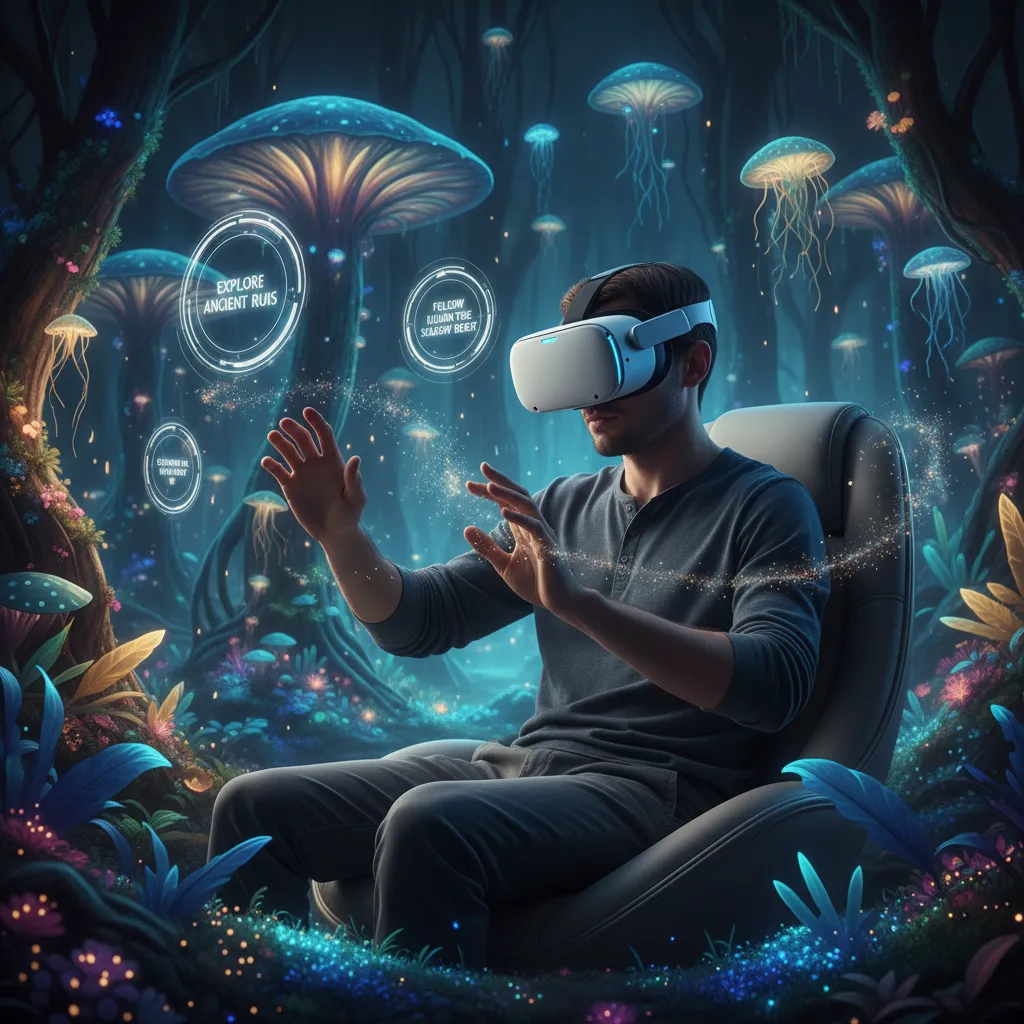
VR and AR are all about presence—making you feel like you are truly in the digital world. AI is the key to making these worlds feel alive and responsive. In an AI for virtual reality stories experience, you could walk up to any character and start a conversation. In an AI augmented reality narratives game played in your city, historical figures could appear on street corners, telling you stories about the location that adapt based on your questions. This level of interaction is crucial for maintaining the illusion of presence and creating deeply immersive storytelling technology. Related: Copilot+ PC: The AI Laptop Revolution with Snapdragon X Elite
AI in Game Development Storytelling: From Side Quests to Living Worlds
The games industry is the primary testbed for these technologies. While we haven’t yet seen a mainstream AAA game built entirely on a generative narrative, the building blocks are in place. Games like The Elder Scrolls IV: Oblivion with its “Radiant AI” were early pioneers. Today, projects like NVIDIA’s ACE (Avatar Cloud Engine) are showcasing stunning demos of AI-powered NPCs that can hold lifelike conversations. The future of gaming involves worlds that are less predictable, more surprising, and infinitely more engaging.
Interactive Entertainment and Beyond: AI in Education and Digital Humanities
The potential extends far beyond gaming.
- Education: Imagine a history lesson where you can interview an AI-powered Abraham Lincoln about his decisions during the Civil War.
- Training: AI can create adaptive training simulations for professionals like doctors or pilots, presenting them with dynamic scenarios that respond to their actions.
- AI in Digital Humanities: Researchers are using AI to analyze vast archives of texts and create interactive models of historical events or literary works, offering new ways to engage with our cultural heritage.
The Storyteller’s Toolkit: AI Tools for Writers and Creators
Contrary to the fear that AI will replace writers, many see it as an incredibly powerful collaborator. A new ecosystem of AI tools for writers is emerging to augment, not automate, the creative process. Related: Claude 3.5 Sonnet: A Deep Dive into Its New Features
- Brainstorming and Ideation: LLMs can be used as a tireless brainstorming partner to generate plot hooks, character backstories, or world-building ideas.
- Narrative Design Assistants: Tools can help writers visualize complex branching narratives, track plot threads, and ensure consistency across a sprawling story.
- Dialogue Generation: While final dialogue often needs a human touch, AI can generate placeholder or secondary character dialogue, freeing up writers to focus on the crucial story beats.
- Integration with Game Engines: Plugins for popular engines like Unreal and Unity are making it easier for developers of all sizes to integrate advanced AI narrative design features into their projects without needing a PhD in machine learning.
The Human Element: Navigating the Challenges and Ethics of AI Storytelling
The road to this AI-driven future is not without its obstacles. The technical and ethical hurdles are just as significant as the creative opportunities.
The Coherence Conundrum: Keeping the Story on Track
One of the biggest challenges of AI narrative is maintaining long-term coherence. LLMs can sometimes “hallucinate” or lose the plot thread over extended interactions, leading to nonsensical outcomes. Developers are working on “narrative manager” or “AI director” systems that act as an invisible hand, guiding the generative systems to ensure the story remains compelling and stays true to its core themes without being overly restrictive.
Ethical AI Storytelling: Bias, Representation, and Manipulation
AI models are trained on vast amounts of human-generated text, and they can inherit the biases present in that data. This raises critical questions for ethical AI storytelling:
- How do we prevent AI characters from perpetuating harmful stereotypes?
- How do we ensure fair and diverse representation in procedurally generated worlds?
- What are the ethics of creating AI companions designed to form strong emotional bonds with users?
These are complex issues that the industry must address responsibly as the technology matures. Related: Humane AI Pin Review: Fad or Future of Phones?
AI and Emotional Engagement: Can an Algorithm Make Us Cry?
The ultimate goal of storytelling is to evoke emotion. While AI can simulate emotional responses, crafting a genuinely moving arc—with setup, payoff, and nuanced character development—remains a profoundly human skill. The challenge lies in teaching AI the art of storytelling, not just the science. Achieving true AI and emotional engagement is perhaps the final boss for this technology.
The Future of Storytelling AI: Peering into the Crystal Ball
The pace of narrative AI advancements is staggering. Looking ahead, we can anticipate a future of interactive media that feels seamlessly integrated with our lives.
Fully Emergent Narratives: Stories Written in Real-Time
The holy grail is the “emergent narrative,” a story that arises entirely from the simulation of a complex world and its AI inhabitants. The player’s actions are just one input among many, and the story unfolds organically from the interactions of all the systems. These will be less like traditional stories and more like “anecdote generators,” creating unique, shareable moments that are entirely personal to each player.

The Holodeck Dream: AI-Powered Holographic Storytelling
As display technologies like holography and advanced AR glasses improve, we move closer to the Star Trek “Holodeck” concept. Imagine stepping into a room that transforms into any story world you can imagine, populated by intelligent AI characters who can see, hear, and react to you in physical space. This is the ultimate convergence of AI in immersive media.
The Impact on Human Creativity
The future of interactive media will likely involve a deep collaboration between human and machine. AI will handle the immense complexity of managing a dynamic, responsive world, freeing human creators to focus on the high-level vision, emotional core, and thematic depth of the story. It’s a partnership that could unlock unprecedented levels of creativity and redefine what a story can be. Related: Apple Intelligence: Your Guide to the New AI Features
Conclusion
We are moving from an era of static, pre-defined stories to one of dynamic, living narratives. AI interactive storytelling is not a fleeting trend; it is a fundamental evolution of the medium. By harnessing the power of generative AI, we are building worlds that listen, characters that remember, and plots that adapt in real-time, offering a level of personalization and immersion previously unimaginable.
While significant challenges in coherence, ethics, and emotional depth remain, the trajectory is clear. The line between storyteller and audience is blurring, creating a new form of collaborative art. The future of storytelling AI promises not just to entertain us, but to provide us with infinite worlds to explore and endless stories to live. The next chapter is unwritten, and for the first time, the pen is in both our hands and the hands of our intelligent, creative machines.
FAQs
Q1. What is AI interactive storytelling?
AI interactive storytelling is a form of digital entertainment where artificial intelligence is used to generate and manage a narrative in real-time based on a user’s choices, actions, and inputs. Unlike traditional branching narratives with pre-written paths, AI creates dynamic plots, dialogue, and character behaviors on the fly, leading to a highly personalized and unique experience for each user.
Q2. How does AI create interactive stories?
AI creates interactive stories by using a combination of technologies. Large Language Models (LLMs) generate realistic, unscripted dialogue. Generative AI and procedural generation create story elements like quests, environments, and even music. Finally, a “narrative manager” AI oversees the experience, ensuring the generated content remains coherent and aligned with the story’s main themes, adapting the plot based on player actions.
Q3. What are some examples of AI storytelling?
Early examples include the “Radiant AI” system in the game The Elder Scrolls IV: Oblivion, which gave NPCs daily schedules. Modern examples are more sophisticated, like the AI-driven characters in experiences developed with platforms like Inworld AI or Charisma.ai. The interactive mystery AI Dungeon is another prime example, using an LLM to generate a text-based adventure in response to any action the player types.
Q4. Will AI replace human writers?
Most experts believe AI will not replace human writers but will instead become a powerful collaborative tool. AI can handle complex world-building, generate secondary content, and brainstorm ideas, freeing human writers to focus on high-level creative direction, emotional nuance, and crafting the core narrative themes. The future is likely a partnership between human creativity and AI-driven systems.
Q5. What are the benefits of using AI in storytelling?
The key benefits include unprecedented personalization, near-infinite replayability, and deeper immersion. AI can create stories that adapt specifically to each user’s playstyle, leading to AI for personalized experiences. It also enables the creation of more dynamic and believable game worlds populated by NPCs who feel more like living beings than robotic quest-givers.
Q6. What is the difference between branching narrative and generative narrative?
A branching narrative is like a “Choose Your Own Adventure” book; all possible paths and outcomes are pre-written by a human author. A generative narrative, powered by AI, does not have pre-written paths. Instead, it creates the story—the events, dialogue, and consequences—in real-time based on the player’s actions and the established rules of the world.
Q7. What are the main challenges of AI narrative design?
The primary challenges include maintaining long-term narrative coherence (preventing the story from becoming nonsensical), ensuring ethical content generation (avoiding bias and harmful stereotypes), and achieving genuine AI and emotional engagement that can rival human-authored stories. Creating AI that understands the art and nuance of storytelling, not just the logic, remains a significant hurdle.