AI Image Generators: The Future of Creative Content & Ethical Concerns
Introduction
In an age where technology continuously redefines the boundaries of human capability, AI image generators stand as a monumental leap in the realm of creativity. Once the exclusive domain of human imagination and skill, the process of generating images is now being revolutionized by artificial intelligence. From conceptualizing fantastical landscapes to designing compelling marketing visuals, AI art generators are rapidly becoming indispensable AI creative content tools for individuals and industries alike.
These powerful algorithms, capable of translating textual prompts into stunning visual realities, promise unprecedented efficiency and unlock new avenues for artistic expression. However, with great power comes great responsibility, and the meteoric rise of AI generated images also ushers in a complex web of ethical AI art dilemmas. Questions concerning AI copyright issues, the impact of AI on artists, and the very definition of creativity itself are at the forefront of this technological revolution. This comprehensive guide will delve deep into the mechanics, leading platforms, applications, and profound ethical considerations surrounding AI image technology, offering a balanced perspective on the future of AI art and its place in our creative landscape.
The Dawn of a New Creative Era: What Are AI Image Generators?
At its core, an AI image generator is a sophisticated software tool that leverages artificial intelligence to create visual content from various inputs, most commonly descriptive text prompts. These tools are fundamentally changing how we approach design, art, and visual communication. The ability to generate images with AI has moved from theoretical discussions to practical, everyday applications, making advanced visual creation accessible to a much broader audience.
Understanding Text-to-Image AI: How It Works
The magic behind these generators lies in a specific branch of AI known as text-to-image AI. This technology primarily relies on deep learning models, particularly generative adversarial networks (GANs) and more recently, diffusion models.
Here’s a simplified breakdown of how AI generates images:
- Training Data: AI models are trained on colossal datasets containing billions of images paired with descriptive text. This allows the AI to learn the intricate relationships between words and visual concepts – what a “red car” looks like, how “futuristic city” might be rendered, or the artistic style of “Van Gogh.”
- Prompt Interpretation: When a user enters a text prompt (e.g., “A majestic astronaut riding a horse on the moon, photorealistic, cinematic lighting”), the AI parses this text, breaking it down into concepts and attributes.
- Noise Reduction (Diffusion Models): In the case of diffusion models, the process starts with pure visual noise (like static on a TV). The AI then iteratively “denoises” this image, gradually shaping it based on the understanding derived from the text prompt, until a coherent image emerges.
- Generation: The model synthesizes new pixels, creating an image that aligns with the specified prompt and learned visual styles. This process is complex, involving intricate algorithms that piece together elements, textures, colors, and compositions to form a novel visual output.
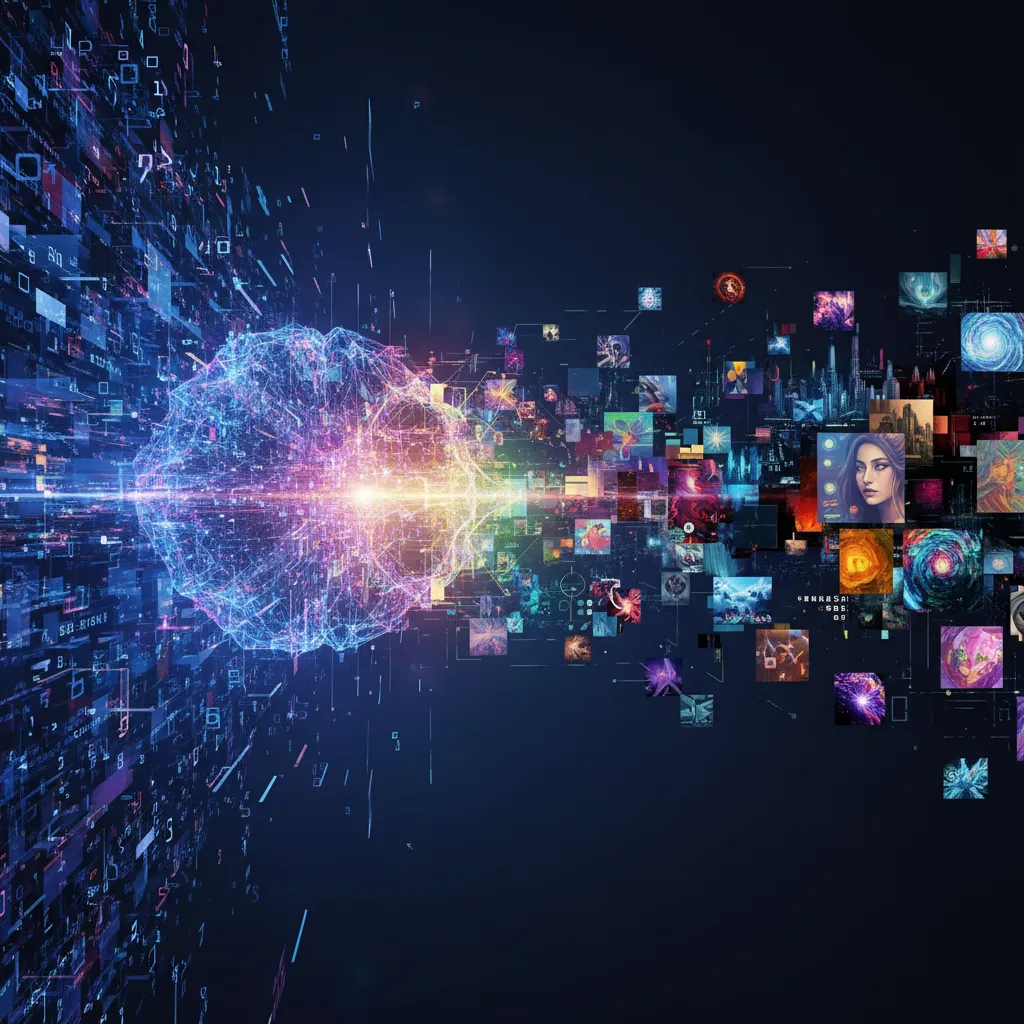 Conceptual image of AI image generation process
The continuous refinement of these models means that the quality and fidelity of AI generated images are improving at an astonishing rate, blurring the lines between human and machine creativity.
Beyond Simple Prompts: Nuances of AI Creativity
While the core functionality is text-to-image, modern AI art tools offer far more granular control. Users can specify artistic styles (e.g., “watercolor,” “cyberpunk,” “oil painting”), camera angles, lighting conditions, specific resolutions, and even negative prompts (things you don’t want in the image). This level of control transforms these tools from mere image synthesizers into powerful collaborators, allowing users to fine-tune their vision with remarkable precision. The evolving AI creativity landscape means that understanding the nuances of prompt engineering is becoming an art form in itself.
Leading the Charge: Popular AI Image Generators Explored
The landscape of AI image generator tools is vibrant and competitive, with several platforms pushing the boundaries of what’s possible. Each offers a unique blend of features, strengths, and access models.
DALL-E 3: Precision and Integration
Developed by OpenAI, DALL-E 3 is renowned for its exceptional understanding of complex prompts and ability to generate highly coherent and contextually relevant images. Unlike some predecessors, DALL-E 3 excels at accurately rendering specific details and text within images. Its integration with ChatGPT allows for more conversational and iterative prompt refining, making it incredibly user-friendly. For those seeking precision and detail, DALL-E 3 is often considered a top contender for the best AI image generator.
Midjourney: Artistic Flair and Community
Midjourney has carved out a niche for its distinctive aesthetic and capacity to produce visually stunning, often ethereal, and highly artistic images. Operated primarily through a Discord server, it fosters a strong community of users who share prompts and creations, pushing collective boundaries. While sometimes less literal in its interpretation than DALL-E 3, Midjourney’s strength lies in its ability to inject a unique artistic sensibility into its outputs, making it a favorite among those looking for more stylized AI art trends. If you’re looking for an AI art generator with a strong artistic bent, Midjourney is a powerful choice.
Stable Diffusion: Open-Source Power and Customization
Stable Diffusion, an open-source model, stands out for its flexibility and accessibility. Its open-source nature means it can be run locally on compatible hardware and customized extensively. This has led to a thriving ecosystem of community-developed models, plugins, and interfaces, allowing for unparalleled control and specialization. For users who value customization, privacy, and the ability to tinker with the underlying technology, Stable Diffusion offers an unmatched platform. It represents a significant player among new AI image generators due to its community-driven development. For more options, explore this list of top AI art generators 2024.
Free AI Image Generators: Accessibility for All
Beyond the subscription-based giants, a growing number of free AI image generator options are emerging, providing entry points for enthusiasts and casual users. Platforms like Stable Diffusion’s online interfaces (e.g., DreamStudio by Stability AI), Craiyon (formerly DALL-E mini), and various free trials or limited-use versions of premium tools offer opportunities to experiment without financial commitment. While these might sometimes offer fewer features or lower resolution outputs than their premium counterparts, they are invaluable for exploring the potential of AI content creation.
The Transformative Power: AI in Creative Content and Industries
The implications of AI image generators extend far beyond novelty, profoundly impacting various creative fields and industries. These tools are not just generating pretty pictures; they are reshaping workflows, inspiring new artistic movements, and democratizing visual creation.
Revolutionizing Graphic Design and Marketing
For graphic designers and marketing professionals, AI in graphic design is a game-changer. AI can rapidly generate multiple design concepts, mockups, and variations, drastically reducing the time spent on initial ideation. Imagine needing an array of banner ads with slightly different themes – an AI graphic tool can produce dozens in minutes. This allows designers to focus on refinement, strategy, and client communication rather than repetitive tasks. From creating eye-catching social media visuals to developing unique brand imagery, AI visual content is becoming a core component of digital marketing strategies.
Empowering Digital Artists and Illustrators
While concerns about AI impact on artists are valid, many digital artists are discovering AI as a powerful collaborative partner. AI for digital artists can act as a sophisticated sketch assistant, generating background elements, experimenting with styles, or even creating complex textures that would traditionally take hours. Artists can feed their own sketches or styles into AI models to generate variations or explore new directions, expanding their creative horizons. This symbiotic relationship, where human artistic vision guides AI execution, represents a fascinating aspect of human-AI art collaboration.
 Artists and AI collaborating on digital art
Enhancing Visual Content Creation
The demand for high-quality visual content is insatiable, from blog posts and presentations to video games and architectural visualizations. AI visual content tools can significantly streamline this process. Businesses can quickly generate unique stock-like images without licensing fees, creating consistent brand aesthetics across various platforms. Game developers can rapidly prototype environments and character designs. Architects can visualize complex structures with different materials and lighting conditions. The speed and versatility of AI image generation explained through practical applications are undeniable. For more on how AI is boosting productivity, check out these AI tools revolutionizing everyday productivity.
New AI Art Trends and Styles
AI art trends are constantly evolving, giving rise to entirely new aesthetics and artistic movements. We’re seeing “glitch art” generated by prompt errors, hyper-realistic fantasy scenes, and abstract compositions that challenge traditional notions of art. The ease with which styles can be replicated, mixed, and innovated upon means that the AI creativity landscape is a hotbed of experimentation. This dynamic environment is attracting a new generation of digital creatives eager to explore the uncharted territories of AI art. Read more about how AI art is redefining creativity.
Navigating the Ethical Labyrinth: Concerns and Challenges
The dazzling capabilities of AI image generators are accompanied by profound ethical questions that demand careful consideration. These concerns range from the economic impact on human artists to complex legal issues surrounding intellectual property and the potential for misuse. Understanding these challenges is crucial for fostering responsible development and deployment of AI image technology.
AI Copyright Issues and Intellectual Property
Perhaps the most contentious area is that of AI copyright issues. When an AI creates an image, who owns the copyright? Is it the person who wrote the prompt? The developer of the AI model? Or does the AI itself hold some claim? Current legal frameworks are struggling to keep pace with these new forms of creation. Most jurisdictions typically require human authorship for copyright protection, leaving AI generated images in a legal gray area.
Furthermore, the training data for many AI art generators often consists of vast amounts of copyrighted material scraped from the internet without explicit permission or compensation to the original artists. This raises significant questions about AI and intellectual property, with many artists arguing that their work is being used to train systems that then compete with them, often without proper attribution or remuneration. This debate is fundamental to the ethical AI art discussion, driving lawsuits and calls for new regulatory frameworks.
 Legal discussion on AI art copyright
The Impact on Artists: Displacement vs. Collaboration
The AI impact on artists is a deeply felt concern. Many fear that AI image generator tools will devalue human artistic skill, lead to job displacement, and commodify art to the point where human creators struggle to compete. The speed and low cost of AI-generated content pose a genuine economic threat to illustrators, concept artists, and photographers.
However, as discussed, another perspective sees AI as a tool for augmentation and collaboration. Artists can leverage AI to accelerate their workflow, overcome creative blocks, and explore new styles. The challenge lies in defining a future where human artists and AI creative content tools can coexist and mutually enrich the creative ecosystem, rather than one superseding the other. This requires active participation from the artistic community in shaping the development and ethical guidelines of future of AI art tools.
Deepfakes and Misinformation: A Societal Threat
Beyond the art world, AI image technology presents a serious societal threat in the form of deepfakes and the spread of misinformation. Highly realistic AI generated images can be used to fabricate convincing but false visual evidence, create propaganda, or impersonate individuals with malicious intent. This raises critical concerns about trust in visual media, the integrity of news, and the potential for psychological manipulation. Developing robust detection methods and clear ethical guidelines for the responsible use of AI visual content is paramount to mitigate these risks.
Bias in AI-Generated Images
AI models learn from the data they are trained on. If this data contains biases (e.g., predominantly featuring certain demographics, body types, or cultural representations), the AI image generator will perpetuate and even amplify these biases in its outputs. This can lead to the creation of images that are stereotypical, exclusionary, or perpetuate harmful societal norms. Addressing bias in how AI generates images requires diverse and meticulously curated training datasets, alongside ongoing research into bias detection and mitigation techniques. The pursuit of ethical AI art includes striving for inclusive and representative outputs.
The Future of AI Art: Collaboration, Regulation, and Evolution
The trajectory of AI image technology is undoubtedly upward, but its ultimate form and societal acceptance will be heavily influenced by how we address the current challenges. The future of AI art is likely to be a complex interplay of human ingenuity, technological advancement, and thoughtful regulation.
Human-AI Art Collaboration: A Symbiotic Relationship
Increasingly, the most compelling vision for the future involves human-AI art collaboration. Instead of viewing AI as a replacement, it’s seen as an unparalleled assistant, muse, or enhancer. Artists can use AI to explore ideas, create foundational elements, or generate variations, then apply their unique human touch to refine, interpret, and inject emotion. This symbiosis could lead to entirely new art forms and creative processes that were previously unimaginable. The human element of intention, curation, and storytelling will remain vital, ensuring that AI creativity serves as a tool for expression rather than an autonomous creator. Many digital artists are already pioneering this path, blending their traditional skills with AI art tools to create hybrid masterpieces.
Towards Ethical AI Art Development
For ethical AI art to flourish, a multi-faceted approach is required. This includes:
- Transparency: Clear disclosure about when an image is AI-generated.
- Consent: Ensuring that artists’ work is not used in training datasets without their permission or fair compensation.
- Accountability: Establishing clear lines of responsibility for the outputs of AI systems.
- Bias Mitigation: Continuously working to reduce inherent biases in training data and model outputs.
- Legal Frameworks: Developing new copyright laws and intellectual property rights that adequately address AI and intellectual property in the age of generative AI.
Organizations, governments, and the AI community must collaborate to establish industry standards and best practices for responsible AI content creation.
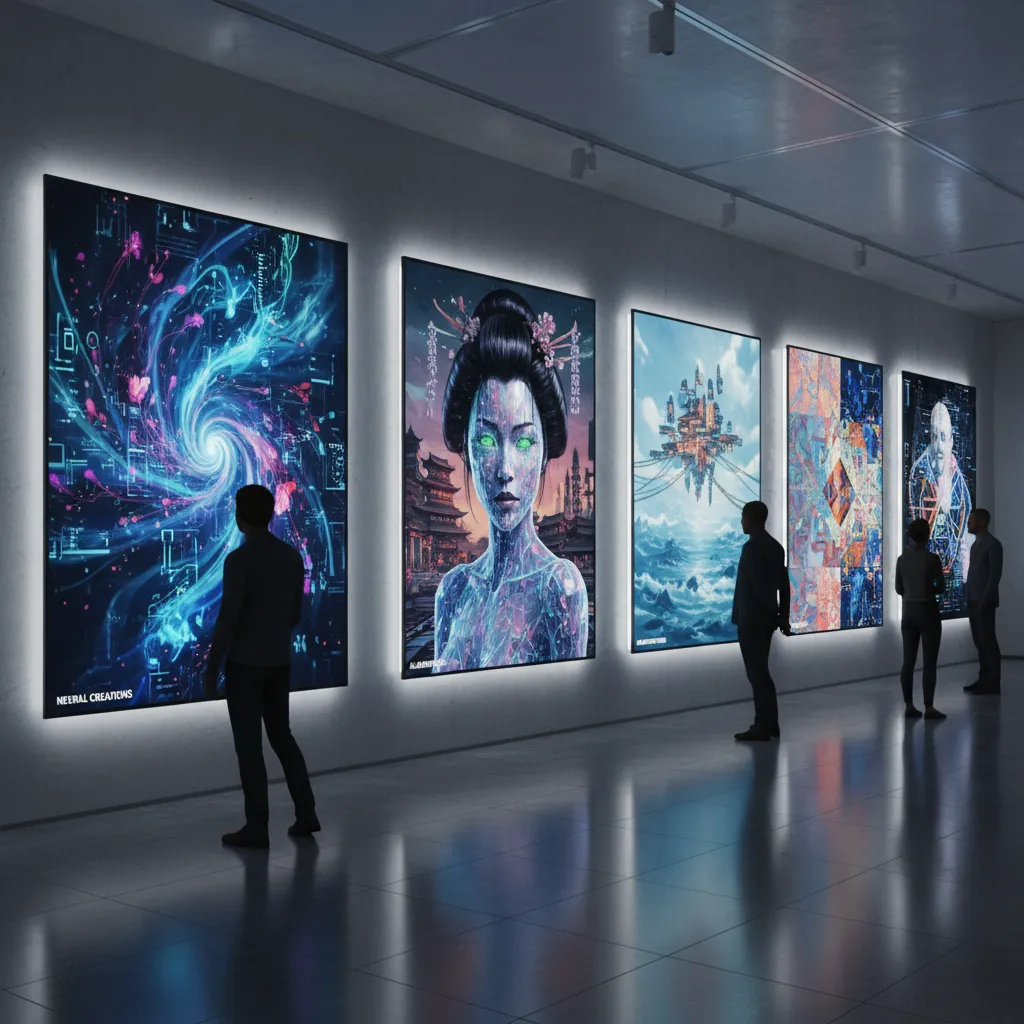 Gallery showcasing future AI-generated artwork
The Evolving Landscape of AI Image Technology
The pace of innovation in AI image technology is relentless. We can anticipate even more sophisticated models capable of understanding nuanced commands, generating longer-form visual narratives, and creating interactive or 3D assets with unprecedented ease. Personalized AI image tools comparison will become even more critical as the options multiply. The integration of these tools into everyday design software will become seamless, making AI in graphic design an indispensable part of the creative workflow. The rise of new AI image generators will continue, each pushing the boundaries further. From text-to-image AI evolving into text-to-video and text-to-3D, the horizon of AI visual content is vast and exciting.
Conclusion
AI image generators represent a pivotal moment in human creativity and technological advancement. They offer incredible potential to democratize design, accelerate creative processes, and inspire entirely new forms of art. Tools like DALL-E 3, Midjourney, and Stable Diffusion are not just novelties; they are powerful AI art tools reshaping industries from graphic design to digital art, offering unprecedented capabilities to generate images with AI.
However, this revolution is not without its complexities. The pressing ethical AI art concerns surrounding AI copyright issues, the AI impact on artists, and the potential for misuse demand our collective attention. Navigating the future successfully will require open dialogue, innovative legal frameworks, and a commitment to responsible development that prioritizes human values and creative integrity.
Ultimately, the future of AI art is likely one of human-AI art collaboration, where these powerful technologies serve as extensions of human creativity, rather than replacements. As we continue to explore the capabilities of AI image generation explained in this article, it is crucial that we do so with foresight, empathy, and a clear understanding of both the immense promise and the significant challenges that lie ahead. Embrace the change, but advocate for a future where technology empowers, rather than diminishes, human artistry.
FAQs
Q1. What is an AI image generator?
An AI image generator is a software tool that uses artificial intelligence, particularly deep learning models, to create images from various inputs, most commonly descriptive text prompts. These AI art generators learn from vast datasets to understand visual concepts and synthesize new images.
Q2. How does text-to-image AI work?
Text-to-image AI works by interpreting a text prompt and then generating a corresponding image. Models like diffusion models start with random noise and gradually refine it, guided by the textual description, until a coherent image matching the prompt emerges, effectively learning how AI generates images.
Q3. What are the best AI image generators currently available?
Some of the best AI image generator tools include DALL-E 3 (known for precision and integration), Midjourney (favored for artistic style), and Stable Diffusion (valued for open-source flexibility and customization). There are also various free AI image generator options available.
Q4. What are the main ethical concerns surrounding AI art?
Key ethical AI art concerns include AI copyright issues (who owns AI-generated content?), the AI impact on artists (potential job displacement), the use of copyrighted material for training data without consent, and the potential for misuse in creating deepfakes or spreading misinformation.
Q5. Can AI image generators be used for commercial purposes?
Yes, many AI image generator tools allow for commercial use, though specific terms vary by platform. Users often acquire commercial rights to the images they create, especially with paid subscriptions. However, the legal landscape for AI and intellectual property is still evolving, making it essential to review each platform’s terms of service carefully.
Q6. Is it possible for human artists and AI to collaborate?
Absolutely. Many digital artists are already engaged in human-AI art collaboration, using AI art tools as assistants to generate concepts, refine ideas, create textures, or explore new styles, ultimately integrating AI-generated elements into their unique artistic vision. This symbiosis represents a significant part of the future of AI art.
Q7. How can I learn to use AI image generators effectively?
Learning to use AI image generator tools effectively often involves understanding “prompt engineering” – the art of crafting precise and descriptive text prompts to guide the AI. Experimentation, studying examples from other users, and utilizing platform-specific features are key to mastering these AI content creation tools.