AI & The Future of Work: Job Apocalypse or Evolution?

Introduction: Facing the AI Automation Anxiety
The arrival of sophisticated generative AI has done more than just streamline tasks; it has ignited a global debate about the very nature of employment. Every day, news headlines oscillate between fear-mongering predictions of mass technological unemployment and optimistic forecasts of unprecedented productivity.
The question is no longer if AI job automation will happen, but how deeply and how quickly it will reshape the global economy. If you’ve ever found yourself typing “will AI take my job” into a search engine, you are grappling with the collective uncertainty surrounding the future of work.
This is not the first technological disruption—the Industrial Revolution, the advent of the personal computer, and the internet all sparked similar anxieties about AI replacing jobs. However, the current wave of artificial intelligence is unique. It’s not just automating manual labor; it’s automating routine cognitive tasks, the very tasks that formed the backbone of the middle class.
In this deep dive, we move beyond the hyperbole. We will analyze the true AI impact on employment, dissecting which jobs AI will replace, which sectors are safest, and, critically, how you can leverage AI career planning to transition from a potential victim of displacement to a pioneer of the new economy. The evidence suggests that while we face significant AI job displacement, the overarching trend points towards an evolution—one built on human-AI collaboration and a new set of essential future job skills.
The Core Debate: AI Job Displacement vs. Job Creation
When discussing the future of work, the narrative often splits into two opposing camps: the pessimists who predict a job apocalypse, and the optimists who foresee limitless job creation. The reality, according to major economic studies, lies in the complex overlap between these two extremes.
The Specter of Technological Unemployment
Historically, automation has caused temporary disruption but always led to greater overall employment due to increased efficiency and demand for new services. For example, when ATMs arrived, bank tellers didn’t disappear; their roles shifted from transaction processing to customer relationship management and sales.
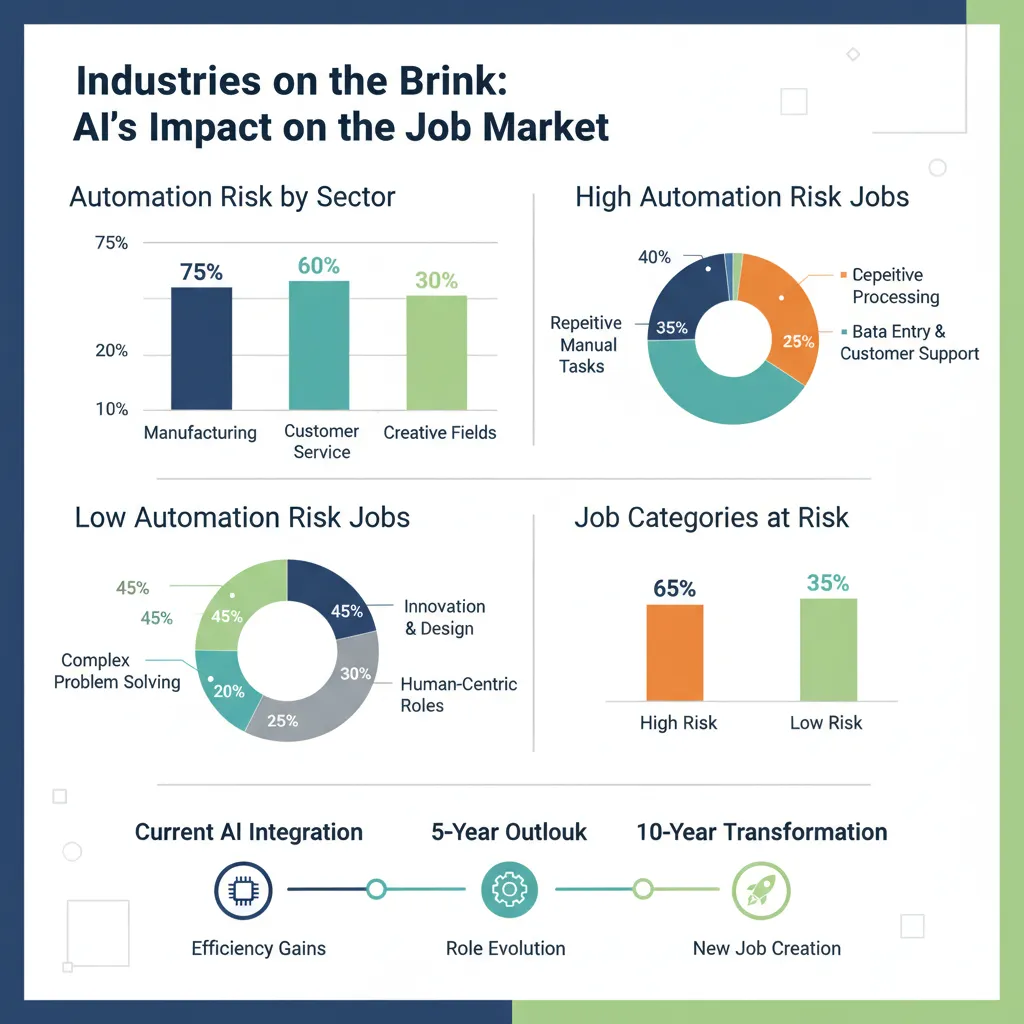
However, the speed and scope of current AI are different. Studies from organizations like the World Economic Forum and OECD indicate that millions of roles globally could face significant disruption—meaning 50% or more of the tasks within those roles can be automated. This is the definition of AI job displacement.
The roles most vulnerable to AI job automation are those characterized by:
- Repetitive Data Handling: Data entry, transcription, and basic bookkeeping.
- Predictable Physical Tasks: Assembly line work, fast-food preparation, and some forms of logistics (Keywords: automation and jobs).
- Routine Cognitive Tasks: Basic legal document review, simple coding snippets, and initial customer support triage.
The consensus is clear: if your job primarily involves moving information from point A to point B without requiring complex judgment, emotional intelligence, or novel creation, it is at high risk.

The Economic Upside: The New Jobs Created by AI
While AI automates tasks, it simultaneously creates entirely new categories of work. Economists refer to this as the “productivity dividend.” When AI handles the mundane, human capital is freed up to focus on higher-value activities: innovation, strategic planning, complex problem-solving, and relationship management.
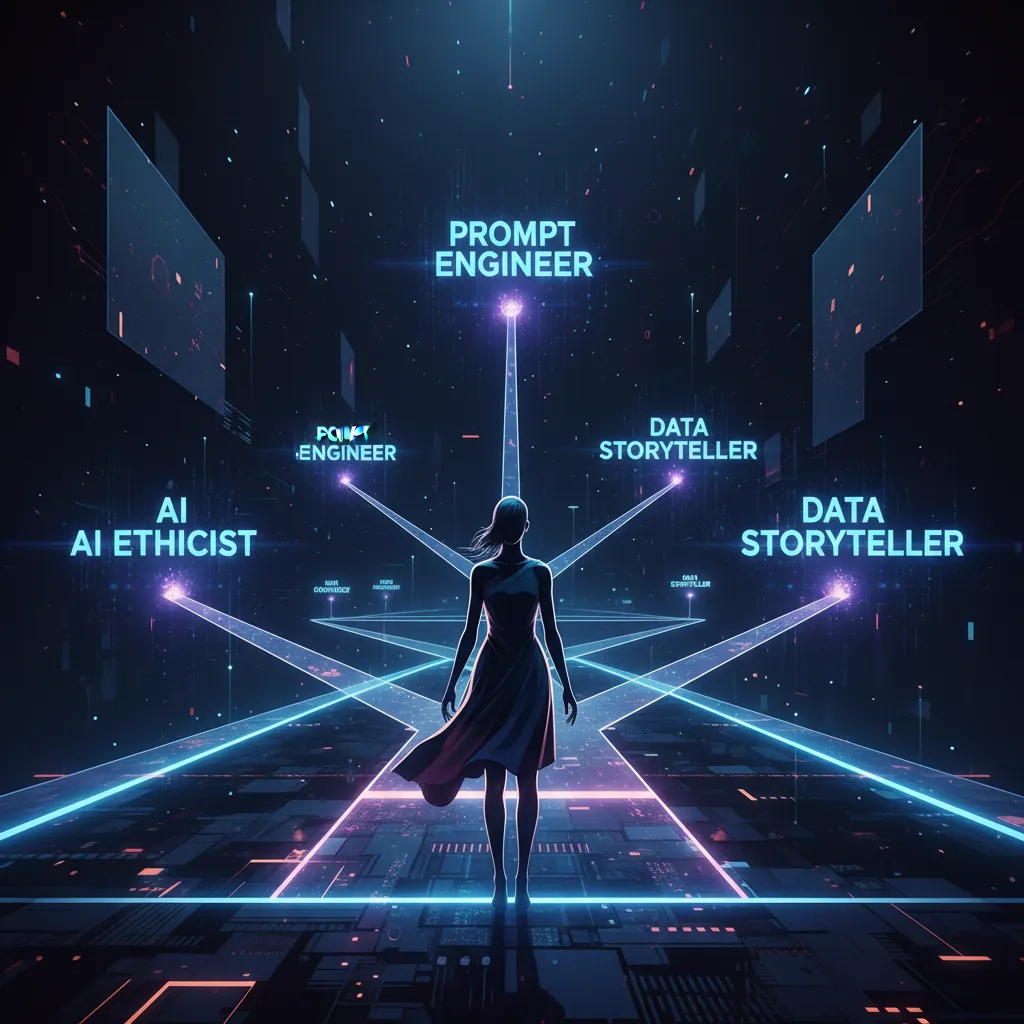
The shift isn’t just about making existing jobs easier; it’s about generating entirely new job families. Consider the recent surge in demand for prompt engineering careers. This role did not exist five years ago, yet today, it is a critical function for businesses utilizing generative AI tools. Similarly, the growing need to regulate and ensure fairness in AI algorithms has spurred demand for AI ethicist jobs.
These new roles often involve:
- Teaching and Training AI: Data curation, annotation, and model fine-tuning.
- Managing and Maintaining AI Systems: MLOps, AI infrastructure engineers, and AI maintenance technicians.
- Integrating AI into Business Strategy: AI strategists, transformation consultants, and AI governance officers.
The positive AI job market trends suggest a net gain in employment, but only for those who are willing to pivot and acquire the necessary future job skills.
[Related: Mastering Generative AI: Next-Gen Content Creation]
Analyzing AI Job Automation: Where is the Impact Hitting Hardest?
To understand how to survive AI, we must first identify the battleground. The impact of AI is not uniform; it varies wildly across industries and specific occupational roles.
High-Risk Sectors: Routine and Predictable Work
These are the sectors where AI replacing jobs is happening at an accelerated rate, primarily targeting middle-skill, white-collar roles that involve heavy data processing or standardized communication.
| Sector | Jobs Impacted | AI Application | Risk Level |
|---|---|---|---|
| Finance/Accounting | Bookkeepers, entry-level auditors, data entry clerks. | Automated reconciliation, fraud detection, algorithmic trading. | High |
| Customer Service | Call center agents, basic technical support. | Advanced chatbots, IVR systems, sentiment analysis for complaint routing. | Very High |
| Legal | Paralegals performing document review, contract drafting. | Large language models (LLMs) for discovery and boilerplate generation. | Medium-High |
| Coding/IT | Junior coders for simple tasks, scriptwriters, debugging. | AI code generation (e.g., GitHub Copilot) and automated testing. | Medium |
| Media/Content | Copy editors, basic article summaries, translation. | Generative AI for first drafts, localization, and SEO optimization. | High |
Low-Risk Sectors: The Careers Safe from AI
Paradoxically, some of the highest and lowest-paid jobs are the most resilient. AI proof jobs are generally those requiring uniquely human attributes that current and near-future AI systems cannot replicate.
1. Roles Requiring Deep Human Interaction and Empathy
AI can simulate empathy, but it cannot truly feel or understand complex human motivation, distress, or joy.
- Healthcare Professionals: Surgeons, psychologists, senior nurses, physical therapists. (AI assists diagnosis, but human touch is essential for care delivery).
- Educators and Trainers: K-12 teachers, corporate trainers, life coaches. (Learning requires relational trust and adaptive pedagogical methods).
- Sales and Leadership: High-level strategic negotiators, CEOs, diplomatic roles. (These require nuanced political and social judgment).
2. Roles Requiring Extreme Novelty and Unpredictable Creativity
While generative AI is creative, it operates within the boundaries of its training data. True, boundary-pushing artistic innovation and scientific breakthroughs remain human domains.
- Conceptual Artists and Designers: Those creating entirely new genres or aesthetics.
- Scientific Researchers: Developing novel hypotheses and designing complex experiments.
- Specialized Trades: Plumbers, electricians, and specialized mechanics. (Requires complex physical manipulation in unpredictable, non-standardized environments).
The Evolution of Work: Embracing Human-AI Collaboration
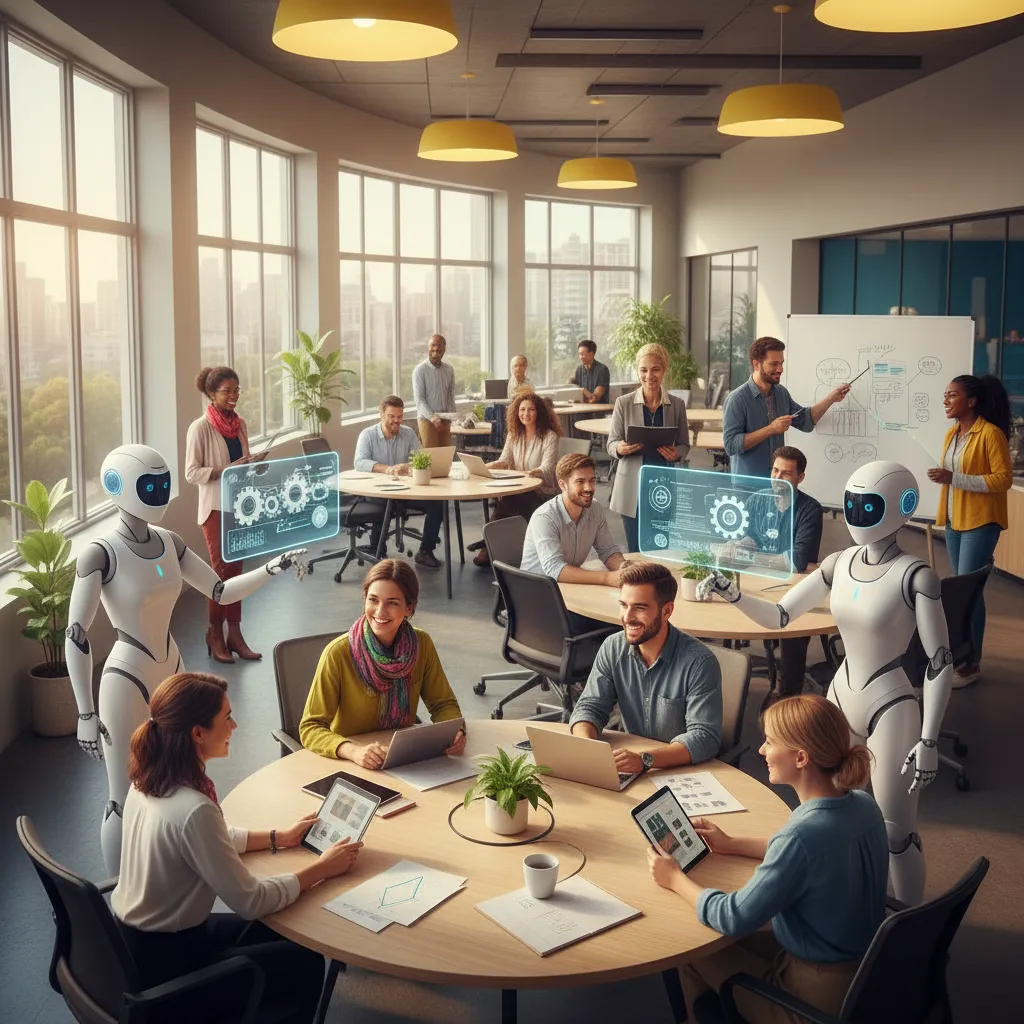
The greatest opportunities in the future of work lie not in avoiding AI, but in mastering it. The transition is not about man versus machine, but rather human-AI collaboration—a partnership where each entity leverages its unique strengths.
Shifting from Replacement to Augmentation
The most successful professionals in the coming decade will be those who view AI as an indispensable tool, a super-powered colleague that handles the 80% of tasks that are routine, allowing the human worker to focus on the 20% that requires creativity, judgment, and complex reasoning. This is the core concept of augmentation.
For instance, a modern marketing manager is no longer manually pulling data; they are using an AI dashboard (an example of AI in the workplace) to analyze thousands of data points instantly, allowing them to spend their time designing nuanced campaign strategies based on those insights.
The benefits of AI in workplace settings are staggering:
- Increased Speed and Productivity: Tasks that took days can now be completed in minutes (e.g., summarizing large legal documents).
- Enhanced Accuracy: AI can spot errors and inconsistencies far better than a human working alone.
- Better Decision Making: AI provides real-time data analysis, leading to more informed strategic choices.
This symbiotic relationship is the defining characteristic of the evolving AI job market trends. Professionals who resist integrating AI tools into their workflows risk falling behind those who embrace them as productivity boosters.
[Related: Unlock Peak Productivity: Best AI Tools]
The Critical Role of Human Skills
If AI handles routine tasks, what skills become paramount for human workers? The answer lies in the skills that are difficult to digitize or automate—the “soft” skills and core cognitive abilities.
The Four Pillars of AI-Proof Skills:
- Critical Thinking and System Thinking: AI can optimize a process, but a human is needed to question the process itself, understand the systemic impact of AI decisions, and identify entirely new, non-obvious problems to solve.
- Emotional Intelligence (EQ): The ability to lead, motivate, empathize with customers, negotiate complex deals, and manage team dynamics requires a depth of EQ that is currently beyond machine capability.
- Creative Synthesis: True creativity is not just generating variations (which AI does well), but synthesizing disparate pieces of information, culture, and experience into a genuinely novel idea or product. This fuels innovation and artistic direction.
- Ethical Judgment and Governance: As AI systems become more powerful, human oversight—particularly in areas like bias detection, fairness, privacy, and accountability—becomes essential. This drives the demand for roles like AI ethicist jobs.
How to Survive the AI Revolution: Preparing for the Future Job Skills
For individuals experiencing AI automation anxiety, the most constructive path forward is proactive adaptation. The key to successful adapting to AI lies in a dedicated commitment to learning and reskilling for automation.
The Imperative of Upskilling and Reskilling
Upskilling means learning advanced skills related to your current field, often involving AI tools (e.g., a writer learning how to prompt LLMs effectively). Reskilling means acquiring a completely new set of skills to shift careers entirely (e.g., a retired factory worker learning cloud computing basics).
Governments, educational institutions, and businesses are increasingly focusing on these two areas as a crucial defense against large-scale AI job displacement.
Essential Skills for the AI Age
To maintain competitive relevance in the future job skills landscape, focus on mastering competencies that directly relate to interacting with or managing intelligent systems:
- Data Fluency and Literacy: Understanding how data is collected, cleaned, analyzed, and used by AI models. You don’t need to be a data scientist, but you must be able to interpret AI outputs responsibly.
- Prompt Engineering and Interface Management: The ability to communicate effectively with large language models and generative AI systems is now a foundational skill. It requires precision, context setting, and iterative refinement. This is why prompt engineering careers are flourishing.
- Cybersecurity Awareness: As more processes are automated and interconnected, the surface area for cyber threats expands. Understanding basic security principles is vital for any role utilizing cloud-based AI tools.
- Domain Expertise + AI Toolset: Deep knowledge in a specialized area (e.g., structural engineering) combined with fluency in AI tools relevant to that domain creates an irreplaceable competitive edge.
Practical Steps for AI Career Planning
- Audit Your Current Role: Break down your daily tasks. Which 80% are repetitive and rule-based? Those are the tasks AI will take. Which 20% require judgment, negotiation, or creative synthesis? Double down on those.
- Embrace Lifelong Learning: The learning curve is now constant. Dedicate time to online courses (Coursera, edX, specialized bootcamps) focused on AI fundamentals, data analysis, and machine learning concepts.
- Become a ‘Superuser’ of AI Tools: Don’t just observe AI—use it. Experiment with tools like ChatGPT, Midjourney, and specialized industry AI assistants (e.g., legal review software, architectural design tools). This is the best way of preparing for AI revolution.
- Network in Emerging Fields: Seek out professionals already working in artificial intelligence jobs and new tech sectors. Mentorship and informational interviews can provide invaluable insights into AI job market trends.
[Related: AI Productivity Tools 2024]
New Horizons: Jobs Created by AI and Emerging Careers
The true optimism surrounding the AI and employment statistics comes from the potential for entirely new and high-value careers. These are the jobs created by AI, roles focused on the management, optimization, and ethical governance of intelligent systems.
1. The Prompt Engineer and AI Communicator
These roles are the bridge between human intent and machine execution. They translate complex, vague human needs into precise, effective prompts for generative models. This requires a unique blend of linguistic skill, domain expertise, and technical understanding of model limitations.
- Skills Required: Exceptional communication, deep understanding of specific domain (e.g., marketing, finance), knowledge of different model architectures (GPT, Claude, Llama).
2. The AI Ethicist and Governance Specialist
As AI becomes integrated into sensitive areas (hiring, lending, healthcare), the need for ethical checks grows exponentially. AI ethicist jobs ensure that algorithms are fair, unbiased, and compliant with privacy regulations.
- Skills Required: Law, philosophy, sociology, data science fundamentals, strong moral and ethical reasoning.
3. Machine Learning Operations (MLOps) Engineers
This is the IT infrastructure of the AI age. MLOps engineers deploy, maintain, monitor, and scale machine learning models in production environments. They ensure the AI systems are running efficiently and reliably.
- Skills Required: Cloud computing (AWS, Azure, GCP), DevOps principles, expertise in Python, model monitoring tools.
4. Human-AI Teaming Managers
These managers specialize in designing workflows where humans and AI co-exist seamlessly. They focus on maximizing the output of the combined team, reducing friction, and training human workers to trust and effectively use their AI counterparts. This is the frontline of human-AI collaboration.
Understanding the Impact of AI on Economy and Global Policy
The scale of AI job displacement necessitates a global policy response. We cannot simply rely on individual upskilling for AI to solve a structural economic shift. Governments and international bodies are debating mechanisms to soften the transition and ensure the societal benefits of AI in workplace settings are distributed equitably.
Productivity Gains vs. Wealth Concentration
The most significant impact of AI on economy is its potential to drive massive productivity gains, potentially leading to lower costs for goods and services. However, a major concern is that the wealth generated by AI will be highly concentrated in the hands of a few technology owners and high-skilled capital managers. This could exacerbate economic inequality.
Policy discussions often center around:
- Universal Basic Income (UBI) or Universal Basic Services (UBS): Safety nets to protect those affected by rapid automation.
- Taxation of Automated Labor: Shifting taxation from human payroll to the automated outputs of machines, incentivizing human employment while funding retraining programs.
- Mandated Corporate Reskilling: Requiring companies that heavily utilize automation to invest a percentage of their profits into reskilling for automation and educational programs for displaced workers.
The success of preparing for AI revolution at a societal level depends on policymakers addressing these structural issues proactively, transforming potential economic crisis into managed social evolution.
Conclusion: It’s Evolution, Not Apocalypse
The intense debate over “AI & The Future of Work: Job Apocalypse or Evolution?” ultimately concludes with a nuanced understanding of adaptation. While the headlines focus on AI replacing jobs, the fundamental data confirms that AI is not aiming for extinction; it’s aiming for augmentation.
Mass AI job displacement is a certainty for roles that are repetitive and predictable, feeding the current AI automation anxiety. But this displacement clears the field for higher-order, uniquely human tasks, giving rise to exciting new artificial intelligence jobs and demanding a renewed focus on core human skills: critical thinking, creativity, and empathy.
The core message for anyone wondering will AI take my job is simple: The AI revolution is a catalyst for change, not a death sentence for human employment. Your job security in the future relies entirely on your willingness to engage in upskilling for AI, embrace human-AI collaboration, and commit to lifelong learning. By mastering the art of working with intelligent systems, you position yourself not only to survive the technological shift but to thrive at the forefront of the new economy.
Start your AI career planning today by identifying the AI tools relevant to your industry and making them your new co-pilot. The future of work belongs to the adaptable.
FAQs (People Also Ask)
Q1. Which jobs are 100% safe from AI?
While no job is entirely 100% immune to automation of some tasks, roles requiring deep, unpredictable social interaction, high-stakes ethical judgment, complex physical dexterity in non-standard environments (e.g., plumbers, specialized surgeons), and genuinely novel creative thinking are the most secure. These are often referred to as AI proof jobs.
Q2. How quickly is AI expected to take over jobs?
The pace varies significantly by sector. Routine data processing and customer service jobs are seeing rapid deployment (within the next 3–5 years). However, widespread AI replacing jobs across highly complex sectors is expected to be a gradual process spanning the next 10–15 years, requiring major societal and infrastructural changes.
Q3. What is the difference between upskilling and reskilling for automation?
Upskilling for AI means improving your current skills, specifically by learning to use AI tools relevant to your existing career to enhance productivity (e.g., a lawyer learning to use an AI contract review platform). Reskilling for automation involves teaching yourself entirely new competencies to switch careers due to AI job displacement (e.g., a displaced factory worker learning data analysis).
Q4. What specific skills should I learn to improve my chances of surviving AI?
Focus on future job skills that complement AI, rather than competing with it. The most valuable skills include prompt engineering, data literacy, system thinking, emotional intelligence, complex problem-solving, and AI governance/ethics. These skills facilitate effective human-AI collaboration.
Q5. Are prompt engineering careers a stable long-term option?
The specific title “Prompt Engineer” may evolve, but the underlying skill—the ability to interact with, query, and refine outputs from large language models (LLMs)—is a foundational skill for the AI age. This competency will remain critical as AI becomes integrated into every aspect of AI in the workplace.
Q6. Will AI increase or decrease employment overall?
Major studies suggest the AI impact on employment will likely result in a net increase in total employment over the long term, echoing previous technological revolutions. However, this relies heavily on massive investment in reskilling for automation and education to ensure displaced workers can transition into the new jobs created by AI.
Q7. What is “AI automation anxiety”?
AI automation anxiety is the psychological stress and fear experienced by workers concerning the potential loss of their job or career stability due to rapid advancements in artificial intelligence and AI job automation. Addressing this requires practical AI career planning and understanding the need for adapting to AI.