The AI Adaptive Learning Revolution: Empowering Students & Teachers
Introduction
Picture a traditional classroom: thirty students, one teacher, and one textbook. For over a century, this one-size-fits-all model has been the bedrock of education. But it operates on a fundamental flaw—the assumption that every student learns at the same pace, in the same way. The result? Some students are left behind, while others are bored and unchallenged.
What if we could dismantle this rigid structure? What if education could be as unique as each student’s fingerprint? This is not a futuristic dream; it’s the reality being built today by the AI adaptive learning revolution.
This isn’t just another buzzword in the ever-growing lexicon of EdTech. It represents a paradigm shift in how we approach knowledge transfer, student development, and the very role of an educator. By harnessing the power of artificial intelligence, we are on the cusp of creating truly personalized education AI that understands, responds to, and anticipates the needs of every learner.
In this deep dive, we’ll explore the incredible landscape of AI adaptive learning. We will unpack how this technology works, examine its profound impact on student engagement and outcomes, and reveal how it’s becoming one of the most powerful AI tools for teachers, freeing them to do what they do best: inspire. This is the story of the future of learning technology—a future that is more inclusive, effective, and empowering for everyone involved.
Unpacking the Code: What Exactly is AI Adaptive Learning?
At its core, AI adaptive learning is an educational method that uses artificial intelligence algorithms to orchestrate interactive learning experiences that are tailored to the unique needs of each individual. Think of it as a personal tutor, a curriculum designer, and a data analyst all rolled into one intelligent system.
This approach moves beyond the static, linear path of traditional learning. Instead of forcing every student down the same road, it creates a dynamic, branching journey where the terrain changes based on the traveler’s performance, confidence, and learning style.
From Static to Dynamic: The Evolution of EdTech
For years, “EdTech” meant little more than digital textbooks on a tablet or a Learning Management System (LMS) for submitting homework. While these were steps toward modernization, they essentially just digitized the old, linear model. The content itself didn’t change; only the medium did.
The introduction of AI marks the leap from a static to a dynamic model. The system doesn’t just present information; it engages in a constant dialogue with the learner. It asks: Did you understand that concept? Should we try a different explanation? Do you need a harder problem to stay engaged? This continuous feedback loop is what makes the learning “adaptive.”
The Core Components of an Adaptive System
The magic of AI education platforms lies in a sophisticated, cyclical process that continuously refines the learning experience.
- Data Collection: As a student interacts with the platform—answering questions, watching videos, or working through simulations—the AI gathers thousands of data points. This includes right/wrong answers, time spent on a task, concepts they struggle with, and even their confidence levels.
- Analysis & Interpretation: This is where learning analytics AI comes into play. The algorithms analyze this data in real-time to build a comprehensive profile of the student’s knowledge, skills, and learning preferences. It identifies knowledge gaps and areas of mastery with a precision no human could replicate for an entire class.
- Adaptation & Personalization: Based on the analysis, the system instantly adapts. If a student is struggling with fractions, it might offer a foundational video on the topic, followed by simpler practice problems. If another student masters the concept quickly, the AI will serve up more complex, multi-step word problems to deepen their understanding. This is the heart of AI for differentiated instruction.
- Content Presentation: The system then delivers the next piece of AI-driven educational content in the optimal format for that student—be it a game, a video, a block of text, or an interactive exercise.

This cycle repeats endlessly, creating a truly personalized learning path that is constantly being optimized for effectiveness and engagement. It transforms the learning environment from a passive monologue into an active, responsive dialogue.
The Student Renaissance: Forging Personalized Learning Paths
The most profound impact of AI adaptive learning is felt by the students themselves. By shifting the focus from a standardized curriculum to the individual learner, this technology is unlocking potential in ways we’re only beginning to understand.
Beyond Pace: True Custom Learning Experiences
Personalization in education used to simply mean letting students learn at their own pace. AI takes this concept lightyears further. It’s not just about speed; it’s about depth, style, and substance. Custom learning experiences powered by AI can tailor:
- Content Modality: Some students learn best by watching videos, others by reading, and still others by doing. AI can identify this preference and deliver content in the most effective format.
- Difficulty Level: The system ensures a student is always in their “zone of proximal development”—a state where the material is challenging enough to be engaging but not so difficult that it becomes frustrating.
- Scaffolding & Support: When a student gets stuck, the AI can provide hints, break down the problem into smaller steps, or link to prerequisite knowledge, offering just-in-time support.
This level of personalization fosters a sense of agency and control, which is critical for student engagement AI. Learners feel seen and understood, which transforms their relationship with the subject matter from a chore into a challenge they are equipped to conquer. Related: AI Companions: The Rise of Virtual Relationships

AI Tutoring Systems: A Personal Mentor for Every Learner
One of the most exciting developments in this space is the rise of AI tutoring systems. Platforms like Khanmigo or Duolingo’s AI-powered features provide 24/7 assistance that was once only available to those who could afford private tutors. These systems can:
- Answer specific questions without giving away the solution.
- Engage in Socratic dialogue to help students think through problems.
- Provide immediate, constructive feedback on written assignments or math problems.
- Offer encouragement and motivational prompts.
This continuous AI for student support ensures that learning doesn’t have to stop when the school bell rings or when a teacher is busy helping another student. It democratizes access to high-quality academic guidance, helping to level the playing field.
Boosting Performance with Personalized Study Plans
Forget generic study guides. AI can analyze a student’s entire performance history to generate hyper-personalized study plans. It can pinpoint the exact sub-skills that need reinforcement before a big exam and create a custom-tailored review schedule. This data-driven approach ensures that study time is spent efficiently, targeting weaknesses and reinforcing strengths, leading to a measurable improvement in student performance AI metrics.
Teacher Empowerment: Shifting from Lecturer to Architect
A common fear is that AI will make teachers obsolete. The reality is the exact opposite. AI adaptive learning is the ultimate teacher empowerment technology. It automates the mundane, administrative tasks that consume so much of a teacher’s time, freeing them to focus on the deeply human aspects of education: mentoring, inspiring, and connecting with students.
Taming the Administrative Beast: Reducing Teacher Workload
Ask any teacher, and they’ll tell you that a huge portion of their job happens outside of classroom instruction. Grading papers, creating lesson plans, finding resources, and documenting progress are incredibly time-consuming. This is where teacher workload reduction AI is a game-changer.
- Automated Grading: AI can instantly grade multiple-choice quizzes, fill-in-the-blank questions, and even provide initial feedback on essays, saving countless hours.
- Content Curation: Instead of spending weekends searching for relevant videos or articles, teachers can have AI platforms suggest high-quality, curriculum-aligned resources tailored to their class’s needs.
- Report Generation: AI can automatically generate detailed progress reports for parents and administrators, summarizing student growth with clear data visualizations.
Data-Driven Insights, Not Data Overload
Teachers have always had data, but it was often overwhelming and difficult to act on. Adaptive teaching tools process that data and present it in intuitive dashboards, turning raw numbers into actionable insights.

A teacher can see at a glance:
- Which students are falling behind on a specific concept.
- Which topics the entire class is struggling with, indicating a need for re-teaching.
- Which students are excelling and are ready for an advanced challenge.
This allows for proactive, targeted intervention. A teacher can pull together a small group of students struggling with long division for a focused mini-lesson, armed with precise knowledge of their misconceptions. Related: AI in Healthcare: The Predictive, Personalized Future
Mastering Differentiated Instruction at Scale
Differentiated instruction—the practice of tailoring instruction to meet individual needs—is considered the gold standard of teaching. However, it’s incredibly difficult for one teacher to implement effectively for 30 different students.
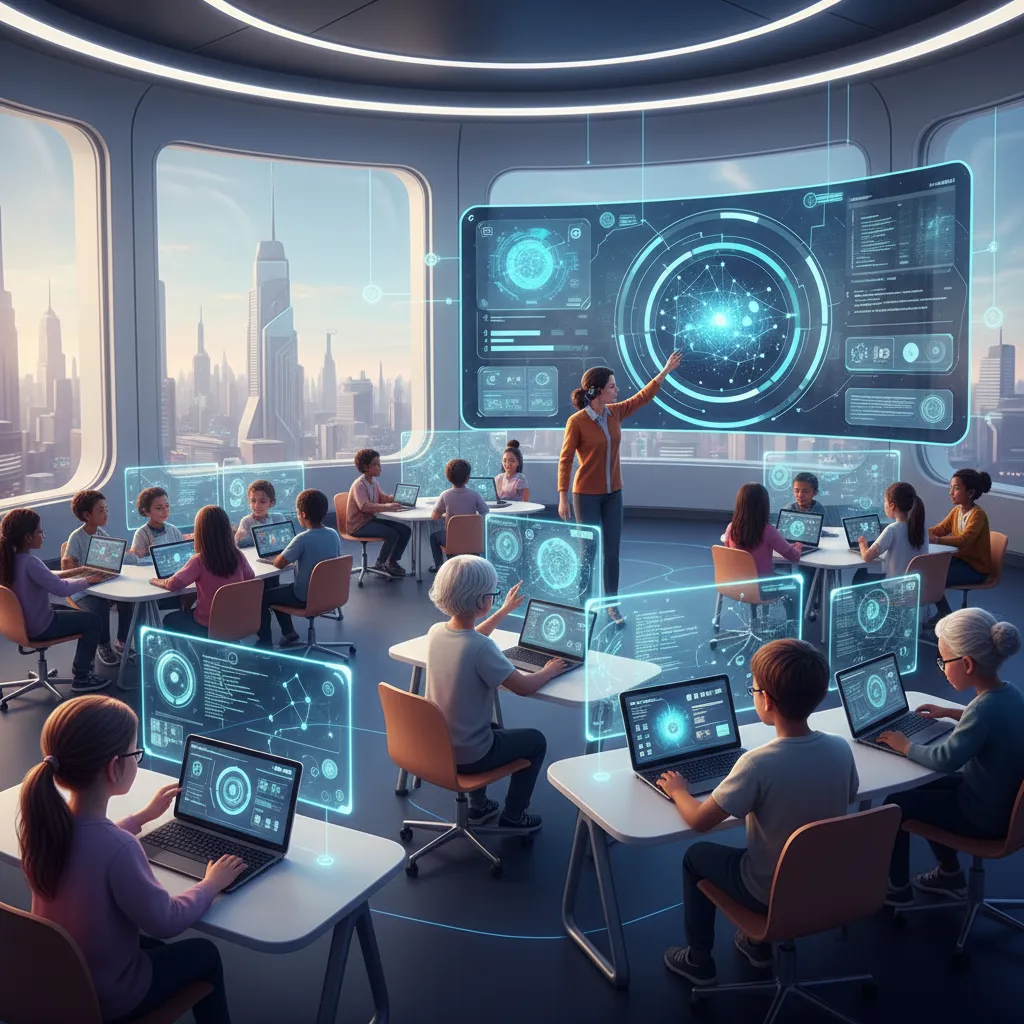
AI makes this scalable. The technology handles the moment-to-moment differentiation of content and pacing, allowing the teacher to transition from being a “sage on the stage” to a “guide on the side.” They can focus their energy on facilitating collaborative projects, leading Socratic seminars, and providing one-on-one emotional and academic support—the irreplaceable human elements of a great education. The classroom transforms into a dynamic workshop, a hub of smart learning environments.
The Technology in Action: AI Education Platforms Making Waves
This revolution isn’t just theoretical; it’s being implemented in classrooms around the world. The applications vary across different educational stages, but the core principle of personalization remains constant.
AI in K-12 Education: Building Foundational Skills
In primary and secondary education, AI is proving invaluable for mastering foundational skills in subjects like math and literacy.
- DreamBox Learning: This platform uses adaptive algorithms to create millions of unique math learning paths for K-8 students. It adjusts the difficulty and content in real-time based on how a student solves problems.
- Amira Learning: Known as the “AI Reading Scientist,” Amira can listen to a child read aloud, assess their proficiency, and provide real-time tutoring to correct pronunciation and identify errors.
These tools provide the kind of one-on-one practice that is essential for building a strong academic foundation, making the vision of future classrooms AI a present-day reality.

Higher Education AI Solutions: Preparing the Future Workforce
In universities and colleges, AI is being used for more complex tasks and to manage large-scale courses, particularly in the realm of AI in online education.
- ALEKS (Assessment and Learning in Knowledge Spaces): Widely used in college-level math and science courses, ALEKS uses adaptive questioning to quickly and accurately determine exactly what a student knows and doesn’t know in a subject, then crafts a personalized curriculum to fill the gaps.
- Gradescope: This tool uses AI to help instructors grade assignments more efficiently and consistently. It can group similar answers together and apply a rubric with a single click, providing faster and more detailed feedback to students.
These higher education AI solutions help prepare students for a workforce where adaptability and lifelong learning are paramount. Related: AI Financial Planning: Taming Inflation for Your Future
Navigating the Future: Challenges and Ethical AI in Learning
No technological revolution comes without challenges, and the integration of AI in education is no exception. As we embrace these powerful tools, it’s crucial to proceed with caution and thoughtful consideration of the ethical implications.
The Data Privacy Conundrum
Adaptive learning systems collect vast amounts of data on student performance and behavior. This raises critical questions about privacy and security. Who owns this data? How is it being used? How do we protect it from breaches? Establishing clear and transparent AI in education policy is essential to build trust among students, parents, and educators.
Algorithmic Bias and Equity
AI models learn from the data they are trained on. If that data contains historical biases related to race, gender, or socioeconomic status, the AI can inadvertently perpetuate and even amplify those inequities. Ensuring Ethical AI in learning means rigorously auditing algorithms for bias and designing systems that promote equity, rather than reinforcing existing disparities.
Preserving the Human Element
Perhaps the most important challenge is ensuring that technology serves, rather than supplants, human connection. Education is not merely the transfer of information; it’s about fostering curiosity, building resilience, and developing social-emotional skills. The goal of educational AI innovations should always be to augment the capabilities of great teachers, not to replace them. The human-to-human connection between a teacher and a student remains the most powerful educational tool of all. Related: AI and Cybersecurity: Revolutionizing Defense and Threat Detection
Conclusion: A Smarter, More Human Future for Education
The AI adaptive learning revolution is not a distant sci-fi concept; it’s one of the most significant EdTech trends of 2024, and it’s already reshaping classrooms. By delivering truly custom learning experiences, these systems are igniting student curiosity and building confidence in a way the traditional model never could. They are creating a new generation of learners who are more engaged, more autonomous, and better prepared for the complexities of the future.
Simultaneously, this technology is empowering educators, transforming them from content deliverers into learning architects. By automating administrative burdens and providing deep, actionable insights, AI tools for teachers are enabling them to dedicate their time and talent to what truly matters: mentoring, inspiring, and connecting with their students on a human level.
The road ahead requires careful navigation of ethical and practical challenges, but the destination is clear: a future where education is more personal, more effective, and more equitable for everyone. This isn’t just the future of technology; it’s the future of learning itself.
Frequently Asked Questions (FAQs)
Q1. What is AI adaptive learning in simple terms?
In simple terms, AI adaptive learning is an educational technology that acts like a personal tutor for every student. It uses artificial intelligence to analyze a student’s performance in real-time and automatically adjusts the curriculum—the content, difficulty, and pace—to match their individual learning needs and style.
Q2. What is a real-world example of adaptive learning?
A great real-world example is the language-learning app Duolingo. The app’s AI tracks which words you get right and wrong, how quickly you answer, and which grammar concepts you struggle with. Based on this data, it customizes your future lessons, bringing back words you need to practice more often and introducing new concepts only when you’re ready.
Q3. How does AI help teachers with their workload?
AI significantly reduces teacher workload by automating time-consuming administrative tasks. This includes instantly grading quizzes, providing initial feedback on assignments, curating relevant learning resources, and generating detailed student progress reports. This frees up teachers to focus on high-impact activities like one-on-one student interaction and creative lesson planning.
Q4. What is the difference between personalized and adaptive learning?
While often used interchangeably, there’s a key difference. Personalized learning is a broad term for tailoring education to individual student needs, which can be done by a teacher with or without technology. AI adaptive learning is a specific method for achieving personalization at scale, where an AI system actively makes real-time, data-driven decisions to change the learning path for the student without direct teacher intervention for every step.
Q5. What are the main challenges or ethical concerns of AI in education?
The main challenges include ensuring student data privacy and security, preventing algorithmic bias that could perpetuate social inequities, and maintaining the crucial human element of the teacher-student relationship. There is also a concern about the digital divide, where access to these advanced tools may not be equitable for all students.
Q6. Will AI replace teachers in the future?
No, AI is not expected to replace teachers. Instead, it is designed to be a powerful tool that augments their abilities. AI can handle the repetitive tasks of content delivery and assessment, empowering teachers to focus on the uniquely human roles of mentoring, inspiring critical thinking, fostering collaboration, and providing social-emotional support, which technology cannot replicate.