Achieve FIRE: Your Ultimate Guide to Financial Independence & Early Retirement

What if you could reclaim your time? Imagine a life where your days aren’t dictated by a 9-to-5 job, but by your passions, curiosities, and a sense of profound freedom. This isn’t a far-fetched dream; it’s the core principle of the FIRE movement, a lifestyle phenomenon empowering people to take control of their financial destiny.
FIRE stands for Financial Independence, Retire Early. It’s more than just a clever acronym; it’s a fundamental shift in how we view work, money, and life itself. This isn’t about getting rich quick or never working another day. It’s about building a financial foundation so strong that work becomes a choice, not a necessity.
This ultimate FIRE movement guide will walk you through everything you need to know. We’ll demystify the concepts, provide actionable early retirement strategies, and show you how to achieve FIRE on your own terms. Whether you dream of being able to retire early at 40 or simply want to gain control over your finances, you’re in the right place.
What is the FIRE Movement, Really?
At its heart, the FIRE movement is about achieving financial independence—the point at which your passive income from investments covers all your living expenses. The “Retire Early” part is the exciting result of reaching that milestone. For some, it means leaving the traditional workforce decades ahead of schedule. For others, it’s about having the freedom to pursue passion projects, start a business, or work part-time without financial pressure.
The movement is built on a few simple but powerful financial independence principles:
- A Radically High Savings Rate: FIRE adherents often save 50% or more of their income. This is the primary engine that accelerates the journey.
- Intentional Spending & Frugal Living: This isn’t about deprivation. It’s about consciously directing your money towards what truly brings you value and ruthlessly cutting out the rest.
- Aggressive, Strategic Investing: Making your money work for you through compounding is non-negotiable. This typically involves investing in low-cost index funds and other assets.
- Income Maximization: You can only cut so many expenses. A core tenet of FIRE is finding ways to increase your earning potential through career growth or side hustles for FIRE.
The ultimate goal is to achieve financial freedom, giving you the power to design your life exactly as you see fit.
The First Crucial Step: Calculating Your FIRE Number
Before you can start your journey, you need a destination. In the FIRE world, this destination is your “FIRE number”—the total amount of invested assets you need to become financially independent.
The most common way to calculate this is by using the 4% Rule.
The 4% Rule Explained
The 4% Rule, based on the Trinity Study, suggests that you can safely withdraw 4% of your initial investment portfolio value each year in retirement without depleting your principal (it’s adjusted for inflation).
To find your FIRE number, you simply flip this rule on its head:
Your FIRE Number = Your Annual Expenses x 25
Let’s break it down with an example:
- Step 1: Track Your Annual Expenses. Let’s say after careful budgeting for FIRE, you determine you live comfortably on $50,000 per year.
- Step 2: Multiply by 25. $50,000 x 25 = $1,250,000.
In this scenario, $1.25 million is your FIRE number. Once you have that amount invested, you can theoretically withdraw $50,000 a year (4% of $1.25M) to live on indefinitely. You can use an online FIRE calculator to play with different scenarios, but this simple formula is the foundation of all early retirement planning.
The 7 Core Pillars of Your FIRE Journey
Achieving a goal as audacious as early retirement requires a structured approach. Think of these seven pillars as the building blocks of your wealth building FIRE strategy. These are the essential FIRE journey steps.
Pillar 1: Master Your Mindset & Define Your “Why”
Before you change your budget, you must change your mindset. The FIRE journey is a marathon, not a sprint. There will be challenges of FIRE, from market downturns to social pressure. Your “why” is the fuel that will keep you going.
Why do you want to achieve financial freedom?
- To spend more time with your family?
- To travel the world?
- To escape a toxic work environment?
- To start your own business without the pressure of needing immediate profits?
Write it down. Make it visible. This purpose will be your anchor.
Pillar 2: Ruthless Budgeting and Expense Tracking
You cannot optimize what you don’t measure. The first practical step is to understand exactly where every single dollar is going. Use budgeting apps (like YNAB or Mint) or a simple spreadsheet to track your income and expenses for 2-3 months.
The results will likely surprise you and reveal “leaks” in your spending. This is where frugal living FIRE comes into play. It’s not about eating ramen every night; it’s about making conscious choices. Do you really need that $200 monthly cable package, or would that money be better off invested and compounding for your future?

This phase is about aligning your spending with the “why” you defined in the first pillar. Every dollar saved is a dollar you can invest to buy back your future time.
Pillar 3: Annihilate High-Interest Debt
High-interest debt—like credit card balances or personal loans—is the antithesis of FIRE. It’s like trying to run a race with an anchor tied to your leg. The interest you pay actively works against your wealth-building efforts.
Becoming debt free FIRE is a critical milestone. Two popular strategies for tackling debt are:
- The Avalanche Method: Pay the minimum on all debts, but throw every extra dollar at the debt with the highest interest rate first. Mathematically, this saves you the most money.
- The Snowball Method: Pay the minimum on all debts, but focus on paying off the smallest balance first, regardless of the interest rate. This provides powerful psychological wins that build momentum.
Choose the method that works for you and get started.
Pillar 4: Dramatically Increase Your Income
Saving is only half the equation. The fastest way to accelerate your FIRE timeline is to increase the gap between what you earn and what you spend. Focus on:
- Career Advancement: Become indispensable at your job, negotiate raises, and acquire new skills that command a higher salary.
- Side Hustles for FIRE: Start a side business, freelance, or find gig work. This extra income can go directly towards your investments without impacting your current lifestyle. [Related: The Next-Gen AI Assistants for a Seamless and Smart Life] might give you some ideas for leveraging technology to boost your productivity.
Pillar 5: Build Your Passive Income Engine
This is where the magic happens. The goal of FIRE is to eventually live off your investments, not your savings account. Building a robust engine of passive income FIRE streams is the key to making your wealth sustainable.
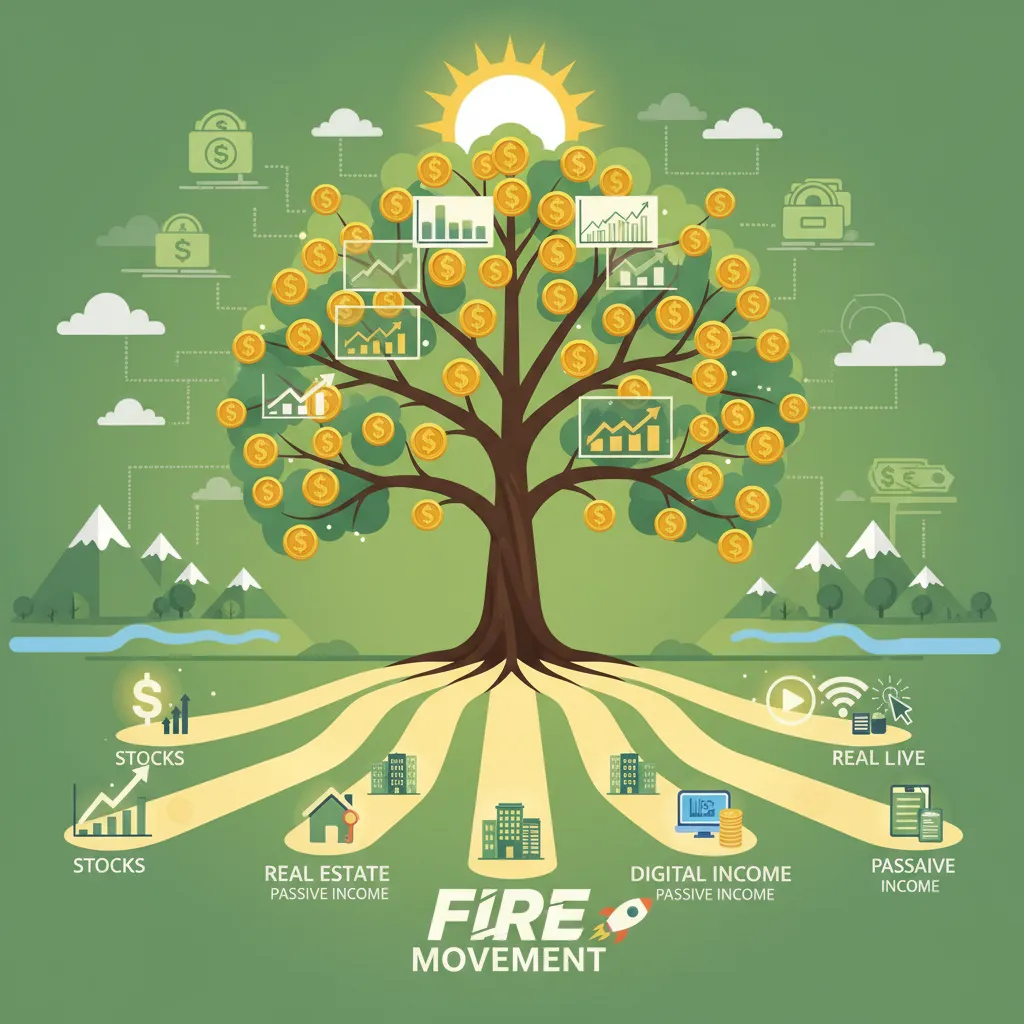
Popular sources of passive income include:
- Stock Market FIRE: Earning through capital gains and dividends from stocks and ETFs.
- Real Estate Investing FIRE: Generating rental income from properties.
- Business Income: Royalties from creative work, affiliate marketing, or creating digital products.
The dream is living on dividends FIRE, where the cash flow from your assets is enough to cover your lifestyle without ever needing to sell the underlying assets.
Pillar 6: Invest Aggressively and Intelligently
You cannot save your way to financial independence. You must invest. The power of compound interest is the eighth wonder of the world, and it’s the force that will do the heavy lifting on your FIRE journey.
While there are many investment strategies FIRE followers use, the most common is investing in low-cost, broadly diversified index funds or ETFs (like VTSAX or VTI). This strategy provides exposure to the entire market, is low-maintenance, and has historically provided strong returns over the long term.
It’s crucial to understand your risk tolerance and invest consistently, through market highs and lows (a practice known as dollar-cost averaging). Don’t try to time the market; focus on time in the market.
Pillar 7: Optimize Everything
The final pillar is about finding efficiencies in every corner of your financial life.
- Tax Optimization: Maximize contributions to tax-advantaged retirement accounts like a 401(k), Roth IRA, or HSA. These accounts offer significant tax breaks that supercharge your savings.
- Insurance: Review your insurance policies (health, auto, home) annually to ensure you have adequate coverage without overpaying.
- Lifestyle Optimization: Make conscious choices about major expenses like housing and transportation. House hacking (renting out parts of your primary residence) or moving to a lower cost-of-living area can shave years off your FIRE timeline.
Finding Your Flavor: The Different Types of FIRE
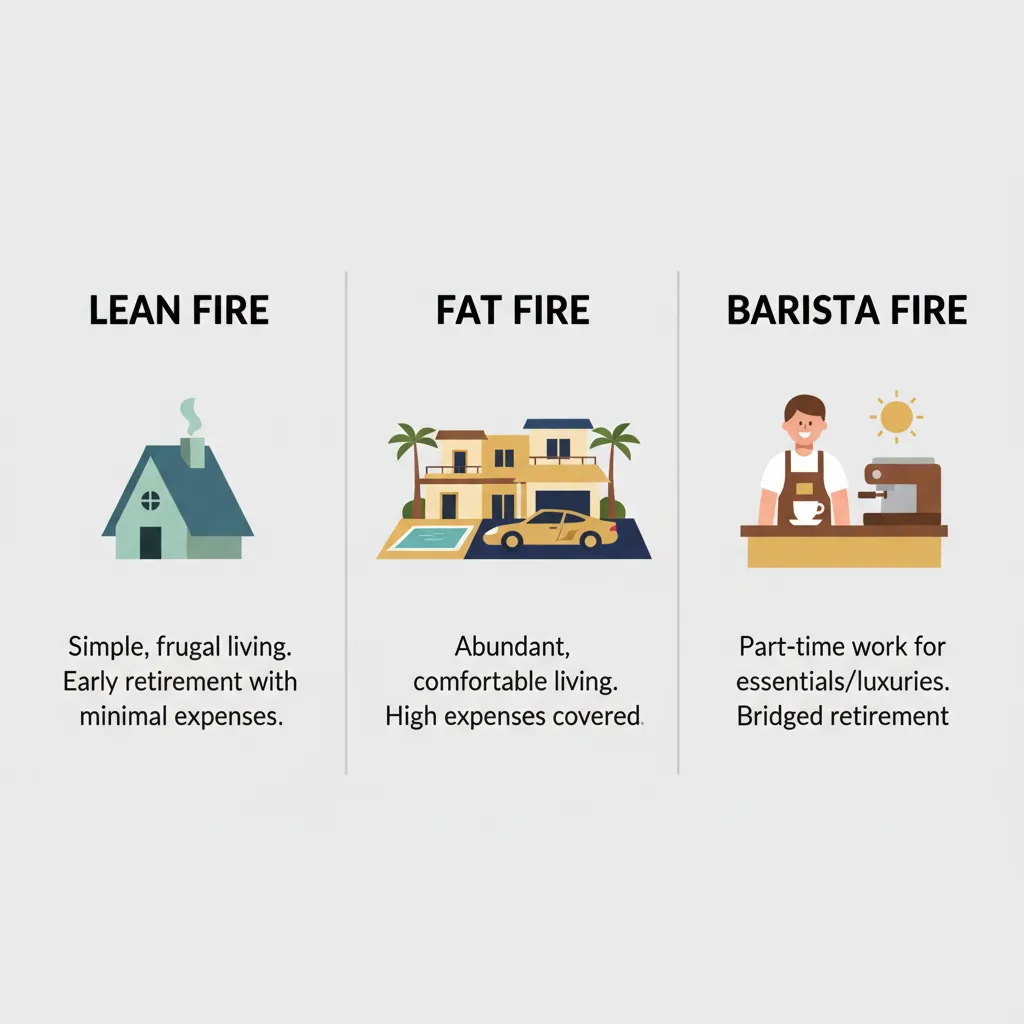
The FIRE movement isn’t a one-size-fits-all plan. It has evolved into several different approaches to suit various income levels, lifestyle desires, and risk tolerances. Understanding the distinction between lean FIRE vs fat FIRE and other variations is key to finding the path that’s right for you.
Lean FIRE
- The Goal: To retire on a minimalist budget, typically less than $40,000 per year.
- The Pro: The required FIRE number is much lower, making it the fastest path to retirement. It prioritizes time and freedom over material possessions.
- The Con: It requires a disciplined, frugal lifestyle that may not be sustainable or desirable for everyone. There is less of a financial cushion for unexpected large expenses.
Fat FIRE
- The Goal: To retire with a comfortable or even luxurious lifestyle, often with an annual budget of $100,000 or more.
- The Pro: It offers a high standard of living in retirement with plenty of room for travel, hobbies, and luxuries. You have a massive financial safety net.
- The Con: It requires a much larger nest egg (e.g., $2.5 million+), which means a longer time in the workforce, a very high income, or both.
Barista FIRE Explained
- The Goal: A hybrid approach where you’ve saved enough that you can quit your main high-stress career but still work part-time at a low-stress job (like a barista) to cover current expenses and, crucially, access subsidized health insurance.
- The Pro: It allows you to leave the traditional grind much earlier. Your investment portfolio continues to grow untouched, while your part-time job covers the bills. It’s a great way to ease into retirement.
- The Con: You are not fully retired in the traditional sense, as you still rely on some form of employment.
Other Variations
- Coast FIRE: You’ve invested enough that, without contributing another penny, your portfolio will grow to support a traditional retirement. This frees you up to work less demanding jobs just to cover current living expenses.
- Mini-Retirements: Instead of one long retirement at the end, this strategy involves taking extended breaks (1-2 years) throughout your career to travel or pursue passions, funded by your savings. These mini retirement ideas are a way to enjoy the benefits of FIRE long before you reach your final number.
The Realities: Challenges and Considerations on the FIRE Path
The FIRE journey is incredibly rewarding, but it’s not without its obstacles. Being aware of the potential challenges of FIRE can help you navigate them successfully.

- Market Volatility: Your net worth will fluctuate. It takes discipline to stay invested during market downturns and not panic-sell.
- Burnout: The pressure to save 50%+ of your income can lead to burnout. It’s important to find a sustainable pace and enjoy the journey.
- Social Pressure: Your friends and family may not understand your frugal choices or your desire to leave a successful career. Finding FIRE community support online (like on Reddit’s r/financialindependence) or in person is vital for staying motivated. [Related: Humane AI Pin Review: Fad or the Future of Phones?] explores how new tech can connect us, and these communities are a prime example.
- Finding Purpose Post-FIRE: A significant challenge for many is answering the question, “What now?” After years of focusing on a financial goal, you need to find new sources of purpose and structure.
Conclusion: Your Journey to Freedom Starts Now
The FIRE movement is about so much more than retiring early. It’s a powerful framework for intentional living. It’s about questioning the status quo, aligning your spending with your values, and building a life of options and freedom. It’s the ultimate path to achieve financial freedom.
Whether your goal is to retire early at 50, travel the world on your own terms, or simply have the security of knowing work is a choice, the principles of FIRE can get you there. It requires discipline, patience, and a clear vision. But the reward—a life designed by you, for you—is worth every bit of the effort.
The journey of a thousand miles begins with a single step. Start today. Calculate your expenses, make one small budget cut, and set up an automatic investment. Your future self will thank you.
FAQs
Q1. What is the FIRE movement in simple terms?
The FIRE (Financial Independence, Retire Early) movement is a lifestyle whose goal is to gain financial independence and retire far earlier than the traditional age. It is achieved by aggressively saving and investing a high percentage of one’s income—often 50% or more—to build a portfolio that can cover all living expenses.
Q2. How much money do you need to achieve FIRE?
The amount of money you need is unique to you and is called your “FIRE number.” It’s calculated by multiplying your expected annual expenses in retirement by 25. For example, if you plan to live on $40,000 per year, you would need a portfolio of $1 million ($40,000 x 25).
Q3. Is the FIRE movement realistic?
Yes, the FIRE movement is realistic for many people, but it requires significant discipline, sacrifice, and financial literacy. Its feasibility depends heavily on factors like income, savings rate, lifestyle choices, and investment performance. It is more accessible to high-income earners but is achievable for those with average incomes who are extremely disciplined with their finances.
Q4. What is the difference between Lean FIRE and Fat FIRE?
Lean FIRE is a strategy where you retire on a minimalist budget (e.g., under $40,000/year), requiring a smaller investment portfolio. Fat FIRE is the opposite, aiming for a retirement lifestyle with a much higher spending level (e.g., over $100,000/year), which requires a significantly larger nest egg.
Q5. What is the 4% rule for retirement?
The 4% rule is a guideline stating that a retiree can safely withdraw 4% of their initial investment portfolio in the first year of retirement and then adjust that amount for inflation each subsequent year. Following this rule should, in theory, allow the portfolio to last for at least 30 years.
Q6. How do you start the FIRE journey with little money?
Starting the FIRE journey with little money begins with two main goals: minimizing expenses and maximizing income. Create a strict budget, eliminate all non-essential spending, and pay down high-interest debt. Simultaneously, focus on increasing your income through career advancement, skill development, or starting a side hustle. Every extra dollar earned can then be invested.
Q7. What is Barista FIRE?
Barista FIRE is a hybrid approach where an individual has saved enough to no longer need their primary, high-stress job, but they still work part-time or in a low-stress job. This work covers current living expenses and often provides access to benefits like health insurance, allowing their main investment portfolio to continue growing untouched.